




The violent chaos rippling through France will become the Fifth Republic’s new norm.
While greater police enforcement and public anger will eventually quell these riots, greater disorder awaits. Street riots are ingrained in French political culture. They are easy fun for thugs and warped homages to the French Revolution for leftist ideologues.
But the chaos to come will likely be of an altogether different scale than what we’re witnessing now. The bitter bill of socialism is why — specifically, its crisis levels of debt and soaring borrowing costs and France’s unwillingness to cut spending.
Many Americans perceive the looting and running street battles on our TV screens through the prism of a failed immigration policy. But immigration is only one issue here. France’s central problem is that its government spends too much money and excessively dominates the economy to the detriment of its people.
The facts are undeniable here. France’s debt-to-GDP ratio today stands at 118%. Its youth unemployment rate is just under 20%, double that of the United States. France’s total unemployment rate is 8.3% versus 4.1% in the U.S. Economic growth has also averaged 2.1%-2.3% in the U.S. over the past 10 years compared to 1.1%-1.3% in France. And France’s population is aging fast, depriving an already revenue-starved government and employment-starved economy of resources.
A NEW BOOK ARGUES THAT DEMOCRACY NEEDS MORE RELIGION
What role does immigration play?
In contrast to the U.S., where immigrants tend to have high labor market participation rates, many French first- or second-generation immigrants struggle to find good work. The French employment market is far more restrictive in its hiring and firing practices, discouraging employers from taking a chance on low-skilled or non-native job applicants. Getting a foot on the social mobility ladder is far harder in France than in the U.S.
Its claims of constitutionally vested equality notwithstanding, French society is also riven with quiet but systemic racial prejudice. Alongside absurd regulatory requirements for employment, access to the casual work often favored by immigrants is difficult in France.
But just as it fails to offer the carrot of economic mobility to immigrants, France also fails to dangle a necessary stick. The failure to confront rampant criminality in the suburbs of major French cities has allowed criminals to seize effective control of entire neighborhoods. The southern port city of Marseille is a picture of dysfunction in this regard. The broader social effect is felt in the propagation of a sense of criminal impunity. Caught between high crime rates and generous welfare programs, immigrants become dissected from the rest of society. And without access to quality education and employment, cultural integration gives way to deliberate isolation.
What happens next?
It’s possible that the far-right National Rally party will now mobilize public fury over these riots to secure Marine Le Pen’s election to the presidency next spring. But even if Le Pen does win, and even if she is able to implement tough immigration laws, immigrant communities will likely return to the streets in greater fury. But more riots will follow regardless.
Why? The economy, stupid.
Whether or not France cracks down on immigration or expels noncitizens from its borders, its central challenge will remain. The economy is weak and the government is reaching a breaking point in terms of how much more money it can borrow. The devil is in the data. French government spending today constitutes a stunning 57% of gross domestic product (it’s approximately 34% in the U.S. when federal, state, and local government spending is included). This expenditure crowds out private investment while requiring punitive tax rates. The economy has long lived and is now dying under the government’s thumb.
At the same time, the French pension system (U.S. Social Security system equivalent) is designed for the early 20th century rather than the 21st century. The standard retirement age is a ludicrously low 63 years, with many individuals able to retire on very generous full benefits long before that age. Tentative reform efforts have been abandoned due to political pressure. But rather than admit that this is a problem which must be fixed, next year’s presidential aspirants are instead offering voters a range of lies.
Le Pen promises to cut immigration-related expenditures. But she also says she’ll lower the pension age even further! There is no world in which the math adds up. You can’t increase pension spending for an aging population and also expel working-age residents. This is catnip for idiots.
Equally moronic is the far-left Jean-Luc Melenchon’s pledge that France’s fiscal problems can be resolved by further gouging high earners and high net worth individuals and corporations. This approach would only deepen France’s economic malaise while precipitating the mass emigration of private capital. Melenchon also wants France’s central bank to breach EU rules and effectively default on the debt it holds. But this would be like dealing with high inflation by printing more money. The bond markets and international investors would view France as an utterly uninvestable. Other centrist candidates offer only slightly less unserious proposals. The basic truth is that the politicians and most French people refuse to recognize that they’re heading off a fiscal cliff.
Economic realities will eventually force some eyes to open.
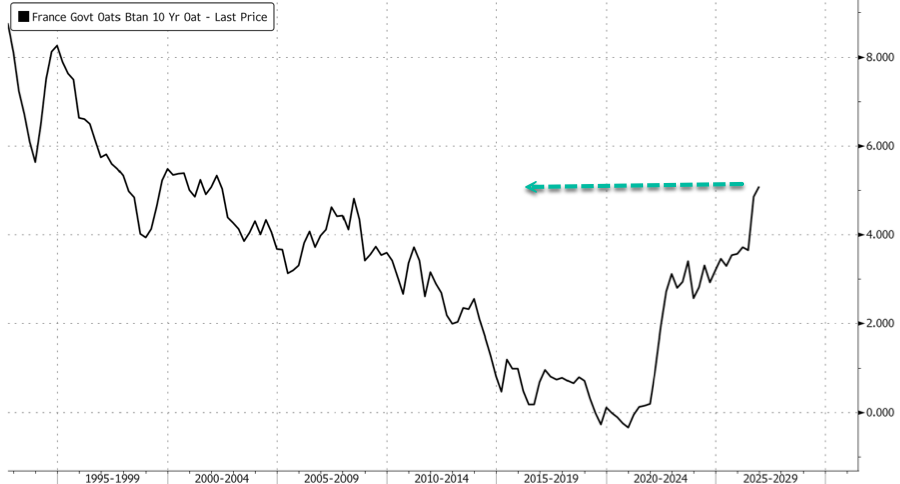
As investors increasingly recognize that the next government is unwilling or unable to pursue dramatic reforms, they’ll demand ever-higher premiums to lend France more money. This will throttle public finances as the government is forced to reallocate revenues to cope with higher bond market premiums. But a future government will, in the next few years, ultimately be forced to choose between major spending cuts (that might be vetoed by a parliamentary vote of no confidence), or economic collapse. After all, if the government refuses cuts, mortgage and consumer interest rates will soar, banks will stop lending, private capital would flee for the hills of other European states, and the European Union will bring down the hammer.
That brings us back to the potential for riots.
Many French will surely take to the streets in such a crisis scenario. Many peacefully, many not. And if the economic hammer falls, they’ll be taking to the streets in a condition of extreme economic stress. Political opportunists will fan the flames. Rioters, looters, and other criminals will seek opportunity amid what would likely be an overwhelmed police force. And it wouldn’t end quickly. France would either muddle its way to restored bond market confidence, or the European Central Bank would insist upon structural spending cuts in return for a bailout.
RUSSIAN ASSASSINATIONS ON WESTERN SOIL DEMAND VIOLENT RETALIATION
Would the French accept the sour medicine? Would they accept life-expectancy tethered increases to the pension age, a general end to early full-benefit retirement and 35-hour workweeks, major cuts to public sector employment, liberalization of the labor market, and cost reforms to the healthcare system? These reforms would affect everyone in society. They would spark rage and disbelief. Calls would grow for a Frexit, or French exit from the EU. But if not indigenous spending reforms or reforms under an EU bailout, what then? No one is going to bankroll a nation leaning off the cliff edge. France either cuts spending or it becomes a failed state.
French streets are almost certainly headed for many more days of fury.
Continue reading...
[ H/T Washington Examiner ]