
A major polling scandal rocked the political world just two weeks before the midterm elections in which a fake firm fabricated results in key races, raising questions about the validity of a polling industry already under constant scrutiny.
The firm, called Wedgewood, claims it was conducting a “social experiment” to reveal the issues plaguing the industry and call for the need for reform.
True or not, the moment and its fallout underlined the general hysteria embedded within the polling industry in which people don’t trust the data.
There are reasons to be skeptical. In 2016, the media could not wrap its head around the fact that Donald Trump could defeat Hillary Clinton, and therefore brushed aside polls that showed the race close.
“Nobody believed the polls because the people that talked on TV couldn’t imagine Donald Trump winning,” said veteran GOP pollster Scott Rasmussen, the president of RMG Research and founder of the Napolitan Institute.
But, Rasmussen said, the polls were accurate.
“The polling that year was very good. The national polls, the RealClearPolitics average, showed Hillary Clinton would win the popular vote by 3 [points]. She won by 2,” said Rasmussen.
He added there were surprises in three states in 2016 — Pennsylvania, Michigan, and Wisconsin — but that the polling averages “were within the margin of error.”
In 2020, many polls overstated Joe Biden’s projected margin of victory, and, while correct on the result, the race ended up a nail-biter.
In 2022, survey data for much of the election cycle showed a red wave hitting land, and many pundits and analysts agreed with that. But by the time voters were counted, Republicans ended with meek gains.
Right now, polling for this year’s midterm elections suggests Democrats are on the precipice of a blue wave. They’re polling well across the board and are competitive in traditionally red states such as Kansas and Texas. Many Republicans are skeptical of the available data.
But both Democratic and Republican pollsters who spoke to the Washington Examiner contend that public opinion research remains a trustworthy tool, though it’s an “imprecise tool,” as veteran Democratic pollster and Zenith Research founder Adam Carlson puts it.
Polls represent a snapshot in time, meaning a survey taken weeks before the election could render drastically different results from a later iteration or the Election Day returns.
“A lot of times [people say] ‘this poll missed by like 10 points,’ and it was fielded a month before the election. A lot of things happen in the last month of the election,” said Carlson, pointing to the $80 million Michael Bloomberg invested into the midterm elections this week.
Brent Buchanan, founder and CEO of Cygnal, told the Washington Examiner that in private polling, “there’s not a lot of error because we wouldn’t get hired again.”
Instead, Buchanan said the bigger problem is not the polling but rather “that the media is a crappy consumer of polling.”
“They don’t ever look at the surveys and scroll down to the bottom and say, do these demographics make sense for this state or district?” he continued.
Jeff Horwitt, a partner at Democratic polling outfit Hart Research, disagreed, contending that the media does a good job of covering and analyzing polls but stressed pundits need to focus on the “entire story.”
“If all you focus on is the trial heat number … you’re missing clues about what could happen” in a given election, said Horwitt.
That said, it’s never been easier to conduct a poll, making the barrier of entry lower and increasing the number of polls circulating on social media and TV.
“It’s gotten to the point now where anybody with a Claude account can conduct a poll. It doesn’t mean it’s a good poll,” said Buchanan.
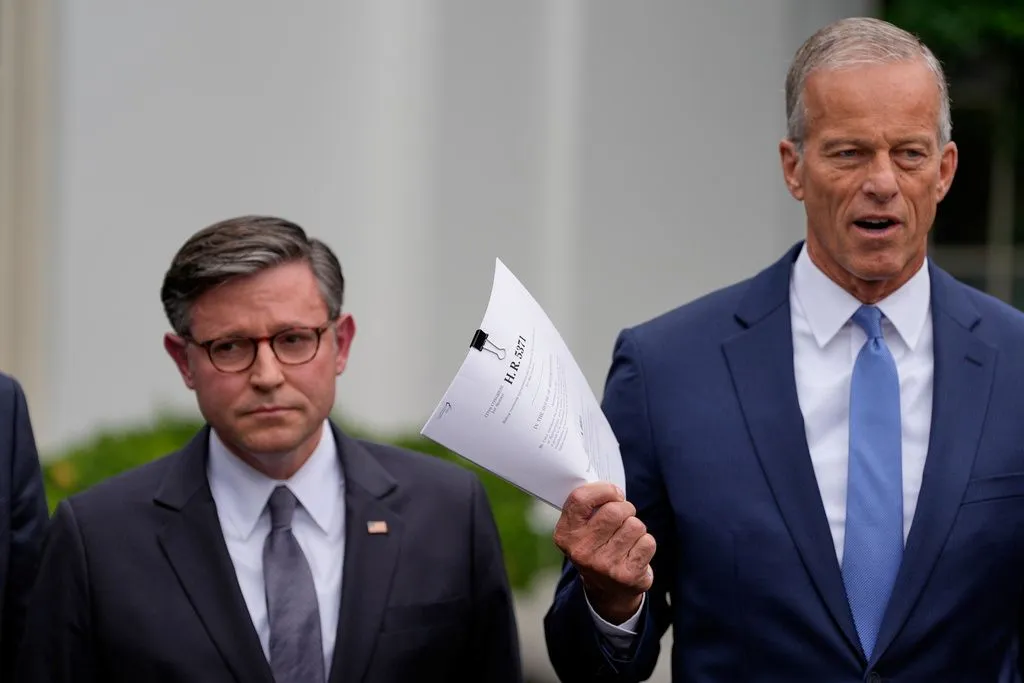
House Speaker Mike Johnson (R-LA) and other Republican leaders have pleaded with supporters not to trust available polling data.
“The polls are wrong,” Johnson said at an event recently, because pollsters are undercounting Republicans, especially those in rural areas who might be harder to reach for polls.
Trump has relentlessly attacked polling as an institution in the last decade, meaning his supporters are less likely to respond to surveys, making it harder to gauge support, but “Trump turns out people who just never vote,” according to Carlson.
And while it’s true that rural voters — traditionally Republican voters — are harder to reach, it may not save the GOP the majority this year.
“It’s the lower propensity voters, those less frequent voters, the newer voters that are obviously harder to reach,” said Buchanan. “But we did some analysis yesterday that if you stuck more of them in the poll and less of your frequent voters, it would actually look worse for Republicans.”
Though it’s not just Republicans rejecting the data. Michigan Democrat Mallory McMorrow, who was a victim of a Wedgewood poll, posted to social media “DON’T TRUST THE POLLS,” explaining that a fake poll showed her in the single digits after polling competitively against Abdul el Sayed and Haley Stevens.
The survey went viral, she said her donations dried up, and she was out of the race not long after.
Another distrust factor is the proliferation of partisan polls, which parties typically push out to raise campaign dollars. Trump, Johnson, and others have repeatedly said their internal polls look better than the publicly available trough of data. Republicans insist they aren’t on defense in deep-red terrain, seats that Trump carried by double digits in the 2024 elections.
But few Republican-sponsored polls are currently in the political ecosystem, compared to a deluge of Democratic polls showing them competitive in such races.
There’s a reason for this, says Horwitt.
“Follow the money and follow where they’re investing their resources, and that tells you all you need to know. Period,” said Horwitt.
Republicans in recent weeks have pulled money from traditional battlegrounds — like Long Island — and moved them to areas Trump won decisively in 2024, like South Carolina’s 1st District in the Charleston area.
Meanwhile, Democrats are investing money in the South Carolina and Mississippi Senate races, two contests Republicans should be able to hold with ease.
Wedgewood, the fraudulent pollster, conducted a “survey” in Mississippi, showing the Democrat down just 4 points in a state Trump carried by 23 points in 2024. Democrats began their spending in the race not long after.
The long-term damage from the Wedgewood saga is likely yet to be realized, and it’s the third instance this cycle in which a fake pollster released numbers that were picked up and disseminated by the media.
NEW FAKE POLLING SCANDAL RILES DEMOCRATS AHEAD OF MIDTERM ELECTIONS
Some, like Carlson, fear it will cast doubt on startup polling firms like his that lack the reputation of a larger outfit. That’s bad for the industry, but he remains confident in its accuracy, despite the apparent flaws.
“Polling is a constant work in progress, which is also why we need people taking risks and innovating, which also means smaller firms, you know, who have less inertia on trying out new stuff to take big risks,” said Carlson, “but you have s*** like Wedgewood — it undermines that.”
Continue reading...
[ H/T Washington Examiner ]