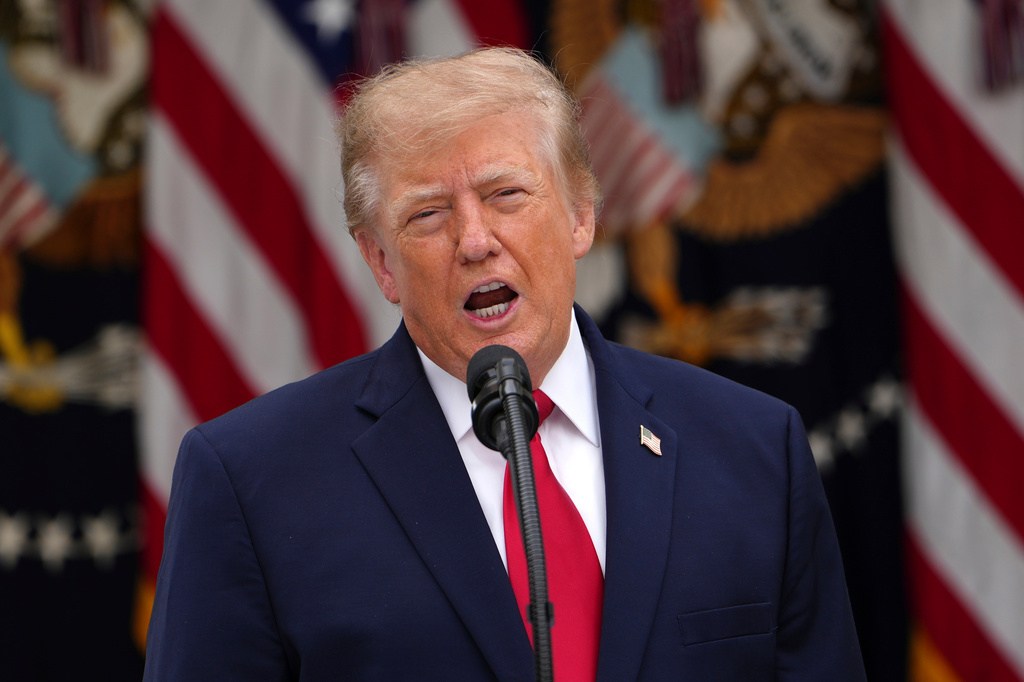





One word can move a red line. In February, President Donald Trump was asked whether he would accept anything short of zero uranium enrichment in Iran. His answer was unequivocal: “We don’t want any enrichment. We don’t want enrichment.”
Then came Vice President JD Vance.
In an Oct. 6 interview with Reuters, Vance said Iran would have to make a “meaningful” reduction in its enrichment capacity as part of an agreement to end the war. He also asked the obvious question: If Iran does not want a nuclear weapon, why does it need uranium enriched to 60%?
“Meaningful reduction” may sound tough. But it is not another way of saying zero.
It means some enrichment survives.
That distinction matters beyond the present negotiation. Vance has said he has not decided whether to seek the presidency in 2028. If he does, the language being used today could become the starting point for American Iran policy after Trump leaves office.
Presidential terms end. Negotiating baselines survive them.
And we have already tried limiting Iranian enrichment rather than eliminating it.
The 2015 nuclear agreement allowed Iran to enrich uranium to 3.67%, maintain a limited stockpile, and operate a restricted number of centrifuges. The point was to lengthen the time Iran would need to produce enough fissile material for a weapon, not to eliminate Iran’s enrichment capability.
Critics of that agreement, myself included, should acknowledge an inconvenient fact.
When Trump withdrew the United States from the deal in May 2018, Iran had not simply ignored its enrichment restrictions. A March 2019 report from the International Atomic Energy Agency found that Iran remained below both the 3.67% enrichment ceiling and the agreement’s stockpile limit. Iran began stepping away from its commitments later, after the American withdrawal and reimposition of sanctions. The IAEA records that the process began on May 8, 2019. Its later accounting of JCPOA monitoring makes that chronology clear.
So, it would be too easy — and historically wrong — to say the agreement failed because Iran cheated from Day One.
But that history does not argue for recreating the same arrangement.
It should make us ask a harder question: If Washington gets another chance to negotiate Iran’s nuclear future, why preserve the capability that created the problem in the first place?
Iran’s record of concealment did not begin with Trump’s withdrawal. In 2025, the IAEA concluded that several undeclared sites had been connected to an undeclared structured nuclear program. Its findings included nuclear material at three undeclared locations for which Iran had not provided technically credible explanations.
That history matters when deciding what inspectors should be asked to verify.
Under a limited-enrichment agreement, the IAEA must police a series of negotiated lines: enrichment level, stockpile size, centrifuge numbers and types, research activity, and other technical restrictions. A violation can become an argument over measurements, exemptions, and thresholds.
Zero enrichment creates a much cleaner rule.
If Iran is enriching uranium, it is violating the agreement.
That does not make inspectors omniscient. A clandestine centrifuge plant can be difficult to find. Zero enrichment will not magically expose a facility hidden underground.
But once enrichment is discovered, there is no debate over whether it falls on the permitted side of some technical limit.
There is another advantage. A legal enrichment industry necessarily leaves Iran with centrifuges, technicians, uranium feedstock, expertise, and supply chains that could also support illicit activity. Dismantle that infrastructure, and the legitimate ecosystem in which cheating can hide becomes much smaller.
The IAEA has sophisticated tools for finding undeclared nuclear activity. Environmental sampling, for example, can detect minute particles of enriched uranium. But no inspection system can guarantee that every secret site will be found immediately.
That is precisely why the permitted baseline matters.
None of this requires denying Iran peaceful nuclear technology. Nuclear medicine, research, and civilian power do not require Iran to enrich its own uranium. Fuel can be supplied from abroad.
The sine qua non should therefore be precise: no domestic uranium enrichment.
Highly enriched uranium should be removed or rendered unusable. Enrichment infrastructure should be dismantled. Centrifuges and relevant components should be accounted for. Inspectors should have the access needed to search for undeclared activity.
I am also skeptical that a durable peace can ultimately rest on the present Iranian regime. Iran’s people deserve a government accountable to them, and a long history of concealment makes trust a poor foundation for an agreement.
But Washington cannot make nuclear policy depend on when or whether political change arrives.
Assume, for the moment, that peace must be negotiated with the government that exists.
Then write the agreement for a government we do not trust.
That makes Vance’s wording more consequential, not less.
“Zero enrichment” is a rule.
“Meaningful reduction” is a negotiation.
Sixty percent can become 20%. Twenty percent can become 5%. Centrifuges can be reduced instead of dismantled. Each concession can be described as progress while the underlying capability survives.
Whatever one thinks of Trump’s decision to leave the Joint Comprehensive Plan of Action, there is no reason the next agreement must recreate its central compromise.
The question should not be how much Iranian enrichment Washington is willing to tolerate.
WHAT POPE LEO AND THE NOBEL COMMITTEE BOTH FORGOT
It should be why a country that says it does not want a nuclear weapon needs to enrich uranium at all.
Peace with Iran may require compromises. Domestic uranium enrichment should not be one of them.
Arie Blitz, M.D., M.B.A., is a retired physician and independent writer in Weslaco, Texas, who writes on foreign policy, medical ethics, and public policy.
Continue reading...
[ H/T Washington Examiner ]