






In Focus delivers deeper coverage of the political, cultural, and ideological issues shaping America. Published daily by senior writers and experts, these in-depth pieces go beyond the headlines to give readers the full picture. You can find our full list of In Focus pieces here.
LEVITTOWN, Pennsylvania — Quiet Road curves three times along its full third of a mile length that runs from Quincy Drive back to Quincy Drive.
Nearly 40 homes line Quiet Road, most of them were built in 1955 and are identical in build — called the “Jubilee Model” by developers William, Abraham, and Alfred Levitt. These are two-story houses that are a variation on the Cape Cod.
Levittown, Pennsylvania, and Quiet Road are the quintessence of the mid-century suburbia that has spurred seven decades of derision by urbanists and elite commentators.
Conformity, sprawl, TV dinners, stay-at-home moms, 2.5 kids, cookie-cutter houses — largely, the elite critiques of Levittown are cultural-aesthetic objections by highly educated creative-class types. “American suburbia reduced to its logical absurdity,” one critic called Levittown in the Atlantic Monthly.
The more practical objection, and the one that probably bears most directly on human flourishing, is this: Levittown, and the 20th-century sprawling suburb, was built for cars rather than for humans; they are unwalkable, and foster an unhealthy dependence on cars.
“Levittown initiated the major shift to automobile-centered urbanism,” the Society of Architectural Engineers stated.
Based on this reputation, I came to Levittown in early October to catalog modern family life in a car-dependent suburb. Car dependence is one of the things that makes middle-class parenting such a drag in the U.S. today. It even drives down the birthrate.
But instead of Car Hell, I found a sort of kid heaven Levittown: An oasis of childhood freedom and an extraordinarily tight-knit community.
Photo by Timothy P. Carney
" data-image-caption="
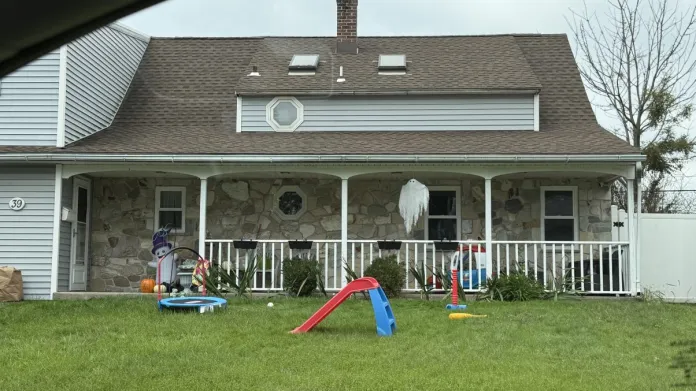
Playthings are scattered on the front yard in a neighborhood of Levittown, Pennsylvania. (Timothy P. Carney)
" data-large-file="https://www.washingtonexaminer.com/wp-content/uploads/2026/10/IMG_6867-e1791724417319.jpg?w=696" height="576" width="1024" src="https://www.washingtonexaminer.com/wp-content/uploads/2026/10/IMG_6867-e1791724417319.jpg?w=696" alt="Playthings are scattered on the front yard in a neighborhood of Levittown, Pennsylvania." class="wp-image-4762042" srcset="https://www.washingtonexaminer.com/wp-content/uploads/2026/10/IMG_6867-e1791724417319.jpg 1204w, https://www.washingtonexaminer.com/...10/IMG_6867-e1791724417319.jpg?resize=300,169 300w, https://www.washingtonexaminer.com/...10/IMG_6867-e1791724417319.jpg?resize=768,432 768w, https://www.washingtonexaminer.com/...0/IMG_6867-e1791724417319.jpg?resize=1024,576 1024w, https://www.washingtonexaminer.com/.../10/IMG_6867-e1791724417319.jpg?resize=150,84 150w, https://www.washingtonexaminer.com/...10/IMG_6867-e1791724417319.jpg?resize=696,391 696w, https://www.washingtonexaminer.com/...0/IMG_6867-e1791724417319.jpg?resize=1068,601 1068w" sizes="(max-width: 1024px) 100vw, 1024px">
Playthings are scattered on the front yard in a neighborhood of Levittown, Pennsylvania. (Timothy P. Carney)
If you believe the attacks on Levittown, you should come check out the Cobalt Ridge and Quincy Hollow sections of Levittown at about 3:30 p.m. on a school day. Yes, at Walter Miller Elementary School, you will see the familiar and dreadful long line of cars snaking through the parking lot for pickup. But you would also see dozens of solo elementary-school kids walking or scooting home, like a bunch of Gen Xers.
A teenage older brother crosses Queen Anne’s Creek on a footbridge to pick up his 10-year-old little sister and walk her home through the long and wide swath of green that runs on either of side of the creek. This greenbelt is dotted with benches, tree swings, and basketball courts, where other teenagers are shooting around idly.
Between the footbridges are a few spots where stepping stones have been laid, by which any kid willing to get his soles a bit wet can cross from Cobalt Ridge to Quincy Hollow.
By 4:30 p.m., the soccer fields adjacent to Miller Elementary are full with teams of all ages. In off-peak hours, though, you’ll find a dozen neighborhood kids joined up for pickup football. T.J., a dad who raises two kids across the street from the soccer fields, points to the little backstop there and tells me his son taught his daughter to hit a baseball there.
T.J. grew up in a different section of Levittown and says his childhood was idyllic. His dad grew up here in Cobalt Ridge. Why would this family stick around for three generations? Ask the urbanist critics, and you’ll assume he was stuck here. But T.J. will tell you he just wants to give his kids the childhood he had.
There was “always somebody’s grandparents that were two, three, four doors down from you, and they were just sweet, loving people. There was always stuff going on. There’s always kids around.”
Every single parent I interviewed in Levittown praised it as a great place to raise kids, and the presence of other kids was the most common reason.
“Lots of kids,” says Jen, walking her kids across the footbridge after school. Specifically, Jen points to the freedom and the outdoor life Levittown gives her children. “My kids don’t have electronics,” she tells me. “They go play outside. They ride their bikes. They run around.”
That density of families, combined with greenbelts, basketball courts, creeks, and baseball backstops, is worth a fortune to any parent.
The critics of suburbia are correct to hate car-dependence. When kids can’t have fun without being driven to their friends’ house, or when the only activities available are across town, the kids have less fun and are less active. Also, the parents spend more time as their kids’ chauffeurs.
In Levittown, the parents have to drive to the supermarket, to the hardware store, and to work. But the kids can go all week without getting in the car.
“I grew up in Thornridge,” T.J. says, referring to another section of Levittown. “There was a little church at the bottom of the section. All the kids used to get together, and we played football and baseball in the churchyard.”
“There’s ball fields up here. There’s the greenbelt here,” Carol, on the other side Quincy Hollow, tells me. “There’s fields down at Walter Miller across the bridge… [Children] can get all kind of places.”
One urbanist attack on Levittown is the pattern of the roads — the streets are winding, and there’s not much of a grid. Urbanists love grids, because grids minimize walking distance between any two points, and they create more unplanned encounters. This is a good argument as far as it goes.
But the winding roads in Levittown have a purpose: They slow down the cars. And without a grid, most roads are only driven on by the residents, which reduces both the speed and volume of traffic.
Speed and volume of traffic are the two most important factors that affect kids’ ability to walk around a neighborhood, because getting run over by a car is one of the biggest threats to children’s safety. That’s another reason Levittown swarms with kids.
But if you trust the most official walkability index in the U.S., the one kept by the Environmental Protection Agency, you would think Cobalt Ridge is very unwalkable — it ranks below average on the EPA’s measure. Why? The section has low intersection density (it’s not a grid), and very little commerce in walking distance.
By comparison, check out a wealthy older neighborhood 20 minutes away, Newtown Borough. The historic part of this Borough gets the most-walkable designation from the EPA. When I drive down Jefferson Street on Monday afternoon, though, I see a couple pushing their infant in a stroller and walking their pit bull on the pavement on the edge of Jefferson Street, thanks to inadequate sidewalks. Almost everywhere in Cobalt Ridge and Quincy Hollow, and in many of Levittown’s sections, for that matter, there are sidewalks, separated from the street by a strip of grass.
Newtown is walkable in a different way — and the way urbanists care about.
Council Rock North High School is steps from State Street. During lunch, or right after school, the high schoolers can walk to Wendy’s or 7-Eleven.
For the adults, there’s a ton to do as well. Walk up and down State Street, and you’ll pass two clothing boutiques, a bookstore, a hardware store, two home-goods stores, a Starbucks, a tea house, and a local coffee shop — plus multiple lunch spots. Neighbors bump into each other at lunch or on the sidewalk.
As Jody, a local mom, gushes about walkable Newton, I notice a pattern: Much of the civil society here is built around the stores. It’s not that everything costs money — there’s a state park nearby, and Porchstock is an annual, roving, walking, free music festival. But Newtown’s commerce is a pillar of the local civil society.
The boutiques are locally owned. You’re happy to spend a bit more at Newtown Hardware, because you’re paying for the experience, you’re paying for a clerk who knows you and looks you in the eye, and you’re paying to subsidize a lovely business that makes State Street look beautiful and where you can run into your neighbors.
In Levittown, commerce is much more utilitarian. No Main Street runs through the sections. The supermarkets are on New Falls Road, Veterans Highway, or one of the other car-focused thoroughfares with multiple lanes in each direction and 45-mile-per-hour speed limits. Most of the businesses in Levittown are in strip malls on the edge of the sections. Many store chains, including Dollar General and Family Dollar. A tiny minority of them are “third places” built for serendipitous neighbor encounters.
And that’s fine. The parents in Levittown are not doing civil society by going shopping. They’re taking care of human needs and then coming back to the place where civil society happens: The bicycle-littered and playset-laden front yards on Quiet Road, and the parks and schools of Levittown.
WALKABILITY, BUT FOR CHILDREN
The urbanists have a lot of good points. It is ideal to have work, your local cocktail bar, and your bookstore within walking distance. Strip malls and county highways are less social, less-human forms of commerce.
But too many urbanists are dead wrong about Levittown and the suburbs.
This is a great place to walk, run, and scoot around — if you’re a kid. And if you’re a parent, and your kids are free and safe, then life is good.
Continue reading...
[ H/T Washington Examiner ]