









LLM (‘AI’) hype and panic funding was described yesterday. This supplement explains how the funding fraud works (spoiler alert, this is a complex, technical finance model); the public are in the dark.
Protect & SurviveThe Financial Jigsaw Part 2 (Episode 97-issue 2): Continues with an explanation of how the mega-billion-dollar circular financing model works for Data Centres, combined with government public/ private partnerships (PPP). As I wrote yesterday, you and your pension pot are at risk of losing everything. I describe here the mechanics of a finance model which has been practised for centuries. And this model will crack if the US attempts any kinetic action in Iran, before or after mid-terms. War and AI data centres are inseparable partners – ‘look out below’ for the shortened US holiday next week.

This massive ‘AI’ hyper-scale technology cycle has fused private corporate balance sheets with government financed procurement and sovereign military lands with public ratepayer guarantees. This combination of government and commerce is euphemistically called “Public/Private Partnerships.” The result is a monolithic financial structure explicitly designed to privatise profits for the top 1% while off-loading all the infrastructure costs and risk directly onto the American public.
The Productivity Gap versus The Trillion-Dollar Hurdle explains the severe vulnerability of the Large Language Model (LLM) boom. The current cash-flow generation should be evaluated against ongoing infrastructure costs. At present, enterprise and consumer LLM deployment remains limited to basic productivity tooling, code completion, automated transcriptions, email drafts, and customer service chatbot automation. This is not ‘intelligent AI’, but merely an extension of traditional database software search engines.
Austrian’s Newsletter is a reader-supported publication. To receive new posts and support my work, consider becoming a free or paid subscriber.
While functionally useful, these features offer incredibly modest pricing power and subsequent limited benefits for users. Across the Fortune 500 companies, only a small minority of enterprises can demonstrate measurable operating profit expansion directly attributed to generative ‘AI’ deployments. Meanwhile, annual capital expenditures among primary infrastructure providers have reached historic, parabolic heights:
- Amazon (AWS): Annual capex commitments exceeding $200 billion.
- Alphabet (Google): Annual infrastructure outlays near $185–$205 billion.
- Microsoft: Total capex pacing at roughly $175–$190 billion.
- Meta: Open-source infrastructure spending tracking around $135–$145 billion.
Independent financial assessments indicate that to service, power, amortise the ongoing deployment of data centres, and specialised silicon the technology ecosystem must generate trillions in incremental annual enterprise revenue over the coming decade. Selling $20-per-month seat-licenses to copywriters and junior coders cannot bridge this multi-trillion-dollar divide.
Because commercial, end user software budgets alone cannot cover this gap, the entire artificial financial structure relies on an impossible singular, chilling economic premise; that of a complete substitution of white-collar and operational human wages. They are not spending billion-dollar data centre construction to augment the middle class; they are building them to potentially replace the human payroll entirely. In their utopian dreams all production and services, as well as government, will be operated entirely by artificial Agentic AI.

This innovative Accounting Architecture is invoked when end-market cash flow fails to cover capital outlays. Corporate balance sheets then resort to recursive financing, a term often referred to as ‘vendor financing’ or “round-tripping.” It is the exact same accounting engine that drove the catastrophic telecom boom in the early 2000s. The capital injection is a primary silicon manufacturer (like Nvidia) or tier-one cloud provider allocating billions of dollars in equity or debt financing into an affiliated LLM developer or specialised compute provider (such as OpenAI, Anthropic, or specialised cloud hosts like CoreWeave).
In ‘Contractual Procurement’ the receiving firm does not simply hold the cash. They are contractually bound to expend that capital by purchasing specialised accelerators, such as Nvidia H100/B200 General Purpose Units (GPUs) or leasing dedicated server capacity directly from the investing entity in a circular round of financing.
The ‘Revenue Recognition’ is where the hardware or cloud vendor books the returning capital directly as top-line revenue on its income statement. Stock markets blindly price these vendors at massive price-to-sales multiples (often 25x to 35x). Every billion dollars circulated through this circular loop creates tens of billions in aggregate market-capitalisation expansion.
This recursive accounting generates the appearance of compounding organic demand, drawing in secondary capital from sovereign wealth funds and private equity investors. Furthermore, specialised compute providers increasingly pledge these depreciating chip clusters as collateral for more billions in private credit facilities. They are borrowing further liquidity against hardware that is subject to rapid depreciation and obsolescence, effectively turning outdated silicon into the foundational (phantom) collateral for the technology credit market.
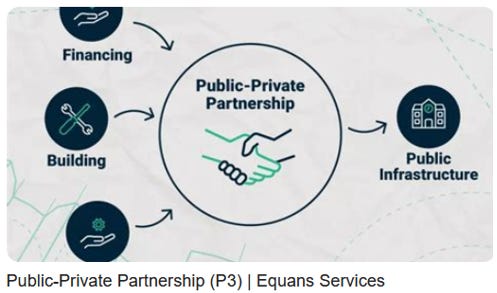
The Government Enabler enters the loop. The US government offers Title 10, Other Transaction Authorities (OTAs), and Sovereign Land Leases. The private circular financing loop has an absolute physical constraint: operating expenses. Supercomputing arrays require vast real estate, millions of gallons of cooling water, and massive electrical baseloads, none of which can be acquired with vendor equity credits alone. To secure these physical requirements, without eroding their artificially inflated profits, the private technology sector has anchored itself to federal statutes and national security designations.
The regulatory and procurement framework of the federal government has been strategically restructured to accommodate these build-outs: bypassing competitive acquisition. The traditional Federal Acquisition Regulation (FAR) enforces competitive bidding to guard public funds and prevent monopoly capture. Under initiatives like the Department of Government Efficiency (DOGE), alternative procurement vehicles, specifically ‘Other Transaction Authority’ (OTA) under 10 U.S.C. § 4022, have been heavily financed with debt.
By invoking subsection (f) (”Follow-on Production”) alongside FAR 6.302-1 (”only one responsible source”), multi-billion-dollar, non-competitive contracts can be awarded directly to preferred entities. Notable awards include massive allocations to SpaceX for programmes such as the “space-based airborne moving target indicator” tracking network (”The Golden Dome”) with 4.16 billion dollars and the Space Data Network backbone at $2.29 billion.
Massive data centres on military land aggressively circumvent municipal zoning approvals, public utility commissions, and state environmental assessments. Hyperscale infrastructure move onto active sovereign military reservations. Utilising Enhanced Use Leases (EUL) under 10 U.S.C. § 2667, massive data-centre footprints are placed safely behind federal perimeters, such as Fort Bliss in Texas and Dugway Proving Ground in Utah.
For the Department of War, this ensures secure, co-located intelligence integration. For the technology companies, operating on federal defence installations, provide structural legal immunity from local county oversight and municipal taxes, insulating their computational facilities while they draw heavily on regional water tables and electrical power grids.
The Monopolies of State Capture and Power Settlement Rails integration extends far beyond defence procurement into the direct ownership of the physical and financial rails that service the LLM sector; this is ‘Power Arbitrage’. Because large-scale data centres threaten to destabilise regional power grids, regulatory authorities have cleared “co-location” frameworks, enabling technology infrastructure to interconnect directly behind the electrical meter at nuclear, fossil, and specialised energy facilities before electricity ever reaches the public transmission network.

Simultaneously, political insiders have positioned their personal enterprises to capture this exact demand bottleneck. In late 2025, Trump Media & Technology Group (TMTG) announced a $6 billion all-stock merger with TAE Technologies, an energy firm targeting utility-scale fusion and advanced power management specifically engineered to feed off-grid AI data centres.
While the Department of Energy deploys billions in grid-resilience grants under programs designated for “new large loads,” the private energy ventures of connected political networks secure direct commercial off-take agreements from the hyperscalers to control the flow of capital moving through this deregulated market.
World Liberty Financial (WLF), co-founded by Donald Trump and his family, introduced its proprietary stablecoin (”USD1”) and pursued a national trust bank charter via the Office of the Comptroller of the Currency (OCC). Securing a national trust charter enabling the domestic, programmatic settlement of multi-billion-dollar corporate digital-asset and technology transactions without standard commercial banking intermediaries or traditional regulatory scrutiny.
It positions private executive family holdings as the unassailable toll-collector for high-volume transactions across the entire technology sector. The consolidation strategy culminates in industrial restructuring. Moves to sever Tesla’s operations from its ShanghAI Gigafactory reflect strict regulatory prerequisites. A top-tier Department of War contractor cannot maintain its operational manufacturing supply chain inside a foreign strategic rival like China.
By shedding Chinese operational exposure, the pathway is carefully cleared to merge Tesla’s autonomous robotics, energy storage, and ground fleets directly into SpaceXAI. Once consolidated, such a conglomerate can petition for “National Defence Protected Status”, an unassailable regulatory shield granting broad immunity from standard federal anti-trust enforcement under the statute title of critical national security infrastructure.

Historical precedents, like Tulip Mania, Telecom Fibre, and the absence of a financial shock absorber, create speculative assets that violently de-couple from physical economic assets and follow well-documented historical trajectories. The Dutch Tulip Mania (1636–37) ‘wealth’ was generated by trading paper forward contracts on un-bloomed bulbs. Pricing expanded entirely through speculative re-sale rather than real agricultural yields.
When buyers finally demanded physical settlement, the absence of real tulips caused the entire forward-contract market to dissolve overnight. Current LLM valuations resemble these forward contracts by pricing-in the total future extraction of corporate and government payrolls before the underlying technical systems have proven structural commercial profitability. In other words, investors are betting on a future phantasy of utopian automation decades ahead.
The Dot-com Telecom Crash (2000–01) was another classic example. Telecom carriers borrowed aggressively to bury thousands of route-miles of fibre-optic cable on the assumption of infinite immediate data demand. When end-user monetisation failed, 95% of the infrastructure stayed in the ground unused, driving major debt defaults and evaporating five trillion dollars in paper promises (equity) by the end of the cycle. But at least the collateralised hardware remained in place and stable for decades ready to accommodate the birth of new enterprises to kick-start and expand the internet of things of today (IoT). So it came good in the end, like the railway mania of yesteryear, but took 25 years to arrive.
Again, just as the 2008 mortgage crisis became a contagion of failed paper derivatives, like ‘collateralised mortgage obligations’ (CMOs), the current LLM cycle risks turning thousands of rapidly depreciating data centres into toxic collateral and subsequent failing debt obligations. However, the crucial structural difference today is that in 2001, the broader United States macro economy was structurally sound and the federal budget operated at a fiscal surplus. The national debt-to-GDP ratio was manageable, and benchmark Treasury yields remained remarkably stable. Domestic energy supplies were predictable, and the industrial manufacturing base was intact. But 2008 was far from contained and caused a global financial crisis (GFC) which almost crashed the entire global economic environment.
Today, the LLM infrastructure bubble sits atop an economy entirely stripped of its traditional shock absorbers. The national debt exceeds $40 trillion, with annual debt service costs exceeding $1 trillion and growing. The concurrent issuance of massive corporate debt by hyperscalers competes directly with short term US Treasuries, artificially driving up capital costs and interest rates across the entire real economy.
Middle-distillate fuels, refined diesel, and base materials face real-world supply constraints, elevated freight costs, and geopolitical shipping disruptions. These realities lock in a high baseline inflation floor for food, transit, and consumer staples regardless of stock market movements.
While technology-related data-centre spending artificially inflates headline Gross Domestic Product (GDP) statistics, domestic manufacturing output and non-AI business investments remain critically weak and failing. If the LLM investment cycle contracts today, capital cannot rotate into a healthy domestic industrial sector. Instead, asset deflation in equity markets will violently collide with persistent cost-push inflation in physical essentials, yielding a severe, paralysing stagflationary shock for everyone.
The Asymmetric Settlement: Who Profits versus Who Pays. The mechanics of this structure establish a strict, engineered asymmetry where capital gains leaves systemic liabilities distributed across the real economy. At the core sits the Corporate-State AI Apparatus, heavily reinforced through federal grid modernisations, rate-basing allowances, non-competitive defence OTAs, and sovereign military land leases.
This centralised engine is fed by Nvidia’s round-tripping finance models, an annual hyperscaler capex commitment exceeding $700 billion, the defence communications architecture of SpaceXAI, high-yield hardware debt held by frontier model labs, and off-grid power development channelled through private entities like TMTG.
From this infrastructure, economic outcomes divide into two radically distinct vectors: The Extraction of GAIns by corporate insiders, tier-one venture sponsors, and top executives harvest liquidity at the cycle’s peak through secondary share offerings, debt-financed corporate equity buybacks, and un-competed sovereign defence appropriations.
By anchoring their technical platforms to national security mandates and specialised federal charters, these entities secure long-term, structural insulation from ordinary commercial market discipline. The socialisation of liabilities by the broader public absorbs the downside through structural mechanisms. Immediate operating burdens are borne by regional utilities rolling the staggering capital expenses of new substations, grid interconnections, and high-voltage transmission lines directly into the regulated public rate base and raising residential monthly utility bills to support corporate computational loads. Simultaneously, federal grants underwrite the broader electrical buildout using taxpayer capital.
Systemic downside exposure is created because hyperscalers represent a dominant, concentrated share of total S&P 500 capitalisation, an eventual correction in hardware capex directly impacts institutional pension funds, broad-market index allocations, and household retirement accounts. This intersection of circular corporate accounting, statutory capture, and underlying physical constraints has established a structure where the speculative profits of artificial intelligence remain strictly private, while the physical, electrical, and systemic risks reside fully and permanently underwritten by the public ledger.
What comes next is the Actionable Execution Matrix. Understanding that this system is engineered to extract profits while socialising liabilities offers a massive, actionable trading edge. While retail investors and pension funds remain trapped unknowingly buying inflated broad-market technology funds (via ETFs etc,), institutional prediction markets on Kalshi and Polymarket are pricing these exact friction points at pennies on the dollar.
Mainstream financial media is entirely missing the physical bottlenecks. They are reporting record stock valuations while ignoring the FERC Grid Interconnection Bottlenecks, which are the hidden regulatory collisions between residential utility commissioners and behind-the-meter data centre co-locations.
The Sovereign Munitions and Hardware Depreciation Deadlines are the exact statutory timelines where federal OTA production funding must either clear Congress or trigger immediate contract restructurings. The Regional Baseload Spike is the physical impossibility of delivering gigawatt baseloads to military and rural installations without triggering automatic regional electric rate surcharges and outages. Sources
- Edited extracts from https://triggledger.substack.com/p/the-trillion-dollar-AI-illusion-how
- Echnocrats are stealing the world’s data for their own AI training https:/ www.truth11.com/ai-is-creating-doom-loops-all-over-the-economy/?
SUNDAY WARTIME UPDATED SUMMARY – [Hat Tip to No1 saving me valuable editorial space]

(Sunday 10/11/26) – The gloves are off! In Ukraine. “Russian Deputy Defence Minister Colonel-General Yunus-Bek Yevkurov confirmed what frontline movements have signalled for months: the operational self-restraints that governed the initial stages of the Special Military Operation (SMO) have been completely discarded. Yevkurov assessment cuts through four years of legalistic terminology. For the Middle East SitRep, read this hilarious article by No1 with its many options for this weekend’s war – I’m still laughing whilst trying to finish this post!


Tweet
Continue reading...
[ H/T The Burning Platform ]
