

Summary
- Every major crisis raises a question about education: What kind of people are we raising?
- Much contemporary education encourages harmful modes of thought.
- How can we expect students to protect a civilization they have been taught to despise?
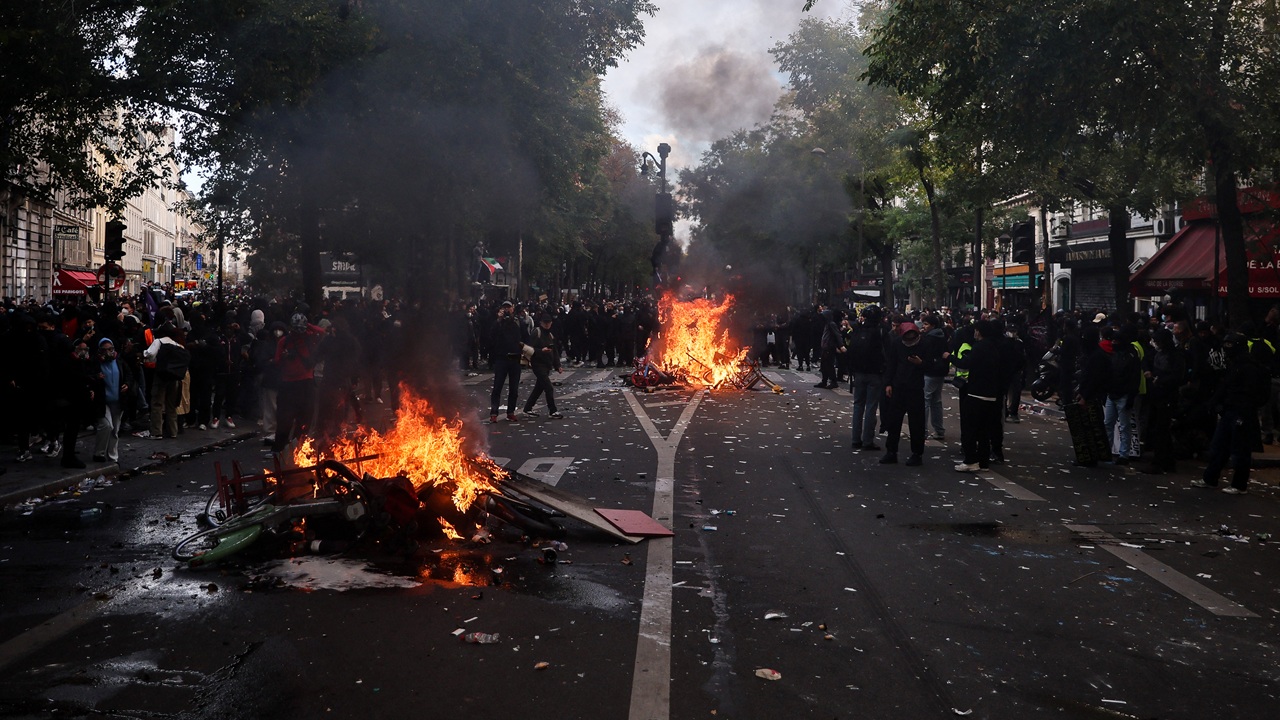
When violence and destruction broke out this month in France and soon spread to other European nations, many looked for a politician or a policy to blame. But they forgot that a very real culprit is what’s taught in the classroom.
Every major crisis today raises a question about education: What kind of people are we raising? We can pass new laws and elect new leaders, but we will keep inheriting the same heartbreak if we neglect the character of rising generations.
The events in France should shake Americans awake. Activists there are upset, but people should be able to face disagreements without resorting to arson, vandalism, and violence to solve them.
Fires have broken out at several schools in France during protests. It seems that buildings made for shaping children’s futures have become targets of destruction.
What have adults in those building taught young people about their responsibility to preserve what others have built for them? Those in France cannot teach children their country is irredeemably evil and then act bewildered when they want to tear it down.
Make no mistake: America is not immune to the violence in France, because its educational institutions fail students in the same way. American education is saturated with ideas and curricula that encourage children to see their country as the oppressor. Divisive, racist ideology divides students according to labels. This political mission appears openly in educational materials.
One teacher training book, “Lessons in Liberation: An Abolitionist Toolkit for Educators,” invites educators to use schools as a “site of organizing.” One section of the book suggests the label “gang” is just a “word that has been used to criminalize groups of people who pose a threat to the status quo of racial capitalism.” It argues “anyone can be harmful especially in oppressive conditions, and violence is not synonymous with ‘gangs.’”
Another example is “Cultivating Genius: An Equity Framework for Culturally and Historically Responsive Literacy.” It wants teachers to select texts for classroom reading based on whether they “agitate the oppressors.” The book flags physical education teachers to “examine the history of race and criticality as it relates to sports, whether athletes are putting a Black power fist in the air or kneeling during ‘The Star-Spangled Banner.’”
When rebellion becomes a moral identity, children learn to interpret disappointment as oppression. Too often, students are taught to blame rather than to take responsibility. Grievance does not excuse violence, and students who are taught otherwise will think that accountability belongs only to others, and not to themselves.
That worldview holds a monument to be an insult, a statue an enemy, and a teacher a representative of an oppressive system. Even a neighbor can become guilty through ancestry alone.
How can we expect them to protect a civilization they have been taught to despise? Children need to know their lives can contribute something good, their neighbors are worth loving, and their country needs them. Taking hope away is a betrayal that can lead to anger and violence.
A school that tolerates intimidation implicitly teaches that violence works, and that institutions are fundamentally untrustworthy. Those lessons leave the classroom. Americans don’t have to look to France to see the results of this approach to education. Look to the racial brawls in high schools across America.
Educators like me have been accused of whitewashing history for insisting children should instead learn to love their country and to appreciate Western civilization. Teach shortcomings alongside the principles that made “a more perfect union” possible. Give children reasons for gratitude: liberty, constitutional government, equality before the law, and individual rights.
Our country offers something better than what we’re seeing in France. America is “We the People,” she is a melting pot—e pluribus unum. Bring your traditions, join a common national story, and accept obligations to people whose ancestors were different from yours.
Children deserve to belong to something larger than their grievances. School should be their first practice in that civic covenant. Your right to learn requires my restraint. My safety requires rules—and consequences for breaking them. Kindness means protecting the quiet child from the bully and the teacher from intimidation. We owe one another that protection because we belong to the same country.
Beginning in the earliest grades, children need gratitude, service, discipline, and responsibility. And parents need to know what their schools are teaching. Schools must inspire children with reasons to love their country and a sense of responsibility toward their neighbors.
Education got us into this mess. Only education will get us out.
We publish a variety of perspectives. Nothing written here is to be construed as representing the views of the Daily Signal.
Continue reading...
[ H/T The Daily Signal ]