





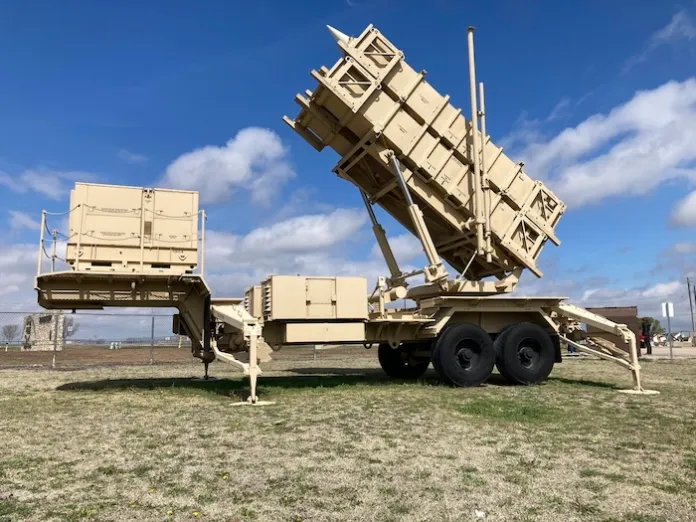
Lessons learned from the roughly 2,500 soldiers from the Space and Missile Defense Command who have led the air defense mission against Iranian attacks will play a role in shaping the future of the Golden Dome for America.
The majority of the SMDC soldiers in the region, which makes up about 25-30% of the total force, are primarily those responsible for manning Patriot and THAAD air defense systems that intercepted incoming Iranian ballistic missiles and drones.
“They have clearly risen to the occasion and provided just an incredible, really eye-watering type of protection to our soldiers and our allies and to U.S. interests overseas in CENTCOM right now,” Lt. Gen. John Rafferty, commanding general of Space and Missile Defense Command, told reporters on Wednesday at the Annual Association of the U.S. Army conference.
One way they are trying to learn and apply lessons from the war for homeland defense “is through collection of data and data on the performance of adversary systems,” he said, adding that “just being aware of the different ways in which they’re performing, but also anticipating what the next changes are going to be.”
U.S. troops have faced thousands of Iranian drone and missile attacks since the war began on Feb. 28. Shortly after the war commenced, an Iranian drone attack killed six U.S. service members in Kuwait, another U.S. service member died during a March 1 attack on the Prince Sultan Air Base in Saudi Arabia, and three others were killed in a similar attack in Jordan in July.
As the war in Iran demonstrated, U.S. adversaries are incentivized to target American air defense operators and platforms to gain an advantage.
“One of the efforts that the army is working on is something that’s loosely referred to right now as defend the defender, but recognition that that we always do a better job of protecting our formations, but realizing their air defense formations are very high on the enemy’s target list,” the lieutenant general said. “I wouldn’t say that they’re more vulnerable than any other portion of the Joint Forces out there, but given how particularly important they are to enable multi-domain operations, we’re particularly interested in protecting [them].”
As one side makes a new development or advancement, the other side will look to counter it with their own exploitations. Staying ahead is a continuous effort.
One area where the Army is hoping to see growth — or rather shrinkage — is the size of its weapons systems as well as its survivability.
As a whole, the Pentagon is looking to build out a comprehensive air defense system, which the administration has dubbed Golden Dome for America. It’s intended to detect, track, and intercept incoming ballistic, cruise, and hypersonic missile threats through a layered system of ground, air, and space-based sensors and interceptor systems.
The Army will play a role in the Golden Dome, even as the Air and Space Force leads it.
Rafferty emphasized that the “threat has grown” and stressed that “really the whole idea behind Golden Dome for America is recognizing that what protected us yesterday won’t protect us next year and the year after.”
The department is examining the existing packages of air defense systems — which often include interceptors, command and control systems, and a sensor — to try to silo them, that way military leaders can pick and choose how to configure their air defense strategies.
LOCKHEED MARTIN ANNOUNCES NEW AIR DEFENSE INTERCEPTOR MISSILE DESIGNED FOR HYPERSONICS
The military’s need to defend its bases was further emphasized last month with the thwarted attempted terrorist attack targeting a U.K. military base that housed U.S. aircraft. Six people have been arrested in connection with the incident, including five British nationals and one British-Iranian dual citizen.
“I can confirm our assessment that it is highly likely to have been coordinated in Iran, almost certainly directed by Iran’s Islamic Revolutionary Guard,” Prime Minister Andy Burnham told Parliament last week. “We will not tolerate these threats on our soil.”
Continue reading...
[ H/T Washington Examiner ]