







I recently had the opportunity to represent the Heritage Foundation in Israel at the U.S. Embassy in Jerusalem’s celebration of America’s 250th anniversary. The event was held at the Museum of Tolerance in Jerusalem and attended by many hundreds of people, including a delegation from the United States.
Israel is a country I used to visit several times a year for many years. I even lived and studied there for a short time. However, when my wife and I started having children, I stopped international travel. Twelve years and four kids later, my wife decided that while she appreciates my devotion to her and the kids, it was time for me to restart making some long trips away from the house from time to time. (If you are married, you’ll understand.)
I was excited to return to Israel. I wanted to know what had changed and what was the same. As a conservative working around politics, I know how Israel is disparaged in our media today. None of the negative claims I have read recently matched my past experiences in Israel, but I wanted to know if there was something behind the media accusations. Can you really no longer buy a Jerusalem Cross in the Old City? Can you no longer access the Church of the Holy Sepulchre? Has Israel lost its faith and turned against American interests?
I am American and Jewish—and a proud American and Jew at that—and my time a decade ago in Israel taught me that our two nations were bonded by our Judeo-Christian lineage and faiths. While Christianity is not Judaism, that does not mean I should not enjoy the beautiful history, buildings, and teachings of my Christian brethren. I hope my Christian friends take full advantage of the Jewish teachings, practices, and culture as well. This is the Judeo-Christian West after all. We’ve achieved a lot together, and we can still learn from one another and achieve more together.
I came to three conclusions from my time in Israel. The first was about Israel’s treatment of Christians, the second was about Israel’s bolstered conservatism, and the third was about Israel’s future.
Israel’s Treatment of Christians
To address the elephant in the room, there is absolutely no truth that I could find that corroborates the negative accusations that Israel mistreats Christians.
I looked as best a human can throughout Jerusalem and beyond. I traveled on foot, by taxi, and in my own personal rental car all around the city every day. I did not notify anyone about where I was going or when I would be someplace, and I recorded many of the places I visited. Anyone could see that I was Western by my clothes, language, and build. To anyone who met me, I was a tourist.
I researched common recent accusations made against Israel—and particularly Jerusalem, and I listened to work by a prominent podcaster who has been spreading negative rumors about the nation and city.
Despite claims that Christians are being mistreated, I saw many Catholic and Orthodox priests. They were treated so normally it was unremarkable. They were friendly, content, and happy to talk with me.
I visited the Western Wall intent on infiltrating the Jewish rebels who (the podcaster assured me) are conspiring to rebuild the Third Temple. Again, nothing to report here. Most of those I saw seemed too busy praying for God’s favor to have time for such plots. The rest appeared to be tourists.
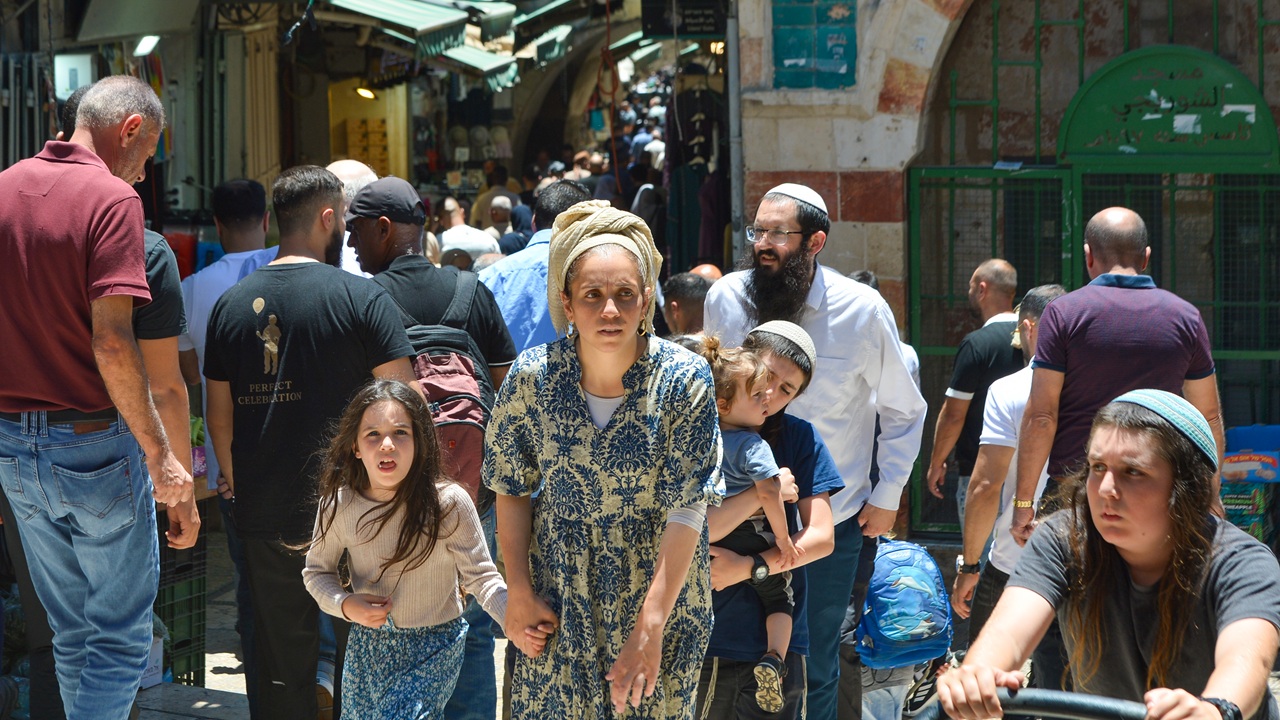
Yes, you can buy a Jerusalem Cross in the Old City, the airport, and countless other places in Israel. They are ubiquitous. In fact, if you so much as make eye contact with one of the many vendors selling Jerusalem crosses in the Old City’s Christian Quarter, the vendor will harass you for several storefronts in an attempt to sell you a cross. He will follow you so far that other vendors selling similar crosses will be annoyed and then get into an argument with the original seller. (Pro tip: When the argument begins, that is the moment to make your escape.)
Christian tourists were visiting Jerusalem freely, spending time at some of the most important and meaningful sites in their faith without restriction. In fact, in some ways the Christian Quarter is my favorite Quarter because I felt it was cleaner with a calmer energy. I couldn’t help but speculate that that calmness must be rooted in the peace that comes with knowing the Messiah has arrived.
Despite diligent efforts, I could not find a single instance of the mistreatment of Christians anywhere in Jerusalem. I did, however, find many instances of goodwill and engagement between Christians and Jews, foreign tourists and Israelis.
Bolstered Conservatism
When I previously spent time in Israel in the early 2000s, leftist movements had rising influence. There was also a palpable tension between the state’s religious and secular identities. Israel’s economy was going through a rapid modernization, which exacerbated this tension.
I wondered at the time what would become of the religious and national character of Israel and whether the foundational elements of Israel’s culture and character would be undermined by economic globalization.
Twenty years later, it seems to me that Israel is coming out in a good place.
In Jerusalem, religion was actually more present than I remember it being in the past.
Perhaps the most striking change was the sheer number of religious young people. I was blown away when I tried to visit the Western Wall at midnight on a Wednesday and was met by a sea of young people. There were thousands of them—at midnight!
I later learned they were going to the Wall to engage in Slichot, repentance ahead of the Rosh Hashana holiday (the Jewish new year).
Despite the penitential character of that evening, the young people’s energy was joyful. It was like walking with a party train into the Old City to meet up with a few thousand of our closest friends at a prayer site.
In addition to seeming more religious than it had in the past, Israel also felt much more conservative. This conservatism touches not just attitudes toward culture, but also toward national security.
Many people there—conservative and liberal—told me that since the Oct. 7, 2023, Hamas attacks, the nation has come to terms with no longer compromising its need for robust security with concessions outside the national interest. There seemed to be a consensus that previously influential international governments and NGOs will no longer exert power over how Israel conducts its affairs.
This is not to say, however, that Israelis are committed to conflict. Quite the opposite. Israelis have seen war for too long, and they do not want it for their children.
Hamas’ Oct. 7 attacks helped Israelis conclude that suicidal empathy—whether for Palestinians or other groups whose causes are pushed by international governments—cannot result in peace.
On that note, there is great hope for the Heritage Foundation’s Abraham Accords Institute. There is widespread belief that after America is victorious in its conflict with Iran, the Abraham Accords framework will be further embraced by the people of Israel and their neighbors. This will help the region to pursue cooperation and stability through economic, cultural, and security agreements aligned with each nation’s national interests. The days of selling out the region’s security and prosperity to the international community’s ideological fantasies will end.
Israelis also love America. They fly American flags on private land. They put up memorials to America’s accomplishments and tragedies. They follow our politics and see our joint struggle with Islamic terrorism and border control. They love our culture. One of my favorite hidden gems just outside of Jerusalem is the Elvis Café which is a mix between a museum celebrating all things Elvis and an American dinner. Most importantly, Israelis see the survival of America as the survival of freedom on Earth, and as such, they tie America’s fate to their own.
It is clear Israel does not only openly recognize and celebrate its shared Judeo-Christian foundations with America: It recognizes and celebrates our shared societal commonalities as peoples and Western democracies fighting to remain free.
I guess many American talking heads have missed all that I saw.
The Future
I came to my first two conclusions about Israel as a layman, but my conclusion about the future of Israel is where my layman’s perspective ends and my professional experience at the Heritage Foundation begins to impact my thoughts.
During my trip, I did have official duties to attend to, and in this role I found myself in rooms with U.S. and Israeli officials and other dignitaries and cultural figures. There were two prominent themes to these meetings.
First, when discussing anti-Western forces, everyone recognized the centrality of China, Russia, and Iran. Israel’s battle front is America’s battle front. They all understood that the alliance between our nations is central to the defense of Western civilization.
Second, everyone agreed that Israel and the United States have the opportunity to grow closer together and benefit one another’s citizens more than ever before.
I was proud that the officials on both sides seemed to have read the Heritage Foundation report last year that outlined a new path for the U.S.-Israel alliance. The report outlines how this alliance will open the pathway for many benefits for our nations, including two-way investments, which will enrich and bring opportunities to both Americans and Israelis.
The Heritage Foundation will play a critical role in forwarding the future of the Abraham Accords. The Abraham Accords framework is the only plan discussed that these leaders believed had the true potential to bring stability to the region, end forever conflicts, and solidify the region as an asset and ally to America in our global power struggle against China and Russia.
Conclusion
As a young man, I lived in Israel for many months studying Hebrew and traveling throughout Israel and to several of her neighbors. It was very exotic for me, coming from a small town in Pennsylvania. I loved the adventure of it all—living in another country, hearing another language spoken on the streets, experiencing a different culture, and seeing the places where Biblical figures walked.
But eventually the adventure wore thin, and I realized I missed home. I didn’t just miss home because that’s where my family was or because it was familiar to me. I missed home because I was, well, American.
I wanted to return to my land and culture, to touch American grass, shop at an American grocery store, fly fish in an American river, and watch American football. Americans have a truly special inheritance and way of life. Regardless of what your particular economic and other challenges might be—and I know the challenges are real—believe me when I say that you and I have it better in America.
I have found while visiting Israel and other countries that they see the U.S. and its people as the standard bearers of the free world. This is another truth the media obfuscates.
The people of Israel and the West understand that without the U.S., freedom is lost. As I spoke to Israelis about this, the voice of President Ronald Reagan kept sounding in my mind: “The United States remains the last, best hope for a mankind plagued by tyranny and deprivation. America is no stronger than its people—and that means you and me. Well, I believe in you, and I believe that if we work together, then one day we will say, ‘We fought the good fight. We finished the race. We kept the faith.’”
We, as Americans, have the burden and fortune to hold the line. In doing so, we define our own destiny, as well as that of the free world. What I saw in Israel is that the people of that nation understand this and have our back.
Spending time in Israel is an amazing experience. I hope that if you have not visited it—or have not done so in a while—you’ll add visiting to your to do list. This is especially important if you are a young person interested in American politics. Jerusalem is the bedrock of our nation’s Judeo-Christian faith and Western civilization, and the Middle East will continue to be strategically important to U.S. interests and national security.
Following this visit, it was particularly clear to me that we should not relinquish our intellectual and political lives to the media or any other entity that, in the end, is making a profit and a brand off dividing us and inciting our worst emotions and instincts. We must instead investigate with our own eyes and experience things in our own unique ways. Perhaps there is a role for Heritage in that as well.
The conservative movement is based on seeking the Truth. We are a diverse group, and we wrestle with one another and our diverse viewpoints in the pursuit of Truth. But we must endeavor to do this as many of our movement’s great leaders did before us—Rush Limbaugh comes to mind—as builders and happy warriors struggling as Jacob to claim our inheritance. What was Jacob renamed by God after that struggle again?
We should align ourselves with those people and institutions who speak truth while seeking to build consensus and inspire us to our best selves, not with those who tear down through deceit and diminish us to our most primal selves.
I went to Israel to build, to see the truth, to share my perspective. Most importantly, I went back as an American to reconnect with the foundations of America and my faith.
I return having accomplished what I set out to do, but the work is not done.
Hopefully, if you have read this far, you found something valuable from my experience. Together, I hope we will recommit to ensuring America First belongs to the builders of a future in which America and its citizens thrive, the Judeo-Christian West and Western civilization endure, and our allies and partners across the world succeed with us. Not at our expense, but alongside us.
My visit showed me that Israel embraces this. Once lies no longer blind, the path to unite and build the future we wish to bequeath to our children becomes clear. Let’s unite with the builders, sideline the grifters, and get on with winning the fight for freedom and prosperity. Let’s hold the line.
Continue reading...
[ H/T The Daily Signal ]