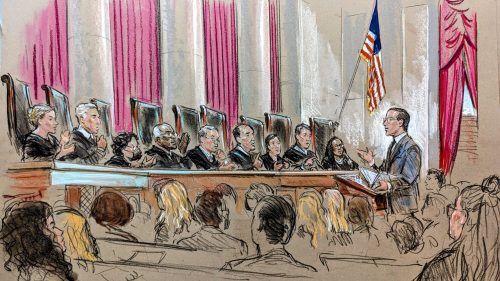


The Supreme Court will hear oral argument on Tuesday in an Alaskan bush pilot’s challenge to the forfeiture of his $95,000 airplane. Prosecutors sought that forfeiture on the theory that the pilot, Ken Jouppi, must have known a passenger was bringing beer to an Alaskan village where alcohol is prohibited. That penalty, Jouppi argues, violates the Eighth Amendment’s ban on excessive fines.
The case before the court began in April 2012, when Jouppi, who is now 83 years old, was scheduled to fly a passenger from Fairbanks to Beaver, Alaska – less than a one-hour flight. Beaver, whose population was reported as 48 in the 2020 census, is a “dry” village: it bars not only the sale of alcohol, but also the importation and possession of alcohol. There are no roads to or from the village, and the closest hospital is in Fairbanks.
Before Jouppi took off for Beaver, state troopers arrived at the airport with a warrant to search his plane. According to the state, law enforcement officials had “receiv[ed] information that Jouppi had repeatedly transported passengers with alcohol to” dry villages. They found the equivalent of three cases of beer that his passenger was bringing to her husband, who works in Beaver, and charged both the passenger and Jouppi (as well as his company) with knowingly bringing alcohol to a “dry” village.
The passenger pleaded guilty. Jouppi went to trial, where he was found guilty. The trial judge sentenced him to three days in prison and ordered him to pay a fine of $1,500.
Under state law, prosecutors also sought to forfeit Jouppi’s plane. The Alaska Supreme Court ruled that the forfeiture did not violate the Constitution. It concluded that “the forfeiture of Jouppi’s airplane is not grossly disproportional to the gravity of the offense for which he has been convicted and, therefore … does not violate the Excessive Fines Clause of the Eighth Amendment.”
Jouppi then came to the Supreme Court last year. He asked the justices to decide whether, to determine if a fine violates the Excessive Fines Clause, courts should consider the gravity of the specific defendant’s conduct. The court agreed in July to take up his case.
Jouppi and Alaska disagree on virtually every aspect of the dispute – not only the legal issues and conclusions, but also the facts. Although he denied knowing that any beer was on the plane, Jouppi characterizes the case as one hinging on just one six-pack of beer – which, state troopers testified, was visible in a grocery bag.
Jouppi urges the Supreme Court to reverse the Alaska Supreme Court’s decision and send the case back to the lower court for it to take another look, stressing that “[t]he Excessive Fines Clause was built for cases like this.” He points to the Supreme Court’s 1998 decision in United States v. Bajakajian, in which the justices agreed that requiring a defendant to forfeit $357,144 for violating a federal law that required him to report that he was taking more than $10,000 in cash out of the country was unconstitutional. “As the Court has recognized,” Jouppi contends, “a forfeiture … violates the Excessive Fines Clause if it is ‘grossly disproportional to the gravity of a defendant’s offense.’” Moreover, he continues, in making that determination, courts should look at “the gravity of a defendant’s offense … not purely in the abstract, but with reference to the defendant’s own wrongdoing” – both his own culpability and “‘the gravity of the actual offense giving rise to forfeiture.’”
However, Jouppi suggests, the Alaska Supreme Court instead “evaluated [his] wrongdoing at a stratospheric level of abstraction,” by looking broadly at the harm that the plane-forfeiture law was intended to address rather than any harm that Jouppi himself might have caused by flying a six-pack of Budweiser into Beaver. When a court looks at wrongdoing “purely in the abstract,” Jouppi tells the justices, “the societal harm of even the most minor infraction will dwarf any fine imaginable.” For example, he says, in 2019, the failure to wear a seatbelt led to more than 2,000 deaths and 46,000 serious injuries, at a cost of $11 billion; the costs of speeding-related accidents amounted to $46 billion. But it would be “grossly disproportional,” Jouppi asserts, for the government to require the forfeiture of a car whenever someone failed to wear a seatbelt or went one mile per hour over the speed limit.
The Alaska Supreme Court was also wrong, Jouppi continues, when it concluded that the forfeiture of Jouppi’s $95,000 plane was not grossly disproportional because that value was “only” nine-and-a-half times the maximum fine that could be imposed under state law for any class A misdemeanor, which could also include (among other things) selling alcohol to a minor, “the unauthorized practice of law, medicine, or osteopathy,” indecent exposure to a child, domestic violence in a child’s presence, “misconduct involving a corpse,” and bestiality. “That a worst-case animal abuser, or corpse abuser, or faux-osteopath could merit a $10,000 fine sheds no light on ‘the gravity of [Jouppi’s] crime’ or whether forfeiting an airplane for a six-pack is excessive,” Jouppi emphasizes.
Alaska paints a very different picture, countering that “Jouppi’s crime was not flying in ‘a six-pack.’” Instead, it writes, “Jouppi loaded two cases of beer and four six-packs of 16-ounce beers on his plane destined for a village of a mere 48 people with no roads in or out and no emergency medical services.” It explains that the law allowing villages like Beaver to prohibit alcohol are a response to “the destruction caused by alcohol in its isolated, rural communities.” And because alcohol “often arrives by plane” in remote villages, state law requires a pilot who is convicted of knowingly transporting alcohol into a dry community to forfeit his plane. That penalty, the state says, both “prevents the airplane from being used again to import alcohol and deters others from doing the same.”
The state contends that “Jouppi fights a strawman” by “insisting that the Alaska Supreme Court considered his offense ‘purely in the abstract’”; rather, that court upheld “the forfeiture of Jouppi’s airplane … as applied to Jouppi’s actual circumstances.” In doing so, Alaska says, it “reviewed and considered all the facts that led up to Jouppi’s conviction for knowingly transporting alcohol into a dry village. Jouppi’s actions fell squarely within the conduct targeted by the law, and he threatened to cause the same harm feared by the legislature. Whether Jouppi knew about all or just some of the nine gallons of beer he loaded onto his plane does not change the constitutional analysis.”
Moreover, the state continues, “Alaska’s forfeiture regime is not unusual or extreme.” The state points to a long history of federal laws requiring “the forfeiture of ships used to commit a host of crimes, including customs fraud, piracy, and the slave trade.” And indeed, it notes, when Alaska became a territory, “Congress imposed similar punishments” there, requiring ships to be forfeited “for the illegal killing of fur-bearing animals and the importation of alcohol. Those laws, like Alaska’s now, deterred hard-to-detect crimes and incapacitated criminals from using the vessel to repeat the offense.”
Finally, the state distinguishes the history of laws requiring the forfeiture of ships and planes from those involving “forfeitures of currency, such as that in Bajakajian.” Like the provision of English law on which it was based, the Excessive Fines Clause, it writes, was intended to serve as “a rebuke of ‘huge monetary penalties’ assessed by the King’s judges against his enemies.” Courts assess those penalties, the state argues, by looking at the “‘value of the fine in relation to the offense.’” But when considering “punitive forfeitures of vessels and other instrumentalities of crime,” the state stresses, the inquiry focuses on “whether the forfeiture is limited to the property ‘“tainted” by unlawful use’” – precisely the situation in Jouppi’s case.
Like Jouppi and the state, the “friends of the court” briefs filed supporting each side take very different positions.
A brief supporting Jouppi from the group Fair and Just Prosecution contends that “[f]ines and forfeitures in this country have evolved beyond their intended purpose of retribution and deterrence” and “now function as a revenue-generating tool that can fill budget gaps without formally raising taxes.” “Mandatory forfeiture statutes” like the one at issue in this case, the group argues, “create not only disproportionate punishments, like Jouppi’s, but also the perception that the system has self-serving goals other than public safety in mind.”
Another brief supporting Jouppi, from the Pacific Legal Foundation, pushes back against the idea that a court should consider the constitutionality of the forfeiture of Jouppi’s plane in light of the harm that the forfeiture law was intended to address. “The Court should analyze the confiscation of a person’s property based on individual culpability,” the group argues, “because the Constitution protects individual rights.”
By contrast, a “friend of the court” brief from the Alaska Legislative Council, a bipartisan committee formed to (among other things) represent the state’s legislature when it is not in session, stresses that the legislature enacted the plane-forfeiture law as “a calibrated response to a crisis unparalleled elsewhere,” “recogniz[ing] that the extraordinary isolation of rural Alaska villages, coupled with the complete dearth of public-safety infrastructure in many such communities, left residents uniquely vulnerable.” The Supreme Court, the council says, “has made clear that ‘judgments about the appropriate punishment for an offense belong in the first instance to the legislature.’”
Former U.S. Attorney General William Barr, along with three former Alaska attorneys general, also filed a brief supporting the state. They argue that “Jouppi’s proposed rule would” in fact “reach far beyond Beaver” to other “Alaska Native” communities, where it would “systematically understate the gravity of offenses in the communities where deterrence and prevention matter most.” Barr and the other lawyers tell the court that “[t]he question in this case is not whether six beers, standing alone, could cause every alcohol-related harm in rural Alaska. The question is whether the Constitution requires a court to pretend that Jouppi’s six beers were headed nowhere in particular, threatened nothing, and could have been conveyed by some other means. It does not.”
Continue reading...
[ H/T SCOTUSblog ]