American exceptionalism, the idea that the United States is uniquely virtuous, has deep roots that predate the nation itself. The founders of New England, in words echoed by President Ronald Reagan, famously declared that it was to be “as a citty upon a Hill. The eies of all people are upon us.”
At best, American exceptionalism can be beneficent in intent and beneficial in result. In time the New England states would become leaders in the abolition of slavery. Closer to our time, the United States would translate its victory in the Second Word War into the Marshall Plan, the World Bank, and the currently embattled international legal order under the aegis of the United Nations. The 18th Amendment, the juvenile death penalty (until 2005), and the failure to guarantee a right to healthcare furnish examples of exceptionalism gone wrong.
And then there is the Supreme Court’s wariness toward international law. At the Founding and for decades thereafter, the court tended to embrace “the law of nations,” either as a guide to interpreting relevant statutes or even as furnishing a rule of decision in appropriate circumstances. In more recent times, however, majorities have balked at viewing treaties as self-executing, taking guidance from the International Court of Justice, or applying statutes that expressly incorporate “the law of nations” into domestic law.
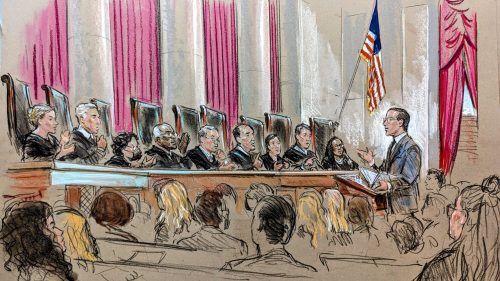
A grant of certiorari just this month will likely confirm the trend. The case is Mullin v. Refugee and Immigrant Center for Education and Legal Services, in which the justices will review one of the Trump administration’s earliest attempts to restrict immigration. On the administration’s first day, a presidential proclamation declared that “an invasion is ongoing on the southern border.” The proclamation, among other things, sought to suspend entry to the United States for non-citizens “engaged in the invasion,” even for refugees fleeing persecution and seeking to apply for asylum. But the edict went one step further. It also mandated expedited removal to asylum seekers who had crossed the border seeking to apply for asylum and provided for expedited removal of such persons.
The proclamation was issued notwithstanding a congressional framework that seeks to facilitate asylum – indefinite lawful residence – to those escaping persecution in their home country, set forth primarily in the 1952 Immigration and Nationality Act as amended by the 1980 Refugee Act and later amendments (codified under Title 8 of the U.S. Code). This framework: a) ensures a right to apply for asylum, b) links eligibility for asylum to refugee status, and c) provides protections against the government removing persons who would be likely to face persecution or torture.
Section 1158 establishes the right to seek asylum. It provides that “Any alien who is physically present in the United States … irrespective of such alien’s status, may apply for asylum.” The same section makes eligibility for asylum conditional, among other things, on a demonstration of refugee status. For this the statute relies on the definition of refugee in section 1101(a)(42) as a person who is unwilling or unable to return to their home country “because of persecution or a well-founded fear of persecution on account of race, religion, nationality, membership in a particular social group, or political opinion.”
In turn, safeguards from removal come from two sources. The Immigration statute itself states that noncitizens cannot be removed to a country where the attorney general determines that the “alien’s life or freedom would be threatened in that country because of the alien’s race, religion, nationality, membership in a particular social group, or political opinion.” In addition, the Foreign Affairs Reform & Restructuring Act of 1998 restricts removal to a country when “there are substantial grounds for believing the person would be in danger of being subjected to torture.”
The Trump administration initially justified the denial of asylum and removal projections to those within the United States by invoking the president’s authority to suspend entry “of any aliens or of any class of aliens into the United States [that] would be detrimental to the interests of the United States.” The logic is that no one who violated the suspension by entering should be entitled to asylum and removal protections. To this defense the administration has added the formal role of the attorney general and director of Homeland Security. The INA grants each official the authority to grant asylum to eligible applicants as well as withhold removal for those who qualify. At the same time, the statute makes clear that these decisions are subject to individualized judicial review under an “abuse of discretion” standard. (At least until the second Trump administration, decisions not to grant relief to those who had demonstrated that they had qualified for asylum were the “exceedingly rare“ exception.)
The lower courts rejected both justifications. Judge Randolph Moss of the U.S. District Court for the District of Columbia dismissed the administration’s claim that the president’s suspension of entry to those “engaged in [the] invasion” invalidated asylum and removal protections that expressly applied to persons physically in the country. The D.C. Circuit agreed with a slightly different emphasis. Writing for the majority, Judge Michelle Childs also rejected the idea that a suspension of entry justified eliminating asylum and removal safeguards for those present in the United States. To this point she added that, as a grant of asylum is discretionary, the express right to apply it entails individualized consideration rather than blanket elimination. (Judge Justin Walker issued a partial dissenting argument that the grant of discretionary authority permits a blanket denial of asylum claims.)
The D.C. courts’ holdings are not wrong so far as they go. Suspending entry would appear to be a different power from removing someone after they had entered. The provisions for asylum strongly imply individualized consideration and even suggest a presumption of granting asylum to those who meet the detailed eligibility requirements. The relevant provisions plainly bar removal of those who qualify for that protection. But whether this reasoning will be sufficient at the Supreme Court is another matter. This is so not least given the justices’ recent penchant for giving the executive wide latitude on immigration.
But the justices should take into account some additional perspective.
One relevant perspective comes from international law. Surprising as it may seem, the United States is not exceptional in having to grapple with immigration, refugees, and asylum. More surprising still, these common global challenges has yielded what should be familiar, common legal standards that apply, and to a great extent which owe their development to, the United States. Perhaps most surprising of all, standard domestic doctrines invite reference to this body of law when interpreting applicable federal statutes.
Consider first asylum. As an initial matter, the domestic asylum framework incorporates international standards as a function of congressional intent. As the court itself recognized in 1987’s INS v. Cardozo-Fonseca, Congress enacted the Refugee Act of 1980 to bring U.S. law in conformity with the nation’s obligations as a state party to the 1967 Protocol to the 1951 Refugee Convention. Crucially, in determining those obligations, the court sensibly drew upon the views of the UN Office of the High Commissioner for Refugees.
What do those obligations contemplate? The Refugee Conventions do not expressly provide for a right to apply for long-term asylum, as opposed to specifying rights for refugees fleeing persecution. But the UNCHR has maintained that international law presupposes individualized consideration of refugee status, especially before that status is denied. Given that Congress made the requirements for refugee status the basis for being eligible for asylum, it would be odd to conclude that the U.S. would remain in conformity with the convention as interpreted by the UN’s most authoritative body should the executive reject the right to seek asylum by means of a categorial denial of all asylum claims.
Not surprisingly, categorical rejection of asylum claims would also be at variance with widespread international practice, especially as mandated in Europe. And neither last nor least, the administration’s position would also be inconsistent with the 1948 Universal Declaration of Human Rights’ express guarantee of a right to asylum. Though not binding, the UDHR was adopted without dissent by the UN General Assembly, reflects the dominant position of the Member States, and informs their practice.
The Charming Betsy canon leads to the same conclusion. In the 1804 case Murray v. the Schooner Charming Betsy, Chief Justice John Marshall famously stated that “an act of Congress ought never to be construed to violate the law of nations if any other possible construction remains.” Marshall’s reference to the “law of nations” is generally understood to apply to modern customary international law. International custom arises given a near consensus of state practice perused out of a sense of legal obligation.
Section 1158’s grant of authority to the executive to grant asylum applications can be construed at least in two ways. It might mean a complete categorical discretion to deny. Or it might be better understood to assume individualized consideration. The latter clearly better comports with international practice. Yet there is even a stronger consideration. Customary, and for that matter treaty law, clearly prohibits removal to countries where a refugee has a well-founded fear of facing persecution or torture. When the result is expedited removal, the categorical denial of asylum status to persons claiming to escape from persecution and torture places the U.S. in obvious jeopardy of violating exactly this well-established international prohibition.
Which brings up the matter of removal itself. Here the upshot of Congress’ intent is more direct. Article 33.1 of the 1951 Refugee Convention provides: “No Contracting State shall expel or return (“refouler”) a refugee in any manner whatsoever to the frontiers of territories where his life or freedom would be threatened on account of his race, religion, nationality, membership of a particular social group or political opinion.” Likewise, Article 3.1 of the Convention Against Torture mandates that “No State Party shall expel, return ("refouler") or extradite a person to another State where there are substantial grounds for believing that he would be in danger of being subjected to torture.” As noted, the Refugee Act in the first instance sought to place the U.S. in conformity with the Refugee Convention. FARRA sought to do the same with CAT. Categorically removing persons in the U.S. seeking asylum all but guarantees violations of the treaties that Congress sought to uphold.
So strong is the congressional intent argument that the Charming Betsy need not set sail. Yet even if the relevant statutory provisions were somehow ambiguous, the Charming Betsy canon would compel rejection of the administration’s position. Assume that section 1182(f), which grants the executive discretion to deny asylum claims, authorizes a categorial denial of applications across the board. Assume further that this section, along with section 1185(a)(1), can be read to permit removal of persons within the United States denied the opportunity to apply for asylum on the basis of persecution or torture. Even without the conventions, international practice has separately established “non-refoulement” – the prohibition of returning, or “refouling,” a person to return to a territory where he may be exposed to persecution as a matter of binding customary international law. Reading the relevant statutes to permit removal would then constitute a clear violation of non-refoulement. That reading would therefore also run counter to the Charming Betsy canon.
A sad yet likely irony is that Mullin v. RAICES will privilege one strand of American exceptionalism over another. Much of the international law relevant to the case reflects the nation’s exceptional effort to leverage its dominance after the Second World War not to establish a traditional empire, but to construct a rules-based international order. One of many achievements was the 1951 Refugee Convention, like the Universal Declaration of Human Rights, brought about in no small part thanks to the efforts of Eleanor Roosevelt as a U.S. representative to the UN. Against this is the view that America has little to heed from the rest of the world, including on matters that implicate international affairs. The court adopted this stance on immigration as recently as last term. We shall see which view prevails.
Continue reading...
[ H/T SCOTUSblog ]