




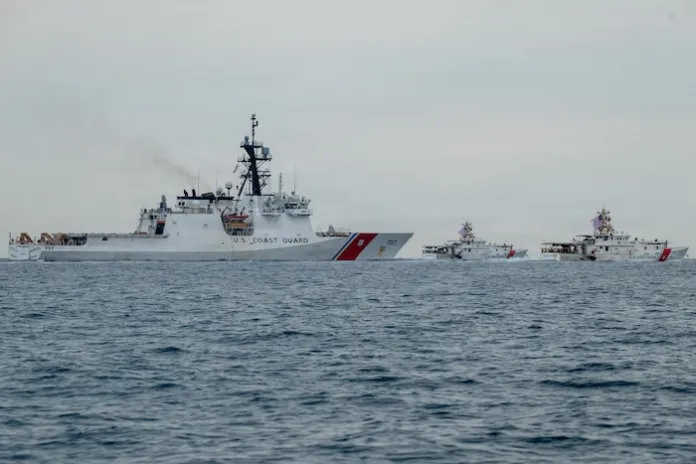
The U.S. Coast Guard is evaluating whether to station cutters in Panama as one component of the military’s broader effort to crack down on cartel activity throughout the Western Hemisphere.
The commandant of the Coast Guard, Adm. Kevin Lunday, directed Vice Adm. Jo-Ann Burdian, the commander of the Atlantic Area Coast Guard, to review the possible creation of a Western Hemisphere Expeditionary Cutter Squadron in April.
While the order to move forward with the plan has not yet been given, Burdian told the Washington Examiner that if it does get approved, “We’ve been directed to have those forces in place by the end of the calendar year. So, we are looking toward a couple of final details, but they have not yet been approved or decided upon. So, we’re still in that planning process.”
Earlier this year, the Coast Guard held a training with Panama and 17 other partner nations called PANAMAX 2026, and it “showed us the value of having cutters permanently in the space down there,” Burdian added.
U.S. and Panamanian service members work together to secure a simulated drug trafficking boat during the Distinguished Visitor Day demonstration at Panama City, Panama, Aug. 13, 2026. PANAMAX 2026 seeks to improve interoperability and strengthen collective capacity to conduct complex multinational and all-domain operations to ensure the free flow of commerce through the Panama Canal and maintain security and stability in the region. (U.S. Air Force photo by Staff Sgt. Ethan Sherwood)
" data-image-caption="
U.S. and Panamanian service members work together to secure a simulated drug trafficking boat during the Distinguished Visitor Day demonstration at Panama City, Panama, Aug. 13, 2026. PANAMAX 2026 seeks to improve interoperability and strengthen collective capacity to conduct complex multinational and all-domain operations to ensure the free flow of commerce through the Panama Canal and maintain security and stability in the region. (U.S. Air Force photo by Staff Sgt. Ethan Sherwood)
" data-large-file="https://www.washingtonexaminer.com/wp-content/uploads/2026/10/Panamax-2026.jpg?w=696" src="https://www.washingtonexaminer.com/wp-content/uploads/2026/10/Panamax-2026.jpg" alt="U.S. and Panamanian service members work together to secure a simulated drug trafficking boat." class="wp-image-4763885" srcset="https://www.washingtonexaminer.com/wp-content/uploads/2026/10/Panamax-2026.jpg 700w, https://www.washingtonexaminer.com/wp-content/uploads/2026/10/Panamax-2026.jpg?resize=300,200 300w, https://www.washingtonexaminer.com/wp-content/uploads/2026/10/Panamax-2026.jpg?resize=150,100 150w, https://www.washingtonexaminer.com/wp-content/uploads/2026/10/Panamax-2026.jpg?resize=696,464 696w" sizes="(max-width: 700px) 100vw, 700px">
U.S. and Panamanian service members work together to secure a simulated drug trafficking boat during the Distinguished Visitor Day demonstration at Panama City, Panama, Aug. 13, 2026. (U.S. Air Force photo by Staff Sgt. Ethan Sherwood)
Panama is strategically located between Costa Rica and Colombia and has access to both the Caribbean Sea and the Eastern Pacific Ocean.
“I think the nice thing about [possibly] establishing the ECS in Panama is you can really go anywhere in the region from Panama, and when we allocate assets to a combatant commander, we sort of rely on them to work with us on where they ought to operate. I’m not sure we would need to station or establish additional squadrons elsewhere in the region to support the region in the way that they need,” she explained.
“We operate globally, but we’re typically home-ported in the United States, and for the first time this year, we’ll have a six-cutter squadron that’s stationed between Subic (Philippines) and Singapore and the Western Pacific, and are [thinking about] duplicating that expeditionary cutter model here in the Western Hemisphere,” Burdian added.
The Trump administration has prioritized defense of the Western Hemisphere, which in practice has meant a whole-of-government approach: the State Department designated several cartels as foreign terrorist organizations and the Treasury Department’s Office of Foreign Assets Control has sanctioned several entities connected to those cartels, while the military strengthened its partnerships with regional partners and began using lethal force.
The Trump administration’s National Security Strategy, released in December 2025, states its goal is to “ensure that the Western Hemisphere remains reasonably stable and well-governed enough to prevent and discourage mass migration to the United States,” and it wants the regional governments to “cooperate with us against narco-terrorists, cartels, and other transnational criminal organizations.”
Burdian said her review “really is the commandant responding to that demand signal, understanding that the landscape of force allocation to the Department of War has changed, given where the conflicts are, where the priorities are, and directing me as the operational commander in the Western Hemisphere theater to say, ‘Hey, take a look at establishing something like that in the Western Hemisphere.’ So, that’s what’s ongoing now.”
The Coast Guard used to be the primary entity involved in stopping the maritime drug trade, but it’s now paired with U.S. Southern Command, strengthening its military-to-military relationships with more than a dozen Central and South American countries.
In September 2025, U.S. forces began targeting suspected drug boats in the Caribbean Sea and Eastern Pacific Ocean lethally. These strikes have killed approximately 230 mariners since the campaign began. In late July, a Pentagon inspector general report revealed that U.S. Southern Command estimated it spent roughly $820 million on the mission.
U.S. forces have also carried out several interdictions of logistic support vessels off Ecuador’s coast since late August.
“The fact that the cartels, several of the cartels in the region, have been designated as terrorist organizations now gives the joint force and the national security apparatus in the United States more authority to act in our own best interest, where perhaps we’ve been constrained before,” said Gen. Joseph Ryan, Western Hemisphere Command’s commanding general. “Make no mistake, these are designated terrorist organizations. They are global economic syndicates that have created a business model that is survivable, has survived over decades, and will continue to survive unless we disrupt the economic side of it. It is not just drugs.”
Burdian and Ryan appeared on a panel with Gen. Luis Cardozo, the Colombian army attache to the U.S., at AUSA, the annual Army conference in Washington, D.C., on Monday.
“To confront [the cartels] requires a system, a robust system, because these groups have been able to insert themselves in the society in a very important way, and they feed themselves within there,” Cardozo said through a translator. “That’s why it’s fundamental that when those groups cross the border, they don’t find a safe space to sustain themselves there, and that’s precisely what we see with this cooperation with this alliance. That those criminal groups don’t have a place to find a safe space to hide.”
The U.S. military also carried out an airstrike in June in coordination with Venezuela targeting Hector Rusthenfold Guerrero Flores, the leader of Tren de Aragua, a U.S.-designated terrorist organization, and carried out a joint U.S.-Ecuadorian operation targeting a training camp used by the Comandos de la Frontera. Panama has allowed the U.S. to conduct jungle training and other exercises on its soil, and El Salvador has opened bases to armed U.S. aircraft. Guatemala has said it wants “to lead, with U.S. assistance, active military operations” against U.S.-designated terrorist organizations within the country, as well.
OPERATION SOUTHERN SPEAR LATEST PRICE TAG IS UP TO $820 MILLION
Not only do the cartels traffic drugs, but many have also begun mining illegally to exploit natural resources.
“They also use illegal mining, and I know in many countries in Latin America, this is happening also because they found in gold another source of finances. They destroy the environment, destroy the habitat of the citizens, and achieve great resources so they can finance themselves,” Cardozo added.
Continue reading...
[ H/T Washington Examiner ]