





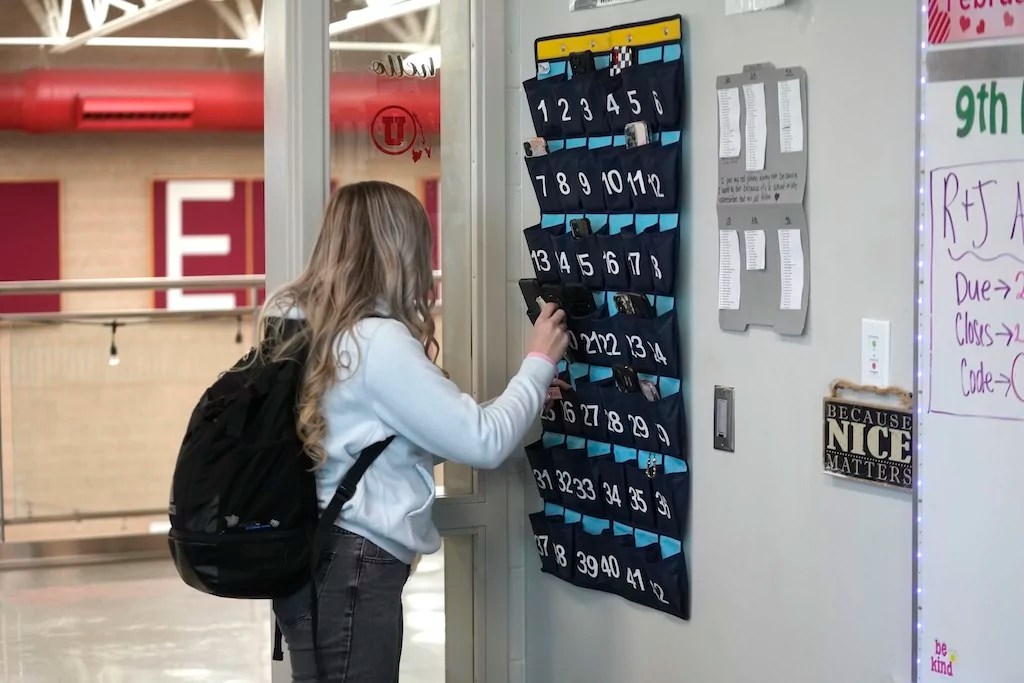
On Oct. 1, Sens. Mark Kelly (D-AZ) and Tom Cotton (R-AK) introduced a bipartisan bill aimed at keeping phones out of the hands of children while in the classroom. According to Kelly’s press release, the Unplugged Schools Grant Act “would establish a federal grant program for states that adopt policies prohibiting students from possessing or using personal electronic devices during school hours. The funding would help schools put those policies into practice, including by paying for secure storage options such as lockers, lock boxes, or phone pouches.”
This is a welcome step in an age when technology dominates so much of our lives. It is especially important in the classroom, where screens now compete for students’ attention at nearly every moment. But removing electronic devices and focusing on learning only addresses part of the problem. The bigger challenge is teaching children and young adults to navigate a world in which screens are ever-present. They need to learn how to socialize, occupy themselves, and, yes, be bored in this tech-fueled world.
There is no need for K-12 students to have a phone close by during school hours. And according to Kelly’s press release, parents will still be able to contact their children when needed for urgent or personal matters.
A ninth grader places her cellphone in to a phone holder as she enters class at Delta High School, Friday, Feb. 23, 2024, in Delta, Utah. Most schools have policies regulating student cellphone use at school. However, the reality is students don’t always follow the rules and schools enforce them sporadically. (AP Photo/Rick Bowmer, File)
" data-large-file="https://www.washingtonexaminer.com/wp-content/uploads/2025/01/school-cell-phone-bans-dc.webp?w=1024" src="https://www.washingtonexaminer.com/wp-content/uploads/2025/01/school-cell-phone-bans-dc.webp?w=1024" alt="A ninth grader places her cellphone in to a phone holder as she enters class at Delta High School, Friday, Feb. 23, 2024, in Delta, Utah. Most schools have policies regulating student cellphone use at school. However, the reality is students don’t always follow the rules and schools enforce them sporadically. (AP Photo/Rick Bowmer, File)" class="wp-image-3302903" srcset="https://www.washingtonexaminer.com/wp-content/uploads/2025/01/school-cell-phone-bans-dc.webp 1024w, https://www.washingtonexaminer.com/...school-cell-phone-bans-dc.webp?resize=300,200 300w, https://www.washingtonexaminer.com/...school-cell-phone-bans-dc.webp?resize=768,512 768w" sizes="(max-width: 1024px) 100vw, 1024px">
A ninth grader places her cellphone into a phone holder as she enters class at Delta High School on Friday, Feb. 23, 2024, in Delta, Utah. (Rick Bowmer/AP Photo, File)
Children and adults alike fear that a phone-free span of time equals boredom. But unstructured class time shouldn’t be spent entertaining oneself while transfixed to a glowing screen. And unsurprisingly, boredom is good for you. It’s not necessarily something to avoid. Learning to navigate boredom in a healthy manner has a host of benefits. The information overload is turned off. We are inundated with data anytime we open our phones.
Boredom also naturally fosters creativity. It spurs reflection. When the mind can rest from the media onslaught, it can focus its energy on other things. Boredom also helps with something far too many struggle with at present: the ability to focus.
A phone-free classroom requires students to interact with their peers in a healthy manner. Without the distraction of a device, students must engage in old-fashioned, tech-free problem-solving. They must learn to navigate their world, engage with others, and regulate their emotions. There is no sinking back into a comfortable cocoon and staring at a phone. Basic social skills are necessary for life. And they are certainly not formed through social media engagement and competing for internet likes and reposts.
Of course, collecting phones at the beginning of the school day does not undo screen dependence or teach children and teenagers to use technology responsibly. Just as with other things, learning extends far beyond the classroom doors. Parents, along with educators, have to model good behavior when it comes to technology use. Boundaries must exist. Parents need to encourage face-to-face interactions. Parents and educators alike also need to make it clear that every idle moment doesn’t need to be filled with internet usage. The work begins at school, and positive outcomes in schools should encourage the creation of phone-free periods at home.
Technology is here to stay. And the argument can be made that our dependence on it will only increase, especially with the rise of artificial intelligence. We shouldn’t be scared of technology. We also shouldn’t behave as though we can’t function without it. We should all be able to put our phones down and step away from computers. That is an important lesson for this generation, which began using technology at an early age. Meaningful days in and out of the classroom aren’t ones filled to the brim with a constant stream of notifications, likes, or entertainment. Learning and having substantive discussions away from screens are essential. Experiencing life in raw and real ways has profound effects on young people. It helps to shape them in ways a computer cannot and should not.
In his book The Anxious Generation, author Jonathan Haidt says, “Experience, not information, is the key to emotional development.”
NEW JERSEY SIGNS LEGISLATION BANNING CELLPHONES IN SCHOOLS
He also writes, “This is the great irony of social media: the more you immerse yourself in it, the more lonely and depressed you become.”
We want children who can navigate both the classroom and beyond in a healthy manner. Encouraging phone-free classrooms through a bill that offers grants is a positive step in the right direction. Children deserve the chance to experience life to the fullest. This is a good place to start.
Continue reading...
[ H/T Washington Examiner ]