







Bliss was it in the late 1970s to be alive, as Wordsworth almost said, but to be a domestic terrorist was very heaven. Just ask Indianapolis’s Tony Kiritsis, who, in February of 1977, parlayed an ideological kidnapping into an unlikely turn as a folk hero. Children may wonder how America came to include millions who cheer, say, the assassination of UnitedHealthcare CEO Brian Thompson. The Kiritsis saga is part of the answer.
Perhaps because his story is so obviously redolent of present times, the Greek-American has received considerable attention in the last two years. A 2025 treatment of his crime, Gus Van Sant’s feature film Dead Man’s Wire, debuted at the Venice Film Festival and opened this January widely to some acclaim. Now, streaming service MGM+ has released the eight-episode American Hostage to go over the same ground.
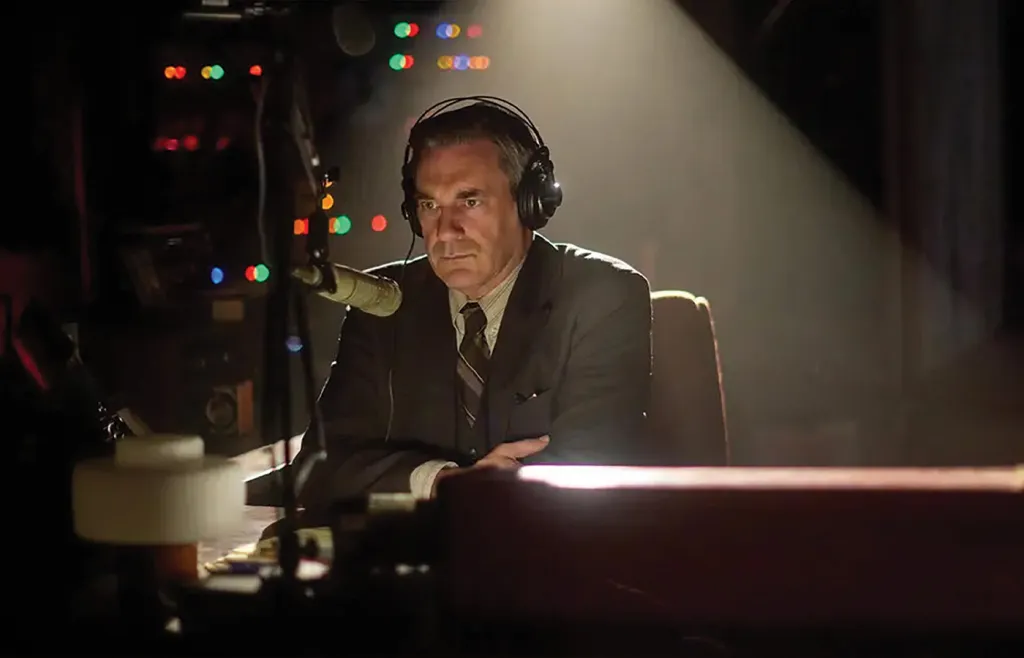
What Kiritsis actually did is the subject of the propulsive series premiere. Played by a twitchy Giovanni Ribisi, Kiritsis takes captive banker Richard “Dick” Hall (Kristoffer Polaha) for the sin of foreclosing on an undeveloped commercial property. Eager to share his grievances, the kidnapper contacts local radio host Fred Heckman (Jon Hamm) and demands an on-air interview. What follows is an uneven but occasionally exhilarating look at journalistic ethics, capitalist excess, and the vagaries of public opinion. More than anything, however, it is an examination of how easily a reporter’s career can perch between crisis and triumph. Call the narrative-structure police: Heckman effortlessly displaces Kiritsis as star of this ostensibly true-crime drama.
Jon Hamm in “American Hostage.” (Steven Ackerman/MGM+/Sony Pictures Television)
" data-large-file="https://www.washingtonexaminer.com/wp-content/uploads/2026/10/LA.TV_.110426.jpg?w=1024" height="658" width="1024" src="https://www.washingtonexaminer.com/wp-content/uploads/2026/10/LA.TV_.110426.jpg?w=1024" alt="Jon Hamm in "American Hostage." (Steven Ackerman/MGM+/Sony Pictures Television)" class="wp-image-4785535" srcset="https://www.washingtonexaminer.com/wp-content/uploads/2026/10/LA.TV_.110426.jpg 1400w, https://www.washingtonexaminer.com/wp-content/uploads/2026/10/LA.TV_.110426.jpg?resize=300,193 300w, https://www.washingtonexaminer.com/wp-content/uploads/2026/10/LA.TV_.110426.jpg?resize=768,494 768w, https://www.washingtonexaminer.com/wp-content/uploads/2026/10/LA.TV_.110426.jpg?resize=1024,658 1024w" sizes="(max-width: 1024px) 100vw, 1024px">
Jon Hamm in “American Hostage.” (Steven Ackerman/MGM+/Sony Pictures Television)
That turnabout is due primarily to the quality of the respective lead performances. As Heckman, an upright newsman stumbling onto — then into — a once-in-a-lifetime story, Hamm summons a gravitas that quickly puts Mad Men’s Don Draper out of mind. Ribisi, meanwhile, has been relying on the same tricks since his 1995 Friends appearance as Phoebe Buffay’s dimwitted brother. Among the 51-year-old’s actorly tools — funny voices, jerky physicality, and an “aw shucks” mien — are none that tend to impress your humble critic. Then again, the Hamm-Ribisi matchup is hardly a fair fight. The former’s character is a complicated grown-up with capacious professional and personal worlds. The latter’s is a tedious man-child who spends nearly the entire series holed up in a room.
Nevertheless, American Hostage takes care to illustrate the sour admiration with which a disgruntled public greets Kiritsis. By the end of the third episode, well-wishers have set up a shrine to the man, complete with flowers and a six-pack of PBR. By the fourth, the kidnapper is exchanging live pleasantries with callers to Heckman’s show, including one who proposes that Kiritsis is owed not only his land back but the money he might have made from opening a restaurant there. If (confessed) Thompson murderer Luigi Mangione is streaming the series from his Brooklyn jail cell, he is surely amused to see another scoundrel basking in the glow of fame. But the joke is on him and his predecessor: The minute “Free Tony” T-shirts sell out, fickle shoppers begin snatching “I Heart Dick” merchandise from the shelves.
The caprice of both crowds and individuals is at the center of American Hostage’s thematic vision. Bored listeners may want Dick Hall’s head today, but they are just as likely to demand Kiritsis’s tomorrow. Even Heckman can’t seem to decide whether the hostage-taker is foe or friend, collaborating with FBI agent Cormac McNally (Jonathan Tucker) one minute, then castigating the fed for misleading Kiritsis the next. Or perhaps Hamm’s character is merely overwhelmed by his own change of mind. A figure of such benevolence that he pulls the cheese out of mousetraps, Heckman violates one ethical tenet after another as his initial on-air interview gives way to full embroilment in the story.
The series dramatizes Heckman’s turmoil in two compelling ways. The first, an intriguing professional-rivalry subplot, sees right-hand man Ben Hairston (The Good Place’s William Jackson Harper) seize control of the news team as our hero goes from neutral correspondent to de facto Kiritsis advisor. The second, a far more personal subplot, places Heckman’s marriage in danger as family secrets become the currency with which Kiritsis’s compliance can be bought. In both cases, Heckman is plainly betraying his previous values. Hairston is correct, for instance, when he insists that journalists “lose our way … the moment we think we’re doing something to save someone’s life.” Yet that bloodless standard means little when things get bloody. Does Heckman err? Of course he does. So, God willing, would we all.
There is, too, the matter of American Hostage’s setting: not just comparatively sleepy Indianapolis but the tactically unsophisticated world of 1970s law enforcement. Throughout the series, cops stand around confused and seem perfectly glad to defer to Heckman’s amateur judgment. Introduced to the aforementioned Agent McNally, one bumbling lawman mishears “profiler” as “pro-lifer.” If Heckman is wrong to take charge of the situation, most viewers will be inclined to look the other way. The man is surrounded by idiots.
HBO’S WAR, WITH DOMINIC WEST, IS A CLEVER LEGAL DRAMA
As it turns out, the ’70s seem to have been a lamentably good time to commit political crimes. One need barely know one’s history to recall that the real-life Kiritsis would have watched Carlos the Jackal and other OPEC hostage-takers get away clean months earlier, to name just one such televised example among many. When, in the course of the series, Indianapolis prosecutors offer Kiritsis full immunity to release Hall, we readily believe it. That’s just how things were done back then.
If the story doesn’t quite work out like that, only the burn-it-all-down radicals in our midst will complain. Ignore them. Kiritsis’s saga may have produced a decent TV show, but the man was a villain.
Graham Hillard is the TV critic for the Washington Examiner magazine.
Continue reading...
[ H/T Washington Examiner ]