









Charles Murray, a scholar at the American Enterprise Institute, told a packed Andrew W. Mellon Auditorium in Washington this week that social science has become redundant. It was a striking assertion, not least because Murray is a social scientist, one of the finest of our time.
He made his remarks at the Encounter Books annual gala where he accepted the Jeane Kirkpatrick Prize for Academic Freedom. Goodness knows, he has demonstrated the merits of academic freedom over many decades of a career speaking frankly and incisively, but also with charity, about the thorniest of issues of race, sex, and genetics.
His point about the redundancy of social science was that all the really big questions about how humankind should conduct itself to thrive were answered centuries or millennia ago by such varied thinkers as Aristotle and Adam Smith. Today’s studies and controversies on these matters in academia are, in the scheme of things, merely “footnotes.”
Among the Aristotelian virtues Murray singled out as necessary for human fulfillment is that of self-restraint, which is a long way from being the most obvious feature of modern culture. This idea fit the theme of the other main speech delivered from the Mellon stage, which came from Larry Arnn, president of Hillsdale College, who was awarded the Encounter Prize for Advancing American Ideals.
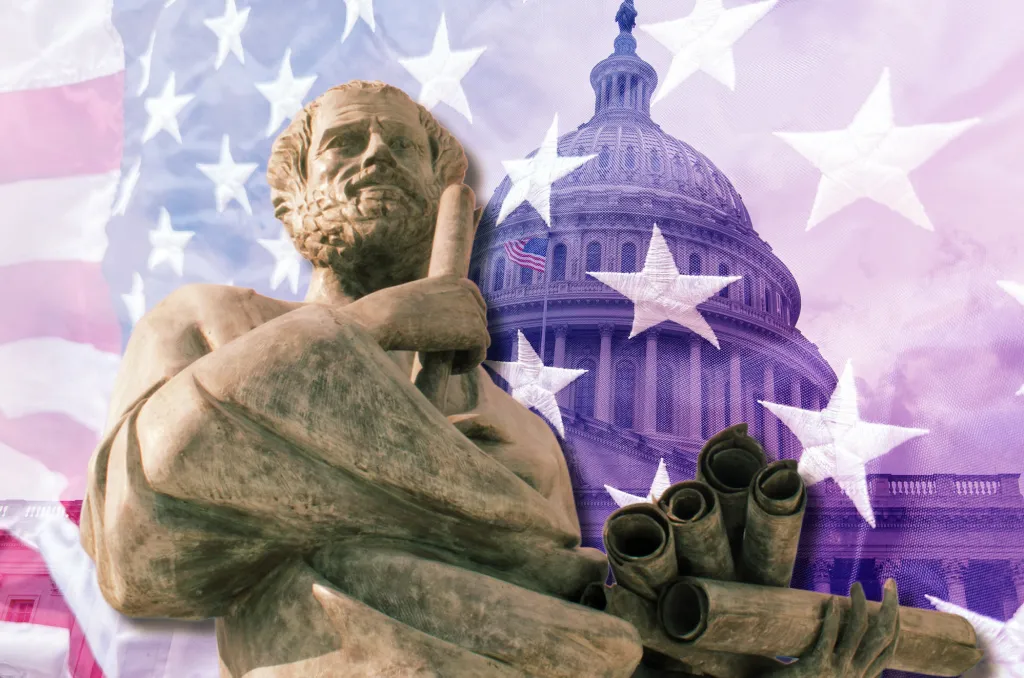
(Washington Examiner illustration; Getty Images)
" data-large-file="https://www.washingtonexaminer.com/wp-content/uploads/2026/10/aristotle_midterms.jpg?w=1024" height="679" width="1024" src="https://www.washingtonexaminer.com/wp-content/uploads/2026/10/aristotle_midterms.jpg?w=1024" alt="Aristotle midterms hugo gurdon columm" class="wp-image-4785556" srcset="https://www.washingtonexaminer.com/wp-content/uploads/2026/10/aristotle_midterms.jpg 1997w, https://www.washingtonexaminer.com/wp-content/uploads/2026/10/aristotle_midterms.jpg?resize=300,199 300w, https://www.washingtonexaminer.com/wp-content/uploads/2026/10/aristotle_midterms.jpg?resize=768,509 768w, https://www.washingtonexaminer.com/wp-content/uploads/2026/10/aristotle_midterms.jpg?resize=1024,679 1024w, https://www.washingtonexaminer.com/...26/10/aristotle_midterms.jpg?resize=1536,1018 1536w" sizes="auto, (max-width: 1024px) 100vw, 1024px">
(Washington Examiner illustration; Getty Images)
Arnn pointed out that restraint was essentially the same thing as self-government, and this pointed to the fact that America and its Declaration of Independence therefore embody the Aristotelian virtue. “You cannot separate personal rights from duties,” he told me, enlarging on the theme of his speech, adding, “Nature commands that if you are given a thing” — an ability, skill, or power — “you are supposed to use it. This capacity we have to choose and to know … and our incredible capacity to communicate” give us not merely the right to think, understand, and choose, but also the imperative to do so.
Humans are made for self-government, not for subservience to kings or commissars. America has many faults, but the theory of the nation — democracy tempered by debate, modesty, and wisdom — is the proper expression of our nature and the appropriate realization of our social instinct. “In order to create or achieve anything,” Arnn said, “we have to do it” ourselves rather than slough it off on to others. “The principles of our country are built on recognition of that fact … the fact that we have the capacity and we have a necessity to use it.”
EL SAYED AND THE ART OF CONNING VOTERS
Between them, Murray and Arnn made the case for the interconnected virtues of tradition, reason, order, appropriateness, utility, and beauty. Against these, particularly in the final days before the midterm elections, are demagogic politicians who promise wrenching disorder, excess, dishonesty, and ugliness. The Democrats’ trickery, fielding decoy candidates in Alaska in a desperate bid to retake the Senate majority, comes to mind.
Such people have always been with us, just as much as the great thinkers. As Edmund Burke, the father of political conservatism, wrote seven years before the birth of the United States, “It is a general, popular error, to imagine the loudest complainers for the public to be the most anxious for its welfare. If such persons can answer the ends of relief and profit to themselves, they are apt to be careless enough about either the means or the consequences.’
Continue reading...
[ H/T Washington Examiner ]