






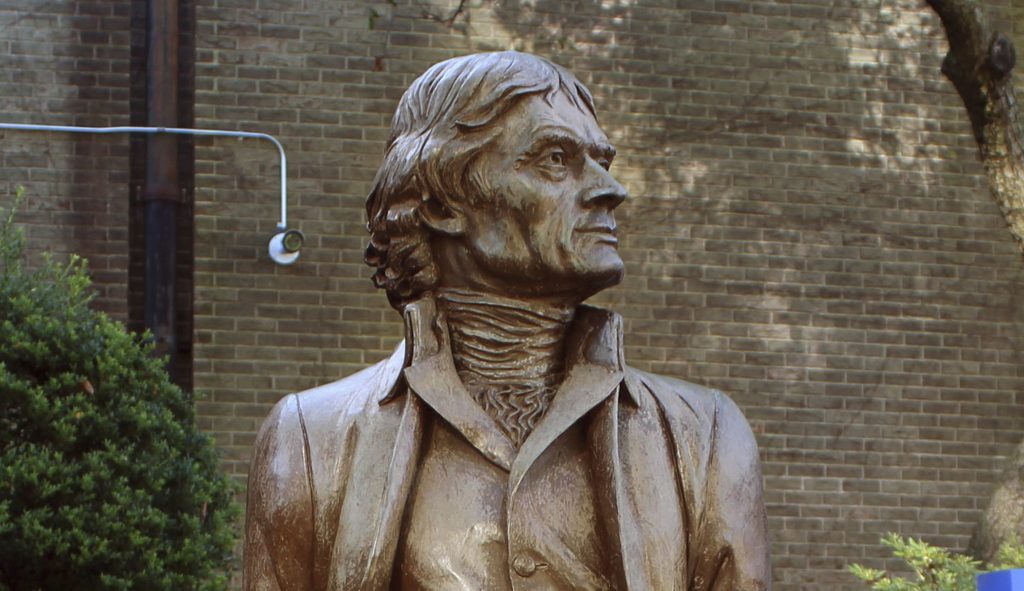
On the Seine’s left bank in the 7th Arrondissement stands a 10-foot-tall bronze statue, not to a French hero, but to Thomas Jefferson. The author of the Declaration of Independence and the United States of America’s third president served as a diplomat to France between 1784 and 1789. He was an admirer of France, even of the Revolution, before denouncing the atrocities committed by Robespierre and the Reign of Terror.
The statue was dedicated on July 4, 2006, commemorating the 230th anniversary of American Independence.
Twenty years later, France is, once again, in turmoil with destructive nationwide riots, initially sparked by student protests and hijacked by leftist and anarchist organizations. And twenty years later, as America celebrates its 250th, Jefferson’s reputation has soured among his own countrymen.
For President Donald Trump and Republicans, the French riots are a warning: that open borders and failure to assimilate migrants, who “despise everything” about Christianity and Western Civilization, will eventually lead to chaos. The U.S. needs to address immigration lest it reap similar results.
However, the 2020 George Floyd “mostly peaceful” protests happened, costing more than $1 billion in property damage, so Americans are capable of destructive tendencies like the French. Policies alone won’t reinvigorate America’s record-low, dwindling national pride, malaise, and anxiety about the future.
A more spiritual remedy is required, and the path forward lies through reconciling with Jefferson.
More than any other Founding Father, Jefferson embodies the country’s original sin and underlying hypocrisy: The same man who championed “all men are created equal” owned slaves, whom he seldom emancipated, unlike George Washington. Moreover, despite seeing slavery as a “moral depravity” and contrary to natural law, he still saw blacks as inferior to whites, and he foresaw slavery as the defining issue that could destroy the nation he helped found.
Perhaps his greatest offense is fathering six children with his slave, Sally Hemmings.
During Woke 1, which Rep. Alexandria Ocasio-Cortez (D-NY) shruggingly laughed off as being simply “crazy,” Jefferson’s nuanced and contradictory nature endured heightened scrutiny. Indeed, he has been at the epicenter of wokeism’s critiques of the American founding. In 2020, protestors tore down statues of him; the New York City Council unanimously removed his statue from its chamber in 2021; and years earlier, in 2016, University of Virginia students and faculty petitioned to not quote him, the university’s founder.
Who knows what Woke 2.0 has in store, but the eve of the 2026 Election is indicating a wider reckoning. Democratic candidates have openly embraced socialism and anti-Americanism or won positions, most prominently New York City Mayor Zohran Mamdani in 2025. It’s not without cause. For a majority of citizens, the American Dream is perceptibly “out-of-reach.” Meanwhile, millennials and Gen Z are grappling with debt, underemployment, market instability, and limited housing affordability. Against this backdrop, favorability of socialism and communism has grown, with 38% of Gen Z expressing favorable views — up from 18% in 2010 among similar age groups.
Previous generations have failed to teach basic civics and offer answers to these crucial questions: Why is America good? Why is it worth preserving? Why is a man like Jefferson admirable?
Blessed Fulton Sheen, who was recently beatified by the Catholic Church on Sept. 24, understood how waning national pride requires a spiritual remedy. During a 1960s TV broadcast titled Quo Vadis, America?, he presciently juxtaposed the architects of the American Revolution and French Revolution, pitting Jefferson against Louis de Saint-Just. The former was the “antecedent of all Americans today who believe in self-government,” expressing in the nation’s founding document the dignity of man and the source of rights. The latter, meanwhile, was the author of terror, which confiscated property along with perpetuating the “destruction of life, rights and liberties.”
As Sheen summarized, the American Revolution recognized God as Creator, whom Jefferson believed in; the French Revolution, in favor of the secular Supreme Being, rejected the Christian virtue of patriotism — which, derived from the word pietas, means love of God, neighbor and country. “When one goes out,” Sheen warned, “all go out.”
As Sheen saw then, Jefferson is central to understanding America and loving the nation — and understanding how incompatible America and communism truly are.
At its core, wokeism, an offshoot of Marxist postmodernist thought, is destruction: a rejection of the prior order. As evidenced by cancel culture, wokeism doesn’t believe in mercy or forgiveness. It appeals to seeing the worst in neighbors rather than virtues. Moreover, wokeism’s solution is more government intervention, which contrasts with the virtues of limited and self-government. If the democratic socialist candidates attain the levers of power, Americans should expect riots a la France.
However, to borrow from Scripture, looking back at sin turned Lot’s wife into salt. The same applies to nations: We, too, can become calcified by only ruminating on flaws and the past. Jefferson, conversely, was an optimist, opining to John Adams in 1816, “I like the dreams of the future better than the history of the past.”
FRANCE ROCKED BY ANTI-GOVERNMENT PROTESTS AND RIOTS: WHAT TO KNOW
True progress in America needs a reconciliation with Jefferson’s sins — while also lauding his virtues and actions. He established a nation that has since been a beacon of freedom, and the Declaration has been the rallying cry for oppressed people, at home and abroad, because it understands a sacred truth: All men are created equal.
Though Jefferson failed to fully live up to that call, it nevertheless remains America’s primary hope. The horizon to which the nation must continue striving toward. Reviving patriotism will require an understanding of civics and an address to economic concerns, but first it must begin with a radical acceptance and forgiveness of Jefferson for his flaws and, by extension, of the nation itself. Only then can we, as a country, see the goodness of America’s principles and virtues: the ones Jefferson enshrined in its founding document 250 years ago.
Continue reading...
[ H/T Washington Examiner ]