




Guest Post by Peter Reagan

Americans love a good story about somebody betting on himself.
One of my favorites involves FedEx founder Fred Smith.
Back when Federal Express was still struggling to get off the ground, the company reportedly found itself with just $5,000 in the bank – not enough to cover a roughly $24,000 fuel bill. Smith had already been turned down for additional funding. So instead of flying home, he went to Las Vegas.
And gambled the company’s last $5,000 playing blackjack.
That sentence makes me cringe every time I read it.
Fortunately for Smith, he came back with $27,000. It wasn’t enough to solve FedEx’s problems, but it bought the company a little more time. Smith later described the money less as a solution than as a sign that things might turn around.
They certainly did.
Today, that story gets told as an example of entrepreneurial nerve.
But imagine it had gone the other way. Think, for a moment, about how many other entrepreneurs tried exactly the same strategy and lost. You won’t hear their stories, though. Because they didn’t get famous.
That’s the thing about a bet: No matter how smart you are, how much research you’ve done or how strongly you believe in the outcome, you don’t actually know how it ends.
Which brings me to a much, much larger bet.
The Wall Street Journal recently called the artificial intelligence buildout “the biggest economic bet in U.S. history.”
That isn’t just colorful language.
Economist Stijn Van Nieuwerburgh estimates investment in data centers, power systems, networking infrastructure, specialized chips and other AI-related equipment will total an astonishing $10.3 trillion from 2025 through 2032. That works out to an average of 3.63% of U.S. GDP every year.
Put into historical context, that’s where things get really remarkable. Take a look:
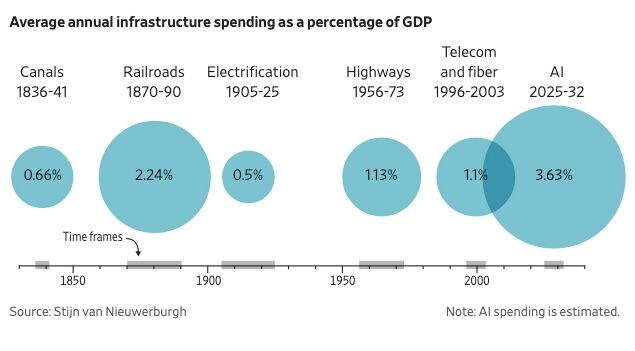
Image via WSJ
These are the biggest infrastructure projects in American history.
The construction of the interstate highway system? About 1.13%. Telecommunications and fiber during the dot-com boom? About 1.1%. The projected AI buildout: 3.63%.
In other words, relative to the size of the economy, America is preparing to spend far more on AI infrastructure than it did building the railroads, highways or telecommunications networks that fundamentally reshaped the country… after (in many cases) bankrupting millions of investors.
Now, that doesn’t mean the money is being wasted.
Those earlier infrastructure booms changed America for the better. Railroads connected markets. Highways transformed transportation and commerce. Telecommunications infrastructure eventually became part of the foundation of everyday life.
AI could prove equally transformative.
But I think there’s another lesson hiding in those historical comparisons:
A technology can change the world and still cost too much money, too quickly.
Those two ideas aren’t contradictory.
I’m not an AI luddite. I’m also not going to tell you artificial intelligence is definitely a massive speculative bubble that’s about to burst.
AI is producing useful tools and becoming embedded in businesses throughout the economy. And the potential productivity gains are almost always described as “enormous,” even though we haven’t actually seen them yet.
The question isn’t Is AI useful? It’s this: What happens when so much of the economy starts depending on one new technology meeting extraordinarily high expectations?
That’s a different question.
And increasingly, it’s an important one because we’re beginning to pay some of the costs of the AI buildout before we know exactly how large the eventual payoff will be.
Federal Reserve Governor Michael Barr pointed to this problem recently.
Barr said the surge in AI-related investment has increased demand for certain high-tech goods, raising prices for businesses and consumers. He remains optimistic that AI will eventually increase productivity and allow the economy to grow faster without generating as much inflation.
There’s just one rather important problem:
We don’t know when those productivity gains will arrive.
Barr said AI-related demand, along with higher energy prices, has helped knock inflation progress “off course.” He argued that additional monetary-policy tightening may be needed to bring inflation back toward the Fed’s 2% target.
Fed Governor Lisa Cook raised a similar concern this week.
She called the inflationary pressure from the AI buildout one of her principal concerns for 2027, specifically pointing to the possibility that supply bottlenecks could linger even while everyone waits for AI’s promised productivity gains.
That’s worth thinking about.
The data centers have to be built before they generate their hoped-for economic benefits. The chips have to be manufactured, the electrical grid upgraded, the workers hired… The money has to be spent first, up front.
In other words, many of AI’s costs arrive today. The productivity payoff comes tomorrow – maybe.
And that gap matters.
You can see the problem particularly clearly with electricity.
Huge data centers require enormous amounts of power. Serving them can require new power plants, transmission lines and other grid infrastructure.
And that has led to an increasingly practical question: Who pays for it?
This week, the Senate considered legislation requiring state utility regulators to consider whether large electricity users such as data centers should bear the additional infrastructure costs required to serve them rather than shifting those costs onto ordinary households.
The proposal had already passed the House 417-3. It received 57 votes in the Senate, three short of the 60 required to advance.
There was disagreement over the legislation itself – some Democrats argued it didn’t go far enough to shield consumers, while Republicans described it as a way to hold data centers accountable for the costs they create.
But look past that political disagreement and notice what both sides were arguing about: How do we keep ordinary families from getting stuck with the bill?
That’s when an abstract $10.3 trillion technology buildout starts becoming a kitchen-table economic issue.
Maybe your family never buys an AI service.
Maybe you couldn’t name the company operating the nearest data center.
You still use electricity.
And if additional generating capacity and grid infrastructure have to be built to accommodate enormous new industrial demand, somebody eventually has to pay those costs.
That’s why I don’t think AI can be dismissed as simply another technology story anymore.
It has become a macroeconomic story.
Again, none of this means AI won’t succeed.
History gives us plenty of examples of genuinely revolutionary technologies accompanied by periods of excessive enthusiasm and overbuilding.
Consider railroads.
Nobody today would seriously argue that America’s railroad system wasn’t transformative. Railroads connected cities, reduced transportation costs, opened markets and helped build the modern U.S. economy.
But railroad investment also repeatedly went too far.
New York Fed economists have documented how enormous railroad investment booms contributed to financial instability during the 19th century. Railway Mania in Britain during the 1840s was built around extravagant expectations for a genuinely revolutionary technology.
Those expectations weren’t entirely wrong.
The railroads really did change the world.
That didn’t mean every railroad project made economic sense.
The New York Fed has made essentially the same observation about the American experience: Railroads powered tremendous economic growth, but they also required enormous amounts of upfront capital devoted to risky projects. Railroad investments that went wrong helped contribute to several 19th-century financial panics.
That’s the distinction I think matters today.
The question isn’t: Will AI change the world? It very well might. But it’s not a question we can answer in advance.
The better question is: Does AI changing the world guarantee that every trillion dollars we’re committing to the buildout today will eventually produce the economic payoff we’re expecting?
Those are very different propositions.
And here’s where this story gets much bigger than Silicon Valley.
Washington increasingly has reasons to hope AI delivers extraordinary economic growth.
When the national debt crossed $40 trillion, Treasury Secretary Scott Bessent said:
Reuters recently examined that strategy and described an AI-driven productivity boom as central to the hope that stronger economic growth can improve America’s fiscal position.
There is sound logic behind part of that idea.
A larger, more productive economy can generate more income and more tax revenue. Faster GDP growth can also make a given amount of government debt smaller relative to the overall economy.
I’d certainly rather have a rapidly growing economy than a stagnant one.
But growth doesn’t erase the underlying arithmetic.
The Congressional Budget Office currently projects federal debt held by the public will rise from about 101% of GDP in 2026 to 175% by 2056 under its extended baseline.
And here’s the part I find particularly sobering.
The CBO recently modeled what would happen if interest rates eventually ran just one percentage point higher than its baseline assumption.
Under that scenario, debt rises to 222% of GDP by 2056.
That’s an enormous difference from what sounds like a relatively small change.
Which brings us back to AI.
We are hoping AI generates higher productivity and faster economic growth.
At the same time, Fed officials are warning that today’s AI buildout is contributing to inflationary pressure.
Persistent inflation can make it harder for the Fed to lower interest rates. Higher borrowing costs, meanwhile, make an already difficult government-debt problem harder to manage.
That’s an awfully complicated chain of assumptions:
Could that work?
Absolutely. But I wouldn’t call it a sure thing…
And that’s really my point.
The problem isn’t AI, or even the $10.3 trillion projected buildout by itself.
The concern is concentration.
More economic growth is based on AI investment. More electricity infrastructure is being built around AI demand. Meanwhile, Fed officials are already considering AI’s effect on inflation.
And everyone’s hoping an AI-driven productivity boom can help a country struggling beneath an enormous and growing government debt burden.
The better AI performs, the easier some of these problems may become.
But the more we depend on that outcome, the greater the consequences if productivity arrives later than expected, costs run higher than forecast or the economic benefits simply aren’t as large as hoped.
Fred Smith’s famous trip to Las Vegas worked.
But I don’t think the lesson from that story is that betting everything is a brilliant financial strategy.
The lesson is that sometimes a big bet pays off.
Sometimes it doesn’t.
And when the future is uncertain, it makes sense not to have everything riding on a single outcome. That’s just another way of describing diversification.
The same principle applies to your personal savings. Physical precious metals offer one way to diversify a portion of your savings outside a chain of assumptions about new technology, corporate growth forecasts or government economic projections.
AI may transform the world. (I hope it does.)
But your family’s financial future doesn’t have to depend on America’s biggest economic bet going exactly according to plan.
The dollar buys less today than it did a year ago, a decade ago, a generation ago. That slide is the predictable result of endless printing and borrowing. Dr. Ron Paul believes the FED has the answer. But they’re keeping it to themselves. Fortunately, a new financial chart has publicly exposed their secret moves. See it for yourself: https://freekit.birchgold.com/lf/ro...D_v02a_article&placement=article&cid=rp_media
To learn more about how physical gold could help protect your retirement portfolio, click here to get your FREE info kit on Gold IRAs from Birch Gold Group. And now introducing a Crypto IRA to capitalize on the fastest growing market in the world.
Tweet
Continue reading...
[ H/T The Burning Platform ]
Americans love a good story about somebody betting on himself.
One of my favorites involves FedEx founder Fred Smith.
Back when Federal Express was still struggling to get off the ground, the company reportedly found itself with just $5,000 in the bank – not enough to cover a roughly $24,000 fuel bill. Smith had already been turned down for additional funding. So instead of flying home, he went to Las Vegas.
And gambled the company’s last $5,000 playing blackjack.
That sentence makes me cringe every time I read it.
Fortunately for Smith, he came back with $27,000. It wasn’t enough to solve FedEx’s problems, but it bought the company a little more time. Smith later described the money less as a solution than as a sign that things might turn around.
They certainly did.
Today, that story gets told as an example of entrepreneurial nerve.
But imagine it had gone the other way. Think, for a moment, about how many other entrepreneurs tried exactly the same strategy and lost. You won’t hear their stories, though. Because they didn’t get famous.
That’s the thing about a bet: No matter how smart you are, how much research you’ve done or how strongly you believe in the outcome, you don’t actually know how it ends.
Which brings me to a much, much larger bet.
America’s enormous bet on AI
The Wall Street Journal recently called the artificial intelligence buildout “the biggest economic bet in U.S. history.”
That isn’t just colorful language.
Economist Stijn Van Nieuwerburgh estimates investment in data centers, power systems, networking infrastructure, specialized chips and other AI-related equipment will total an astonishing $10.3 trillion from 2025 through 2032. That works out to an average of 3.63% of U.S. GDP every year.
Put into historical context, that’s where things get really remarkable. Take a look:
Image via WSJ
These are the biggest infrastructure projects in American history.
The construction of the interstate highway system? About 1.13%. Telecommunications and fiber during the dot-com boom? About 1.1%. The projected AI buildout: 3.63%.
In other words, relative to the size of the economy, America is preparing to spend far more on AI infrastructure than it did building the railroads, highways or telecommunications networks that fundamentally reshaped the country… after (in many cases) bankrupting millions of investors.
Now, that doesn’t mean the money is being wasted.
Those earlier infrastructure booms changed America for the better. Railroads connected markets. Highways transformed transportation and commerce. Telecommunications infrastructure eventually became part of the foundation of everyday life.
AI could prove equally transformative.
But I think there’s another lesson hiding in those historical comparisons:
A technology can change the world and still cost too much money, too quickly.
Those two ideas aren’t contradictory.
AI doesn’t have to fail to become an economic problem
I’m not an AI luddite. I’m also not going to tell you artificial intelligence is definitely a massive speculative bubble that’s about to burst.
AI is producing useful tools and becoming embedded in businesses throughout the economy. And the potential productivity gains are almost always described as “enormous,” even though we haven’t actually seen them yet.
The question isn’t Is AI useful? It’s this: What happens when so much of the economy starts depending on one new technology meeting extraordinarily high expectations?
That’s a different question.
And increasingly, it’s an important one because we’re beginning to pay some of the costs of the AI buildout before we know exactly how large the eventual payoff will be.
Federal Reserve Governor Michael Barr pointed to this problem recently.
Barr said the surge in AI-related investment has increased demand for certain high-tech goods, raising prices for businesses and consumers. He remains optimistic that AI will eventually increase productivity and allow the economy to grow faster without generating as much inflation.
There’s just one rather important problem:
We don’t know when those productivity gains will arrive.
Barr said AI-related demand, along with higher energy prices, has helped knock inflation progress “off course.” He argued that additional monetary-policy tightening may be needed to bring inflation back toward the Fed’s 2% target.
Fed Governor Lisa Cook raised a similar concern this week.
She called the inflationary pressure from the AI buildout one of her principal concerns for 2027, specifically pointing to the possibility that supply bottlenecks could linger even while everyone waits for AI’s promised productivity gains.
That’s worth thinking about.
The data centers have to be built before they generate their hoped-for economic benefits. The chips have to be manufactured, the electrical grid upgraded, the workers hired… The money has to be spent first, up front.
In other words, many of AI’s costs arrive today. The productivity payoff comes tomorrow – maybe.
And that gap matters.
Someone has to pay for all that electricity
You can see the problem particularly clearly with electricity.
Huge data centers require enormous amounts of power. Serving them can require new power plants, transmission lines and other grid infrastructure.
And that has led to an increasingly practical question: Who pays for it?
This week, the Senate considered legislation requiring state utility regulators to consider whether large electricity users such as data centers should bear the additional infrastructure costs required to serve them rather than shifting those costs onto ordinary households.
The proposal had already passed the House 417-3. It received 57 votes in the Senate, three short of the 60 required to advance.
There was disagreement over the legislation itself – some Democrats argued it didn’t go far enough to shield consumers, while Republicans described it as a way to hold data centers accountable for the costs they create.
But look past that political disagreement and notice what both sides were arguing about: How do we keep ordinary families from getting stuck with the bill?
That’s when an abstract $10.3 trillion technology buildout starts becoming a kitchen-table economic issue.
Maybe your family never buys an AI service.
Maybe you couldn’t name the company operating the nearest data center.
You still use electricity.
And if additional generating capacity and grid infrastructure have to be built to accommodate enormous new industrial demand, somebody eventually has to pay those costs.
That’s why I don’t think AI can be dismissed as simply another technology story anymore.
It has become a macroeconomic story.
We’ve seen this pattern before
Again, none of this means AI won’t succeed.
History gives us plenty of examples of genuinely revolutionary technologies accompanied by periods of excessive enthusiasm and overbuilding.
Consider railroads.
Nobody today would seriously argue that America’s railroad system wasn’t transformative. Railroads connected cities, reduced transportation costs, opened markets and helped build the modern U.S. economy.
But railroad investment also repeatedly went too far.
New York Fed economists have documented how enormous railroad investment booms contributed to financial instability during the 19th century. Railway Mania in Britain during the 1840s was built around extravagant expectations for a genuinely revolutionary technology.
Those expectations weren’t entirely wrong.
The railroads really did change the world.
That didn’t mean every railroad project made economic sense.
The New York Fed has made essentially the same observation about the American experience: Railroads powered tremendous economic growth, but they also required enormous amounts of upfront capital devoted to risky projects. Railroad investments that went wrong helped contribute to several 19th-century financial panics.
That’s the distinction I think matters today.
The question isn’t: Will AI change the world? It very well might. But it’s not a question we can answer in advance.
The better question is: Does AI changing the world guarantee that every trillion dollars we’re committing to the buildout today will eventually produce the economic payoff we’re expecting?
Those are very different propositions.
Washington is making the AI bet, too
And here’s where this story gets much bigger than Silicon Valley.
Washington increasingly has reasons to hope AI delivers extraordinary economic growth.
When the national debt crossed $40 trillion, Treasury Secretary Scott Bessent said:
Reuters recently examined that strategy and described an AI-driven productivity boom as central to the hope that stronger economic growth can improve America’s fiscal position.
There is sound logic behind part of that idea.
A larger, more productive economy can generate more income and more tax revenue. Faster GDP growth can also make a given amount of government debt smaller relative to the overall economy.
I’d certainly rather have a rapidly growing economy than a stagnant one.
But growth doesn’t erase the underlying arithmetic.
The Congressional Budget Office currently projects federal debt held by the public will rise from about 101% of GDP in 2026 to 175% by 2056 under its extended baseline.
And here’s the part I find particularly sobering.
The CBO recently modeled what would happen if interest rates eventually ran just one percentage point higher than its baseline assumption.
Under that scenario, debt rises to 222% of GDP by 2056.
That’s an enormous difference from what sounds like a relatively small change.
Which brings us back to AI.
We are hoping AI generates higher productivity and faster economic growth.
At the same time, Fed officials are warning that today’s AI buildout is contributing to inflationary pressure.
Persistent inflation can make it harder for the Fed to lower interest rates. Higher borrowing costs, meanwhile, make an already difficult government-debt problem harder to manage.
That’s an awfully complicated chain of assumptions:
- Spend trillions today
- Build the infrastructure now
- Pay the price of the added demand for power, equipment and labor
- Wait for productivity gains
- Hope those gains arrive quickly enough to increase economic growth
- And hope that stronger growth improves the nation’s fiscal position faster than rising debt and interest costs make it worse
Could that work?
Absolutely. But I wouldn’t call it a sure thing…
The real risk is concentration
And that’s really my point.
The problem isn’t AI, or even the $10.3 trillion projected buildout by itself.
The concern is concentration.
More economic growth is based on AI investment. More electricity infrastructure is being built around AI demand. Meanwhile, Fed officials are already considering AI’s effect on inflation.
And everyone’s hoping an AI-driven productivity boom can help a country struggling beneath an enormous and growing government debt burden.
The better AI performs, the easier some of these problems may become.
But the more we depend on that outcome, the greater the consequences if productivity arrives later than expected, costs run higher than forecast or the economic benefits simply aren’t as large as hoped.
Fred Smith’s famous trip to Las Vegas worked.
But I don’t think the lesson from that story is that betting everything is a brilliant financial strategy.
The lesson is that sometimes a big bet pays off.
Sometimes it doesn’t.
And when the future is uncertain, it makes sense not to have everything riding on a single outcome. That’s just another way of describing diversification.
The same principle applies to your personal savings. Physical precious metals offer one way to diversify a portion of your savings outside a chain of assumptions about new technology, corporate growth forecasts or government economic projections.
AI may transform the world. (I hope it does.)
But your family’s financial future doesn’t have to depend on America’s biggest economic bet going exactly according to plan.
The dollar buys less today than it did a year ago, a decade ago, a generation ago. That slide is the predictable result of endless printing and borrowing. Dr. Ron Paul believes the FED has the answer. But they’re keeping it to themselves. Fortunately, a new financial chart has publicly exposed their secret moves. See it for yourself: https://freekit.birchgold.com/lf/ro...D_v02a_article&placement=article&cid=rp_media
To learn more about how physical gold could help protect your retirement portfolio, click here to get your FREE info kit on Gold IRAs from Birch Gold Group. And now introducing a Crypto IRA to capitalize on the fastest growing market in the world.
Tweet
Continue reading...
[ H/T The Burning Platform ]



![REES-MOGG & TUCKER CARLSON; British Ruling Class Russophobia – Letter from Great Britain – [10-07-26]](https://substackcdn.com/image/fetch/$s_!OiIG!,w_1456,c_limit,f_auto,q_auto:good,fl_progressive:steep/https%3A%2F%2Fsubstack-post-media.s3.amazonaws.com%2Fpublic%2Fimages%2Fdce9e797-6b75-4aae-95ab-87397fe6dcf1_1045x689.png)