



Sir Jacob Rees-Mogg sat with Tucker Carlson and revealed the British Establishment to be economically exhausted, militarily depleted, and socially fractured, clinging to its crumbling imperial past.
Protect & Survive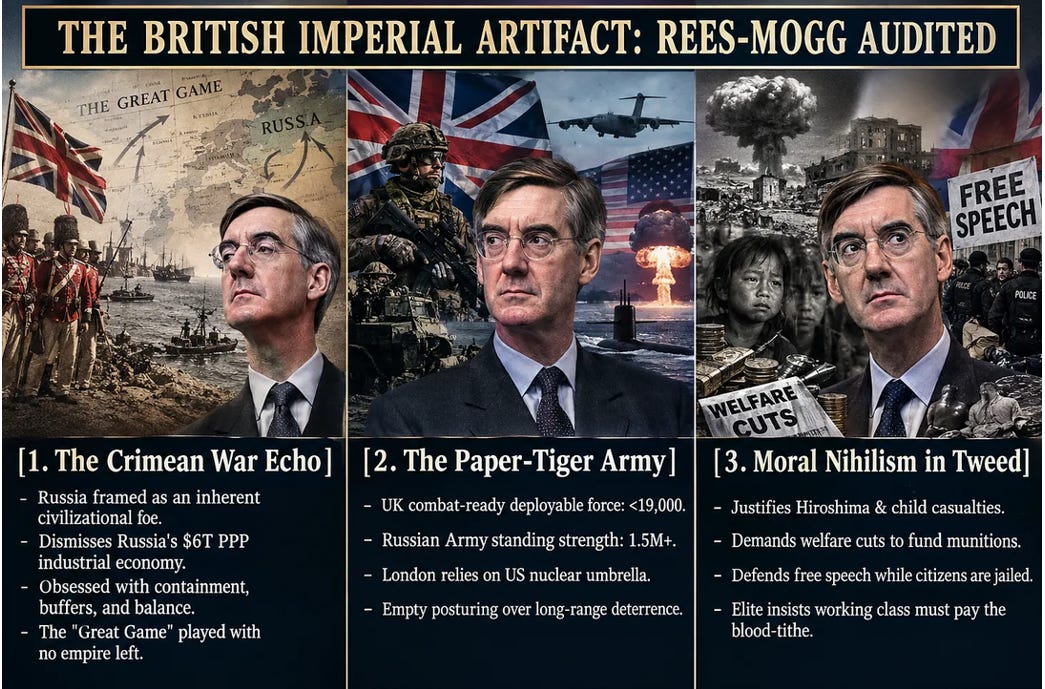
To observe Rees-Mogg defending a war of choice against a Eurasian nuclear power is to understand the historic psychology of the British ruling class: the aristocratic delusion of Palmerston, Cecil John Rhodes, Castlereagh, and the Crimean War, performed from the ruins of a post-industrial state.
The Great Game Redux: Two Centuries of Pathological Russophobia. When Carlson pressed Rees-Mogg on why a nuclear-armed power across the continent presents an existential threat to Britain, Rees-Mogg retreated into a familiar imperial lexicon: spheres of influence, failing states, revisionist empires, and the balance of power. This world-view is not a spontaneous reaction to events in Ukraine. It is the continuation of a two-century fixation that has driven British grand strategy since the 1830s.
Austrian’s Newsletter is a reader-supported publication. To receive new posts and support my work, consider becoming a free or paid subscriber.
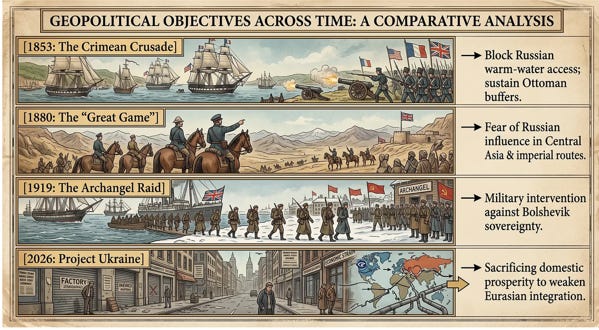
For two hundred years, the British ruling class has viewed Russia, not as a conventional sovereign state with its own security architecture, but as an existential competitor. From the Russophobia whipped up by British newspapers during the Crimean War to the covert operations in Central Asia and Africa, the core doctrine of Whitehall has remained static: keep the Eurasian landmass fragmented, prevent any rapprochement between Berlin and Moscow, and project British maritime power into the continental borderlands.
When Rees-Mogg asserted that Russia is an economic failure, he repeated an outdated financial shibboleth. He cited nominal GDP metrics, distorted by London’s financial services and asset-trading bubbles, while ignoring purchasing power parity (PPP), in which Russia’s real, resource-backed, industrial economy now exceeds $6 trillion, making it the largest in Europe.
To the British patrician, tangible wealth, petroleum, natural gas, titanium, fertilizer, and agricultural land, is dismissed as primitive. He prefers financial paper wealth, even as his own domestic economy struggles with persistent deindustrialisation and declining real wages.
Two years ago I wrote, “In the West, surely we have transparency, rule of law, sanctity of contract, property rights, democracy and freedom, and independent media…really? What if all those wonderful aspirations are merely a facade, a subtle means of persuasion, indicating that the ‘system’ is wonderful and equitable, thus no one would suspect that there really is a sinister oligarchy exercising power hidden in the shadows? What if this whole liberal democratic order is a carefully crafted illusion?” https://austrianpeter.substack.com/p/the-financial-jigsaw-part-2-34-chapter?
Gunboat Diplomacy Without the Gunboats. The central tension of Carlson’s interrogation emerged when he forced Rees-Mogg to confront the material disparity between Britain’s rhetorical posture and its actual military capacity:
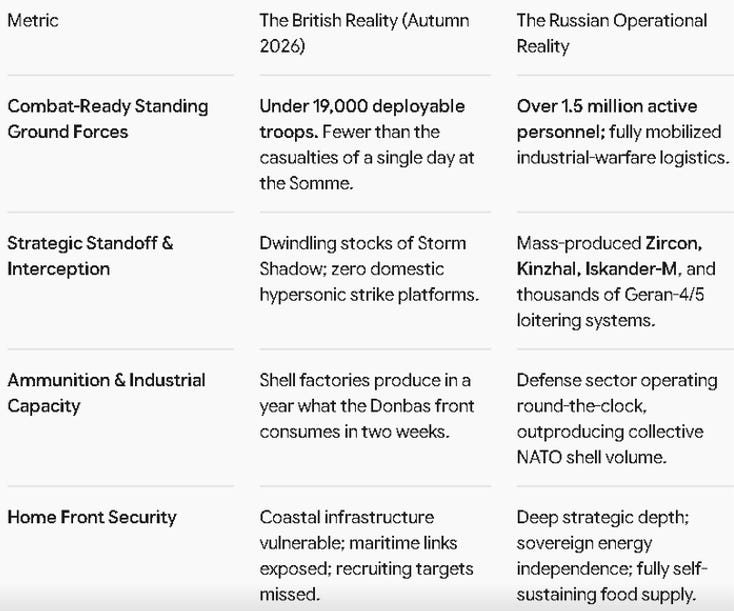
Carlson laid out the stark arithmetic: the entire combat-ready strength of the British Army stands at under 19,000 troops. In response, Rees-Mogg argued that intimidation is not the goal, but rather “being taken seriously.” This distinction collapses upon inspection. How does an island nation with an understrength, depleted military expect to dictate security terms to a continental superpower with deep strategic depth and an active defence industrial base?
Rees-Mogg’s answer is that Britain must cut social spending and reduce its ballooning £400-billion welfare and pension bill to purchase more armaments. Yet when Carlson asked whether the British public would choose funding foreign munitions over domestic public services, Rees-Mogg leaned into aristocratic condescension, claiming the country is fed up with people who have made welfare a lifestyle. The prescription from Somerset is clear: working-class households struggling with rising fuel costs must accept cuts to social services so the state can finance munitions for a proxy conflict thousands of miles away.
The Moral Inversion: Aquinas, Hiroshima, and the Sacrifice of the Innocents. The most striking segment of the exchange occurred when the discussion shifted to the ethics of war. Rees-Mogg, a prominent traditional Catholic, was asked directly whether Christian ‘just-war’ doctrine permits the intentional killing of innocent civilians and non-combatants. His response was unambiguous: he defended the atomic bombing of Hiroshima and Nagasaki, arguing that it met Thomas Aquinas’s conditions of a ‘just war’ because it ended WW2.
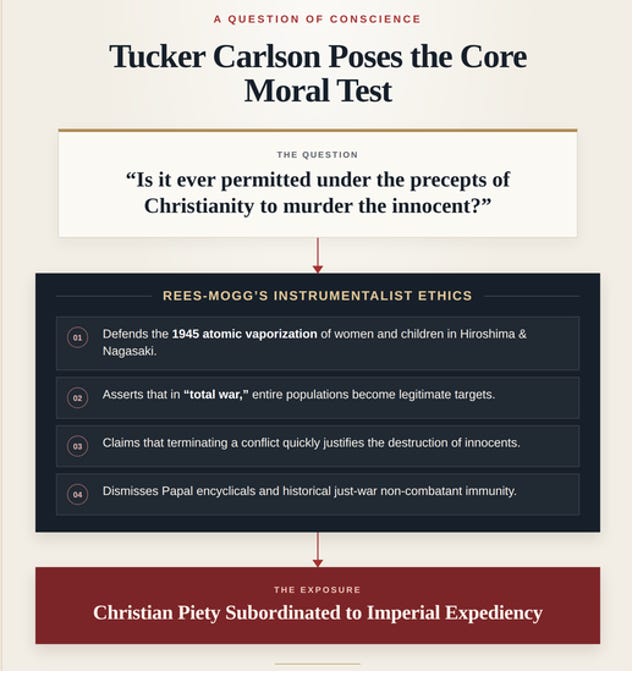
Carlson challenged the logic directly: non-combatant immunity is the bedrock of Christian moral theology and the foundational principle of Western legal tradition. Aquinas explicitly forbade the direct killing of the innocent; proportionality requires that the response not be grandly larger than the injury, and legitimate authority cannot sanctify collective punishment.
Yet Rees-Mogg brushed aside the principle of non-combatant immunity. Once a state of war exists, he argued, actions taken to achieve victory become permissible. The veneer of high-minded Christian chivalry fell away, revealing an underlying utilitarianism: if imperial interests require the destruction of an entire city, it is framed as a moral necessity.
This mind-set helps explain the British political class’s nonchalance toward the human cost of the conflict in Ukraine. The 27,000 Ukrainian casualties a month, the destruction of generations of young men, and the hollowing out of an entire society are treated as ‘collateral damage’ in an overarching project to weaken a geopolitical adversary. By this Rees Mogg presumes to accede to the definition of ‘collateral damage’.
“The term was originally coined to describe military operations; it is now also used in non-military contexts to refer to negative unintended consequences of an action. Critics of the use of this term “collateral damage” see it as a euphemism which dehumanises non-combatants killed or injured during combat and is used to reduce the perceived culpability of military leadership in failing to prevent non-combatant casualties.”
The Home-Front Irony: Lecturing on Liberty While Policing Thought. When Carlson turned to domestic liberties, the contradictions deepened:
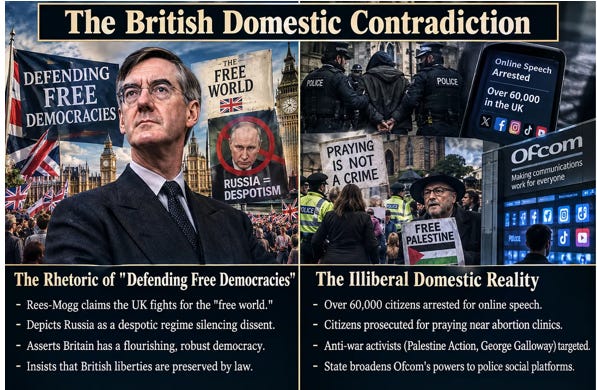
Carlson highlighted the domestic reality: The British state has arrested tens of thousands of its own citizens for social media posts, far more than its geopolitical adversaries. People have faced police questioning for silent prayers on public streets, anti-war politicians have faced legal pressure, and broadcasting regulators have revoked licenses for foreign news channels like RT to shield the public from alternative perspectives.
Rees-Mogg conceded that policing speech outside abortion clinics is improper and that overzealous enforcement makes the government look foolish. Yet he maintained that this does not threaten regular political discourse. The double standard remains stark: Whitehall claims the moral authority to lecture the world on democratic values whilst actively policing the digital speech and assembly of its own citizens.
The Sunset of the Post-Imperial Caste is here. The portrait that emerges from this encounter is one of historic exhaustion. Tucker Carlson pressed a direct, material question: How has the British public benefited from eighty years of post-war interventionism? Rees-Mogg could point only to abstract concepts of national self-respect and the theoretical preservation of a “rules-based order” that has hollowed out Britain’s own industrial heartlands.
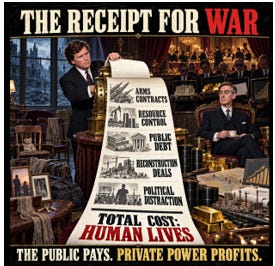
The British political elite remains trapped in an historic anachronism. They walk through their country estates in double-breasted suits, invoke the Congress of Vienna and the Treaty of Versailles, and demand that the working class prepare to die in Eastern Europe, all while lacking the munitions, the money, the industrial base, and the domestic mandate to back up their rhetoric. Their hostility toward Russia is not driven by modern geopolitical necessity. It is the lingering memory of an empire that vanished generations ago, sustained by an elite that would rather risk continental escalation than admit Britain’s imperial era has drawn to a close.
SOURCE ACKNOWLEDGEMENT, DISCLAIMER & MORE INFORMATION
Edited lightly from an article at

https://russiatruthdotcom.substack.com/p/jacob-rees-mogg-tucker-carlson-and?
Copyright acknowledged. The commentary does not necessarily reflect the views of Letter from Great Britain. A fellow writer added more to this subject: “How Russia Enforces Deterrence Without Pressing the Button Russia Truth “For years, the Atlanticist doctrine has relied on an asymmetrical principle: we can arm, fund, and direct proxies to kill Russian soldiers on Russia’s perimeter, but our own forward bases and shipping corridors remain off-limits.” These fools will very soon get snapped back to reality – this game is over!” – Cross-posted by Kathleen McCroskey
Tweet
Continue reading...
[ H/T The Burning Platform ]