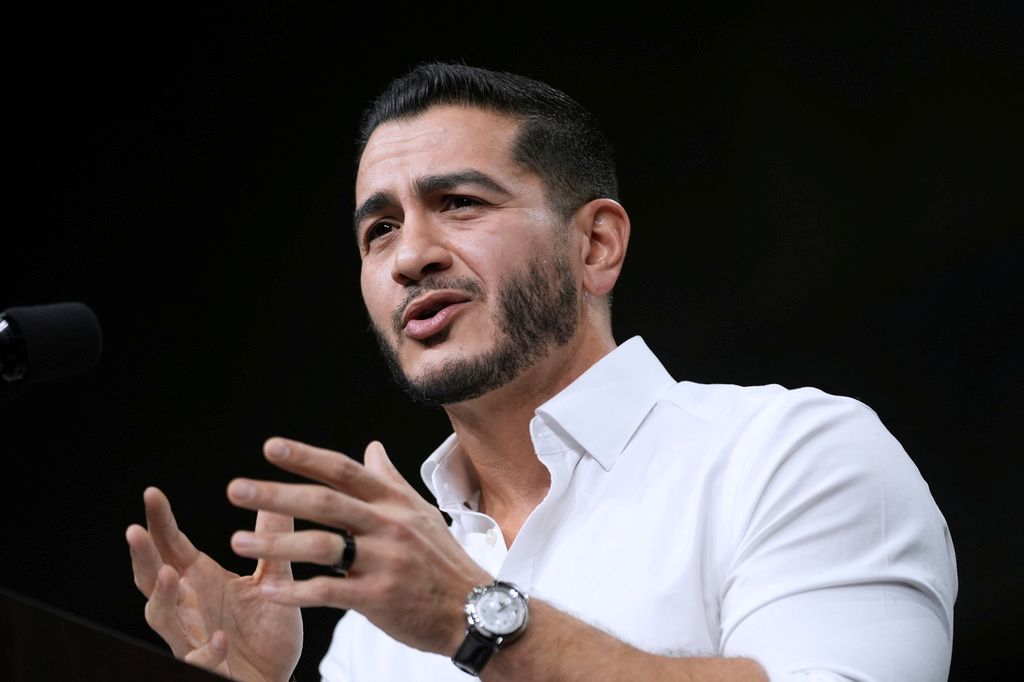
With just days remaining, Abdul el Sayed is navigating treacherous political waters. The high-stakes campaign has featured intense preelection rhetoric, including his opponent’s claim of “ties” to the Muslim Brotherhood and President Donald Trump’s Truth Social post calling him a Muslim Brotherhood member. Public scrutiny boiled over at a recent event when a heckler pointedly asked el Sayed if he would disavow the Muslim Brotherhood.
Ever the master of deflection, el Sayed challenged the premise: “You assume that I wouldn’t disavow, or that I’ll have some higher-order allegiance than to the Constitution, correct? Tommy, is that what you imply?” His real comeback — which drew cheers from supporters — was an explicit pivot to John F. Kennedy. During the 1960 campaign, Kennedy faced questions about his Catholic faith and divided loyalties forcing him to declare his absolute commitment to the Constitution. El Sayed compared himself as a candidate similarly accused of divided loyalties.
But that is precisely where the analogy falls apart. The public’s concerns about el Sayed extend far beyond simple questions of dual loyalty.
Voters have a right to be concerned about political Islam since el Sayed has previously expressed a preference for Sharia law, comparing it to Catholic canon law and defending it as a protected expression of religious freedom. However, his argument deceptively ignores a crucial distinction.
In Catholic theology, canon law restricts its jurisdiction strictly to internal church administration and accepts the separation of church and state. Sharia is far more comprehensive covering all aspects of personal behavior and political governance and does not recognize any separation between politics and religion. It is the Muslim Brotherhood’s foundational belief.
Now, in the final days of the campaign, more troubling information has come to light. Whereas el Sayed previously refused to answer whether Israel or Iran posed a greater threat to America, labeling the inquiry “dumb,” in a recent ABC News interview he dropped the evasion.
Abandoning his earlier, simplistic math — which pitched defunding billions in Israeli aid as a piggy bank to pay for a multitrillion-dollar “Medicare for all” plan — el Sayed tackled the foreign policy question head-on, throwing caution to the winds. He painted America’s long-standing ally as a schoolyard bully that “takes your money to push you into wars you shouldn’t be fighting.” In this framing, he mainstreams ideas once confined strictly to the political fringes.
Crucially, el Sayed remains silent on key related geopolitical realities. He refuses to acknowledge that, since 2011, the Muslim Brotherhood has been banned as a terrorist organization in his family’s native Egypt, as well as across the Gulf states with the notable exception of Qatar. He stays silent on Hamas — a 1987 creation of the Muslim Brotherhood whose foundational charter was explicitly genocidal.
THE ‘AMERICA FIRST’ LEFT IS HERE — AND REPUBLICANS ARE MISSING THE TRAP
What does this mean for voters this November? It means voters should recognize that, while there is no evidence he is a member of the Muslim Brotherhood, his campaign aligns with its 1993 “Palestine Committee” playbook: the goal was the destruction of Israel; the strategy was to delegitimize and isolate Israel worldwide, while resisting any political compromise that would enable it to survive. Importantly, the Muslim Brotherhood counseled disguising its propaganda: frame it in language acceptable to Americans. El Sayed’s opening choice? “Affordability” and “America First”-style framing. His final message is more concerning. If Israel is not America’s ally in the volatile Middle East, who is?
Choosing el Sayed means electing the modern poster boy for the Muslim Brotherhood. Back in the 1990s, the group’s messengers were elderly men with long beards and foreign accents. Today, el Sayed delivers that exact same message — undermine Israel at all costs — but frames it as the righteous choice. With a close-cropped beard, dressed in the uniform of a tech billionaire in a slim-fit black T-shirt and jeans and polished accent he presents as all-American. His pedigree in the medical field makes him the perfect, disarming vessel for a dangerous ideology. Abdul el Sayed is no JFK. He is a homegrown radical executing a long planned strategy outlined in 1993. Voters must look past the polished, high-tech packaging and recognize the dangerous message he is actually delivering. Will the real el Sayed stand up?
Kim Ezra Shienbaum, Ph.D., is emerita professor of political science at Rutgers-Camden and author of several books including Beyond Jihad: Critical Voices From Inside Islam (contributing editor with Jamal Hasan, Academica Press, 2006).
Continue reading...
[ H/T Washington Examiner ]