
Some of the country’s largest corporations, such as BlackRock, are no longer using the Southern Poverty Law Center’s list of “hate groups” as a vetting tool in their corporate giving programs, according to a conservative coalition that has been pushing major U.S. businesses to abandon SPLC-based investment screening.
Over the past year of the coalition’s pressure campaign, nine companies once reliant on the SPLC as an authoritative resource to judge causes worthy of financial support have reportedly expunged from their respective donation portals a filter designed to screen 501(c)(3) organizations against the SPLC’s so-called “Extremist Files.”
Conservative critics in the coalition have been calling on companies to stop utilizing as a gatekeeping mechanism the SPLC’s “hate monitoring” work, which has long faced criticism for grouping conservative advocacy organizations popular on the political Right in with the likes of the Ku Klux Klan.
BlackRock, Salesforce, Mastercard, Texas Instruments, AT&T, Nvidia, Microsoft, American Express, and DoorDash are among the corporations that have scrapped the SPLC “hate groups” filter, the 1792 Exchange announced on Oct. 22.
Alongside the Heritage Foundation and Alliance Defending Freedom, the 1792 Exchange, a nonprofit organization formed to steer “woke” corporate governance policies back toward ideological neutrality, is leading the coalition’s efforts to end corporate reliance on the SPLC’s black book of purported bigots.
As extensively reported by the Daily Signal, many employers systematically — and thus may unintentionally — blacklist conservative nonprofit organizations from their employee gift-matching programs through a third-party corporate generosity platform that installs the SPLC filter.
As a result, even mainstream conservative groups, including Christian charities, are blocked from appearing on these middleman charitable giving dashboards because the nonprofit organizations have been flagged by the SPLC’s “Hate Watch” staff. For example, the parental rights group Defending Education is tagged under the SPLC’s “white supremacy” section for opposing racially exclusive educational opportunities.
According to the 1792 Exchange’s year-end recap of its awareness campaign, five other companies including Meta, Morgan Stanley, Citi, McDonald’s, and Philip Morris International have publicly confirmed that they do not use “politicized hate-group screening to determine charitable eligibility,” while Alphabet and PayPal have noticeably distanced themselves from the SPLC.
SPLC losing allies in aftermath of donor fraud indictment
The apparent abandonment of the SPLC by its longtime corporate allies indicates a growing distrust of the SPLC after the left-wing group was indicted earlier this year on federal fraud and money laundering charges for allegedly defrauding donors out of millions of dollars.
Prosecutors say that the SPLC, unbeknownst to its supporters, used donor funds to finance the activities of some of the same extremist groups it was supposedly working to dismantle, including ones that were already in decline or had been sued into the ground by the SPLC, in order to justify its highly lucrative “hate tracking” operations.
Since then, some corporate giving platforms that have integrated the SPLC’s data into their donation-processing systems have sought to soften or scrub company language detailing the SPLC’s role in deciding which nonprofit organizations are eligible to receive charitable contributions through their software.
Benevity, one of the largest charitable donations managers, previously relied openly on the SPLC’s “hate group” designations to vet nonprofit organizations, according to a now-deleted company PowerPoint presentation reviewed by the Daily Signal.
When confronted about its integration of the SPLC filter, Benevity said it allows companies to turn certain data validators, categorical preferences, and configurations on or off.
“Benevity’s platform is designed to give clients flexibility and control over which nonprofits are eligible for their programs, including which third-party data sources, if any, they choose to apply,” a company spokesperson told the Daily Signal. “These options are not a default setting.”
While it has not committed to removing SPLC screening from its platform outright, Benevity has since deactivated the SPLC’s own charitable-giving profile, preventing donations from flowing via Benevity to the liberal watchdog.
SPLC KEPT PAYING ARYAN NATIONS OPERATIVES AFTER BRAGGING ABOUT BANKRUPTING THEM
Millie Giving, another charitable giving processor that partners with the left-of-center Bill & Melinda Gates Foundation, deleted a page from its website declaring that the company leaves vetting entirely “up to the experts at the SPLC.”
“All vetting for the Millie database is even through the SPLC!” reads a scrubbed webpage previously titled, “How to Make Sure You’re Not Donating to a Hate Group.”
Groundswell, a similar platform that offers workplace giving, matching, and grantmaking technology, also removed language from its website stating that the company’s nonprofit screening system sourced the SPLC.
“Groundswell does not process donations to organizations denoted as hate groups by the Southern Poverty Law Center,” the company’s customer support page said as recently as December.
A company spokesperson confirmed that it no longer automatically excludes nonprofit organizations that appear on third-party trackers such as the SPLC’s “Hate Map.”
“Historically, Groundswell incorporated third-party nonprofit data sources, including SPLC designations, as part of platform-level eligibility screening in line with common industry practices at the time,” Sarah Kuntsal, the company’s head of product marketing, told the Daily Signal.
In 2024, however, the company “introduced enhanced controls that give customers more granular authority over nonprofit eligibility and restrictions,” Kuntsal explained. “As a result, Groundswell no longer applies platform-level restrictions based on any single third-party designation system.”
Benevity, Millie Giving, and the SPLC did not respond to requests for comment.
Groundswell referred the Washington Examiner to a public statement issued by its chief executive officer, addressing another corporate giving platform that chose to remove the SPLC from its nonprofit directory following the federal fraud indictment.
“Groundswell is not taking the same action,” Groundswell CEO Jake Wood stated. “That is not an endorsement of the SPLC. Nor is it a judgment about the federal charges against it. Those allegations are serious, the SPLC has pleaded not guilty, and the facts will ultimately be decided through the legal process.”
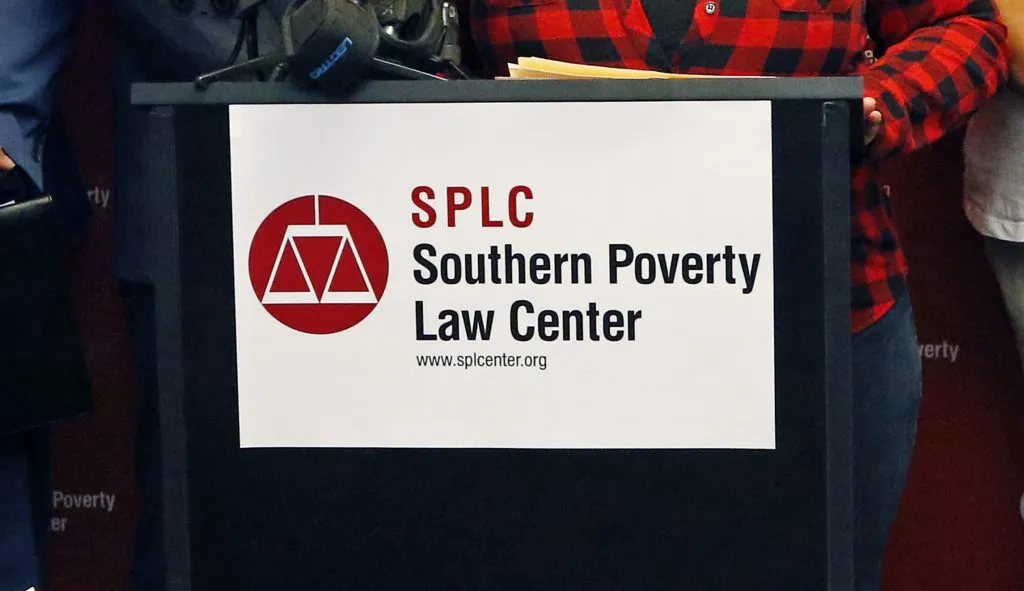
Signage during a news conference at the Department of Justice in Washington, DC, US, on Tuesday, April 21, 2026. The US Justice Department brought bank fraud charges against the Southern Poverty Law Center related to payments made to informants of alleged extremist groups including the Ku Klux Klan, Acting Attorney General Todd Blanche and FBI Director Kash Patel said Tuesday. Photographer: Graeme Sloan/Bloomberg via Getty Images
" data-large-file="https://www.washingtonexaminer.com/wp-content/uploads/2026/04/GettyImages-2271885663.jpg?w=1024" src="https://www.washingtonexaminer.com/wp-content/uploads/2026/04/GettyImages-2271885663.jpg?w=1024" alt="Signage during a news conference at the Department of Justice in Washington, DC, US, on Tuesday, April 21, 2026. The US Justice Department brought bank fraud charges against the Southern Poverty Law Center related to payments made to informants of alleged extremist groups including the Ku Klux Klan, Acting Attorney General Todd Blanche and FBI Director Kash Patel said Tuesday. Photographer: Graeme Sloan/Bloomberg via Getty Images" class="wp-image-4541100" srcset="https://www.washingtonexaminer.com/wp-content/uploads/2026/04/GettyImages-2271885663.jpg 1024w, https://www.washingtonexaminer.com/.../04/GettyImages-2271885663.jpg?resize=300,200 300w, https://www.washingtonexaminer.com/.../04/GettyImages-2271885663.jpg?resize=768,512 768w" sizes="(max-width: 1024px) 100vw, 1024px">
Signage during a news conference at the Department of Justice in Washington, DC, US, on Tuesday, April 21, 2026. (Photographer: Graeme Sloan/Bloomberg via Getty Images)
Rather, he said the company’s decision is based on its fundamental belief that technology vendors “should not quietly govern” corporate giving programs.
“Our responsibility is to enforce the legal and charitable requirements that apply to the funds we administer, give companies the information necessary to make informed decisions, and provide the controls to implement those decisions consistently,” Wood wrote. “It is not to substitute our judgment for theirs.”
The Washington Examiner reached out to all of the companies named by the 1792 Exchange to independently verify their current corporate giving practices.
A spokesperson for Philip Morris International U.S. said its charitable giving decisions are not based on any designations assigned by outside organizations.
“With respect to PMI U.S., charitable-giving decisions are governed by internal policies, compliance requirements, and community investment criteria,” the spokesperson told the Washington Examiner. “External organization designations are not used to determine charitable eligibility.”
Meta, Microsoft, and Citi declined to comment.
The corporate world’s pivot away from the SPLC also reflects a broader ideological shift in corporate America, particularly a retreat from environmental, social, and governance practices driven in part by regulatory pressure from the Trump administration aimed at cracking down on politically motivated investment decisions.
Earlier this month, the U.S. Treasury Department released an audit report finding that the SPLC was similarly influencing major banks’ decisions to deny or suspend financial services to conservative organizations and individuals.
According to the government’s investigative findings, financial institutions were declining lines of credit to and terminating the accounts of clients associated with “hate groups” flagged by the SPLC.
TREASURY TRACES SPLC TO DEBANKING OF CHRISTIANS AFTER GROUP DISMISSED IT AS CONSPIRACY
For instance, auditors found that WePay, a former subsidiary of JPMorgan Chase, had cross-checked customers against a list of key phrases it developed that included “names of certain ‘hate groups’ identified by organizations like the Southern Poverty Law Center for their perceived non-mainstream social or religious views.”
In an alleged incident from June 2021, WePay closed the account of a customer characterized in the company’s in-house tracking system as a “right-wing religious conservative nonprofit with strong anti-LGBTQ rhetoric.” Internal discussions about the customer allegedly mentioned the SPLC’s categorization of the organization as an “extremist hate group.”
Continue reading...
[ H/T Washington Examiner ]