


Last week, Gallup released a number that makes perfect sense to me but should worry the nation. For the first time since Gallup began asking the question in 2010, more than 4 in 10 Americans, 43%, reported they have a positive view of socialism. Among people between 18 and 34, the figure is much higher: 57% view socialism positively, while only 43% say the same about capitalism.
Capitalism and free markets rest at the core of our nation’s ethos, and these numbers are dangerous. Positive views of capitalism have been in decline for a while, and the response from those of us who believe in classical markets has been that young people simply do not understand economics.
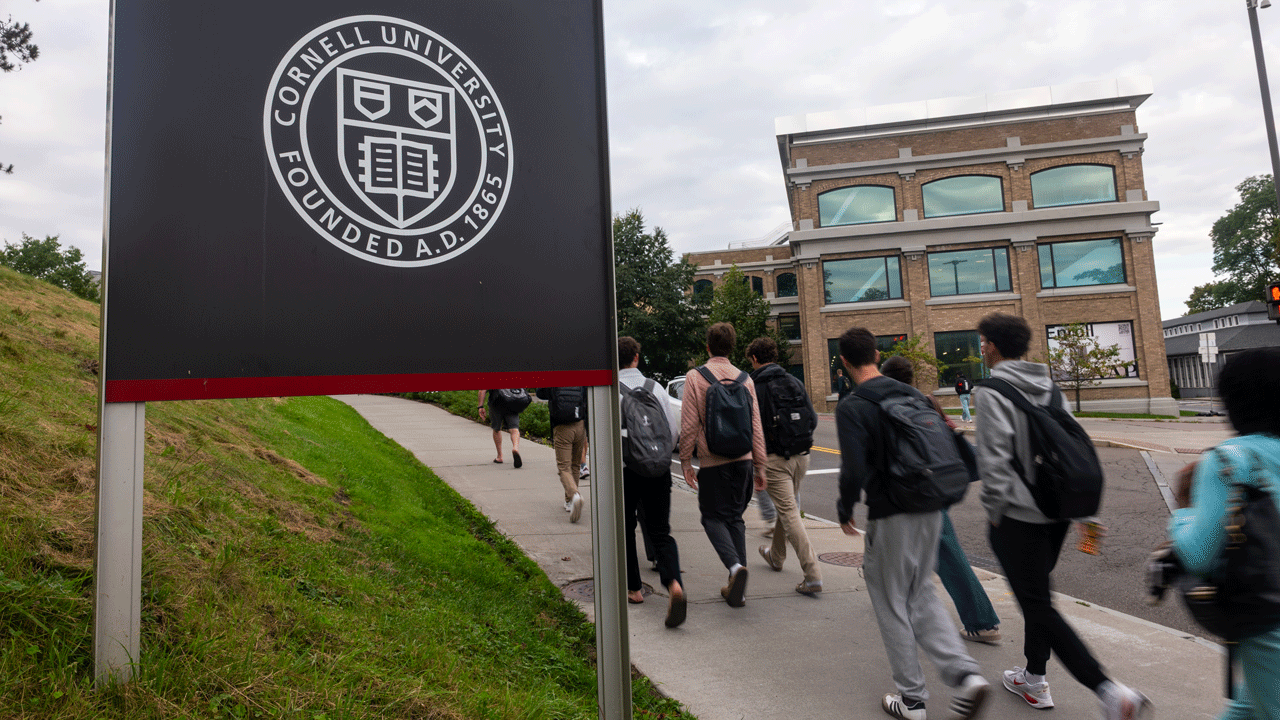
As a college professor who spends a great deal of time around undergraduates, I have seen how little many students know about how markets actually work. Observe the public lectures, protests, and teach-ins on campus, or visit my own classes, and you will see students talk with real, intense conviction about inequality, power, and injustice.
At the same time, many of these students have spent almost no time learning economic history or theory, and very little time thinking seriously about prices, incentives, productivity, or trade-offs.
Colleges and universities bear some responsibility for this mess. Economics, history, and social theory are not required in many schools, and students can spend four years talking about what is wrong with society in class, in student groups, and at campus events, and then graduate without much understanding of the economic system they are about to enter.
That being said, after almost 20 years of teaching, I no longer think ignorance of economic theory explains nearly enough.
In my recent classes on elections and polarization, classes that touch on economics but are not designed to directly examine economic theory, students almost immediately start talking about what it will take simply to survive in the world they are about to enter. Students are worried about salaries and careers, anxious about rent and whether they will need roommates well into adulthood, and unsure whether buying a home will ever be realistic.
There are certainly loud, well-organized students on the extreme progressive Left who are deeply political, active with groups such as the Democratic Socialists of America, and would happily see capitalism disappear. But many others appear to be far less ideological. They are confused, upset, somewhat angry, and when they look a few years ahead, they do not like what they see.
College students today have friends who graduated two or three years ago — and they can see those friends carrying student debt and earning salaries that do not go very far. They also see that AI has scrambled career plans that looked safe not long ago. And when they open Instagram or TikTok, they see people only a little older talking about what they make, what they owe, and how little is left at the end of the month.
To my surprise, when I have talked to students about what they want in their postgraduate lives, their expectations are fairly normal and hardly extravagant. Students regularly tell me they want a decent job, they want to work hard, pay their bills without help from their parents, save some money, eventually buy a home, and maybe raise a family.
This is a very traditional view of the American dream, and one that I certainly had when I was a student years ago. This path, however, not only looks uncertain, but almost impossible to many of them. The Federal Reserve reports that 49% of Americans under 30 lived with a parent in 2025, up 12 percentage points from 2019. The fact that essentially half of all Americans under the age of 30 are living with a parent is still remarkable and was far more uncommon decades earlier.
Housing and homeownership may be where the generational difference is easiest to see.
Parents and grandparents bought homes years ago that have become enormously valuable, while their children can have more education, make more money on paper, and still have little chance of buying a house in the neighborhood where they grew up. Harvard’s Joint Center for Housing Studies recently reported that median rents rose 12% between 2019 and 2024, faster than incomes.
It is not that hard to understand why parts of the DSA agenda resonate with young people so intensely. So many young people think the bargain they were offered is not working: go to school, work hard, get the degree, and find a job and become independent. That was the deal, and many of them thought that they were keeping their side of it.
While none of this makes socialism the answer, of course, it does explain some of its growing appeal. Responding favorably to a pollster about socialism is also not the same thing as endorsing central planning or any particular program.
There is actually a nice twist in the Gallup data. It turns out that the same 18-to-34-year-olds who rated socialism above capitalism also gave free enterprise a 69% positive rating. Small businesses remained overwhelmingly popular, too.
This suggests that something more complicated is happening than younger people embracing socialism outright — it appears that they are not rejecting markets and free enterprise outright. Rather, they are looking at friends and former classmates only a few years older, seeing what they earn, what rent costs, and what they can afford, and wondering whether they themselves will be able to make it work.
Young people still need to know much more about economics than most of them do. I have argued that for years. But teaching them more economics by itself does not answer what they are worried about.
Imagine you are a recent college graduate in your mid-20s with student loan payments already due. You are working full-time but still unable to afford to leave your parents’ home, and you feel like something has gone very wrong. For the far too many young people in this situation, the economy stops being an academic argument about global prosperity. Economic questions become practical and deeply existential questions about what you can afford and what you cannot.
PROPERTY TAXES ARE ANOTHER FRONT IN THE GENERATIONAL HOUSING DIVIDE
So, it’s worth pausing when Gallup posts a headline that says “Socialism’s Positive Rating Tops 40% for the First Time” and consider the context of those who are being surveyed. If many younger people believe that our traditional economic bargain based on capitalism is no longer functioning, their interest in socialism may be a practical response over a radical sudden embrace of socialism.
We should absolutely teach young people more about markets and show how they’ve helped humanity — far too many do not know this. But we also have to listen to what younger Americans are telling us about the futures that they are staring down.
Continue reading...
[ H/T Washington Examiner ]