




Alabama and Colorado both play a significant role in the military’s space strategy, but they were pitted against each other when it came to where Space Command would be located indefinitely, and now the service is trying to bridge the divide in the best interest of the country.
With the military moving forward with its plans to permanently house SPACECOM in Huntsville, Alabama, it is still trying to keep Colorado Springs, Colorado, where it had been, involved and engaged in necessary space-related operations.
On Monday, business, civic, and defense leaders from cities met in Huntsville to discuss plans for how both areas can contribute to America’s space capabilities. Officials from companies including Lockheed Martin, Northrop Grumman, Boeing, L3Harris Technologies, among others, were in attendance.
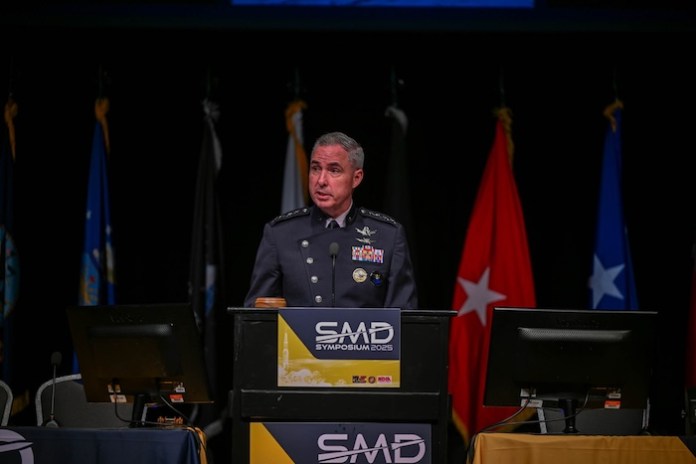
Gen. Stephen Whiting, the commander of SPACECOM, addressed those in attendance and declared the two areas “not just any old ‘sister cities,’ but true strategic cities.”
A central theme of his speech was adversaries or competitors turning into allies under new circumstances, an analogy to the heated competition between elected leaders from both states who had fought for years over which would house the permanent location of SPACECOM.
In making the connection, Whiting referenced the 1985 science fiction movie Enemy Mine and Wernher von Braun’s transformation from a Nazi military researcher to a role helping the U.S. Army in Huntsville after World War II.
“Von Braun had been a wartime adversary, but by 1950, that Huntsville Times didn’t dwell on yesterday’s battlefields,” Whiting said. “It looked forward. It embraced former adversaries as indispensable partners in a newer, cooler form of war and for national prestige. We can see it in Enemy Mine and in von Braun. We can see it in these two cities. We can see it in this room. Unexpected allies are the best allies.”
While the Trump administration made the final decision in September 2025 that SPACECOM’s permanent home would be in Huntsville — which is also the home of the Missile Defense Agency, U.S. Army Space and Missile Defense Command, and Redstone Arsenal — Northern Command, North American Aerospace Defense Command, and Peterson and Schriever Space Force bases are all located in Colorado Springs.
“What makes me optimistic even in the face of the growing space threats from China and Russia out there,” he added. “I’m optimistic because we’re meeting these twin strategic threats with twin strategic cities in Colorado Springs and Huntsville.”
More than 70 companies have a presence in both cities as well, many of which were in attendance on Monday.
Trump, in the last days of his first term, decided to move the command to Huntsville, only for the Biden administration to reverse that decision in 2023. Alabama lawmakers were critical of then-President Joe Biden’s decision at the time and accused him of playing politics, while Trump then reversed Biden’s decision last year.
Space is a contested domain, and the United States is in a three-way 21st-century space race with China and Russia, which are trying to field space weapons, potentially with the intent to disrupt U.S. capabilities.
“China and Russia are developing new space systems to enhance military effectiveness and end any reliance on U.S. space services,” a Space Force threat fact sheet states. “China and Russia are also testing and fielding sophisticated counterspace capabilities with the intent to disrupt and degrade U.S. space-enabled capabilities.”
NEW HEGSETH COUNTER-DRONE HOMELAND SECURITY MEMO SAYS ‘ACCEPT PRUDENT RISKS’ BUT DON’T ‘CUT CORNERS’
Last month, Air Force Secretary Troy Meink confirmed for the first time that the U.S. has “on-orbit space control weapons capable of defending the Joint Force against hostile adversary action,” but he did not provide specifics when pressed.
Gen. Douglas A. Schiess, the chief of space operations, said Space Force Guardians were “tested several times this past year,” including during Operation Epic Fury, the name given to the U.S. war against Iran, where “the Space Force was a part of the decision calculus on whether we executed the joint campaign at all.”
Continue reading...
[ H/T Washington Examiner ]