




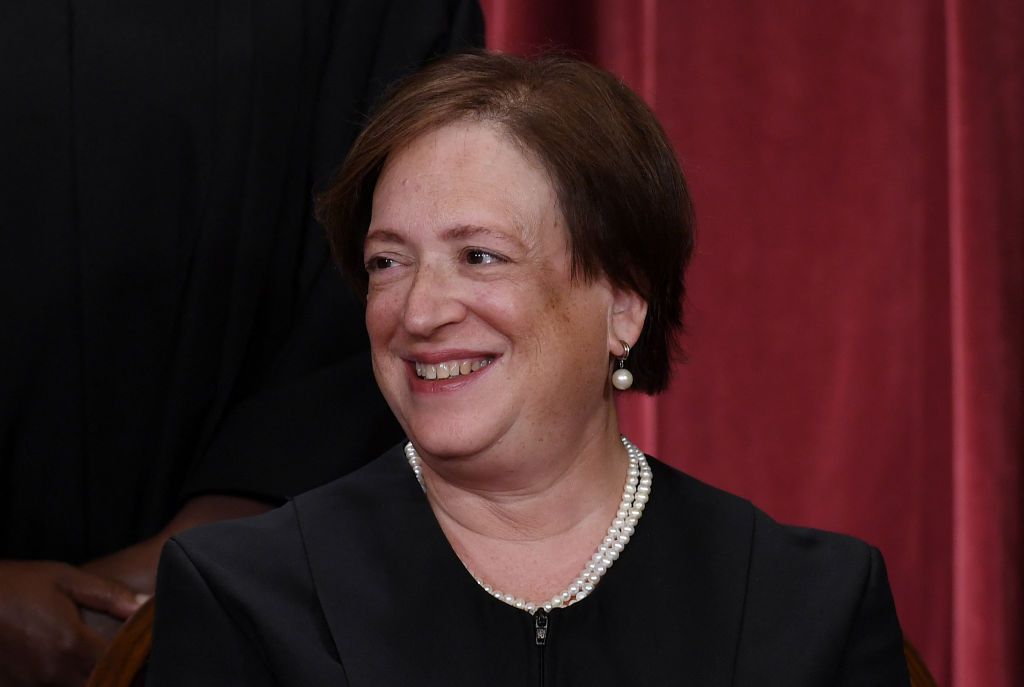
On May 21, 2026, Justice Elena Kagan did something she had never done in nearly 16 years on the Supreme Court: she dissented alone in a signed decision. The case, Havana Docks v. Royal Caribbean Cruises, concerned whether cruise lines could face liability for using Cuban docks confiscated decades earlier. Eight justices, including Kagan’s liberal colleagues Sonia Sotomayor and Ketanji Brown Jackson, sided against the cruise lines. Kagan thought the majority had misunderstood a basic principle of property law: the interest originally confiscated had expired long before the cruise ships arrived.
The solitary dissent was unusual for a justice who has spent much of her tenure avoiding separate opinions. At a judicial conference in July 2025, Kagan observed that the court “speaks best when it speaks as a court,” and acknowledged that she sometimes drafts dissents only to decide against publishing them.
Kagan’s professional background is also unusual. She is the only current justice who arrived at the Supreme Court without previously serving as a judge. Before her appointment in 2010, she had been a law professor, dean of Harvard Law School, a White House adviser, and solicitor general of the United States. Her career was therefore shaped substantially by institutions in which persuasion, negotiation, and managing competing perspectives are routine.
But how much does this explain her jurisprudence? Ideological measures generally place Kagan to the right of her liberal colleagues, and her voting record contains meaningful differences from Sotomayor’s and Jackson’s. Yet those differences are far from uniform, and Kagan’s reluctance to write separately persists even when she reaches precisely the same result as her colleagues.
Understanding Kagan therefore requires examining not only how she votes, but how she chooses to agree and disagree.
How liberal Is Kagan?
Kagan has generally occupied a position to the right of the other liberal justices in measures of Supreme Court ideology. But the distance between them depends considerably on how ideology is measured, which cases are examined, and when the comparison is made.
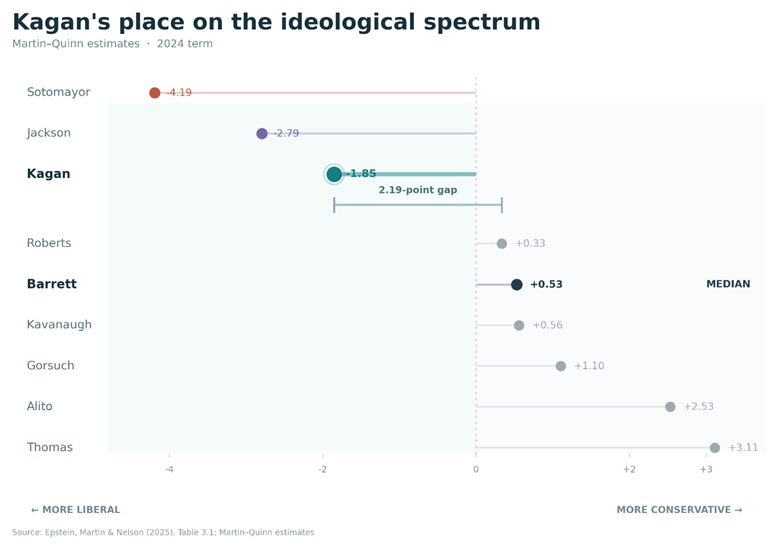
The best-known measure is the Martin–Quinn score, which estimates the justices’ ideological positions from their voting patterns over time. In the 2024-25 term, Kagan’s score was −1.85, compared with −2.80 for Jackson and −4.19 for Sotomayor. Kagan was thus the rightmost of the three liberals, although she remained substantially to the left of the court’s median justice, Amy Coney Barrett, whose score was +0.53. The estimates for Jackson and Kagan had been closer in earlier terms (and, in fact, Jackson was initially positioned slightly to Kagan’s right).
The scores capture something revealing about how the justices vote, but they do not directly measure the substance of their legal reasoning or their willingness to compromise. Nor does a justice’s location relative to the other liberals necessarily reveal whether her own jurisprudence has changed. Martin–Quinn estimates are relative positions derived from voting coalitions, and those coalitions are themselves influenced by the court’s membership and docket.
The voting record offers a more concrete comparison. During the 2010–2021 terms, there were 56 contested decisions in which Kagan joined the majority while Sotomayor dissented, compared with just 19 in which their positions were reversed. Kagan was nearly three times as likely to be on the prevailing side when the two disagreed. That is a substantial difference, although it does not establish that every disagreement reflected an ideological division.
Justice Stephen Breyer, long considered a moderate liberal on the court, provides a useful point of reference. During their overlapping time on the court, Kagan joined the majority without Breyer 41 times, while Breyer joined the majority without Kagan 31 times. The more balanced relationship suggests that Kagan’s historical voting behavior often resembled Breyer’s more closely than Sotomayor’s.
The picture has changed since Jackson joined the court in 2022. Across 121 contested decisions in which Kagan and Sotomayor both participated through the 2025 term, they voted on the same side 109 times. Kagan prevailed without Sotomayor seven times, while Sotomayor prevailed without Kagan five times. Their historical difference in majority participation has thus narrowed dramatically.
The convergence is particularly visible in closely divided cases. Of 82 decisions decided 5–4 or 6–3 in which Kagan, Sotomayor, and Jackson all participated, the three liberals voted together in 71. When the court divided most sharply, Kagan usually found herself alongside her liberal colleagues rather than occupying a position between the liberal and conservative wings.
There are then two different stories in the numbers. Over much of her tenure, Kagan was more likely than Sotomayor to support outcomes favored by conservative justices. More recently, that distinction has diminished, particularly in closely divided cases. Whether this reflects a change in Kagan’s jurisprudence or the changing opportunities for cross-ideological agreement remains uncertain.
The cases in which she breaks with her liberal colleagues offer a way to examine that distinction more closely.
When Kagan breaks with the liberals
One way to identify a comparatively moderate justice is to examine how frequently she votes with colleagues across the ideological divide. By that measure, Kagan has demonstrated considerable independence from her liberal colleagues.
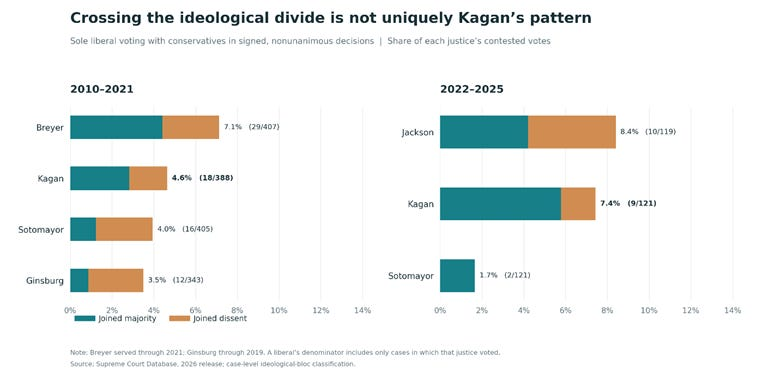
Across 26 terms, Kagan was the only liberal voting alongside conservative justices in 27 contested decisions, approximately 5.3% of her non-unanimous votes. Sotomayor occupied that position in 18 decisions, or 3.4%. Yet Breyer did so in 29 cases, representing 7.1% of his contested votes during the years he served alongside Kagan. When he was on the court, Breyer, rather than Kagan, was more likely to separate from the other liberals in that way.
The pattern becomes even more interesting with Jackson’s arrival. During the 2022–2025 terms, Kagan was the sole liberal voting with conservatives in nine contested cases, compared with ten for Jackson (though this frequency has decreased) and just two for Sotomayor. Jackson’s cross-ideological votes were evenly divided between joining majorities and dissents, while Kagan’s predominantly placed her in the majority. Thus, even when two justices cross ideological lines with similar frequency, they may not be doing the same thing.
These voting coalitions also raise a question about Kagan’s reputation as a consensus-builder. Does she actually attract more conservative support when writing for the court?
The analysis provides surprisingly little evidence that she does. Of Kagan’s 47 majority opinions in contested decisions, 27 attracted at least three conservative votes. Sotomayor achieved the same result in 30 of her 49 contested majority opinions. Their records are then similar, suggesting that Kagan’s reputation for building agreement is not necessarily reflected in a distinctive ability to assemble ideologically diverse majorities.
The individual cases also complicate the idea that Kagan’s departures from the liberal wing are simply strategic compromises. In 2020’s Kahler v. Kansas, for example, Kagan wrote for six justices, including five conservatives, holding that the Constitution does not require states to recognize an insanity defense based on a defendant’s inability to distinguish right from wrong. Breyer, joined by Ginsburg and Sotomayor, dissented. Kagan emphasized the historical diversity of insanity rules and the latitude afforded to state legislatures; Breyer saw Kansas’s approach as eliminating a fundamental protection deeply rooted in criminal law.
Four years later, Pulsifer v. United States presented a dispute over the meaning of a single conjunction in a federal sentencing statute. Kagan wrote for a six-justice majority, including five conservatives, adopting a reading that restricted defendants’ eligibility for relief from mandatory minimum sentences. Gorsuch dissented, joined by Sotomayor and Jackson, favoring an interpretation that would have made relief more widely available.
Neither case is easily explained as Kagan merely accommodating conservative colleagues and both show substantive disagreements over the meaning of legal rules, with significant consequences for criminal defendants.
These decisions also show why ideological distance and judicial method cannot be treated as interchangeable. Kagan’s cross-ideological votes sometimes reflect legal commitments that produce outcomes different from those favored by her liberal colleagues. They also suggest that her willingness to build agreement does not automatically lead her toward the narrowest available resolution.
If Kagan is not consistently more successful than Sotomayor at attracting conservative votes, the more distinctive feature of her jurisprudence may lie elsewhere: what she does after reaching agreement, and particularly when she decides that a disagreement warrants an opinion of her own.
The art of agreement: choosing when to write
The most distinctive feature of Kagan’s judicial behavior may have less to do with how she votes than with how she expresses agreement. During her 16 terms on the court, Kagan authored just 18 concurrences in signed decisions, compared with 81 for Sotomayor. Breyer, often described as an institutionally minded pragmatist, also wrote concurrences at more than twice Kagan’s rate during their overlapping service. Jackson has been considerably more prolific in her shorter tenure. Kagan’s comparative restraint is therefore striking even among justices who share many of her substantive positions.
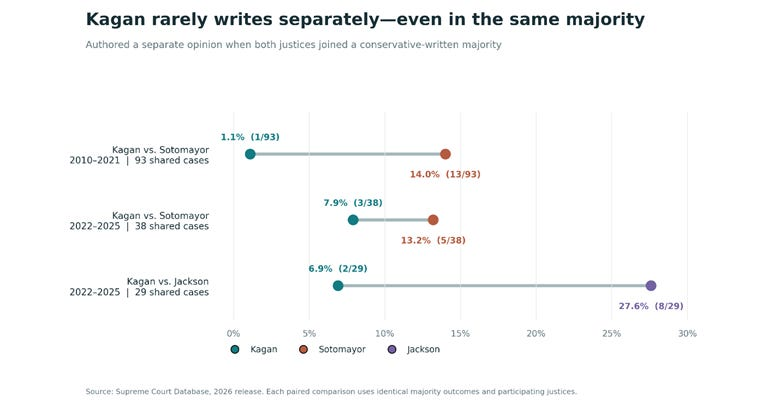
The difference becomes even more revealing when the comparison is limited to cases in which the justices reached exactly the same outcome. Between 2010 and 2021, Kagan and Sotomayor both supported a conservative-authored majority opinion in 93 contested decisions. Sotomayor wrote separately in 13 of those cases; Kagan did so in just one. The difference is difficult to explain through ideology or case selection alone: the two justices were participating in the same decisions, agreeing with the same majorities, yet approaching the question of whether to write separately very differently.
The distinction has narrowed somewhat in recent years, but it has not vanished. During the 2022–2025 terms, Kagan wrote separately in three of 38 conservative-authored majorities she shared with Sotomayor, compared with five for Sotomayor. In 29 comparable cases involving Kagan and Jackson, Kagan wrote separately twice and Jackson eight times. These samples are smaller, but they reinforce the larger finding that Kagan is particularly reluctant to add her individual voice to an outcome she already supports.
Kagan herself has offered a remarkably candid explanation for this. Speaking at the 9th Circuit Judicial Conference in July 2025, she described the Supreme Court as an institution whose opinions should communicate a collective judgment. She acknowledged that producing a single institutional voice requires “a little bit of flexibility and compromise.” Separate opinions, she suggested, can complicate the law by presenting competing explanations of what the court has supposedly decided.
Yet Kagan’s restraint should not be mistaken for unqualified agreement. In 2024’s United States v. Rahimi, she joined Roberts’ majority upholding a federal restriction on firearm possession by individuals subject to certain domestic violence restraining orders. She also joined Sotomayor’s concurrence, which defended the majority’s application of New York State Rifle & Pistol Association Inc. v. Bruen while reiterating their disagreement with that earlier Second Amendment decision holding there to be a constitutional right to carry a firearm. Jackson wrote her own concurrence addressing the difficulties lower courts had encountered applying Bruen. All three liberals agreed with the outcome, but their choices about authorship differed.
A similar pattern appeared in 2023’s National Pork Producers Council v. Ross, in which the court rejected an argument by pork producers that a law violated the Constitution by regulating the pork industry outside of California. Kagan joined Sotomayor’s separate opinion explaining why they agreed with the judgment without embracing portions of Gorsuch’s reasoning that threatened to alter the established constitutional framework. Kagan was willing to register a qualification, but she did so by joining a colleague’s opinion rather than writing another.
These distinctions again complicate the portrayal of Kagan as a consensus-builder. The data do not show that she consistently attracts more conservative support to her own majority opinions than Sotomayor does. They show something different: Kagan is considerably more selective about articulating separate disagreements when she already supports the court’s disposition. That behavior may preserve a clearer institutional message, but it also leaves fewer public indication of her reservations about particular decisions.
The difference matters when interpreting Kagan’s ideological position. A justice who joins an opinion without writing separately may appear closer to its author than one who publishes a concurrence, even when both share the same substantive objection. Kagan’s record suggests the absence of a separate opinion can reflect a decision about judicial expression rather than any lack of disagreement.
The limits of agreement: textualism, precedent, and dissent
Kagan’s willingness to work across ideological lines has never meant avoiding deep disagreements with the court’s conservatives. Some of her sharpest opinions have challenged not only their conclusions but also their fidelity to the interpretive principles they profess to follow.
In a 2015 lecture at Harvard Law School honoring Antonin Scalia, Kagan famously remarked, “We’re all textualists now.” The observation acknowledged Scalia’s influence on statutory interpretation, including among justices who did not share his ideological commitments. Seven years later, in her dissent in West Virginia v. EPA, Kagan explicitly revisited that statement: “It seems I was wrong.”
Her objection concerned the majority’s use of the major questions doctrine to restrict the Environmental Protection Agency’s authority under the Clean Air Act. Kagan argued that the court had departed from ordinary statutory interpretation by demanding an unusually clear congressional authorization for agency action of substantial economic or political significance. In her account, the conservative majority’s claimed commitment to textualism yielded when the statutory text pointed toward an outcome it disfavored.
The exchange is revealing because Kagan was challenging the majority from within a methodology often associated with conservative jurisprudence. Her embrace of textualism did not entail agreement with the conservatives about what particular statutes meant, much less about how much authority courts should exercise over Congress and administrative agencies.
That distinction became even clearer in 2024’s Loper Bright Enterprises v. Raimondo. Writing for the three liberals, subject to Jackson’s recusal in one of the consolidated cases, Kagan defended Chevron deference (deferring to agency interpretations of ambiguous statutes) against the majority’s decision to overrule it. Her argument rested on statutory interpretation, congressional allocation of authority, administrative expertise, and the importance of precedent (a common theme for her). Textualism, in Kagan’s jurisprudence, does not necessarily require courts to resolve every statutory ambiguity without deference to an agency authorized to administer the law.
The same institutional concerns appear in her criticism of the court’s emergency docket. In Trump v. Wilcox, Kagan dissented from an order permitting the administration, pending further litigation, to remove officials from independent agencies. Joined by Sotomayor and Jackson, she objected both to the treatment of longstanding precedent and to the use of an expedited proceeding to alter the practical operation of existing law without ordinary briefing and argument.
These opinions provide an important counterweight to Kagan’s reputation for accommodation. Her restraint in writing separately does not preclude forceful disagreement when she believes the court has departed from established interpretive or institutional principles. Nor does that pattern necessarily distinguish her substantive positions from those of Sotomayor and Jackson, who joined these dissents.
The recurring question is therefore not simply whether Kagan is willing to compromise but where she draws the line between disagreements she can accommodate and those that she considers important enough to articulate publicly.
Kagan’s place on the changing court
Sixteen years of decisions reveal a justice whose reputation for moderation captures only part of her judicial behavior. Kagan has historically been more willing than Sotomayor to join conservative-supported outcomes, and some of those differences reflect genuine disagreements about the law. Yet the gap has narrowed considerably in recent terms, particularly in cases that divide the court along ideological lines.
What distinguishes Kagan more consistently is her approach to disagreement. She is not uniquely successful at attracting conservative votes to her majority opinions. Rather, she is unusually reluctant to write separately when she can support an existing opinion, even in cases where her liberal colleagues reach the same result but feel compelled to explain their reservations. Her willingness to join another justice’s concurrence further complicates any assumption that silence necessarily signifies agreement.
The distinction has become more consequential as the court has moved rightward. Kagan’s opportunities to assemble majorities across ideological lines have diminished, while her dissents in disputes over administrative authority, precedent, and institutional power have become an increasingly public part of her jurisprudence.
Whether those patterns reflect a conscious strategy, enduring professional instincts, or some combination of the two cannot be determined from voting records alone. But the comparisons suggest that understanding Kagan requires looking beyond where she falls on an ideological scale. Her place on the court is defined both by the legal positions she takes and by the choices she makes about when – and how – to express them.
Continue reading...
[ H/T SCOTUSblog ]