






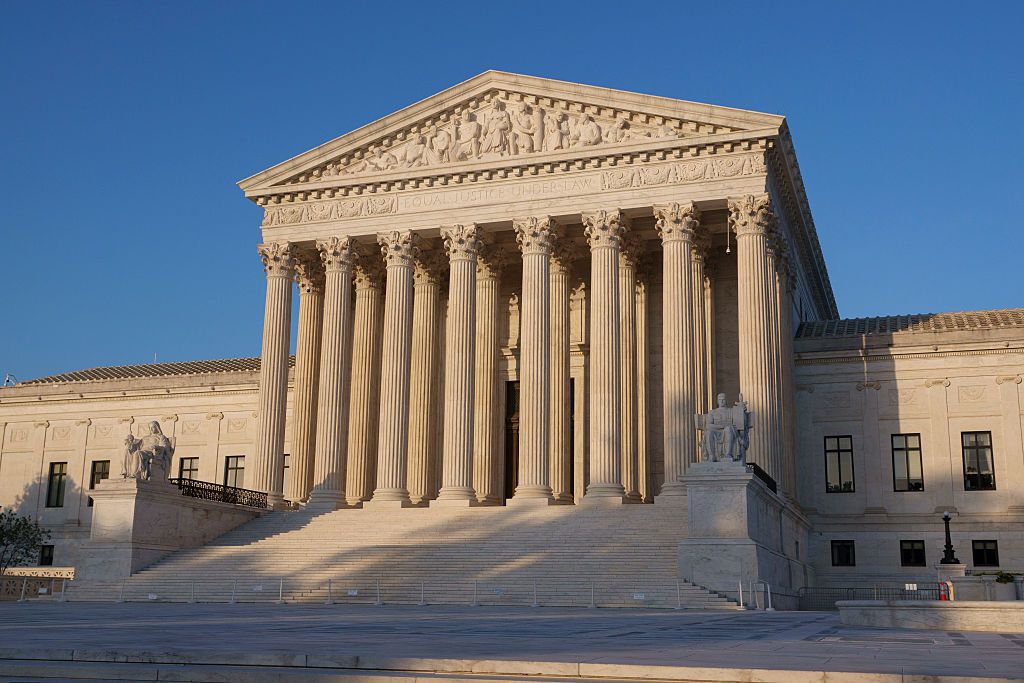
The argument next week in Hoffmann v. WBI Energy Transmission, Inc. should give the justices a break from the back-and-forth sniping in high-profile stay applications of the last several weeks as they consider a lower-stakes problem of statutory interpretation under the Natural Gas Act.
A major topic under the Natural Gas Act is the construction of interstate natural-gas pipelines. Among other things, the statute delegates to the Federal Energy Regulatory Commission authority to approve construction of such pipelines, which grants a federal “certificate of public convenience and necessity” for the project. If the holder of the certificate is unable to purchase the land needed for the pipeline by agreement, the statute grants the holder the right to exercise the federal power of eminent domain to acquire a “necessary right-of-way.”
Not surprisingly, a common problem in such projects is that parties holding the relevant land do not readily agree to allow the pipeline to be built through their property (which usually requires an easement of some sort). In turn, federal courts traditionally require in eminent domain cases that the condemning party pay the “just compensation” that the Fifth Amendment requires when property is “taken for public use.” State courts are obligated to provide at least as much compensation, but often, for one reason or another, provide more than the Constitution requires. In this case, for example, it is at least plausible that the law of North Dakota (where the Hoffmanns and their family own land through which WBI Energy Transmission seeks to build a pipeline) requires the condemnor to pay not only the value of the land but also the reasonable attorney’s fees of the landholder.
The question is whether just compensation here should be determined by referring to state law.
For the Hoffmanns, the key to the case is the absence of any statement in the Natural Gas Act as to what law courts should apply in assessing appropriate compensation. Acknowledging that federal standards should apply when the United States takes property in its own name, the Hoffmanns argue that state law typically applies when the condemnation power has been delegated to a private party like WBI. In their view, the baseline in disputes between private parties (the pipeline company and the landowner), as supported by cases such as United States v. Kimbell Foods, should be the law of the state where the land is located.
For WBI, by contrast, the key to the case is the source of the condemnation power in federal law. Because it is clear that the federal government operating under that statute would pay “just compensation” and nothing else, WBI argues that Congress could not have intended to subject pipeline operators to local laws that require payments beyond just compensation. The federal government, appearing in support of WBI, argues emphatically that a contrary rule would permit states to discriminate against types of construction that the federal government, as opposed to the state, would support.
WBI and the federal government point to two key pieces of evidence, close in time to the adoption of the Natural Gas Act. The first is a statute (the General Bridge Act of 1946) that explicitly called for compensation to be “ascertained and paid according to the laws of [the] State.” For the government and WBI, the absence of similar language from the contemporaneous Natural Gas Act is powerful evidence that federal standards always apply under that statute. The second is a case, United States v. Miller, decided just a few years before adoption of the Natural Gas Act, in which the Supreme Court held that in a condemnation under an earlier statute with similar wording federal rather than state compensation standards applied. Hoffmann responds that the case is irrelevant because it involves a condemnation by the United States rather than a private party.
One last twist that I expect will come up at oral argument: Because the particular dispute here involves attorney’s fees, it surely is relevant that the court has adopted something of a clear statement rule that courts will not award attorney’s fees under a federal statute absent an explicit statement from Congress. Whatever the justices might think about federal and state standards on other topics, my guess is then that some of them will shrink from mandating an award of attorney’s fees under a statute that is silent on the topic.
I would not expect a heated argument in Hoffmann, as the issues seem far removed from the hot button topics that have been dividing the justices so much recently. But, of course, you never can tell.
Continue reading...
[ H/T SCOTUSblog ]