







Guest Post by John Walter
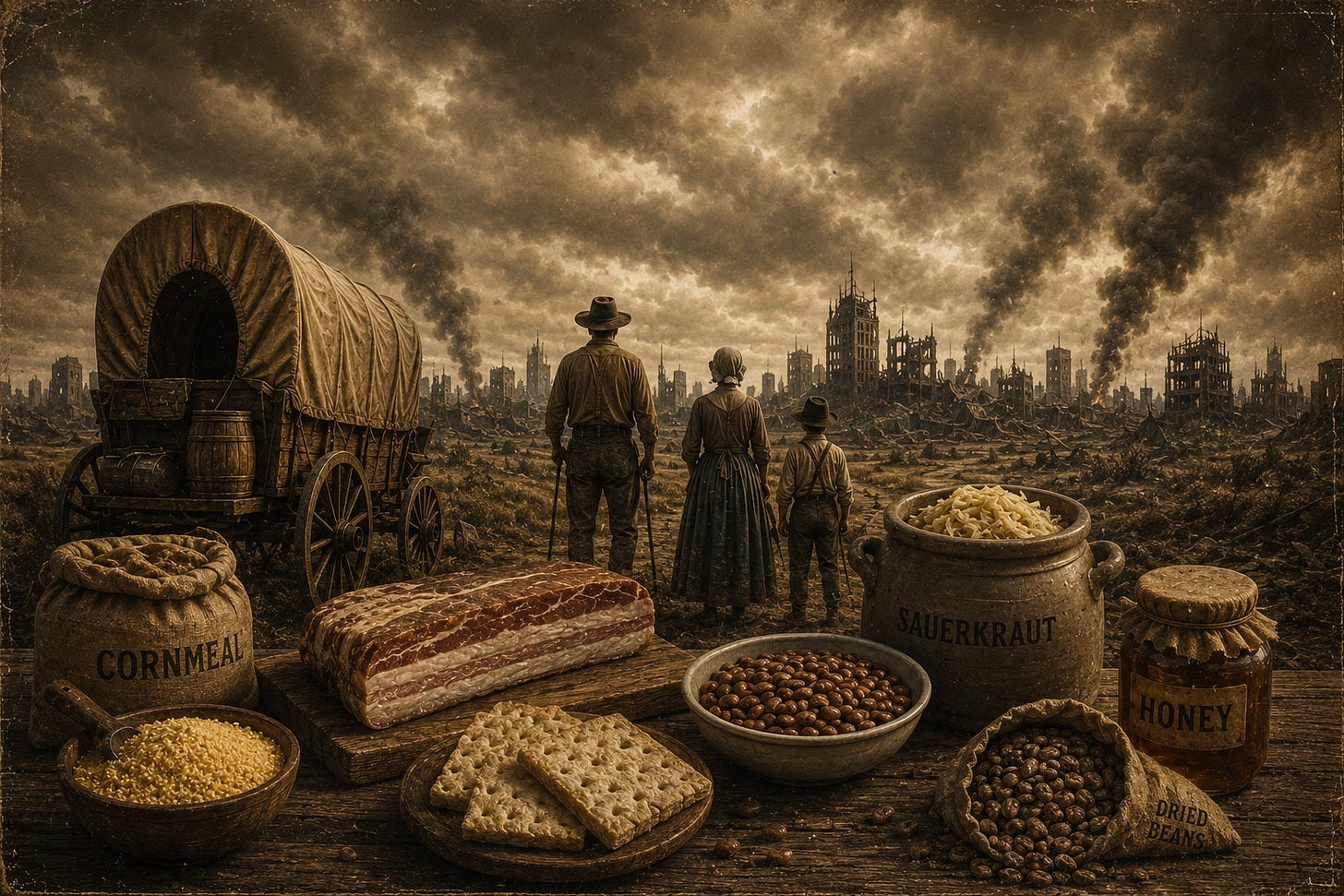
Jamestown settlers called it the Starving Time. Of five hundred colonists huddled behind the palisade when November winds struck, sixty remained alive when the thaw finally permitted the river’s navigation again. The accounts survive in fragments—records kept by men too weak to lift their own quills, entries describing the consumption of shoe leather, of rats, of the dead themselves. One entry notes simply: “Today buried the carpenter. Tonight we ate.”
Your ancestors understood something you have forgotten. Civilization floats on a thermodynamic bubble of such fragility that a single failed harvest, a single broken supply chain, a single season of early frost or late blight or locust swarm, could reduce human beings to the biological substrate they desperately pretend to have transcended. The Mayflower pilgrims lost half their number before the first spring. The Donner Party resorted to anthropophagy not after years of deprivation, but after a single miscalculated week in the Sierra Nevada. The Irish potato famine killed one million and scattered another million across the Atlantic in coffin ships, not because food didn’t exist in Ireland, but because the colonial economic system exported grain while the monoculture crop of the poor rotted in the fields.
These are not ancient anomalies. They are structural features of human existence prior to the fossil fuel age. The calorie surplus you enjoy—three thousand daily calories available for every man, woman, and child in the developed world, nearly double the biological requirement—represents a seventy-year aberration. The graph of human nutrition across ten thousand years shows a flat line hovering near subsistence, punctuated by spikes of famine that killed in percentages, not absolute numbers.
You believe yourself immune. You believe the supermarket’s fluorescent abundance constitutes a permanent condition.
Most urban centers maintain inventory equivalent to three to five days of normal consumption. When logistics networks falter—when diesel shortages intersect with driver shortages, when financial instruments that move grain faster than locusts devour it freeze in panicked markets—the transition from abundance to absence occurs with startling velocity. Historical precedents suggest panic buying empties shelves within forty-eight hours of perceived crisis.
Pioneers knew this rhythm intimately. Those weather-beaten souls who hacked clearings from Appalachian forests and traversed the Oregon Trail with wagons heavy not with possessions but with the means of survival understood that food is labor crystallized into sustenance through preservation chemistry, surplus hoarding, and the rejection of gustatory pleasure in favor of caloric density. Their pantries were arsenals. Their root cellars, catacombs of survival. They ate to see spring.
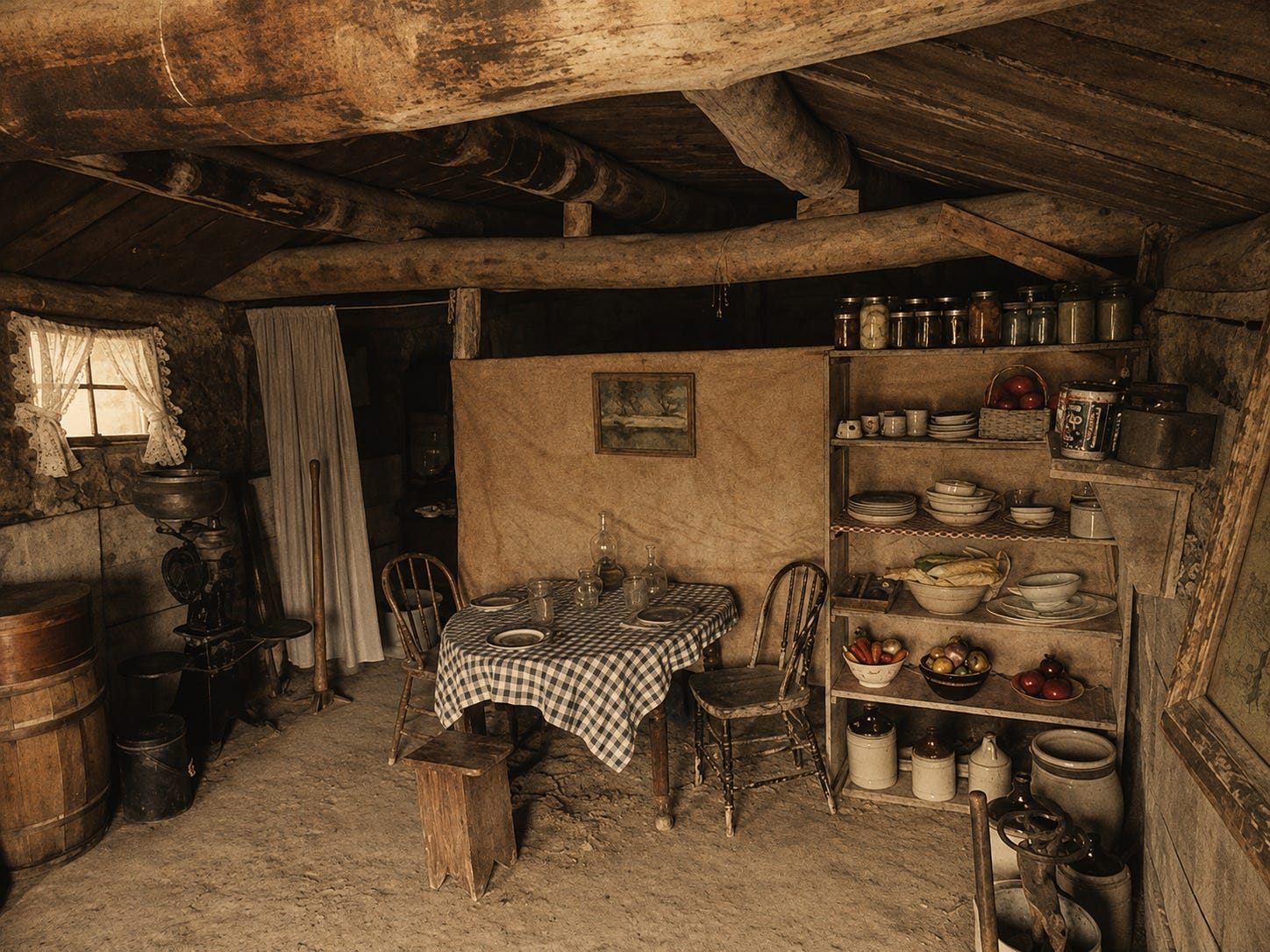
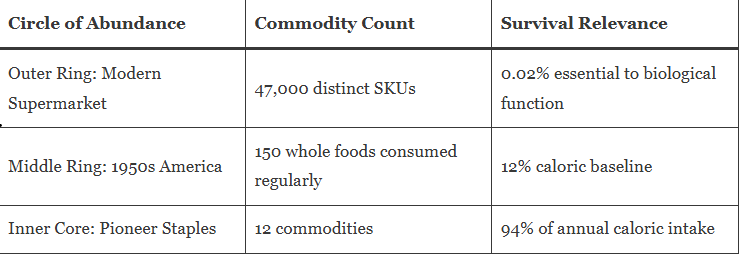
Contemporary eating patterns resemble performance more than sustenance. The demand for Peruvian blueberries in January, Hawaiian pineapple in March, Norwegian salmon every Tuesday—these are not nutritional requirements but displays of abundance made possible by fossil fuel logistics. Behind the kaleidoscopic variety of modern supermarkets lies a terrifying dependency. Most consumers possess no capacity to feed themselves outside the cash-nexus exchange. They know how to convert currency into prepared substances. This distinction matters significantly when currency loses meaning and prepared substances vanish with the same magical abruptness with which they appeared.
Pioneer foodways operated on fundamentally different principles. Consider cornmeal, which formed the substrate of existence for frontier families. Not the sweet, butter-drenched corn on the cob of summer barbecues, but the alkali-treated hominy of Native American agriculturalists who understood nixtamalization centuries before chemists named it. Soaking dried corn in wood-ash lye unlocked niacin and prevented pellagra. Pioneers adopted this technique through desperate observation rather than scientific understanding. They watched indigenous populations thrive where European settlers sickened. They copied. They survived.
Salt pork presents another case study in preservation economics. Modern consumers typically recoil from the concept: meat submerged in brine, packed in barrels, preserved through sodium chloride’s desiccating action.
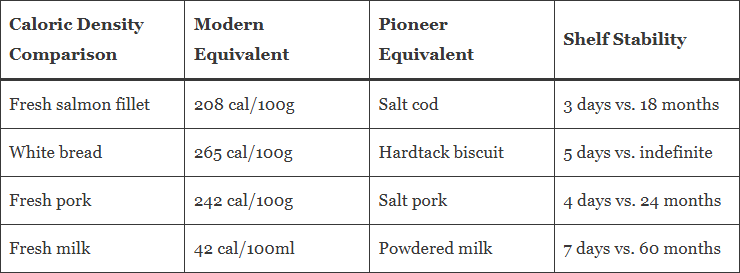
Yet this substance—gray, fatty, aggressively saline—carried the Appalachian frontier through winters when fresh protein meant hunting in snow up to the thigh. A hog slaughtered in autumn yielded approximately 150 pounds of preserved meat. Combined with dried beans, cornmeal, and wild greens when available, this sustained a family of six until thaw. Caloric density reached 800 calories per portion. Fat content approached 85%.
Preservation mathematics governed every aspect of pioneer existence. A family of six required roughly 1,200 pounds of flour annually. They needed 400 pounds of pork, minimum. Salt requirements reached 50 pounds annually, not for taste, but for preservation chemistry. The modern consumer encounters these figures with the incomprehension of a foreign language. Yet this lexicon of scarcity once constituted the only vocabulary of existence.
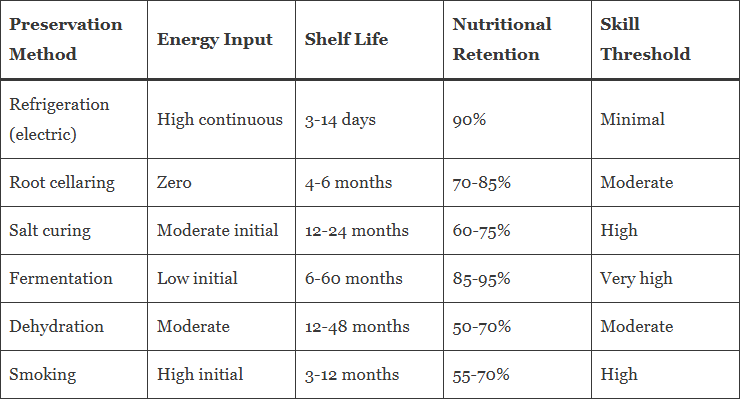
Root cellars exemplified the architectural response to thermodynamic reality. Temperature ten feet below ground remains constant, approximately fifty-five degrees Fahrenheit year-round, regardless of surface conditions. This stability allowed pioneers to store root vegetables through months of killing frost. Potatoes, turnips, carrots, beets, parsnips—these subterranean storage organs became the winter staff of life. Sand packing prevented moisture accumulation that would trigger rot. Darkness prevented photosynthesis that would turn potatoes toxic with solanine. Ventilation systems, often simple pipes extending above ground, allowed ethylene gas to escape while preventing carbon dioxide buildup that would suffocate the stored crop.
The modern freezer—electric, automatic, effortless—has severed this knowledge. When electricity fails, frozen bounty becomes a liability, a ticking clock of spoilage that must be consumed immediately or lost entirely. The pioneer faced no such vulnerability. The root cellar required no fuel, no maintenance, no technological infrastructure beyond construction knowledge and excavation labor. It was permanent. Silent. Immune to grid failure.
Hardtack illustrates brutal functionality in edible form. This cracker—flour, water, salt, baked until achieving the density of kiln-fired ceramic—sustains indefinitely. Civil War soldiers carried it in haversacks. Arctic explorers cached it in supply depots. The texture defies modern dental work. The flavor suggests cardboard. Yet a single square delivers concentrated carbohydrates sufficient to fuel hours of physical labor. It does not spoil. It does not mold. It awaits the teeth desperate enough to crack it.
The return to such staples will shock contemporary eaters. Taste buds calibrated to high fructose corn syrup and artificial flavor enhancers find authentic food—simple, unadorned, minimally processed—bland to the point of inedibility.
This is not accidental. The food industry has spent decades engineering hyper-palatability, bypassing natural satiety mechanisms, creating substances that override biological stop signals. The pioneer diet operated on opposite principles. It filled the stomach. It provided energy. It asked no sensory indulgence.
Fermentation arts present another dimension of preservation largely lost to the industrial age. Sauerkraut—cabbage shredded, salted, packed in crocks to undergo lacto-fermentation—provided vitamin C through winter months when fresh produce meant scurvy. The process required no heat, no electricity, no specialized equipment beyond a heavy ceramic vessel and a stone weight. The resulting product stored for years, growing more acidic, more complex, more nutritionally available with time. Korean kimchi, German sauerkraut, Eastern European pickles, Asian fish sauces—these were survival technologies, the microbial transformation of perishable substrates into stable, nutrient-dense foods.
Pioneers knew seasons with the intimacy of dependence. They knew the exact week when root vegetables must enter storage. They understood humidity requirements of different crops, temperature thresholds of safety, subtle signs of fermentation gone wrong. A failed harvest meant dependency. Dependency meant vulnerability. Vulnerability meant, in extremis, death.
The agricultural calendar governed existence with the rigidity of natural law. Planting too early risked frost-killed seedlings. Planting too late risked immature crops at first frost. Harvesting at wrong moisture content meant mold in storage. Every decision carried consequences measured in survival probability.
The transition back to historical patterns will not be voluntary. It will be forced by circumstance, by the withdrawal of industrial supports that have made food a matter of convenience rather than labor. The body will resist. The mind will rebel. But biology is patient. Metabolisms recalibrate. Palates dull to the absence of artificial intensity.
The sour tang of fermented cabbage becomes, through sheer repetition, not merely tolerable but craved. This is human adaptation plasticity, the same mechanism that allowed Inuit populations to thrive on fat-protein diets devoid of agriculture, that permitted Polynesian navigators to sustain themselves on preserved taro and fish for months of oceanic voyaging.
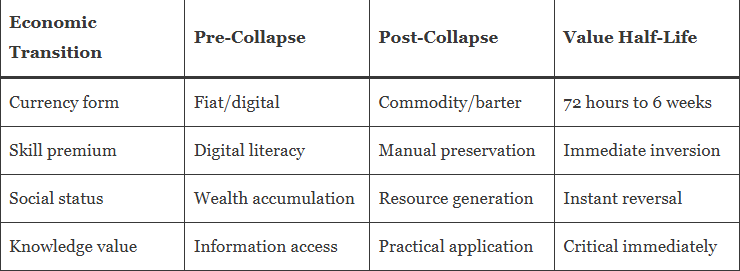
Social dimensions will prove equally jarring. Food will reassert its role as currency. Salt, historically more valuable than gold in frontier economies, will resume its ancient status. The ability to preserve meat, to ferment vegetables, to mill grain—these skills will translate directly into social capital, into authority, into survival itself. The elderly, currently marginalized in youth-obsessed culture, will become repositories of essential knowledge. Their memories of Depression-era techniques, of wartime rationing adaptations, of pre-industrial foodways preserved in immigrant traditions, will carry literal life-or-death value.
The psychological toll will manifest in ways the prepper literature rarely acknowledges. Monotony crushes the spirit. Pioneers suffered from something modern psychiatry might term seasonal affective disorder amplified by dietary restriction. They called it cabin fever. Winter months of endless cornmeal mush, of salt pork and beans, of preserved foods devoid of fresh texture or vibrant flavor—these conditions bred despair, violence, the breakdown of social bonds. Spring greens were not merely nutritional relief. They were psychological salvation. The first dandelion greens, the first wild onions, the first shoots of asparagus—these represented not vitamins but hope, visible evidence that the death season had ended.
When infrastructure fails, modern survivors will face not merely physical deprivation but existential disorientation. The supermarket is a temple of choice, a cathedral of apparent abundance. Its absence will trigger grief responses more commonly associated with bereavement. The mourning will be real. The stages—denial, anger, bargaining, depression—will unfold across weeks of empty shelves and failed delivery promises. Acceptance will come only when the stomach overrides the psyche, when caloric necessity crushes gustatory nostalgia.
The foods that persist through this transition will be those that bridge the gap between immediate spoilage and long-term storage. Dried legumes, hard grains, salt-cured meats, fermented vegetables, honey—these substances will form the new substrate of existence, the baseline below which life cannot sustain itself. Everything else will become seasonal luxuries, brief windows of abundance between long stretches of monotonous adequacy.
Pioneers knew this rhythm. They accepted it. They did not expect strawberries in February or fresh milk in January. Their bodies synchronized to the agricultural calendar, to the slaughtering season, to the harvest and the famine. This synchronization required patience that modernity has systematically destroyed. The attention span has been fragmented by digital stimulation. The delayed gratification circuits have atrophied from disuse. The relearning will be painful.
Yet relearning will occur. Human populations are resilient. The knowledge persists in books, in elderly practitioners, in experimental homesteaders who have maintained these skills as hobbies against precisely this contingency. The transfer will be chaotic. Mistakes will be made. Botulism will claim the careless—those who seal preserves without adequate acidification, who smoke meats at insufficient temperatures, who mistake anaerobic bacterial blooms for harmless yeast. Malnutrition will afflict the ignorant—the urbanite who attempts to subsist on white rice alone, who neglects the alkali treatment of corn, who fails to supplement stored foods with the wild greens that prevented deficiency diseases. But the species will adapt, as it has adapted to every previous disruption, every previous collapse, every previous dark age that interrupted the march of progress.
The foods will be the same. Cornmeal, salt pork, dried beans, hardtack, fermented cabbage. The body will recognize them, eventually. The gut microbiome can be recolonized. The palate can be retrained. What cannot be immediately restored is the psychological framework, the acceptance of limitation, the rejection of infinite choice that pioneer existence demanded. This is the true inheritance of the frontier: not the specific recipes, but the resignation to necessity. The understanding that food is fuel, that pleasure is secondary, that survival is the only metric that ultimately matters.
Preserving food required not merely knowledge but infrastructure. Smokehouses for meat curing. Root cellars for vegetable storage. Springhouses for dairy cooling. These were not optional amenities but essential architecture, built before the main dwelling in many frontier settlements. The smokehouse particularly represented a significant investment of labor and materials. Proper construction required tight joinery to maintain temperature, adequate ventilation to control humidity, and careful siting to prevent fire while maximizing draft. A poorly built smokehouse meant spoiled meat. Spoiled meat meant protein deficiency. Protein deficiency meant death when the hunt failed or the livestock sickened.
The chemistry of preservation operated according to principles the pioneers understood empirically if not theoretically. Salt curing worked through osmotic pressure, drawing moisture from bacterial cells and preventing their proliferation. Smoking deposited phenolic compounds that acted as antimicrobial agents while further dehydrating the meat surface. Fermentation created acidic environments hostile to pathogenic organisms while encouraging beneficial bacteria that produced vitamins and predigested nutrients. These processes, refined over centuries of European and Asian agricultural history, were not intuitive. They were inherited knowledge, passed from mother to daughter, from master to apprentice, from survival manual to desperate reader.
Transitioning to these methods will require not merely individual adaptation but social reorganization. Preservation is labor-intensive. A single hog requires days of processing—slaughtering, butchering, salting, smoking. A garden harvest requires weeks of canning, drying, fermenting. The nuclear family, isolated in suburban isolation, lacks the labor pool to process sufficient calories for winter survival. Extended family structures, neighborhood cooperation, communal labor pools—these social forms will reassert themselves not from nostalgia but from necessity. The barn-raising and harvest-bee of pioneer communities were economic imperatives, not social events. The work required collective effort.
The knowledge transmission will follow generational lines in reverse. The elderly, currently dismissed as technologically illiterate, will become critical infrastructure. Those who remember Victory Gardens, who assisted grandparents with hog butchering, who visited farms where pre-industrial methods persisted—these individuals carry living memory of techniques that cannot be learned from books alone. The feel of properly fermented kraut, the smell of adequately smoked ham, the visual cues of safely canned preserves—these sensory knowledges resist textual transmission. They require demonstration. They require apprenticeship.
Foods that dominate the post-collapse diet will shock the contemporary palate not merely by their monotony but by their intensity. Salt pork is aggressively saline. Hardtack requires liquid to render it chewable. Fermented vegetables assault the nose with volatile acids. These are not subtle flavors. They are survival flavors, developed not for pleasure but for preservation efficacy. The modern preference for mild, fresh, subtle tastes represents a luxury of abundance. When abundance ends, the palate must recalibrate or starve.
The nutritional transition will produce physical symptoms beyond mere digestive discomfort. The shift from high carbohydrate, processed diets to high fiber, whole-food diets will trigger intestinal distress of remarkable intensity. The gut microbiome, adapted to simple sugars and refined flours, will undergo population crashes and blooms as new bacterial communities establish themselves. Gas, bloating, diarrhea, constipation—these are not signs of poisoning but signs of adaptation. They will persist for weeks. They will be unavoidable.
The psychological adaptation will prove more challenging than the physical. The modern mind expects variety. It is trained to seek novelty, to tire of repetition, to demand stimulation. The pioneer diet offered none of these. The same twelve foods, prepared in the same three ways, consumed at the same two meals per day, created a gustatory monotony that modern sensibilities cannot comprehend. This monotony was not accidental. It was the price of security. Variety meant risk. Novelty meant potential poisoning or spoilage. Familiarity meant safety.
When the lights flicker out and the shelves empty, this understanding will return. Not as welcome wisdom but as harsh necessity. The pioneers wait in the shadows of the failing grid, their ghostly hands extended, offering the same bargain they struck with every winter: endure the monotony, accept the labor, abandon the luxury of choice, and perhaps see the spring.
Food will be waiting. Cornmeal does not spoil. Salt pork improves with age. Hardtack lasts generations. Fermentation continues its ancient chemistry regardless of human attention. These substances are patient. They have outlasted empires. They will outlast this one. The only question is whether the human animal, so thoroughly domesticated by industrial convenience, can remember how to consume them, how to survive them, how to endure the long winter of their necessity.
Tweet
Continue reading...
[ H/T The Burning Platform ]
Jamestown settlers called it the Starving Time. Of five hundred colonists huddled behind the palisade when November winds struck, sixty remained alive when the thaw finally permitted the river’s navigation again. The accounts survive in fragments—records kept by men too weak to lift their own quills, entries describing the consumption of shoe leather, of rats, of the dead themselves. One entry notes simply: “Today buried the carpenter. Tonight we ate.”
Your ancestors understood something you have forgotten. Civilization floats on a thermodynamic bubble of such fragility that a single failed harvest, a single broken supply chain, a single season of early frost or late blight or locust swarm, could reduce human beings to the biological substrate they desperately pretend to have transcended. The Mayflower pilgrims lost half their number before the first spring. The Donner Party resorted to anthropophagy not after years of deprivation, but after a single miscalculated week in the Sierra Nevada. The Irish potato famine killed one million and scattered another million across the Atlantic in coffin ships, not because food didn’t exist in Ireland, but because the colonial economic system exported grain while the monoculture crop of the poor rotted in the fields.
These are not ancient anomalies. They are structural features of human existence prior to the fossil fuel age. The calorie surplus you enjoy—three thousand daily calories available for every man, woman, and child in the developed world, nearly double the biological requirement—represents a seventy-year aberration. The graph of human nutrition across ten thousand years shows a flat line hovering near subsistence, punctuated by spikes of famine that killed in percentages, not absolute numbers.
You believe yourself immune. You believe the supermarket’s fluorescent abundance constitutes a permanent condition.
Most urban centers maintain inventory equivalent to three to five days of normal consumption. When logistics networks falter—when diesel shortages intersect with driver shortages, when financial instruments that move grain faster than locusts devour it freeze in panicked markets—the transition from abundance to absence occurs with startling velocity. Historical precedents suggest panic buying empties shelves within forty-eight hours of perceived crisis.
Pioneers knew this rhythm intimately. Those weather-beaten souls who hacked clearings from Appalachian forests and traversed the Oregon Trail with wagons heavy not with possessions but with the means of survival understood that food is labor crystallized into sustenance through preservation chemistry, surplus hoarding, and the rejection of gustatory pleasure in favor of caloric density. Their pantries were arsenals. Their root cellars, catacombs of survival. They ate to see spring.
🜲 Your Refrigerator is a Liar
Contemporary eating patterns resemble performance more than sustenance. The demand for Peruvian blueberries in January, Hawaiian pineapple in March, Norwegian salmon every Tuesday—these are not nutritional requirements but displays of abundance made possible by fossil fuel logistics. Behind the kaleidoscopic variety of modern supermarkets lies a terrifying dependency. Most consumers possess no capacity to feed themselves outside the cash-nexus exchange. They know how to convert currency into prepared substances. This distinction matters significantly when currency loses meaning and prepared substances vanish with the same magical abruptness with which they appeared.
Pioneer foodways operated on fundamentally different principles. Consider cornmeal, which formed the substrate of existence for frontier families. Not the sweet, butter-drenched corn on the cob of summer barbecues, but the alkali-treated hominy of Native American agriculturalists who understood nixtamalization centuries before chemists named it. Soaking dried corn in wood-ash lye unlocked niacin and prevented pellagra. Pioneers adopted this technique through desperate observation rather than scientific understanding. They watched indigenous populations thrive where European settlers sickened. They copied. They survived.
Salt pork presents another case study in preservation economics. Modern consumers typically recoil from the concept: meat submerged in brine, packed in barrels, preserved through sodium chloride’s desiccating action.
Yet this substance—gray, fatty, aggressively saline—carried the Appalachian frontier through winters when fresh protein meant hunting in snow up to the thigh. A hog slaughtered in autumn yielded approximately 150 pounds of preserved meat. Combined with dried beans, cornmeal, and wild greens when available, this sustained a family of six until thaw. Caloric density reached 800 calories per portion. Fat content approached 85%.
Preservation mathematics governed every aspect of pioneer existence. A family of six required roughly 1,200 pounds of flour annually. They needed 400 pounds of pork, minimum. Salt requirements reached 50 pounds annually, not for taste, but for preservation chemistry. The modern consumer encounters these figures with the incomprehension of a foreign language. Yet this lexicon of scarcity once constituted the only vocabulary of existence.
Root cellars exemplified the architectural response to thermodynamic reality. Temperature ten feet below ground remains constant, approximately fifty-five degrees Fahrenheit year-round, regardless of surface conditions. This stability allowed pioneers to store root vegetables through months of killing frost. Potatoes, turnips, carrots, beets, parsnips—these subterranean storage organs became the winter staff of life. Sand packing prevented moisture accumulation that would trigger rot. Darkness prevented photosynthesis that would turn potatoes toxic with solanine. Ventilation systems, often simple pipes extending above ground, allowed ethylene gas to escape while preventing carbon dioxide buildup that would suffocate the stored crop.
The modern freezer—electric, automatic, effortless—has severed this knowledge. When electricity fails, frozen bounty becomes a liability, a ticking clock of spoilage that must be consumed immediately or lost entirely. The pioneer faced no such vulnerability. The root cellar required no fuel, no maintenance, no technological infrastructure beyond construction knowledge and excavation labor. It was permanent. Silent. Immune to grid failure.
 Hardtack and the Geometry of Starvation
Hardtack illustrates brutal functionality in edible form. This cracker—flour, water, salt, baked until achieving the density of kiln-fired ceramic—sustains indefinitely. Civil War soldiers carried it in haversacks. Arctic explorers cached it in supply depots. The texture defies modern dental work. The flavor suggests cardboard. Yet a single square delivers concentrated carbohydrates sufficient to fuel hours of physical labor. It does not spoil. It does not mold. It awaits the teeth desperate enough to crack it.
The return to such staples will shock contemporary eaters. Taste buds calibrated to high fructose corn syrup and artificial flavor enhancers find authentic food—simple, unadorned, minimally processed—bland to the point of inedibility.
This is not accidental. The food industry has spent decades engineering hyper-palatability, bypassing natural satiety mechanisms, creating substances that override biological stop signals. The pioneer diet operated on opposite principles. It filled the stomach. It provided energy. It asked no sensory indulgence.
Fermentation arts present another dimension of preservation largely lost to the industrial age. Sauerkraut—cabbage shredded, salted, packed in crocks to undergo lacto-fermentation—provided vitamin C through winter months when fresh produce meant scurvy. The process required no heat, no electricity, no specialized equipment beyond a heavy ceramic vessel and a stone weight. The resulting product stored for years, growing more acidic, more complex, more nutritionally available with time. Korean kimchi, German sauerkraut, Eastern European pickles, Asian fish sauces—these were survival technologies, the microbial transformation of perishable substrates into stable, nutrient-dense foods.
Pioneers knew seasons with the intimacy of dependence. They knew the exact week when root vegetables must enter storage. They understood humidity requirements of different crops, temperature thresholds of safety, subtle signs of fermentation gone wrong. A failed harvest meant dependency. Dependency meant vulnerability. Vulnerability meant, in extremis, death.
The agricultural calendar governed existence with the rigidity of natural law. Planting too early risked frost-killed seedlings. Planting too late risked immature crops at first frost. Harvesting at wrong moisture content meant mold in storage. Every decision carried consequences measured in survival probability.
🜔 The Social Geometry of Scarcity
The transition back to historical patterns will not be voluntary. It will be forced by circumstance, by the withdrawal of industrial supports that have made food a matter of convenience rather than labor. The body will resist. The mind will rebel. But biology is patient. Metabolisms recalibrate. Palates dull to the absence of artificial intensity.
The sour tang of fermented cabbage becomes, through sheer repetition, not merely tolerable but craved. This is human adaptation plasticity, the same mechanism that allowed Inuit populations to thrive on fat-protein diets devoid of agriculture, that permitted Polynesian navigators to sustain themselves on preserved taro and fish for months of oceanic voyaging.
Social dimensions will prove equally jarring. Food will reassert its role as currency. Salt, historically more valuable than gold in frontier economies, will resume its ancient status. The ability to preserve meat, to ferment vegetables, to mill grain—these skills will translate directly into social capital, into authority, into survival itself. The elderly, currently marginalized in youth-obsessed culture, will become repositories of essential knowledge. Their memories of Depression-era techniques, of wartime rationing adaptations, of pre-industrial foodways preserved in immigrant traditions, will carry literal life-or-death value.
The psychological toll will manifest in ways the prepper literature rarely acknowledges. Monotony crushes the spirit. Pioneers suffered from something modern psychiatry might term seasonal affective disorder amplified by dietary restriction. They called it cabin fever. Winter months of endless cornmeal mush, of salt pork and beans, of preserved foods devoid of fresh texture or vibrant flavor—these conditions bred despair, violence, the breakdown of social bonds. Spring greens were not merely nutritional relief. They were psychological salvation. The first dandelion greens, the first wild onions, the first shoots of asparagus—these represented not vitamins but hope, visible evidence that the death season had ended.
When infrastructure fails, modern survivors will face not merely physical deprivation but existential disorientation. The supermarket is a temple of choice, a cathedral of apparent abundance. Its absence will trigger grief responses more commonly associated with bereavement. The mourning will be real. The stages—denial, anger, bargaining, depression—will unfold across weeks of empty shelves and failed delivery promises. Acceptance will come only when the stomach overrides the psyche, when caloric necessity crushes gustatory nostalgia.
The foods that persist through this transition will be those that bridge the gap between immediate spoilage and long-term storage. Dried legumes, hard grains, salt-cured meats, fermented vegetables, honey—these substances will form the new substrate of existence, the baseline below which life cannot sustain itself. Everything else will become seasonal luxuries, brief windows of abundance between long stretches of monotonous adequacy.
Pioneers knew this rhythm. They accepted it. They did not expect strawberries in February or fresh milk in January. Their bodies synchronized to the agricultural calendar, to the slaughtering season, to the harvest and the famine. This synchronization required patience that modernity has systematically destroyed. The attention span has been fragmented by digital stimulation. The delayed gratification circuits have atrophied from disuse. The relearning will be painful.
 The Alchemy of Endurance
Yet relearning will occur. Human populations are resilient. The knowledge persists in books, in elderly practitioners, in experimental homesteaders who have maintained these skills as hobbies against precisely this contingency. The transfer will be chaotic. Mistakes will be made. Botulism will claim the careless—those who seal preserves without adequate acidification, who smoke meats at insufficient temperatures, who mistake anaerobic bacterial blooms for harmless yeast. Malnutrition will afflict the ignorant—the urbanite who attempts to subsist on white rice alone, who neglects the alkali treatment of corn, who fails to supplement stored foods with the wild greens that prevented deficiency diseases. But the species will adapt, as it has adapted to every previous disruption, every previous collapse, every previous dark age that interrupted the march of progress.
The foods will be the same. Cornmeal, salt pork, dried beans, hardtack, fermented cabbage. The body will recognize them, eventually. The gut microbiome can be recolonized. The palate can be retrained. What cannot be immediately restored is the psychological framework, the acceptance of limitation, the rejection of infinite choice that pioneer existence demanded. This is the true inheritance of the frontier: not the specific recipes, but the resignation to necessity. The understanding that food is fuel, that pleasure is secondary, that survival is the only metric that ultimately matters.
Preserving food required not merely knowledge but infrastructure. Smokehouses for meat curing. Root cellars for vegetable storage. Springhouses for dairy cooling. These were not optional amenities but essential architecture, built before the main dwelling in many frontier settlements. The smokehouse particularly represented a significant investment of labor and materials. Proper construction required tight joinery to maintain temperature, adequate ventilation to control humidity, and careful siting to prevent fire while maximizing draft. A poorly built smokehouse meant spoiled meat. Spoiled meat meant protein deficiency. Protein deficiency meant death when the hunt failed or the livestock sickened.
The chemistry of preservation operated according to principles the pioneers understood empirically if not theoretically. Salt curing worked through osmotic pressure, drawing moisture from bacterial cells and preventing their proliferation. Smoking deposited phenolic compounds that acted as antimicrobial agents while further dehydrating the meat surface. Fermentation created acidic environments hostile to pathogenic organisms while encouraging beneficial bacteria that produced vitamins and predigested nutrients. These processes, refined over centuries of European and Asian agricultural history, were not intuitive. They were inherited knowledge, passed from mother to daughter, from master to apprentice, from survival manual to desperate reader.
Transitioning to these methods will require not merely individual adaptation but social reorganization. Preservation is labor-intensive. A single hog requires days of processing—slaughtering, butchering, salting, smoking. A garden harvest requires weeks of canning, drying, fermenting. The nuclear family, isolated in suburban isolation, lacks the labor pool to process sufficient calories for winter survival. Extended family structures, neighborhood cooperation, communal labor pools—these social forms will reassert themselves not from nostalgia but from necessity. The barn-raising and harvest-bee of pioneer communities were economic imperatives, not social events. The work required collective effort.
The knowledge transmission will follow generational lines in reverse. The elderly, currently dismissed as technologically illiterate, will become critical infrastructure. Those who remember Victory Gardens, who assisted grandparents with hog butchering, who visited farms where pre-industrial methods persisted—these individuals carry living memory of techniques that cannot be learned from books alone. The feel of properly fermented kraut, the smell of adequately smoked ham, the visual cues of safely canned preserves—these sensory knowledges resist textual transmission. They require demonstration. They require apprenticeship.
Foods that dominate the post-collapse diet will shock the contemporary palate not merely by their monotony but by their intensity. Salt pork is aggressively saline. Hardtack requires liquid to render it chewable. Fermented vegetables assault the nose with volatile acids. These are not subtle flavors. They are survival flavors, developed not for pleasure but for preservation efficacy. The modern preference for mild, fresh, subtle tastes represents a luxury of abundance. When abundance ends, the palate must recalibrate or starve.
The nutritional transition will produce physical symptoms beyond mere digestive discomfort. The shift from high carbohydrate, processed diets to high fiber, whole-food diets will trigger intestinal distress of remarkable intensity. The gut microbiome, adapted to simple sugars and refined flours, will undergo population crashes and blooms as new bacterial communities establish themselves. Gas, bloating, diarrhea, constipation—these are not signs of poisoning but signs of adaptation. They will persist for weeks. They will be unavoidable.
The psychological adaptation will prove more challenging than the physical. The modern mind expects variety. It is trained to seek novelty, to tire of repetition, to demand stimulation. The pioneer diet offered none of these. The same twelve foods, prepared in the same three ways, consumed at the same two meals per day, created a gustatory monotony that modern sensibilities cannot comprehend. This monotony was not accidental. It was the price of security. Variety meant risk. Novelty meant potential poisoning or spoilage. Familiarity meant safety.
When the lights flicker out and the shelves empty, this understanding will return. Not as welcome wisdom but as harsh necessity. The pioneers wait in the shadows of the failing grid, their ghostly hands extended, offering the same bargain they struck with every winter: endure the monotony, accept the labor, abandon the luxury of choice, and perhaps see the spring.
Food will be waiting. Cornmeal does not spoil. Salt pork improves with age. Hardtack lasts generations. Fermentation continues its ancient chemistry regardless of human attention. These substances are patient. They have outlasted empires. They will outlast this one. The only question is whether the human animal, so thoroughly domesticated by industrial convenience, can remember how to consume them, how to survive them, how to endure the long winter of their necessity.
Tweet
Continue reading...
[ H/T The Burning Platform ]