


Alberta residents will head to the polls Monday for a historic referendum that could set the oil-rich Canadian province on a path toward independence, possibly reshaping Canada’s political landscape and its relationship with the United States.
The Oct. 19 vote will not determine whether Alberta immediately separates from Canada. Instead, voters will decide whether the provincial government should begin the legal process required to hold a future referendum on independence.
The vote comes amid growing tensions between Washington and Ottawa over President Donald Trump’s trade policies and repeated suggestions that Canada become the 51st U.S. state. Canadian Prime Minister Mark Carney has urged Albertans to reject separation, warning that threats from abroad make national unity increasingly important.
The referendum is one of 10 questions on Monday’s ballot, which also addresses immigration, access to public services, and voter identification requirements. Polling has indicated that most Albertans favor remaining in Canada, although the independence movement has garnered enough support to force a debate over the province’s future.
How did Alberta get here?
Alberta’s independence movement is rooted in decades of frustration with Canada’s federal government, particularly over energy policy, taxation, and the province’s relationship with Ottawa.
The western province is home to some of the world’s largest proven oil reserves and plays a central role in Canada’s energy industry. Separatists have long argued that Alberta disproportionately contributes to the national economy while facing federal regulations that restrict the development and export of its natural resources.
The movement gained renewed attention during former Prime Minister Justin Trudeau’s administration, when disputes over the national carbon tax and energy structure intensified. COVID-19 restrictions also further stoked separatist movements, with some independence advocates emerging from the 2022 Freedom Convoy protests.
Those frustrations continued after Carney succeeded Trudeau, despite the new prime minister’s efforts to improve relations with Alberta’s energy industry.
Alberta Premier Danielle Smith, a member of the United Conservative Party, has opposed independence but acknowledged growing frustration with Ottawa. She called the referendum after facing pressure from separatists seeking greater provincial autonomy and political leverage over the federal government.
Smith said the referendum polling around 23% was “still too high for my liking,” and has collaborated with Carney in order to show national unity. She has praised Carney for improving relationships with the province damaged by his predecessor.
The independence movement also pursued a citizen-led petition to force a vote. That effort became entangled in litigation over Indigenous treaty rights and the provincial government’s obligation to consult First Nations communities.
In May, an Alberta court squashed the separatist petition process, finding that the province had failed to adequately address its constitutional obligations to Indigenous peoples. The decision was appealed, and election officials subsequently verified that the petition had collected enough signatures to meet the statutory threshold.
The government-organized referendum, however, is proceeding separately from that legal dispute.
What happens if the referendum passes?
A vote in favor of separation would not immediately make Alberta an independent country.
Instead, it would direct Smith’s government to begin the legal process required to hold a second referendum specifically addressing whether Alberta should leave Canada.
Canadian law places significant restrictions on provincial succession. A 1998 Supreme Court of Canada ruling following Quebec’s vote on leaving the country established that provinces cannot unilaterally declare independence, even with majority support from their residents.
Parliament subsequently passed the federal Clarity Act in 2000, establishing conditions for negotiations over secession. The legislation requires a clear referendum question and a clear majority in favor of independence before the federal government can enter negotiations, although it does not establish a fixed percentage for what constitutes a clear majority.
GAVIN NEWSOM SAYS TRUMP DOJ INVESTIGATION WON’T HAVE CHILLING IMPACT ON 2028 RUN: ‘QUITE THE CONTRARY’
Even if Albertans eventually voted for independence in a subsequent referendum, separation would require extensive negotiations involving Canada’s federal government and other provinces, as well as constitutional changes.
Those negotiations could address Alberta’s share of Canada’s national debt, federal assets, citizenship, borders, natural resources, and trade agreements.
Indigenous treaty rights would pose another major obstacle. First Nations leaders have argued their agreements with the Canadian government predate Alberta’s establishment as a province in 1905 and cannot simply be transferred to a newly independent state.
Smith has said she would respect the outcome of Monday’s vote and move toward another referendum if voters support beginning the separation process.
A vote to remain in Canada would leave Alberta’s current constitutional status unchanged.
What is at stake for the United States and Canada?
The referendum comes during a particularly sensitive moment for U.S.-Canada relations as Trump continues to pursue aggressive trade policies against one of America’s largest trading partners.
Alberta’s energy industry is deeply embedded in the U.S. economy through pipelines supplying Canadian crude oil to American refineries.
According to the Canada Energy Regulator, Canada supplied 63.4% of U.S. oil imports in 2025, along with nearly all the natural gas imported by the U.S. Canadian exports of crude oil, refined petroleum, natural gas, and natural gas liquids to the U.S. totaled $157.5 billion the same year. Over 80% of those exports originated in Alberta.
An independent Alberta could raise complicated questions about the future of cross-border pipelines, energy agreements, and trade relationships governed by agreements between Washington and Ottawa.
The separatist movement has also attracted attention in Washington. The Financial Times reported earlier this year that Trump administration officials met with representatives of Alberta’s independence movement, raising questions about American involvement in Canada’s internal political affairs.
President Donald Trump speaks with Canadian Prime Minister Mark Carney, right, at a working lunch with leaders of G7 and the Middle East in Evian-les-Bains, France, Tuesday, June 16, 2026. (Evelyn Hockstein/Pool Photo via AP,File)
" data-large-file="https://www.washingtonexaminer.com/wp-content/uploads/2026/08/AP26203838804160_599108.jpg?w=1024" src="https://www.washingtonexaminer.com/wp-content/uploads/2026/08/AP26203838804160_599108.jpg?w=1024" alt="President Donald Trump speaks with Canadian Prime Minister Mark Carney." class="wp-image-4699355" srcset="https://www.washingtonexaminer.com/wp-content/uploads/2026/08/AP26203838804160_599108.jpg 1024w, https://www.washingtonexaminer.com/...08/AP26203838804160_599108.jpg?resize=300,200 300w, https://www.washingtonexaminer.com/...08/AP26203838804160_599108.jpg?resize=768,512 768w" sizes="(max-width: 1024px) 100vw, 1024px">
President Donald Trump speaks with Canadian Prime Minister Mark Carney, right, at a working lunch with leaders of G7 and the Middle East in Evian-les-Bains, France, Tuesday, June 16, 2026. (Pool Photo via AP)
Carney has pushed back against the prospect of foreign interference. Speaking to Global News on Thursday, he said Canada had made its expectations clear that foreign governments, including the U.S., should stay out of the referendum.
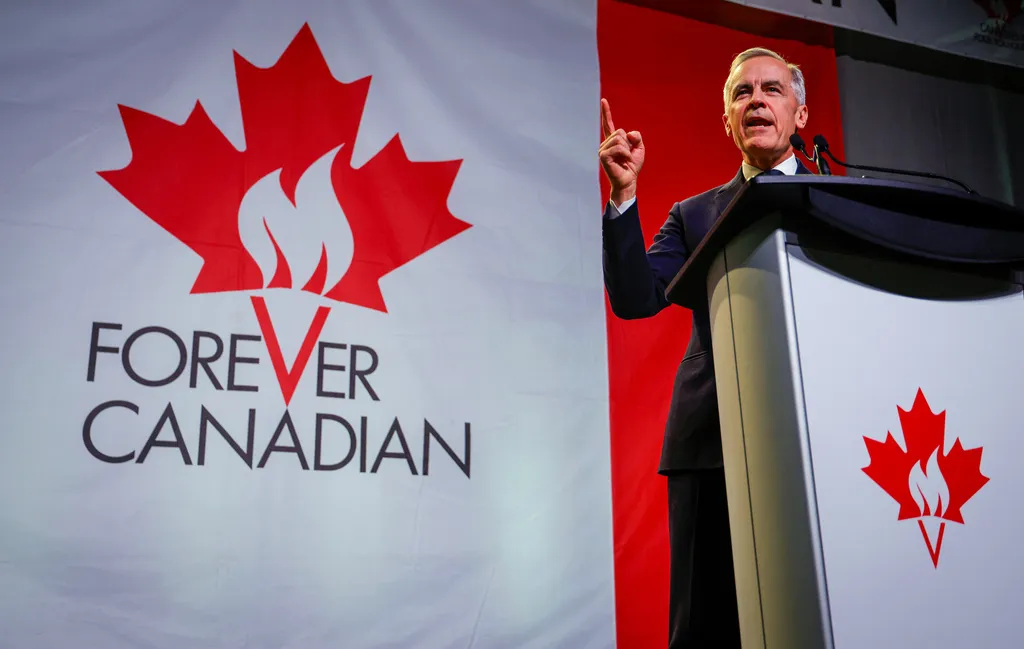
The prime minister escalated his warnings during a series of pro-Canada rallies in Alberta in the final days before the vote.
“This is not a game. This is not poker. A vote against Canada is a dangerous bluff that will lead to years of deep uncertainty and lost opportunities for Albertans and Canadians,” Carney told supporters in Edmonton on Friday.
Carney did not name Trump, but the warning came against the backdrop of the president’s repeated suggestions that Canada join the U.S.
Carney has also pointed to his government’s proposed Pacific Link pipeline, which would provide Alberta’s oil industry with greater access to overseas markets, as evidence that the province can strengthen its economy without separating from Canada.
The prime minister argued the project would help reduce Canada’s dependence on the U.S. while expanding opportunities for Alberta’s energy industry.
HUGO GURDON: KATIE ZACHARIA WAS BAD, BUT THE JOB IS BECOMING IMPOSSIBLE
Carney, who grew up in Edmonton, warned voters against supporting the separation process merely to express frustration with Ottawa, saying it could lead to years of economic and political uncertainty.
Elections Alberta plans to count Monday’s ballots by hand, and the question on separation will be counted first. Results are expected within 48 hours after polls close, to be announced Oct. 29.
Continue reading...
[ H/T Washington Examiner ]