





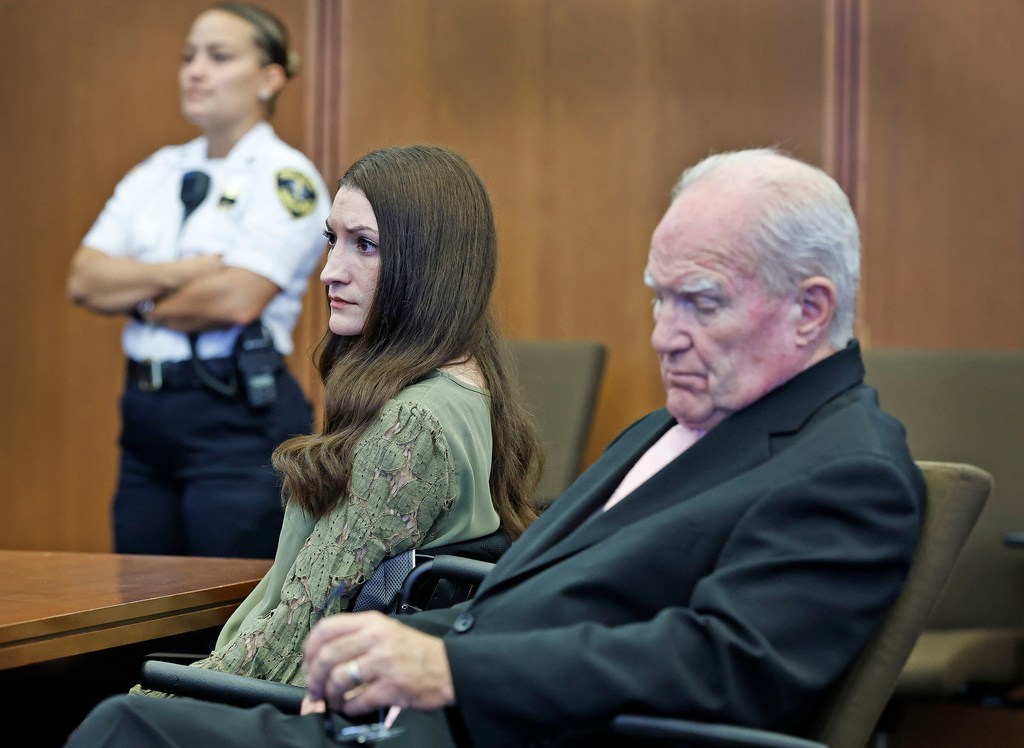
The insanity defense and incompetency rulings are being rampantly abused by defense attorneys and soft-on-crime judges, making a mockery of the criminal justice system and the victims of crime in the process.
The case of Lindsay Clancy brought a renewed focus on this issue. Clancy murdered her three children by strangulation and pleaded not guilty by reason of insanity, claiming postpartum psychosis. The claim itself is dubious, given that Clancy deliberately strangled each of her three children to death over a span of several minutes after deliberately sending and keeping her husband out of the house on errands. Clancy claimed to have killed her children because she heard a voice tell her to do so, and yet has not claimed to hear that voice before or since despite her alleged history of mental turmoil.
LINDSAY CLANCY HOLDOUT JUROR DISCUSSES HARASSMENT, FEARS, AND MEDIA ATTENTION AFTER MISTRIAL
Throughout the trial, Clancy and her legal team acknowledged that she killed her children but maintained that she should not be held criminally responsible, hence the decision to plead not guilty due to insanity. Her lawyer, Kevin Reddington, repeatedly acknowledged that Clancy killed her children, claiming that it was a cocktail of medications and untreated psychosis that were responsible. The insanity defense was full of holes, but the one undeniable fact that everyone agreed on was that Lindsay Clancy killed her children.
The defense almost worked. The jury deadlocked, and the trial was ruled a mistrial, but 11 of the 12 jurors supported Clancy’s insanity defense.
Only later came the proof that Clancy and her team were abusing the insanity defense.
After Reddington failed to remove the holdout juror (and launched a legal and media pressure campaign to intimidate potential future jurors), he decided that Clancy did not kill her children at all. Reddington instead asked the judge to throw out the case entirely because “There is not enough evidence that this woman killed those children” and “this entire case is based on speculation.” Emboldened by the near victory with the jury, Reddington abandoned the central tenet of the insanity defense — that Clancy killed her children — and the insanity plea along with it.
In other words, Reddington essentially admitted to lying to the jury and the public to get the verdict he wanted for his client. The insanity plea was just a tool, one that he used to free Clancy and one that he will almost certainly return to if prosecutors decide to try the case again.
This is not a defense attorney merely advocating for his client; it is a defense attorney manipulating the system and undermining trust in jury trials, one insincere insanity plea at a time.
The common refrain you may hear in response to much of this is that being found not guilty by insanity does not allow a criminal to “go free,” but that is essentially what it does. In Massachusetts, if Clancy had been found not guilty by insanity, she would undergo up to 40 days of evaluations before potentially being committed for a period of six months. A judge would then review her status every year, meaning she could realistically only serve a few years in an institution before walking free. Or a mere six months.
A prime example comes from Kentucky. In 2015, Ronald Exantus broke into a home and stabbed a 6-year-old boy to death. Exantus was found not guilty by reason of insanity for that murder and guilty but mentally ill on three counts of attacking the boy’s family members. He served a grand total of seven years in prison, and was not subject to an immediate involuntary hospitalization proceeding after being released.
In other words, Exantus stabbed a child to death, pleaded insanity, and walked free within seven years. He was deemed so insane that he could snap and brutally murder a child at a moment’s notice, and yet he was loosed on the public.
Others don’t even need to wait seven years, thanks to the incompetence loophole. Whereas criminals found not guilty by insanity can avoid true justice for their crimes, alleged criminals deemed incompetent to stand trial can avoid even going through the trial process at all. Take DeCarlos Brown Jr., the man accused of brutally stabbing Ukrainian refugee Iryna Zarutska to death on a North Carolina train in an infamous 2025 case.
Brown had a long criminal history prior to the incident, but he was free to roam the streets because his most recent trial had been delayed. Brown’s defense attorney had requested a mental health evaluation, and the judge simply released Brown to pursue that evaluation on his own time. Unsurprisingly, he never did. It cost Iryna Zarutska her life.
The incompetency sham continued, with Brown being declared incompetent to stand trial in the murder case. Supposedly, Brown is not mentally competent enough to contribute to his own defense, but was mentally competent enough to flee the scene after the murder and attempt to discard both the alleged murder weapon (the knife) and the sweatshirt he was wearing that could be used to identify him by appearance. And, like seemingly all violent criminals deemed “insane” or “incompetent” in random acts of public violence, Brown just so happened to allegedly target a small, vulnerable woman incapable of fighting back.
Take a more recent example in Rhode Island, where Nelson Blanco was walking free despite a 30-year history of crime. Blanco allegedly stabbed two children in 2003 but was deemed unfit to stand trial, was deemed incompetent to stand trial in 2018 for being in possession of a stolen vehicle, and was arrested for domestic violence in 2024. However, in 2025, he was released to the custody of Rhode Island health officials. That led to him being back out on the street a year later, where he allegedly stabbed a mother and her child (again, two vulnerable victims incapable of fighting back) earlier this month. The two-year-old girl is still in critical condition.
CALIFORNIA: WHERE ATTEMPTED MURDER IS WORTH ONE DAY IN JAIL
In all of the cases listed above (not counting Clancy), these men were deemed too crazy to understand whether their acts were right or wrong or the fact that they were on trial. And yet, based on the incompetency and insanity laws that are on the books, they were protected from facing justice for their crimes and not institutionalized for the rest of their lives. Too crazy to face the justice system, but not crazy enough to prevent them from walking the streets alongside the women and children that they (allegedly) went on to victimize.
As the Clancy case has shown, these insanity and incompetency rulings are increasingly insincere, a tactic taken up by criminals and their defense attorneys, knowing the law treats “insane” criminals with kid gloves. The insanity defense and incompetent to stand trial rulings do nothing to benefit the public or the few criminals who are genuinely insane, who are released instead of receiving the long-term institutional care they need. They serve now only as a loophole for criminals who hope that the justice system will excuse them from their crimes on mental health grounds.
Continue reading...
[ H/T Washington Examiner ]