


CAMBRIDGE, Massachusetts — Last year, in these pages, I explored the myriad challenges facing Harvard University.
A year and a half after Hamas’s brutal invasion of Israel, which prompted a rash of virulently anti-Israel and antisemitic incidents on campus, Jewish students widely reported a lack of safety. In response, in March 2025, the Trump administration’s Joint Task Force to Combat Anti-Semitism announced a “comprehensive review” of $9 billion in grants and contracts due to Harvard’s “failure to protect students on campus from anti-Semitic discrimination.”
A follow-up letter from the White House asserted that the school had “failed to live up to both the intellectual and civil rights conditions that justify federal investment.”
Soon thereafter, President Donald Trump himself declared on Truth Social that “we are going to be taking away Harvard’s Tax Exempt Status. It’s what they deserve!”
A lengthy legal battle ensued, and continues today, as the university sought, and seeks, to restore frozen federal funds and make life more hospitable for all students, including Jewish ones. These efforts included establishing an antisemitism task force with wide-ranging authority to survey the campus climate and present recommendations for its amelioration. But it ultimately falls on university administrators, most prominently President Alan Garber, to carry out those suggestions.
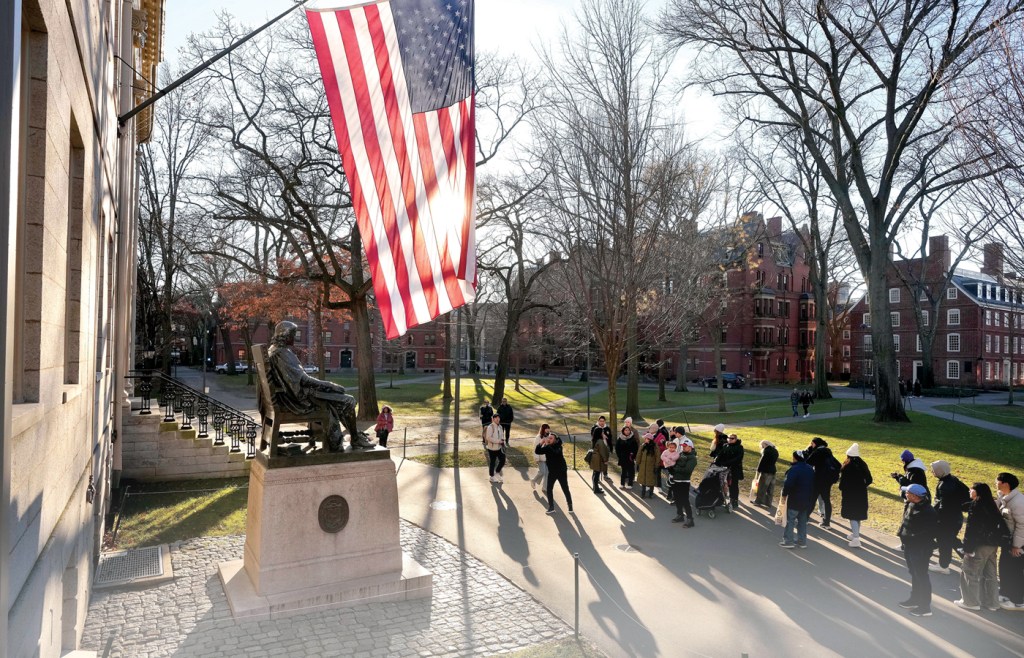
People take photos near a John Harvard statue, left, on the Harvard University campus, Jan. 2, 2024, in Cambridge, Mass. (Steven Senne/AP)
" data-large-file="https://www.washingtonexaminer.com/wp-content/uploads/2026/10/Fea_Restoring.102126.jpg?w=1024" height="658" width="1024" src="https://www.washingtonexaminer.com/wp-content/uploads/2026/10/Fea_Restoring.102126.jpg?w=1024" alt="People take photos near a John Harvard statue, left, on the Harvard University campus, Jan. 2, 2024, in Cambridge, Mass. (Steven Senne/AP)" class="wp-image-4769719" srcset="https://www.washingtonexaminer.com/wp-content/uploads/2026/10/Fea_Restoring.102126.jpg 1400w, https://www.washingtonexaminer.com/...26/10/Fea_Restoring.102126.jpg?resize=300,193 300w, https://www.washingtonexaminer.com/...26/10/Fea_Restoring.102126.jpg?resize=768,494 768w, https://www.washingtonexaminer.com/...6/10/Fea_Restoring.102126.jpg?resize=1024,658 1024w" sizes="(max-width: 1024px) 100vw, 1024px">
People take photos near a John Harvard statue, left, on the Harvard University campus, Jan. 2, 2024, in Cambridge, Mass. (Steven Senne/AP)
At the time, I identified four key goals the university had to achieve, including promptly and verifiably implementing the recommendations its antisemitism task force made; honestly and full-throatedly confronting the problem of foreign students who make common cause with terrorist organizations such as Hamas and Hezbollah, including by expelling students who advance those groups’ interests; genuinely advancing meritocratic practices in hiring and admissions and abandoning its rearguard actions to circumvent the Students for Fair Admissions v. Harvard decision; and restoring a culture of truly open intellectual inquiry.
Nearly 18 months later, and three years after Oct. 7, 2023, how thoroughly has Harvard met these metrics? Has a school whose motto, “Veritas,” means “truth” returned to its true mission? Can students, especially Jewish students, participate fully and confidently in campus life? I returned to my alma mater to try to find out, and while I saw encouraging signs, America’s oldest university still has a long way to go.
Implementing antisemitism task force recommendations
In April 2025, the task force released its long-awaited 311-page study, which found “growing acceptance of stances once seen as outside mainstream debate,” the “social exclusion of some Jewish students and a resulting reluctance on their part to fully express Jewish or Israeli identities or pro-Israel views,” and “extensive levels of discomfort, alienation, and fear” among Jewish students.
Much of the heartache arose from a grotesque letter signed by 31 student organizations on Oct. 8, 2023, one day after Hamas had murdered 1,200 Israelis, the vast majority of them civilians; wounded thousands more; and abducted 250. Titled “Joint Statement by Harvard Palestine Solidarity Groups on the Situation in Palestine,” the letter stated that “we, the undersigned student organizations, hold the Israeli regime entirely responsible for all unfolding violence.” That letter presaged dozens of vituperatively anti-Israel campus demonstrations, numerous verbal and physical assaults on identifiably Jewish students, the tearing down of posters depicting the Israeli hostages held by Hamas, and a nearly monthlong encampment in the storied Harvard Yard.
When I arrived on campus on Oct. 8, a day after Israelis, Jews, and their allies around the world solemnly marked the three-year anniversary of the onslaught, I was pleasantly surprised to encounter no evidence of anti-Israel animus. Nary a protest nor a poster nor a dorm room banner castigating the Jewish state for its supposed crimes against humanity was visible to the naked eye, at least during my various visits to the yard and several residential houses. Jewish life appeared to be humming along at Harvard Hillel, where Jewish students receive hot, kosher dinners.
A night earlier, Harvard students observed the grim milestone, as a crowd of about 100 gathered in a vigil outside the centrally located Zimmer Hall. “Our tradition is wise in grief,” Rabbi Jason Rubenstein told the assembled. “We, over the last years since Oct. 7, have learned from its wisdom and have become, in the saddest of ways, wiser as well.” At the same time, Rubenstein acknowledged, “the very world we inhabit is not the same world. It’s not as safe a world. It’s not as sure a world.”
The sense I got from current students is that things have calmed down considerably since the fiery confrontations of the first 18 months of the war. One law student told me he doesn’t sense hostility on campus in general, noting that two silent protesters appeared at the separate Harvard Law School Oct. 7 memorial wearing keffiyehs and holding signs decrying “80 years of genocide.” Shortly after the event began, Harvard University Police Department officers escorted them out of the hall where the event took place.
But there have been other, more troubling incidents as well, as the Washington Free Beacon’s Ira Stoll, himself a Harvard alumnus, has doggedly reported. In March, the Justice Department sued Harvard over what it called the school’s “toothless non-response to the ongoing relentless antisemitic on-campus discrimination.” For example, Harvard’s English and history departments paid nearly $50,000 to Ta-Nehisi Coates to appear on campus on the second day of the Rosh Hashanah holiday “to read from his chapter on Palestine,” while, more recently, the university’s Kennedy School of Government invited New York Times columnist Nicholas Kristof to defend his notorious column alleging that Israel trains dogs to rape Palestinian prisoners. And just last month, Harvard Law School’s International Human Rights Clinic released a report inaccurately singling out the Jewish state for supposed improper use of white phosphorus.
Thus, while Garber appears to have taken steps to right the ship, his administration still has a long way to go to improve the campus climate for Jewish students.
Confronting disruptive foreign students allied with terrorist groups
If Harvard’s Jewish students still find themselves recovering from the depredations of hateful protesters, what about those antagonists themselves?
Many of the ferociously anti-Israel demonstrators were foreign-born and held student visas. In June 2025, the Trump administration targeted them by imposing significant restrictions on visa holders. The proclamation suspended “the entry into the United States of any new Harvard student as a nonimmigrant under F, M, or J visas” and directed Secretary of State Marco Rubio “to consider revoking existing F, M, or J visas for current Harvard students who meet the Proclamation’s criteria.”
Among the reasons the White House provided was that “Harvard has failed to adequately address violent anti-Semitic incidents on campus, with many of these agitators found to be foreign students.” In typical over-the-top fashion, Trump contended that “we are still waiting for the Foreign Student Lists from Harvard so that we can determine, after a ridiculous expenditure of BILLIONS OF DOLLARS, how many radicalized lunatics, troublemakers all, should not be let back into our Country.”
Harvard promptly sued, seeking an injunction against the visa restrictions. And in June 2025, shortly after my initial article went to press, Judge Allison Burroughs of the U.S. District Court for the District of Massachusetts enjoined the suspensions of visas, chastising “the government’s misplaced efforts to control a reputable academic institution and squelch diverse viewpoints seemingly because they are, in some instances, opposed to this Administration’s own views.” She reserved particular opprobrium for what she characterized as the White House’s “attempts to accomplish this, at least in part, on the backs of international students, with little thought to the consequences to them or, ultimately, to our own citizens.”
But the administration insisted that it maintains significant latitude in enforcing immigration policy, including by denying visas to people with demonstrated links to foreign terrorist groups. Outside of the specific Harvard context, Rubio has waged a lengthy battle to deport Mahmoud Khalil, a Syrian-born graduate student at Columbia University who has spearheaded anti-Israel protests and has steadfastly refused to condemn Hamas. Rubio asserted last year that “the foreign policy of the United States champions core American interests and American citizens and condoning anti-Semitic conduct and disruptive protests in the United States would severely undermine that significant foreign policy objective.”
At a hearing earlier this month before the 1st Circuit Court of Appeals, the administration argued for lifting Burroughs’s injunction. The three-judge panel pressed both the White House and the university over their respective claims, with especially strong scrutiny applied to the government’s lawyers. As the Harvard Crimson put it, the “judges cast doubt on the government’s justifications for the proclamation, including allegations that Harvard fostered antisemitism on campus and collaborated with the Chinese Communist Party.” In particular, Judge Gustavo A. Gelpi Jr. questioned whether the Trump proclamation would also prevent entry to Israeli students and Jewish students from countries outside the U.S. “Eradicating antisemitism, but also eradicating semitism,” Gelpi quipped.
The case may eventually wind up before the Supreme Court. Yet it’s ultimately Harvard itself that enjoys both the power and the responsibility to assess the students it admits carefully, including foreign students, and ensure they adhere to a code of conduct that respects the rights of all of Harvard’s constituents, including its Jewish and pro-Israel ones.
Advancing meritocratic practices
Meritocracy represents another area of tension between the Trump administration and the university. The White House has long criticized Harvard, and academia writ large, for its reliance on affirmative action in admissions and for its deployment of a diversity, equity, and inclusion framework throughout its many schools. The university, it seems, has made halting progress in responding to the administration’s concerns without fully addressing them.
With respect to admissions, the Supreme Court in the landmark 2023 Students for Fair Admission v. Harvard case struck down the use of race-based practices altogether. “The student must be treated based on his or her experiences as an individual—not on the basis of race,” Chief Justice John Roberts wrote in a 6-3 ruling. “Many universities have for too long done just the opposite. And in doing so, they have concluded, wrongly, that the touchstone of an individual’s identity is not challenges bested, skills built, or lessons learned but the color of their skin. Our constitutional history does not tolerate that choice.” Here, it’s worth noting that Burroughs, who enjoined enforcement of the funding freeze and the visa suspension, had also upheld Harvard’s affirmative action regime, and the 1st Circuit affirmed her ruling, only for the Supreme Court to reverse it.
But it’s unclear exactly how faithfully Harvard has hewn to the high court’s decision. Harvard Magazine, which is independent of the university, reported in 2025 that “the percentage of first-year Black students matriculating at Harvard College declined for a second consecutive year in the wake of new, court-driven admissions policies, while the percentage of Asian American students has increased.” The publication reported that Harvard no longer considers students’ races or ethnicities when reviewing their applications but that students can choose to self-report their race. Still, upon taking office, Trump issued an executive order that criticized “forced illegal and immoral discrimination programs, going by the name ‘diversity, equity, and inclusion’” and terminated any funds awarded to “federal grantees who received federal funding to provide or advance DEI.” And in its June 2025 proclamation freezing student visas, the White House alleged that “Harvard has persisted in prioritizing diversity, equity, and inclusion (DEI) in its admissions, denying hardworking Americans equal opportunities by favoring certain groups, despite the U.S. Supreme Court’s 2023 ruling against its race-based practices.” The school denied the allegations.
There has also been modest improvement in the university’s approach to race- and ethnicity-based instruction. In August 2025, presumably in response to pressure from the administration, Harvard transformed its DEI infrastructure into a university-wide Office for Community Support, Non-Discrimination, Rights, and Responsibilities. “This new office,” Harvard Vice President Peggy Newell said at the time, “brings together all of the important work happening under the Office for Community Conduct and the Office for Gender Equity and continues it in one place, with the aim of making it easier for members of our community to know what resources and supports are available to them and where they can go in order to access them.”
As part of the restructuring, all Harvard undergraduate and graduate students are required to complete an “eLearning module” comprising videos, text, and a quiz. CSNDR estimates that the course takes an hour to complete, which is consistent with what I heard from students. The office has even established a “Prevention Team” that aims to “reduce discrimination, interpersonal violence, and the impacts of such harm through strategic, educational, and collaborative efforts in the Harvard community.”
All Harvard students, undergraduate and graduate alike, are subject to the school’s Non-Discrimination and Anti-Bullying Policies, which went into effect in September 2023 and which CSNDR now oversees. Those policies include prohibiting unfair treatment on the basis of race; age; sex, “including gender identity and gender expression, as well as pregnancy”; religion; political beliefs; sexual orientation; and several other categories. I’ve been told that, at least in recent years, “Zionism” has been added to this list of categories and to the mandatory training, meaning that students in some schools are expressly instructed that they may not discriminate against students on the basis of their support for the Jewish state. The CSNDR website appears to confirm this, noting that “the Non-Discrimination Policy includes among its protected categories religion, national origin, shared ancestry or ethnic characteristics, and political beliefs. Zionists, anti-Zionists, and non-Zionists are all protected against discriminatory disparate treatment and harassment under the policy.”
Restoring a culture of open intellectual inquiry
Finally, the university has made some progress in reversing its reputation as one of the campuses least congenial to free expression and academic inquiry. In 2024 and 2025, the Foundation for Individual Rights and Expression ranked Harvard dead last among 251 schools in its annual compilation of free speech ratings, obtaining a score of “abysmal.” “Since 2020,” FIRE found, “we documented 20 speech controversies at Harvard that resulted in a deplatforming, a scholar sanction, a student sanction, or an attempted disruption of an event.”
One year later, the school had climbed the rankings by only a few rungs, to No. 245. “A majority of Harvard students report being ‘very’ or ‘somewhat’ uncomfortable expressing their views on controversial political topics across all of the campus settings FIRE asks about,” the organization concluded. Forty-one percent of respondents said that it’s “not at all” or “not very” clear that Harvard protects free speech on campus.
The findings, coupled with pressure from the Trump administration, including the March 2025 letter from Education Secretary Linda McMahon accusing the school of “promoting divisive ideologies over free inquiry,” prompted the university to engage in at least some free expression soul-searching. Garber initiated a faculty-led “Institutional Voice” working group that, in May 2024, advised the school not to “issue official statements about public matters that do not directly affect the university’s core function.”
JUDGE DISMISSES DOJ’S ‘ISOLATED AND EPISODIC’ ANTISEMITISM LAWSUIT AGAINST HARVARD
Happily, in FIRE’s latest rankings, Harvard jumped 174 ranks to No. 71, placing highly in the group’s Political Tolerance and Comfort Expressing Ideas categories. FIRE credited the school’s adoption of its institutional neutrality stance and moved its color-coding ranking from red to yellow in certain areas. At the same time, the organization found that work remains to be done. “Harvard should respond clearly and forcefully to defend free speech whenever censorship occurs or is demanded,” FIRE said. “Doing so will demonstrate the university’s commitment to free speech and build community trust that the administration will defend expressive rights.” Here, again: progress, but not yet enough.
I’ll conclude by quoting Burroughs’s opinion enjoining the administration’s suspension of international student visas: “This case is about core constitutional rights that must be safeguarded: freedom of thought, freedom of expression, and freedom of speech, each of which is a pillar of a functioning democracy and an essential hedge against authoritarianism. It may be that many of us, having grown up in a culture of free speech and thought, have become complacent, but free speech, particularly in the academic arena, must be zealously defended and not taken for granted.” Whatever the merits and demerits of the rest of her opinion, Burroughs’s vigorous defense of free expression deserves applause from all sides. Here’s hoping Harvard, too, will honor its commitment to free speech, academic inquiry, and, above all, veritas.
Michael M. Rosen is an attorney and writer in Israel, a nonresident senior fellow at the American Enterprise Institute, and author of Like Silicon From Clay: What Ancient Jewish Wisdom Can Teach Us About AI.
Continue reading...
[ H/T Washington Examiner ]