





In October 2018, right before the midterm elections of President Donald Trump’s first term, the jobless rate in the United States held at 3.7%, the lowest level since 1969.
The number of available job openings that month would hit an all-time high of 7.6 million. Median household income also rose to historic highs in 2018. Inflation was well within historic norms. Poverty declined to a historic low of 11.8%.
While Trump’s personal approval ratings hovered in the 40s in most polls in late 2018, surveys done by Gallup and others found that a significant number of Americans (usually above 65%) felt it was a good time to find a job. Over 50% of the public generally believed the economy was in excellent or good condition by mid-November 2018. In most polls, voters trusted Republicans over Democrats on the economy.
First-term midterm elections are generally disastrous for the party in the White House. The 2018 midterm elections ended with mixed returns, seeing the Republicans lose control of the House while expanding their majority in the Senate.
There are a host of reasons why voters act the way they do. The economy is obviously an important factor. As we approach the midterm elections of Trump’s second term, voters hold a far uglier perception about the state of affairs.
Trump’s approval rating for his handling of the economy now hovers in the low 30s or even high 20s. In most polls, voters trust Democrats over Republicans to handle the economy. Trump’s approval on the economy is worse than Joe Biden’s was at any point in his presidency. And, like Biden, it is in many ways a self-inflicted political wound.
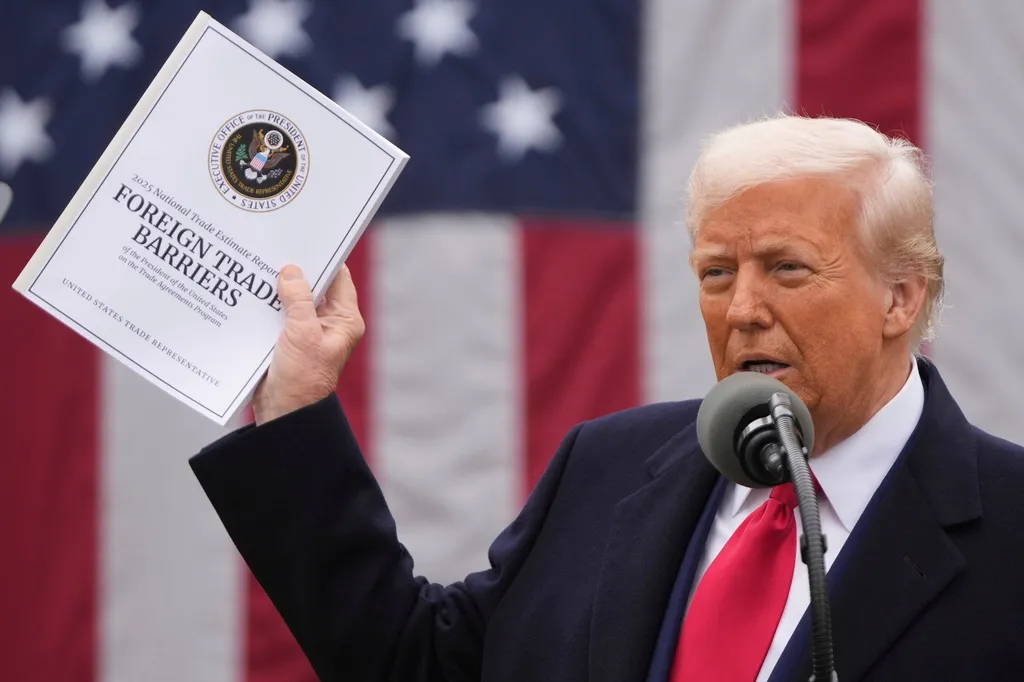
On April 2, 2025, Trump’s approval rating was 47.7%, according to RealClearPolitics aggregated polling. Biden had been at 39% when he left office. On that day, Trump ludicrously declared the trade deficit a national emergency and invoked the International Emergency Economic Powers Act of 1977, abandoning the idea of “reciprocal” trade deals and imposing tariffs on virtually every country and territory in the world.
President Donald Trump speaks during an event to announce new tariffs in the Rose Garden at the White House, April 2, 2025, in Washington. (AP Photo/Mark Schiefelbein)
" data-large-file="https://www.washingtonexaminer.com/wp-content/uploads/2026/09/AP26264196198139.jpg?w=1024" src="https://www.washingtonexaminer.com/wp-content/uploads/2026/09/AP26264196198139.jpg?w=1024" alt="President Donald Trump holds up a document with the words "Foreign Trade Barriers" on it as he speaks during an event to announce new tariffs in the Rose Garden at the White House, Wednesday, April 2, 2025, in Washington." class="wp-image-4742331" srcset="https://www.washingtonexaminer.com/wp-content/uploads/2026/09/AP26264196198139.jpg 1024w, https://www.washingtonexaminer.com/wp-content/uploads/2026/09/AP26264196198139.jpg?resize=300,200 300w, https://www.washingtonexaminer.com/wp-content/uploads/2026/09/AP26264196198139.jpg?resize=768,512 768w" sizes="(max-width: 1024px) 100vw, 1024px">
President Donald Trump speaks during an event to announce new tariffs in the Rose Garden at the White House, April 2, 2025, in Washington. (AP Photo/Mark Schiefelbein)
The stock market immediately plunged 12.4% on “Liberation Day,” its biggest drop since COVID-19. And Trump’s disapproval number spiked over the next month.
Then, during May, Trump delayed numerous tariffs, and his numbers began to climb. By May 29, his approval was back at 47.7%. That was also the day a U.S. Court of Appeals for the Federal Circuit allowed Trump to move forward with his tariffs again. From that day on, the president’s approval was in a downward spiral. Tariffs remain one of Trump’s least popular policies. In most polls, they are less popular than the Iran war.
When normie voters were making their choice in November 2024, many of them surely harbored fond memories of the pre-pandemic Trump I economy. What did the president do in his first two years that he didn’t in 2025 and 2026? Good old-fashioned movement-conservative free-market economics.
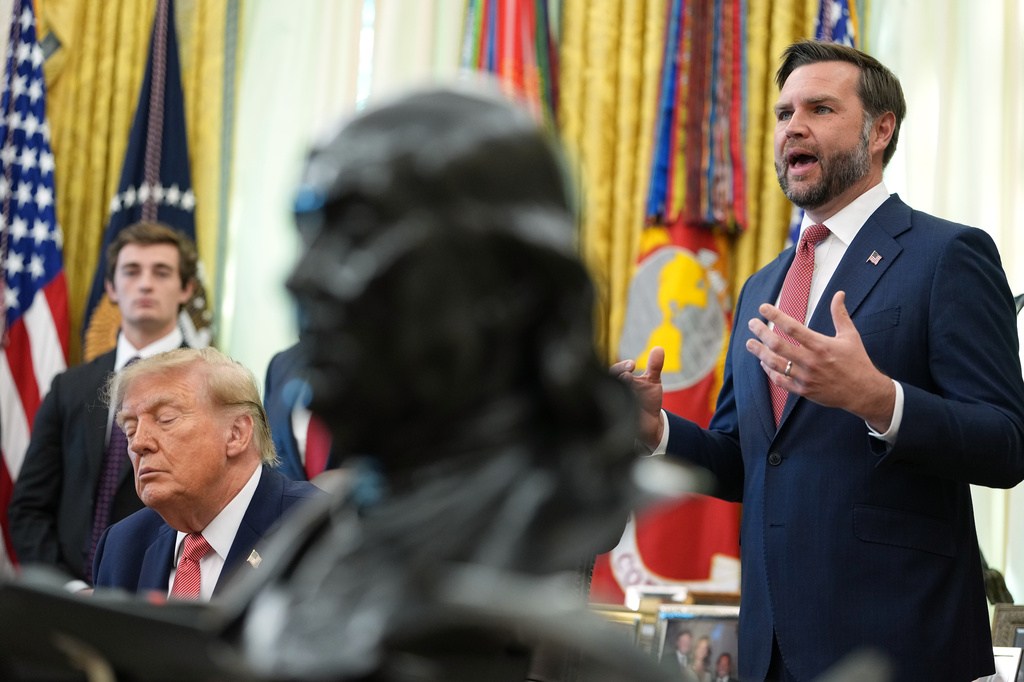
Today, the president is surrounded by left-wing economic voices from former George Soros right-hand man and now Treasury Secretary Scott Bessent to lifelong Democrat and now Commerce Secretary Howard Lutnick to economic progressive and Vice President, JD Vance.
Of course, Trump has always championed protectionism himself. It may well be one of the few policy outlooks that he’s passionately talked about since the 1980s.
Trump entered the White House in 2017 as a political neophyte and was largely compelled to rely on existing conservative infrastructure and personalities. Statist economics had not yet hardened into dogma in certain Trumpworld factions.
Additionally, his administration, dealing with the concocted Russia collusion issue, was likely incentivized to adopt more risk-averse economic policies that would gain congressional support during his first term. Or, as some of us refer to them: policies that work.
Trump and congressional Republicans cut the corporate tax rate (which, like tariffs, is ultimately passed on to consumers) from 35% to 21%. They lowered income tax rates across every income group and expanded the child tax credit. Trump also rolled back numerous regulatory burdens in his first term, including Obama-era environmental rules, all of which were implemented through executive action by his predecessor.
Trump II, on the other hand, unilaterally implemented a host of new regulations and top-down control over economic activity without any buy-in from Congress. It’s not merely that protectionism is a tax on consumers, or that it fosters cronyism, or that it burdens businesses. Trump has administered tariffs in the most impulsive and destabilizing way imaginable.
One site that tracks such things contends that the Trump administration has dropped 749 different announcements, threats, and formal actions since Liberation Day. Among them, 340 tariff measures. There is no way for companies and markets to plan for the mercurial rantings of one man.
Do I believe that voters are clamoring for limited government and free-market economics? Of course not. But they certainly seem to enjoy the benefits a lot more than they do hearing another lecture from the vice president about how the past 40 years were hell.
Trump defenders will likely point out that they would rather do the right thing than the popular one. That is a completely legitimate and admirable position. The problem is that none of the promises of tariffs have come to fruition. Manufacturing, already at historic highs when tariffs were implemented, remains basically stable. The high trade deficit, ostensibly the rationale for Liberation Day, has not shrunk. In April 2025, the trade deficit was $61.6 billion. It was $105.6 billion last month. (You’ll know we’re in trouble when the trade deficit, a sign of our wealth, starts abruptly shrinking.) The number of Americans working in manufacturing jobs was 12.6 million on Liberation Day. It is 12.6 million today.
On Liberation Day, Trump’s defenders argued that protectionism was imperative for paying off the national debt and taking on the threat of China. Today, the president promises to send tariff refund checks to voters if Republicans hold Congress after the midterm elections.
GAVIN NEWSOM SAYS TRUMP DOJ INVESTIGATION WON’T DETER 2028 RUN: ‘QUITE THE CONTRARY’
Meanwhile, the administration is in the middle of fighting a trade war with Canada while the president mollifies Chinese President Xi Jinping at banquets.
Our economy is massive. It can be overcome a lot. But most voters wanted Trump I. They got something very different.
Continue reading...
[ H/T Washington Examiner ]