








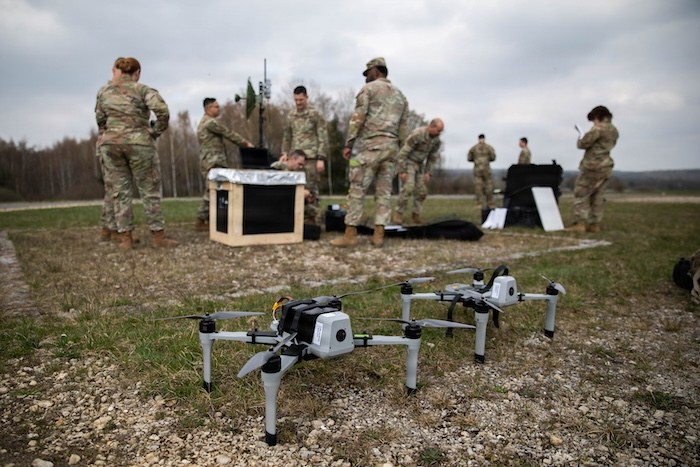
The U.S. military is rapidly working to make its bases all over the world more capable of defending against drone threats as several examples in recent years have demonstrated military installations are obvious targets with vulnerabilities.
Whether it’s bases abroad or domestic, world events have shown “nothing’s a sanctuary anymore,” a senior defense official told reporters at a Defense Writers Group event on Tuesday.
U.S. bases in the Middle East have been damaged by Iranian drones in the war; U.K. authorities prevented a purported Iranian-linked terrorist plot to target U.S. aircraft at Royal Air Force Fairford last month; and several domestic installations have reported unidentified drone sightings overhead in recent years. A daring and notorious Ukrainian drone attack in June 2025 damaged dozens of aircraft and caused more than a billion dollars in damage.
The Pentagon is looking at ways to provide additional countermeasures to military bases, and it’s a big part of the planning for the department’s new base in the continental United States.
“First and foremost is an acknowledgment and a recognition that the drone threat is real, and our ability to protect is part of the job that we’re working on right now, both through the systems that defend our bases, but also it causes us to strategically think differently about that,” the official said. “And I go back to what I said about hardening. When we talk about hardening, we’re talking about how do I protect not only the critical assets like very expensive aircraft and ships and submarines and other things, right? But there are human lives attached to every single one.”
Ukraine’s June 2025 Operation Spiderweb involved the smuggling of drones on a truck into Russian territory. They waited until the driver got to his destination near multiple Russian air bases to launch them, destroying dozens of Russian aircraft and causing more than a billion dollars in damage. This attack became a crystallizing moment for military leaders across the globe to the new defining threat of the next era of conflict.
The defense official said the Ukrainian attack represents “my real nightmares.”
Hardening US bases and rebuilding damaged ones in the Middle East
Multiple U.S. bases in the Middle East have been damaged during the Iran war, but military leaders have not shared specific details about the extent of the damage.
The only comments about base damages came from acting Navy Secretary Hung Cao, who acknowledged that Iranian forces “blew the hell out of Bahrain,” which was a reference to Naval Support Activity Bahrain, home of the U.S. Fifth Fleet.
The senior defense official declined to specify the extent of the damage to the Fifth Fleet headquarters.
“In terms of what’s going on in the Middle East, what I could share there is just simply that we’re meeting with CENTCOM and doing the assessments right now from an installation perspective,” the official said. “Part of this is what will the global posture be in the future, and what does that require us to have?”
The military has also not included the cost of possible repairs in the estimates of war costs given to Congress on various occasions. Pentagon officials have said the damages are not included in the estimate because they have not decided how exactly they intend to rebuild these facilities and whether the host country would contribute to the costs.
This satellite image taken over Naval Support Activity Bahrain on July 23, 2026, displaying extensive damage to the satellite communications system and warehouses. (© Airbus DS 2026 via AP)
" data-image-caption="
This satellite image taken over Naval Support Activity Bahrain on July 23, 2026, displaying extensive damage to the satellite communications system and warehouses. (© Airbus DS 2026 via AP)
" data-large-file="https://www.washingtonexaminer.com/wp-content/uploads/2026/10/Bahrain.jpg?w=700" src="https://www.washingtonexaminer.com/wp-content/uploads/2026/10/Bahrain.jpg" alt="This satellite image taken over Naval Support Activity Bahrain on July 23, 2026, displaying extensive damage to the satellite communications system and warehouses." class="wp-image-4773047" srcset="https://www.washingtonexaminer.com/wp-content/uploads/2026/10/Bahrain.jpg 700w, https://www.washingtonexaminer.com/wp-content/uploads/2026/10/Bahrain.jpg?resize=300,233 300w" sizes="(max-width: 700px) 100vw, 700px">
This satellite image taken over Naval Support Activity Bahrain on July 23, 2026, displaying extensive damage to the satellite communications system and warehouses. (© Airbus DS 2026 via AP)
On Monday, Sen. Elizabeth Warren (D-MA) called on the Pentagon to share the estimated cost of Iranian attacks on U.S. bases, saying, “Americans deserve to know how much of their money is being burned on Trump’s war with Iran.”
The military will need a variety of solutions and strategies to effectively prepare for these emerging threats.
“How do I harden a base is a great question,” the official said. “I can’t pour four [feet] of concrete over everything, so I have to have a different approach, investments, and strategies that we want to have in terms of how we make bases resilient, how I make them defensible, how I protect our people. All of that are things that we’re working on right now to come up with a different strategy.”
‘Next great American base’
Secretary of War Pete Hegseth announced earlier this month the U.S. would build a new military base domestically for the first time in decades.
The military has the opportunity with this project to build an entirely new facility, completely tailored to meet the emerging threats of the 21st century instead of what it has to do with every other current military installation in adapting it to the current environment.
“You construct it from the ground up,” the official said. “That’s what makes it different. So it’s baked into the very nature of the design, as opposed to build a bunch of buildings and then figure out how you’re going to protect them. So part of the construct is the nature of defensive systems are baked in from the very ground up, and that’s what makes that different.
“This is not military construction. This is not the way that we’ve ever built anything before, and so our ability to adaptively build everything into it as we go forward, and that means there’ll be some things above [ground], some things below,” the official added, referencing the possibility that the new base could have an underground component.
The Pacific and Atlantic Oceans are “no longer” barriers “that keep any bad things from happening,” the official said. “So we’ve got to think differently about — the phrase I use so often is this: the installation is the weapon system, and I have to have a mindset that I treat it like it’s a weapon system, not just a piece of real estate.”
Another goal for the “next great American base” is for it and eventually all military bases to be independently powered from the local civilian power grid to ensure that bases can continue to operate during wartime should the U.S. be under attack. Hegseth has dubbed this initiative “Fortress America.”
The senior defense official described the “next great American base” project as the “pilot or the forerunner of what we’re trying to do,” and called it “our strategic insurance policy.”
In August, the Army announced as a part of its Janus Program, it would be installing advanced nuclear reactors at five domestic bases. Contracts to own, construct, and operate these five reactors came out to a combined $2.2 billion. Officials said at the time they expect to build more than 20 nuclear microreactors across military installations over the next several years.
Living on the bases
Hegseth announced on Monday he selected Medal of Honor recipient Dakota Meyer as his senior adviser for the Barracks Task Force, which is looking to improve the living conditions for service members.
The task force was launched a year ago, and Hegseth said in a pre-recorded video, “We’ve made progress, but we’re not at the finish line.”
Meyer, in his new role, will travel to various military installations to hear directly from service members about the conditions they’re living in and what the department could do to improve them.
“Our warfighters should be focused on training, readiness, and defending this great nation,” Meyer said. “They shouldn’t have to fight for basic living conditions when they come home at night. This is about more than barracks, it’s about keeping our commitment to the best that our nation has to offer our men and women who serve.”
Continue reading...
[ H/T Washington Examiner ]