





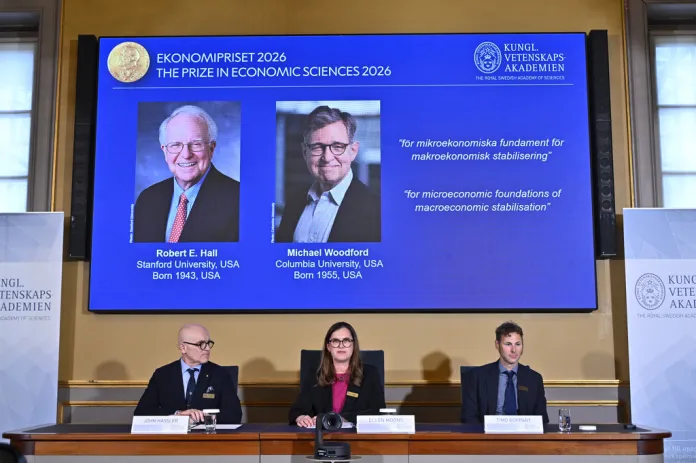
Two American economic professors won the Nobel Prize in Economic Sciences on Monday for a development that reconstructed stabilization policy on microeconomic measures, which the committee said has helped “smooth out the economy’s peaks and troughs.”
The Royal Swedish Academy of Sciences awarded the prize to economists Robert E. Hall and Michael Woodford, of Stanford University and Columbia University, respectively. The academy said its work has helped governments better deal with sudden economic shocks and crises, with its models challenging Federal Reserve policies in recent years.
“The laureates’ work has provided us with a stable theoretical foundation for the models that are now used by central banks and governments around the world,” Nobel Prize in Economic Sciences Committee Chair John Hassler said. “With them, we are better equipped to deal with shocks in the economy, such as energy crises or sudden changes in how much households consume.”
The Nobel committee said the two economists helped analyze why Keynesianist government intervention for stabilization had failed during the 1970s period of stagflation. The committee also argued that the two helped improve Keynes’s model by focusing on micro-level factors, like how individual households and businesses make decisions that affect the economy.
The Federal Reserve under former chairman Jerome Powell had become wary of following these traditional models and instead relied on cues about the condition of the economy rather than theoretical predictions. The current Fed chairman, Kevin Warsh, has advocated for less government intervention to stabilize the economy, in line with the thinking of economists like Milton Friedman, who gained prominence after the shock of 1970s stagflation.
During and after the COVID-19 pandemic, the global economy has faced high inflation, with central banks coming to the forefront of the economic conversation again. Hall and Woodford argued that predictive models for government intervention should include microeconomic factors to understand how households and businesses make decisions.
The Nobel Prize winners also argued that central banks can influence households’ perspectives of the future through clear messaging about future moves, such as how the Federal Reserve may adjust interest rates. Powell and Warsh have been less eager to make clear predictions about the future of the economy, given the major economic turmoil the world has faced in the 2020s.
UN WHISTLEBLOWER ACCUSES NOBEL WINNER OF BEING ‘COMPLICIT IN THE UYGHUR GENOCIDE’
“A central component in these models is that households and businesses are forward looking when making decisions about savings or product prices,” the academy wrote in a press release. “When governments and central banks communicate their plans for economic policy, they can influence this view of the future and move the economy in the right direction.”
Hall and Woodford will split the prize of 12 million Swedish kronor, which is about $1.2 million.
Continue reading...
[ H/T Washington Examiner ]