






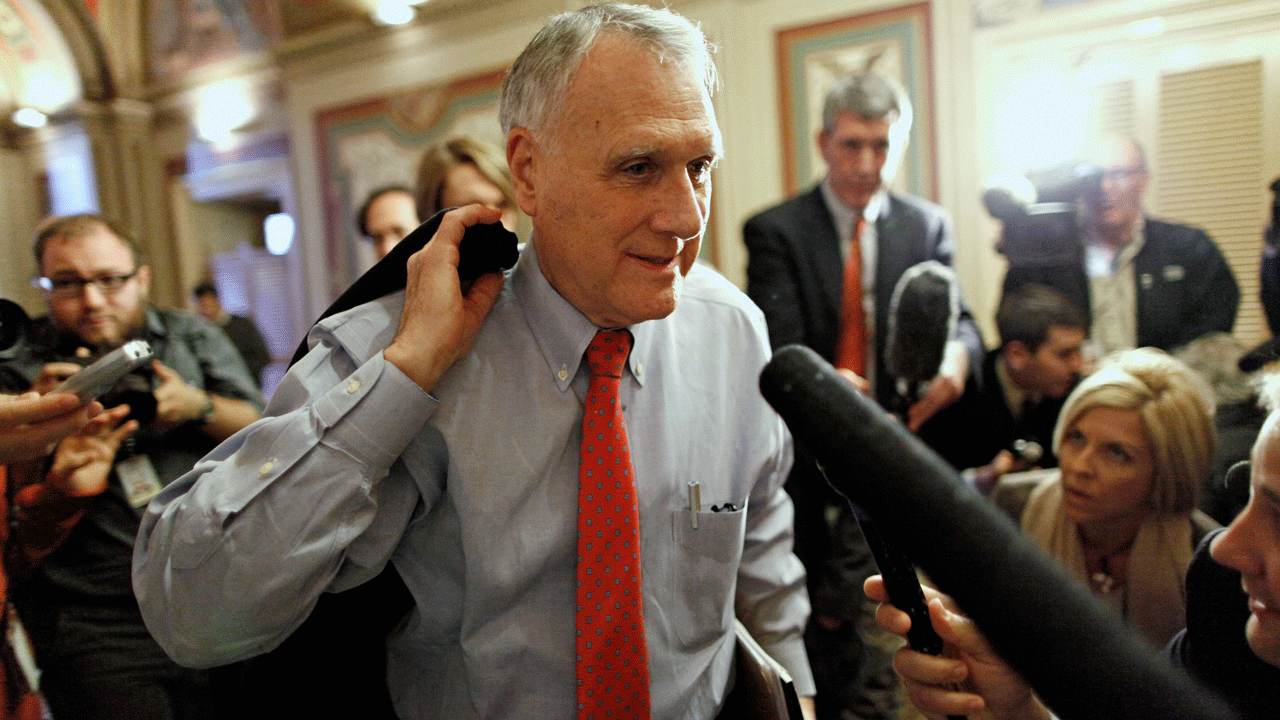
Former U.S. Sen. Jon Kyl died Sept. 16 at the age of 84.
But there is one part of his legacy that is particularly meaningful to me: Jon Kyl was one of the most important champions of crime victims’ rights in America.
Kyl understood something fundamental about crime victims. They are thrust into a relationship with the criminal justice system they never asked for. Suddenly their lives can revolve around prosecutors, defense attorneys, court hearings, plea agreements, sentencing proceedings and parole hearings.
Those accused of crimes have powerful protections under the U.S. Constitution—and they should. The rights to counsel, to confront witnesses, against self-incrimination and double jeopardy, and to due process and a speedy and public trial are fundamental American protections.
But the Constitution contains no comparable federal bill of rights for the person against whom the crime was committed.
Kyl wanted to change that.
Beginning in 1996, the conservative Republican from Arizona joined with liberal Democrat Sen. Dianne Feinstein of California in an effort to amend the Constitution to guarantee meaningful rights to crime victims. For years, they worked together on what became a remarkably bipartisan cause.
They could not muster the two-thirds vote required for a constitutional amendment. But they didn’t quit.
In 2004, Kyl and Feinstein helped enact the federal Crime Victims’ Rights Act, establishing enforceable rights for victims in federal cases, including reasonable protection, notice and attendance at proceedings, the opportunity to be heard, restitution, and treatment with fairness and respect for their dignity and privacy.
It was a major advance. But a federal statute was not the same thing as a constitutional guarantee. Kyl never lost sight of that.
In 2008, California voters overwhelmingly approved Marsy’s Law, placing meaningful and enforceable victims’ rights into our state constitution.
Marsy’s Law was named for Marsalee “Marsy” Nicholas, a 21-year-old UC Santa Barbara student murdered by her former boyfriend in 1983. Days later, her mother encountered the accused killer in a grocery store. The family had not been told he had been released on bail.
Marsy’s brother, Dr. Henry Nicholas, founder and chairman of Marsy’s Law for All, turned that experience into a campaign to ensure other victims would have rights of their own.
In 2014, Dr. Nicholas brought me into the Marsy’s Law cause. I would spend nearly seven years helping lead the national effort, building on California’s success across the country.
State after state amended its constitution to guarantee victims’ rights, including notice of proceedings, the right to be present and heard, reasonable protection from the accused, notice of an offender’s release, restitution, dignity and privacy—and, critically, the ability to assert those rights when they are violated.
That success crossed political lines. Just as Kyl and Feinstein had demonstrated in Washington, protecting crime victims could bring together people who disagreed about plenty of other things.
Today, nearly 130 million Americans live in the 12 states where Marsy’s Law is enshrined in the state constitution, giving them rights and protections should they become victims of crime.
The movement continues. This November, Tennessee voters can add their state to that list.
But Jon Kyl understood that these rights belong in the U.S. Constitution. A victim’s constitutional rights shouldn’t depend on which side of a state line the crime occurred. These rights should belong to every American.
When I joined Marsy’s Law, Kyl reached out to me and was generous with his time. He brought me up to speed on everything that had taken place with the victims’ rights movement. His enthusiasm that Dr. Nicholas was taking the effort national was something to see.
We stayed in touch periodically after that. Whenever we needed him to call or meet with a leader in a state considering victims’ rights, Kyl was there. And he wasn’t just lending his name. He could sit down with policymakers and get into the details. He knew his stuff.
To me, he was a living reminder that seemingly ordinary people can do extraordinary things. Humility, optimism, compassion and a strong sense of justice all come to mind when I think about him.
Earlier this year, after learning of his illness, I joined 25 other victims’ rights advocates in a letter thanking him for what he had done. We were fortunate to tell him while he was still with us: “Victims are now informed, present, and heard because of you.”
I know this is a difficult time for the Kyl family. I hope they know his legacy lives on, especially in his work looking out for victims of crime.
Nearly three decades ago, Jon Kyl said America needed “a new definition of justice—one that includes the victim.”
He helped give us one.
We publish a variety of perspectives. Nothing written here is to be construed as representing the views of the Daily Signal.
Continue reading...
[ H/T The Daily Signal ]