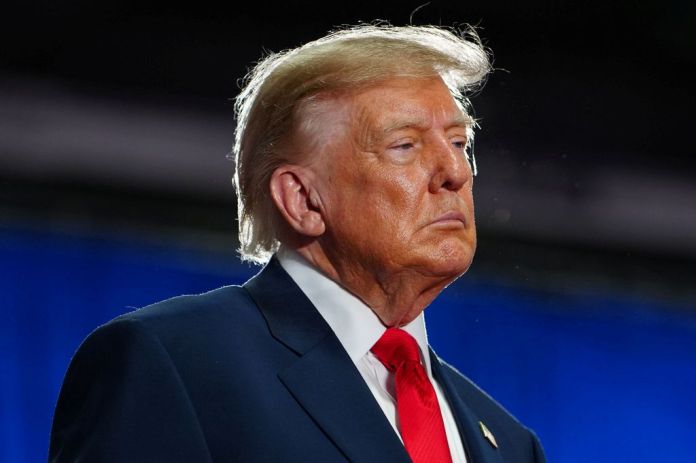







President Donald Trump did not write the CHIPS and Science Act. His administration has nevertheless found a distinctly Trumpian way to use it: When taxpayers finance industrial risk, taxpayers should share in the upside.
On Sept. 8, the Commerce Department finalized $300 million in research and development support for D-Wave Quantum, Rigetti Computing, and Quantinuum. Each company will receive $100 million, and the federal government will take a minority stake in each. The Commerce Department had already described the broader initiative as a portfolio approach to American quantum leadership, with noncontrolling equity intended to improve the taxpayer’s return.
This is a serious use of industrial policy. Quantum technology could affect secure communications, navigation without GPS, sensing, advanced materials, and computing. The Trump administration is right to build domestic research and manufacturing capacity before the United States urgently needs it. Taking equity is also more disciplined than writing a grant with no claim on future value.
Government ownership, however, can be mistaken for government validation. A Commerce Department award may help a company solve a manufacturing bottleneck. It does not prove that the company’s technology delivers a military advantage. The Pentagon is well-positioned to protect Trump’s investment by serving as a demanding customer. Under that approach, every quantum claim would compete against the best available alternative under realistic conditions, regardless of which supplier has federal backing.
That discipline begins by rejecting the idea that quantum is one race with one finish line. For acquisition purposes, it runs on at least three clocks. Post-quantum cryptography is ready for implementation. Quantum sensing and photonics are moving through prototypes and platform integration. General-purpose quantum computing is still working to prove when its value will exceed the cost of the complete system. A single standard of “quantum readiness” would confuse urgency with maturity.
Post-quantum cryptography is the immediate case. In 2024, NIST finalized three standards designed to resist attacks by future quantum computers and urged organizations to begin integrating them. These algorithms run on classical computers. Procurement officials, therefore, do not need to wait for a quantum machine, but they still need evidence that products implement the standards correctly, manage keys securely, work with legacy systems, and can be upgraded. Standardized mathematics does not make every implementation trustworthy.
Quantum sensing is on a different clock. This summer, the Army selected eight winners in a quantum technology competition across navigation, timing, radio-frequency sensing, electromagnetic sensing, and photonics. Winners could pursue Phase I feasibility proposals worth up to $300,000 each. The scale is modest, and that is a virtue. The Army can compare approaches and expose technical weaknesses before a promising laboratory result becomes an expensive program.
DARPA is applying an even harsher test. Its Robust Quantum Sensors program requires teams to build compact sensors for testing on a government-provided helicopter, where vibration, electromagnetic interference, and field gradients punish fragile equipment. A military sensor should be judged by stability, calibration drift, power, maintenance, false alarms, and performance against the best non-quantum sensor on the same mission. Peak sensitivity on a lab bench is not enough.
General-purpose quantum computing has the longest path. DARPA’s Quantum Benchmarking Initiative asks whether an industrially useful quantum computer can be built by 2033 and defines utility in economic terms: Computational value must exceed cost. As of March, DARPA had evaluated approaches from 20 companies, advanced 11 into deeper risk-reduction planning, and moved two earlier performers into government verification and validation. That is how a serious investor separates a technology road map from a sales pitch.
The same whole-system rule should govern claims of quantum speed. The stopwatch must include data loading, state preparation, error correction or mitigation, measurement, classical processing, power, cooling, specialized infrastructure, and operating cost. The comparison must use a tuned classical system on the same task. Otherwise, the Pentagon could buy an impressive calculation whose advantage disappears when the rest of the mission returns.
The Pentagon can make this discipline routine with a one-page quantum evidence record. A program seeking credit for a quantum-derived capability should state the mission task, the strongest non-quantum comparator, the whole-system measure of success, the conditions actually tested, the principal failure modes, and the next experiment capable of disproving the claim. Program executive offices can attach that record to existing technical reviews. This is an extension of DARPA’s Heilmeier questions, not a new approval board.
Where a quantum result will influence an operational decision, the record should also define what weight the result receives outside its tested conditions. A navigation sensor may deserve greater trust after surviving a GPS-denied flight test, but not beyond the demonstrated drift, vibration, or calibration limits. A computing result may inform planning without becoming the sole basis for a consequential decision. Authority should follow evidence, not branding.
The National Security Agency already uses this logic in quantum communications. NSA warns that quantum key distribution remains highly dependent on implementation. Authentication, specialized hardware, trusted relays, validation, insider risk, and denial of service still matter. NSA favors post-quantum mathematical algorithms for national security systems unless those practical limitations are overcome. The agency is evaluating the complete security system, not awarding credit for the word quantum.
The new equity stakes make supplier neutrality more important. Companies receiving federal capital should remain eligible to win defense work, but the government’s financial interest cannot become a shortcut through acquisition gates. Vendors without federal equity should be allowed to beat portfolio companies on performance. Common tests protect taxpayers, warfighters, and credible quantum firms from the reputational damage caused by exaggerated claims.
UKRAINE ISN’T JOINING NATO. NATO IS JOINING UKRAINE
The Pentagon already has the pieces. The Army is testing feasibility across competing sensor approaches. DARPA is pushing sensors onto unforgiving platforms and auditing quantum-computing architectures in stages. The NSA separates theoretical security from fielded security. The Trump administration has an opportunity to make that evidence discipline the common acquisition language for technologies sold under the quantum label.
Trump is right to make a national bet on quantum and to give taxpayers a stake in its success. The way to defend that bet is to give every credible technology a fair path to prove itself. Taxpayers should share the upside. Warfighters should receive only the advantage that survives the test.
Burak Oktenli is an independent researcher based in Washington, D.C. He holds a bachelor’s degree in computer science and engineering from the University of South Florida and a master’s of business administration, and is completing a master’s of professional studies in applied intelligence at Georgetown University. His writing focuses on defense strategy, alliance burden-sharing, military technology, and the governance of autonomous systems.
Continue reading...
[ H/T Washington Examiner ]