






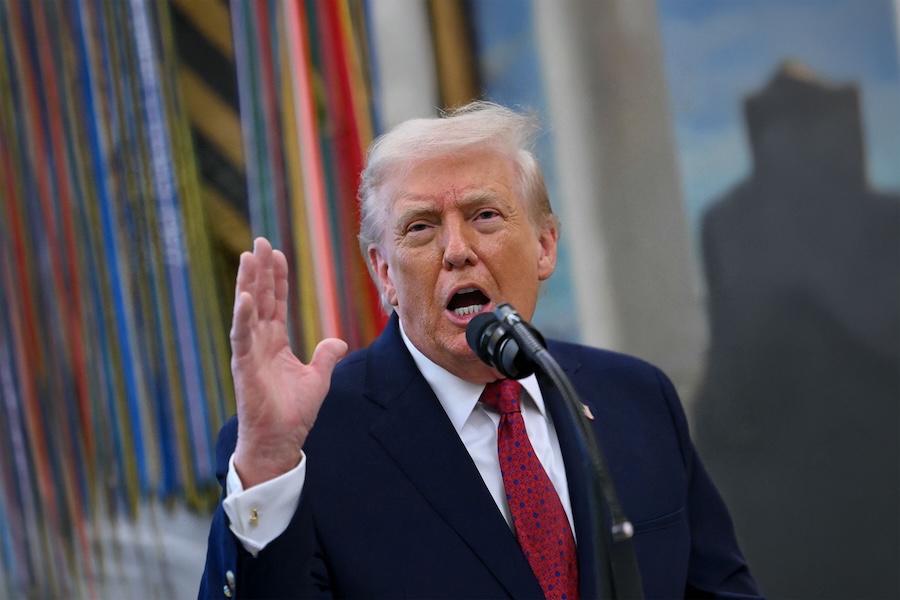
President Donald Trump slapped Canada with sweeping new 50% tariffs Monday, opening a fresh trade fight with America’s northern neighbor while accusing Ottawa of discriminating against U.S. goods.
The tariffs target certain Canadian products tied to disputes over motor vehicles, alcoholic beverages and dairy, three industries where the White House says Canada has stacked the deck against American producers.
Trump signed three proclamations under Section 338 of the Tariff Act of 1930, a rarely used law that allows the president to impose duties of up to 50% when another country discriminates against U.S. commerce.
The new levies are set to take effect Aug. 19, giving the two countries 30 days to negotiate before the tariffs hit.
The White House said the tariffs will cover about $20 billion in Canadian goods.
Excluded from the latest round are several key imports, including energy products, critical minerals, fish and other goods already subject to industry-specific duties.
But unlike some previous Trump tariffs on Canada, the new duties will apply to certain goods that had been protected under the United States-Mexico-Canada Agreement.
The administration said the move is not tied to Trump’s recent threats over wildfire smoke drifting from Canada into the northern United States.
Instead, White House officials said the tariffs are aimed at Canada’s treatment of American exports.
In its statement Monday, the White House emphasized that Canada was one of two countries that chose to retaliate against U.S. tariffs rather than negotiate, with China being the other.
Canadian Prime Minister Mark Carney pushed back, saying Ottawa still supports open trade.
NOW: Treasury Sec. Scott Bessent confirms Canada will face a 50% TARIFF levied by President Trump
BESSENT: “[Canada is] HIGHLY discriminatory on dairy products, U.S. alcohol and beverages have been removed from Canadian shelves!”
“This is really just reciprocity in terms of… pic.twitter.com/KylVdl7WUi
— Eric Daugherty (@EricLDaugh) July 21, 2026
Canadian Prime Minister Mark Carney said the country “believes in the benefits of free and fair trade,” in a statement on Monday.
“In all circumstances, Canada will work relentlessly and take any measures necessary to build our strength at home and to support Canadian workers, farmers, businesses, and families,” Carney said.
Ontario Premier Doug Ford went further and called for Canada to hit back immediately.
“If these tariffs proceed, Canada should respond tariff for tariff, dollar for dollar,” Ford said in a post on X.
The Canadian Trucking Alliance warned the tariff fight could drive up costs and snarl one of the most connected supply chains in the world.
“You cannot disrupt the world’s most integrated supply chain without massive collateral damage,” CEO Stephen Laskowski said in a statement shared with CNN. “These tariffs will immediately spike freight costs, create severe border bottlenecks, and hurt consumers in both nations.”
Trump’s use of Section 338 is a major test of presidential trade power after the Supreme Court ruled in February that he could not use the International Emergency Economic Powers Act to impose sweeping global tariffs.
That ruling killed Trump’s effort to tax imports broadly from every country, including additional punitive tariffs on China, Canada and Mexico.
The administration then turned to other trade laws, including temporary 10% tariffs under Section 122 of the Trade Act of 1974 and a new 25% tariff on many Brazilian imports under Section 301.
Now Trump is reaching for Section 338, an old but powerful weapon aimed directly at countries accused of treating American goods unfairly.
Capital Economics said only about 5% of Canadian imports would be affected by the new tariffs, or roughly 0.6% of total U.S. imports.
But if Donald Trump’s use of Section 338 survives legal challenges, it could become a major tool in future trade negotiations.
“Taking a step back, it’s striking that the Trump administration is now reaching to a new method to implement tariffs,” Brown wrote in a research note Monday.
That is exactly the point.
Trump’s tariff strategy has always been about leverage: make foreign governments feel pain until they stop taking advantage of American workers and industries..
RELATED: Trump Mulls New Canada Tariffs Over Raging Wildfires
Canada may be a close ally, but the White House is making clear that friendship does not excuse trade barriers that hit U.S. farmers, automakers and producers.
Democrats and globalist critics will warn about higher costs and diplomatic blowback.
Trump’s answer is simpler: America has played nice for decades, and its workers paid the price.
Now Canada has 30 days to come to the table.
POLL: Will You Support Trump And His Candidates In The Midterms?
Continue reading...
[ H/T Trending Politics ]