





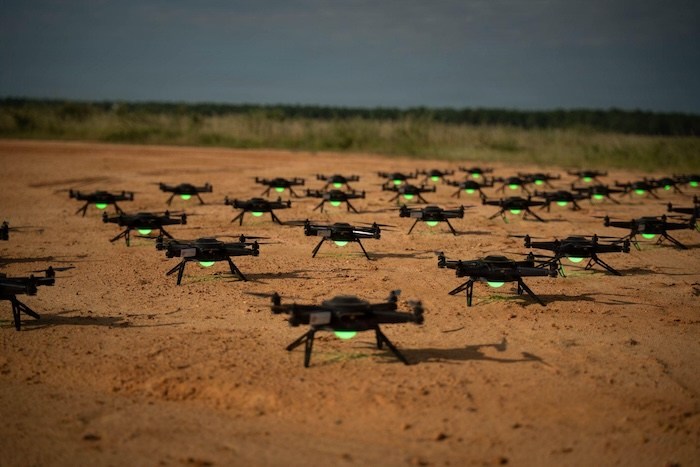
Ukraine has demonstrated that a country does not need the world’s largest defense budget to develop a formidable drone industry. In just a few years, Ukrainian manufacturers have turned inexpensive unmanned systems into important battlefield weapons. Yet much of this success depends on components produced thousands of miles away, particularly in China.
This exposes a problem beyond Ukraine. Western governments are investing heavily in military production, but domestic manufacturing means little if essential components depend on a strategic competitor.
By early 2026, Ukraine’s defense industry could produce more than 8 million first-person-view drones annually, compared with approximately 3 million produced in 2025. In October, Ukraine’s Ministry of Defense reported a 300% increase in drone contracting compared with 2025, while FPV deliveries had risen nearly 3.7 times, demonstrating rapid domestic industrial growth.
These figures represent a significant achievement. They also raise an uncomfortable question: how much of a weapon can genuinely be considered domestically produced when essential components come from abroad?
Ukraine can assemble drones on a massive scale, but many batteries, electric motors, and electronic components remain tied to Chinese supply chains. Local assembly gives manufacturers greater control over production and innovation, but does not eliminate exposure to foreign suppliers.
Lithium-ion batteries are particularly important. Their low weight and high energy density make them essential for many electric drones, affecting flight duration, payload, and range. Batteries also power unmanned ground vehicles, portable communications, and other military technologies.
The problem is not simply that China manufactures many batteries. It controls much of the infrastructure required to produce them.
According to the International Energy Agency, China accounted for more than 80% of global lithium-ion battery production in 2025. The European Union and the United States each held only a small share of manufacturing capacity. Even factories outside China frequently depend on Chinese materials and components.
This dominance extends beyond assembly. Research published by the Center for Strategic and International Studies in December 2025 found that China processes approximately two-thirds of the world’s lithium and more than 70% of its graphite anode material.
These figures show why building factories in Europe or the U.S. is insufficient. A factory may operate on Western soil while depending on Chinese refineries. If supplies are interrupted, domestic capacity offers limited protection.
The distinction between mining and processing is important. Australia and Canada possess significant lithium resources, but extraction is only the beginning. Minerals require refining and processing before battery manufacturing. When those stages occur in China, even allied countries’ minerals can reinforce the dependence Western governments seek to reduce.
Ukraine’s wartime experience has demonstrated the risks of foreign-controlled supply chains.
Chinese export restrictions introduced in September 2024 affected access to certain drones and components, pressuring Ukrainian manufacturers. Companies have developed alternative sourcing arrangements and expanded domestic production, but replacing Chinese components remains difficult. Additionally, while wartime sourcing arrangements sustained Ukraine’s warfighting ability, peacetime laws still in place often penalized defense producers for them.
Such dependence is particularly serious during prolonged war. Wartime production cannot always accommodate delays while suppliers are replaced, factories reconfigured, or alternatives tested. An inexpensive part can become a bottleneck when thousands of weapons depend on it.
For Western defense planners, this should change how industrial readiness is measured.
Governments assess military strength through defense expenditure, inventories, and manufacturing capacity. These indicators matter, but remain incomplete. A country may have the facilities and funding to expand production without reliable access to necessary materials.
The real test is not merely how many systems can be manufactured under normal conditions, but whether production continues when supply chains become contested.
The issue has not gone unnoticed. A June 2026 Atlantic Council report warned of China’s dominance in dual-use battery supply chains and identified cooperation with South Korea as an opportunity for the U.S. and its allies.
However, responding requires more than subsidies for domestic manufacturing.
Western governments should treat critical mineral processing as defense infrastructure. Investment in lithium and graphite extraction is necessary, but refining and battery-grade material production deserve equal attention. Otherwise, greater mining output may simply mean more minerals shipped abroad for processing.
Defense procurement should reflect hidden supply chain vulnerabilities. Governments purchasing drones and other battery-powered military equipment should evaluate price and performance alongside the origin and availability of critical components.
This does not mean every component must be manufactured domestically. Recreating entire supply chains within individual countries would be expensive, inefficient, and often unrealistic. The practical objective is to prevent any single supplier or country from disrupting military production.
This is where cooperation between allies becomes essential.
South Korea and Japan possess advanced battery industries and technical expertise. Partnerships with them, combined with mineral resources from Australia, Canada, and other reliable partners, could diversify supply chains.
Western governments should also consider strategic reserves of processed battery materials and critical components. Stockpiles cannot replace long-term investment, but can give manufacturers time when export restrictions or disruptions threaten production.
None of these measures will deliver immediate independence from China. Mines, refineries, and competitive manufacturing require substantial investment and years of political commitment. Western alternatives may be more expensive initially.
OPINION: FEDERAL AGENTS STOP ILLEGAL VAPES AT THE BORDER. NOW, STATES NEED TO FINISH THE JOB
Yet the cost of industrial redundancy must be weighed against the loss of access to essential materials during conflict.
For Ukraine, diversified supply chains would help manufacturers sustain production. For NATO, the implications are broader. As unmanned systems become increasingly important, producing and replacing them at scale will depend on the industrial networks supporting them.
David Zaikin is the founder and CEO of Key Elements Group, a London-based strategic consultancy specializing in defense and international affairs. He has written on defense procurement and drone warfare for the Jerusalem Post, Forbes, and Stars and Stripes. He has also been featured in interviews with the BBC, Sky News, and CNBC.
Continue reading...
[ H/T Washington Examiner ]