

Guest Post by John Leake
I started following US, Ukrainian, and Russian affairs while I was living in Vienna in the years 2000–2010. On dreary winter weekends, I sometimes went to Burg Cinema, where the The Third Man, a 1949 film noir masterpiece, still played on the big screen every Sunday. Shot on location in Vienna during the Four Powers Occupation of 1945–1955, the film and its deeply intriguing back story never ceased to fascinate me. As I recounted in my recent book, Mind Viruses: America’s Irrational Obsessions:
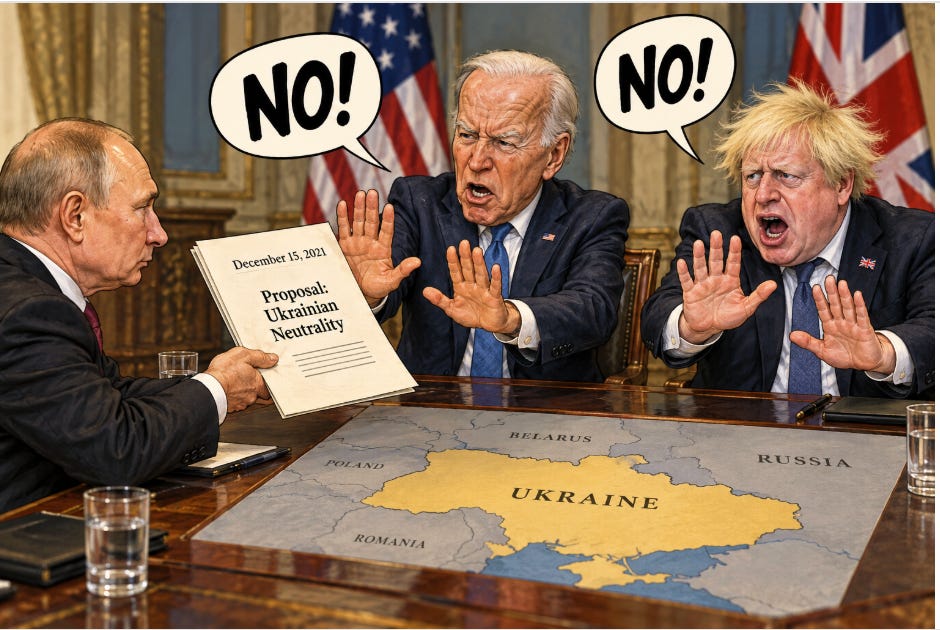
This brings me to the timely point of this essay. Shortly after President Biden was sworn into office in January 2021, tensions between the United States and Russia began to ratchet up over various disagreements. In the autumn of 2021, Russian intelligence told President Putin that, in addition to the ongoing training and equipping of the Ukrainian military, CIA and British intelligence (MI6) are essentially controlling Ukrainian intelligence and turning it into a “springboard for operations against Moscow.” President Putin found these reports highly alarming, and on December 15, 2021, he submitted a security proposal to the US government, with Ukrainian neutrality a key provision. The Biden administration rejected it out of hand.
As NATO secretary Jens Stoltenberg later recounted to the EU Parliament:
Why wasn’t Stoltenberg at least willing to try an Austrian style neutrality deal for Ukraine? Given that the Russians proposed it, they had a strong motive to abide by it. If they subsequently violated the terms of their own proposal, the West would have a clear cause for war with Russia.
Implied in Stoltenberg’s statement is that, in December 2021, he found the prospect of imminent war with Russia in Ukraine preferable to making a concession to Russia to avert war for an indeterminate period, perhaps for as long as Austria had remained at peace with Russia.
Tweet
Continue reading...
[ H/T The Burning Platform ]
On the 71st Anniversary of Austrian neutrality, reflections on how the Russo-Ukrainian War could have been avoided if NATO had accepted Putin’s Dec. 15, 2021 proposal for Ukrainian neutrality.
I started following US, Ukrainian, and Russian affairs while I was living in Vienna in the years 2000–2010. On dreary winter weekends, I sometimes went to Burg Cinema, where the The Third Man, a 1949 film noir masterpiece, still played on the big screen every Sunday. Shot on location in Vienna during the Four Powers Occupation of 1945–1955, the film and its deeply intriguing back story never ceased to fascinate me. As I recounted in my recent book, Mind Viruses: America’s Irrational Obsessions:
This brings me to the timely point of this essay. Shortly after President Biden was sworn into office in January 2021, tensions between the United States and Russia began to ratchet up over various disagreements. In the autumn of 2021, Russian intelligence told President Putin that, in addition to the ongoing training and equipping of the Ukrainian military, CIA and British intelligence (MI6) are essentially controlling Ukrainian intelligence and turning it into a “springboard for operations against Moscow.” President Putin found these reports highly alarming, and on December 15, 2021, he submitted a security proposal to the US government, with Ukrainian neutrality a key provision. The Biden administration rejected it out of hand.
As NATO secretary Jens Stoltenberg later recounted to the EU Parliament:
Why wasn’t Stoltenberg at least willing to try an Austrian style neutrality deal for Ukraine? Given that the Russians proposed it, they had a strong motive to abide by it. If they subsequently violated the terms of their own proposal, the West would have a clear cause for war with Russia.
Implied in Stoltenberg’s statement is that, in December 2021, he found the prospect of imminent war with Russia in Ukraine preferable to making a concession to Russia to avert war for an indeterminate period, perhaps for as long as Austria had remained at peace with Russia.
Tweet
Continue reading...
[ H/T The Burning Platform ]