




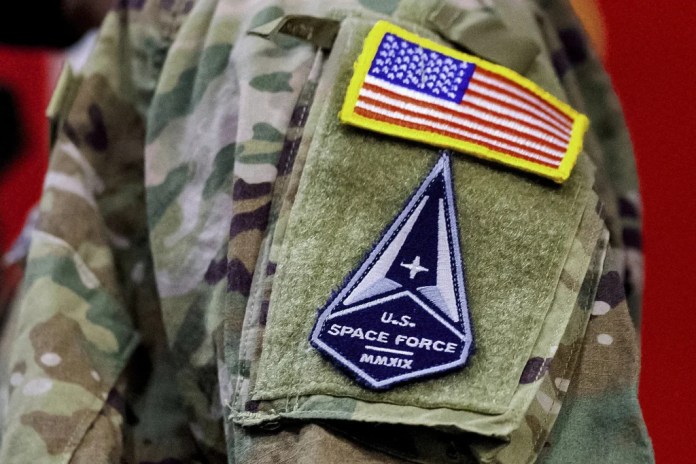
Over the past week, the Washington Examiner reported that Air Force Secretary Troy Meink confirmed the existence of on-orbit space-control weapons. A day later, the outlet reported Gen. Dan Caine, the chairman of the Joint Chiefs of Staff, telling service members to prepare to fight, endure, and win in contested environments stretching from the seabed to cislunar space. Those developments make attribution under degraded conditions more consequential.
That problem is arriving as the Department of the Air Force pushes artificial intelligence deeper into command and control. On Sept. 8, its latest Decision Advantage Sprint for Human-Machine Teaming experiment used AI and Space Force personnel to accelerate command-and-control decisions. Four days later, the United States and 10 international partners expanded the Wideband Global SATCOM partnership to strengthen secure and resilient communications. Faster decisions and more connected redundancy can improve military performance. They also create a specific test requirement: what happens when several services degrade for the same natural reason?
More backups do not automatically produce more independent evidence. An AI system that sees navigation errors, communication loss, timing drift, and sensor anomalies at once may be looking at coordinated hostile action. It may also be looking at the sun.
This is a physical vulnerability with well-understood mechanisms. The National Oceanic and Atmospheric Association documents how space weather can disrupt satellite navigation, radio communications, spacecraft operations, and ground infrastructure through different pathways. For military AI, the important point is that several alarming observations can arrive together while sharing one environmental cause.
History supplies the warning. In May 1967, a powerful solar radio burst disrupted U.S. and British radar and communications systems during the Cold War. Strategic Air Command began preparing aircraft because the interference looked like Soviet jamming. Air Force space-weather forecasters identified the solar cause before the episode hardened into an adversary explanation. The event did not involve AI, but it captured the exact problem AI-enabled command systems now have to solve at machine speed: several alarming observations can share a source without independently confirming the same explanation.
The same logic applies to resilience. A mission package might use multiple navigation constellations, more than one satellite-communications provider, a high-frequency backup, and local backup power. That looks diverse on a slide. Yet navigation signals still cross a disturbed ionosphere. Satellite links can share propagation conditions. HF depends on the ionosphere in another way. A generator can keep a local terminal alive while the remote gateway, timing source, or terrestrial network it depends on is unavailable.
Equipment diversity can, therefore, hide common dependencies. The War Department has understood this in principle for years. Its Mission Assurance Strategy treats natural hazards, civilian infrastructure dependencies, and cascading disruptions as mission-assurance concerns. What acquisition and exercises need to make explicit is the evidence: which mission functions still work when a physically credible disturbance hits several supposedly redundant paths at once?
The 2022 Starlink loss illustrates why margin matters. A relatively modest geomagnetic disturbance heated the upper atmosphere, increased drag, and contributed to the loss of 38 of 49 newly launched satellites. That episode says nothing about the vulnerability of a military constellation. It demonstrates a narrower lesson: a hazard label such as “minor” does not tell an operator how much usable margin a particular system has left.
The first requirement should therefore be a common-dependency map for every consequential redundancy claim. The integrator should identify what the primary and fallback paths share: propagation environment, timing, power, ground infrastructure, data feeds, and control software. The map should also say what the fallback actually preserves. Full mission performance, a lower-rate command channel, local operation, and safe termination are different capabilities.
Second, the Space Force and its partners should test attribution and resilience together. Exercise planners should inject a physically credible space-weather disturbance across several channels, then add unrelated faults and a genuinely hostile action inside the same scenario. The AI should preserve the competing explanations, show which sensors share dependencies, and reduce confidence when the apparent corroboration comes from channels exposed to the same physical cause.
A real adversary can also exploit natural noise. Spoofing during an ionospheric disturbance can be misread as environmental. A cyber intrusion into a ground segment can be blamed on a communications anomaly. Mission protection cannot wait for perfect attribution. If position integrity is poor, actions that depend on precise position should contract whether the cause is solar activity or spoofing. If a command path is questionable, high-consequence actions should require stronger authentication and corroboration regardless of why the path degraded.
Third, recovery has to be part of the test. A warning that subsides does not prove that every dependent service is trustworthy again, and a restored signal does not validate the earlier diagnosis. Permissions should return according to evidence about the specific service and mission function rather than because a dashboard has become quieter.
This fits the Space Force’s broader move toward resilient architectures. Its Objective Force calls for diverse allied and commercial navigation and timing sources, as well as hybrid, self-healing communications. That diversity becomes more useful when the service can show which paths are truly independent, how AI behaves when several fail together, and what evidence supports restoring full authority afterward.
OPINION: AMERICA JUST ADMITTED IT HAS SPACE WEAPONS. NOW, ONE MISCALCULATED ORBIT COULD START WORLD WAR III
The recent shift toward a more explicit warfighting posture raises the cost of getting attribution wrong in either direction. Collapsing ambiguous multi-system degradation into hostile action can accelerate an unsupported conclusion. Treating every correlated failure as environmental can hide a real attack layered on top of a storm. The useful test is whether AI can preserve both possibilities while helping operators protect the mission according to the quality of the evidence available.
The sun can create an enemy-shaped picture without an enemy. As AI moves deeper into space command and control, the Space Force should know whether its systems can recognize that possibility without becoming blind to a real attack layered on top of it.
Burak Oktenli is a graduate student in applied intelligence at Georgetown University and an independent researcher focused on trustworthy artificial intelligence, cybersecurity, autonomous systems, and emerging computing architectures. He holds a bachelor’s degree in computer science and engineering from the University of South Florida and a Master of Business Administration. His work centers on verification, provenance, runtime authority, space governance, and resilient system design for AI-enabled technologies.
Continue reading...
[ H/T Washington Examiner ]