


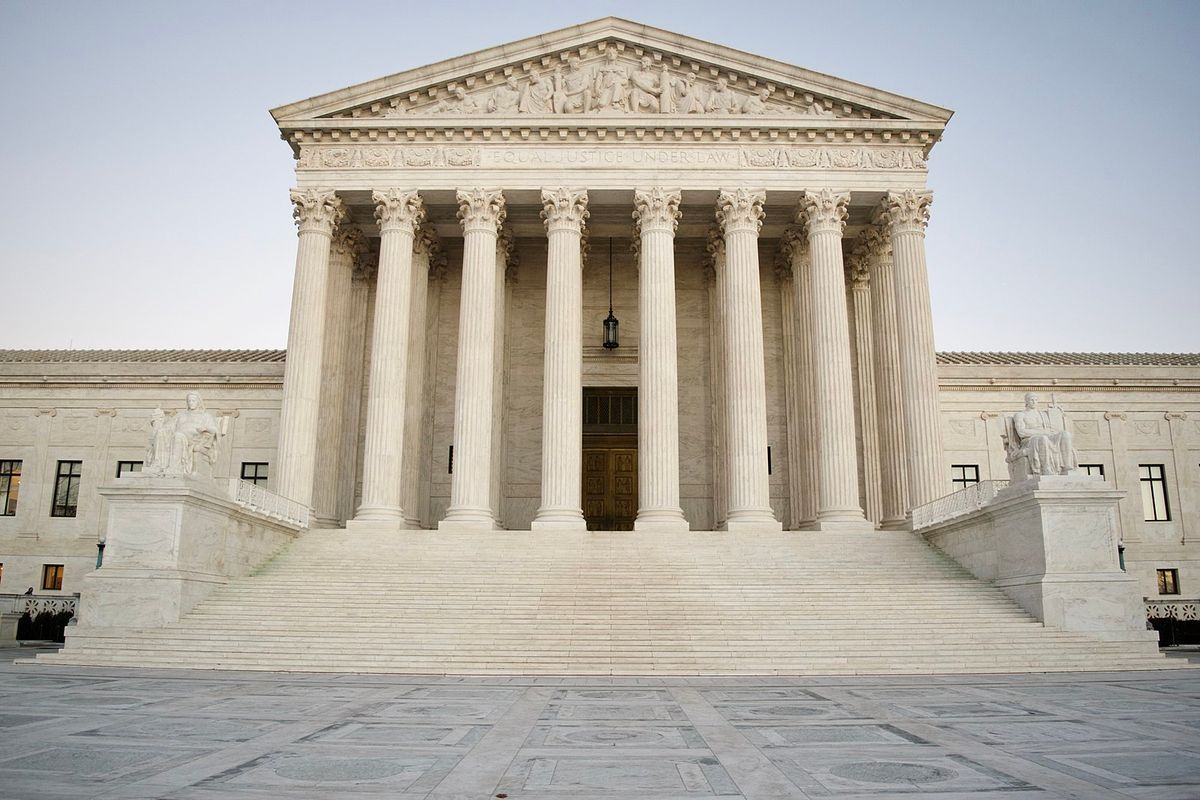
One of the Supreme Court’s most critical functions is deciding what cases to decide.
This process has been explained before, but – given the court is now choosing what cases to hear next term – I’d like to use this column to examine some questions about the certiorari or “cert.” process, as it is known. As we shall see, some of these questions have answers; others do not.
First, a review of the basics. The vast majority of cases come to the Supreme Court in the form of petitions for certiorari, a Latin term meaning “to be more fully informed.” The court receives nearly 4,000 petitions each term and grants review to about 60. By a 100-year-old tradition, review is granted when four of the nine justices want to hear a case. When this occurs, the parties file briefs and the justices hear oral argument before issuing their decision.
This process is a blend of transparent argument and secretive deliberation. The transparent portion is that the losing party in a lower court, the petitioner, files a public petition for certiorari, making the best case for why the court should resolve the legal issue in the case. The winner in the lower court, the respondent, also spells out why the court does not need to review the ruling of the lower court. After that, however, the case disappears into the halls and procedures of the high court.
Question one: how does the court handle and process the petitions?
As noted, by 100-year-old custom, it takes four votes for the court to agree to review a case (the “rule of four”). But the vote to grant or deny cert. is not public. We do not know if a petition met with overwhelming consensus that review was necessary or not, or whether it scraped by or just missed out on being granted.
Nor do we know why the court declines to review a case. When the court agrees to decide a case, the final opinion is likely to make clear why the justices were interested. Denials of cert. petitions, however, are not accompanied by any explanation, except in the few instances when an individual justice writes a dissent from the denial of a petition. Justice Sonia Sotomayor, for example, sometimes points out in a dissent or concurrence what she deems to be an important issue of individual rights in criminal cases. But such dissents are relatively infrequent.
This can be frustrating to counsel: Just how much interest an unsuccessful petition attracted would be useful to lawyers trying to decide whether to petition the court in the future on an issue that has been turned down one or more times.
Question two: what roles do the law clerks and justices play?
The answer is known to some extent but secret in other respects. For seven of the nine justices – all but Justices Samuel Alito and Neil Gorsuch – the initial review is by a single law clerk who writes a memo to be shared with the seven justices who participate in a “pool” for reviewing the petitions. Clerks to Alito and Gorsuch handle the petitions on their own.
But much about this aspect of the process remains hidden from public view. Little is known outside the court’s inner circle about how the clerks prepare their memos and what factors influence their recommendation to grant or deny review. The court’s own internal Rule 10 says the court is looking for cert. petitions that either present a conflict in which two or more lower courts have reached differing interpretations of an important issue of federal law, or which, even in the absence of a conflict, present an important question that the court should decide. But those factors alone do not guarantee cert. will be granted.
Just how influential the memo writer’s recommendation is on the judgment of the justices is also unknown. Nor is there any public knowledge of how often justices think the pool memo reached the wrong recommendation.
The cert. pool has been in use by the court for more than 50 years. The justices are certainly able to make adjustments if they find flaws in how it works, and the separate handling of petitions by Alito and Gorsuch provides some check on the process. But since this is largely an internal procedure of the court’s own making, it is not subject to any public accountability.
And the justices rarely discuss it. In his new book, for example, Alito makes no mention of the cert. process or the pool. Ultimately, little is known outside the court about how individual justices handle the pool memos.
Question three: what influences the grant or denial or cert.?
Many factors besides Rule 10 might contribute to whether a petition is granted. Law clerks may be influenced by whether any of the most respected, regular Supreme Court practitioners are involved in the case. Clients certainly think this matters, since they may spend thousands of dollars to hire firms with top Supreme Court practices, those that boast having former solicitors general and former law clerks to the justices as members of the firm.
The clerks may also be swayed by what judges decided the case below, since some of them are especially respected in conservative or liberal circles. In certain instances, a federal appeals court may provide additional fodder to grant review. A party might have asked for rehearing by the full federal appeals court after losing in a three-judge panel. Such an “en banc” ruling, as it is called, can be especially influential, just as a set of opinions dissenting from denial of en banc review also tees up signals about the importance of a case.
Caution also plays a role here. No clerk wants to recommend that cert. be granted only to find that there are procedural flaws in a case (leading to it being “dismissed as improvidently granted”) or that the justices are not inclined to take up an especially ideologically divisive question.
Question four: why are there so few cert. grants?
The number of granted cases in recent years has reached the lowest level in many decades. At the height of the tenure of Chief Justice Warren Burger (1969-1986) in the 1980’s, the justices were deciding around 150 cases each term. Now the number is closer to 60.
Oddly, no one seems to know why.
There are some possible explanations, to be sure. One obvious factor is the rise of the interim docket, sometimes called the emergency or shadow docket. This docket involves interim requests for relief, where a party to a case asks the Supreme Court to block a lower court order in the interim period while the case is being litigated in a lower court. The Justice Department under President Donald Trump has used this path often, asking the justices to order that a Trump policy be allowed to remain in effect or to take effect after it was blocked by a federal judge.
These interim orders, decided without full briefing and oral argument, are taking up an increasing amount of the court’s time, and some argue that this leaves less time for the justices to add more cert. petitions to be decided on their merits. While this is undoubtedly a factor, the number of cert. petitions being heard by the court each term has been shrinking for a long time, well before the significant uptick in interim docket matters.
Different theories have been proffered by court observers for this decline over time: that Congress is passing fewer new laws that lead to lawsuits and require judicial review; that there is less disagreement between conservative justices and conservative lower court judges, so less need for review; or even that the justices simply like having fewer cases to decide and therefore vote for cert. more sparingly.
It is difficult to prove any one of these theories, and the justices are not providing any answers. In one case last spring involving a state court’s jurisdiction over a products liability lawsuit involving a company based outside the state, counsel for both sides agreed that the court should hear and decide the issue (a rare occurrence, as the winner below typically argues against cert. being granted), but the justices still denied the petition. As is typically the case, there was no explanation.
Question five: when does the court grant cert. before it is requested?
The Supreme Court’s Rule 11 and federal law allow the justices to essentially reach out and grant review to a cert. petition before it has been decided by the appropriate appeals court; that is, before the appellate process has run its course. This once rarely used process has become a much more frequent tool for the justices. Whether they are following the guidance of the rule and focusing on “imperative public importance,” or whether they are impatient to tackle some major legal issues, or whether they simply think it will be more efficient to leapfrog over the court of appeals, the practice is clearly on the rise.
A recent example is Trump v. Slaughter, a fight over the independence of the heads of federal agencies from being fired by the president. The federal government came to the court for an interim stay of the ruling of a federal district court in the District of Columbia that blocked Trump from firing Rebecca Slaughter, a member of the Federal Trade Commission, because there was insufficient cause. The court granted the stay, allowing the firing to take effect, and then also granted cert. and ordered the case to be argued in December 2025.
***
The process of granting review will continue unabated throughout the current court term. And as it does, questions will continue to arise about how the process works – but one should not hold their breath waiting for all the answers.
Continue reading...
[ H/T SCOTUSblog ]