






The New-Keynesian Establishment Is Congratulating Itself On A Job Well Done
By Benjamin Picton, senior market strategist at Rabobank
Growing up in Australia in the 1990s one would inevitably encounter curiously ‘Aussie’ cultural practises. One such practise was school children being directed by teachers to “give yourself a pat on the back” whenever you did particularly well at something. This wasn’t just a figure of speech; the children would literally reach over their shoulder and pat themselves on the back. I’m unsure if this still occurs, or whether it was ever replicated in other countries (maybe New Zealand).
The process of self-congratulation does seem to have been transmogrified to the world of economics. The Nobel Memorial Prize in Economics was yesterday awarded to Woodford and Hall, respectively of Columbia and Stanford universities. The prize winners extended Robert Lucas’ theories of microfoundations to the realm of macroeconomic stabilisation policy, developing many of the models and ideas that still underpin central bank orthodoxy in the present day. Their work bridged the divide between the new classical economics of the 1970s, ‘80s and ‘90s, and the Keynesian macroeconomic theories that were considered orthodox between the Great Depression and the stagflationary shocks of the 1970s.
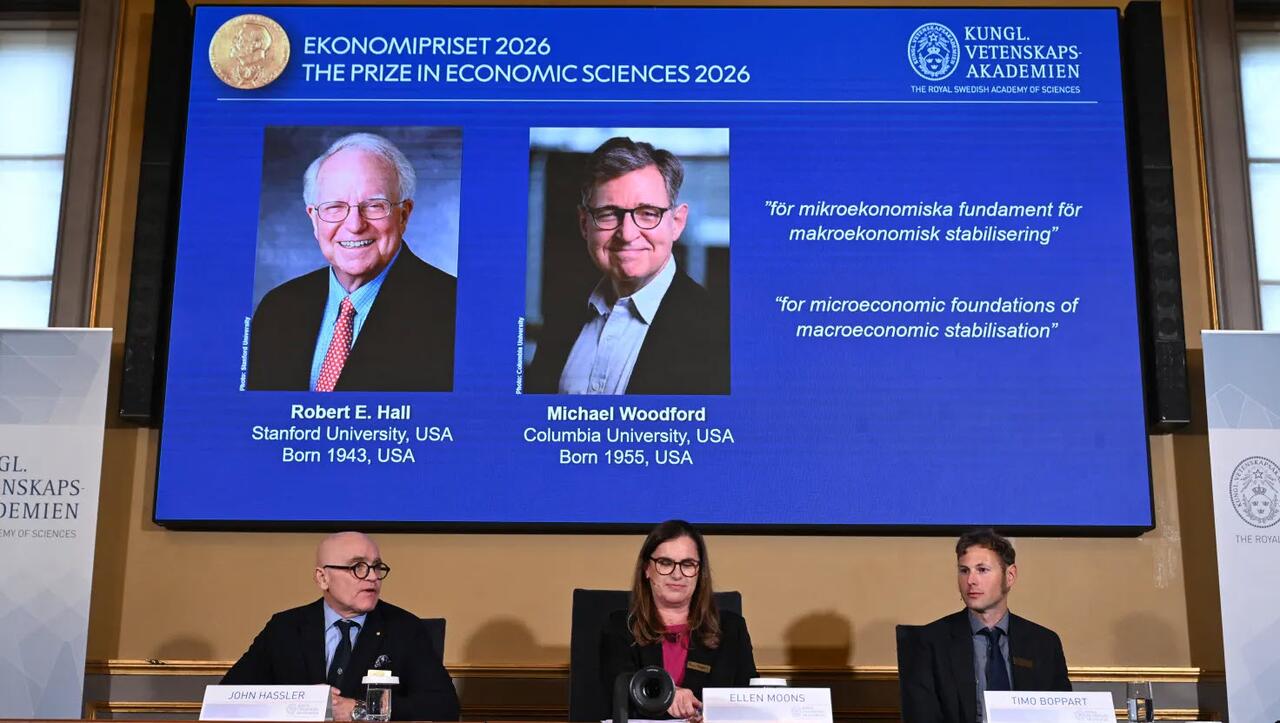
One reading of this is the New-Keynesian economic establishment congratulating itself on a job well done.
Winning the prize signals that the establishment ideas are the best ideas, but there are problems with this.
Firstly, there are legitimate criticisms to be made about the performance of central banks in ensuring macroeconomic stability, with many economists from dissenting schools of thought forming the view that central banks have tended to create the conditions for crises rather than preventing them.
A second criticism might be that renewed Great Power competition and the trend towards all organs of state power being arrayed to achieve foreign policy goals might have rendered New Keynesian ideas old hat.
For those supporting the latter view, goals of macroeconomic stabilization and inflation targeting are arguably being supplanted by other goals. Donald Trump’s recent comments to Time magazine that “certain levels of inflation” will help to pay the national debt “very rapidly” hint towards re-purposing the Fed from an independent inflation fighter to being subordinated to the broader economic strategy of the administration. You could call this financial repression, whereby holders of nominal dollars carry the can for government spending by receiving negative real yields on their investments, or you might call it fiscal dominance, whereby the hands of the central bank are effectively tied by the high level of public debt and real yields must be held negative to ensure financial stability. Handily, the recent rise in bond yields has been accompanied by a rise in US nominal GDP growth.
While the decision to award the economics prize to Woodford and Hall might gloss over developing trends in Western central banking, it also doesn’t encapsulate the way that central banking is conducted in the world’s second largest economy: China. The New Keynesian conception of central banking typically incorporates ideas like the sanctity of independence, the importance of policy rules, the primacy of short-term policy rates in conducting monetary policy and the agreement that inflation stabilization is a central policy objective.
The PBOC departs with virtually all these ideas by manipulating a suite of policy rates, window guidance, bank reserve requirement ratios, direct credit measures and interventions in foreign exchange markets. In the Chinese conception, the central bank directs credit activities from the centre of the economy, working hand in glove with the political apparatus to deliver on state priorities like the expansion of production in certain strategic sectors.
Arguably, in similar fashion to how it has adopted an increasingly Chinese perspective on the virtues of state capitalism and the correctness of a mercantilist view of trade, the Trump administration is also showing interest in a more Chinese conception of the role of the central bank. This is driven by geopolitical competition with China in a similar way to how Western welfare states were expanded due to geopolitical and ideological competition with the Soviet Union in the 20th century.
That does not mean that others are quick to follow the trend. The Reserve Bank of Australia today published the minutes of its September policy rate meeting where the cash rate was lifted for the fourth time this year to a new high of 4.60%. The minutes reinforced that the RBA had been surprised by the strength of growth in the second quarter of the year and both the level and the breadth of inflation recorded in the month of July.
Board members concluded that the three upside risks to inflation (ongoing war in the Middle East, the AI investment boom, and greater-than-expected domestic capacity pressures) were all materialising and that the recent drift higher in international yields implied an upward re-assessment of global neutral rates that combined with an upward drift in medium-term inflation expectations to make raising the policy rate unavoidable.
Consequently, the nine members of the Board voted unanimously in favour of raising the cash rate with the minutes disclosing that holding rates unchanged was only “briefly” considered. This reads as very hawkish and leaves the door very much open to further tightening, but it is also remarkable as an example of absolute orthodoxy that pays zero consideration to any potential role for the RBA in financing state priorities like addressing Australia’s fuel security vulnerabilities or rebuilding manufacturing supply chains that government now views as important elements of sovereignty.
Former RBA Board Member John Edwards, now a non-resident fellow at the Lowy Institute, summed up the lack of policy creativity neatly: “the economic debate about policy change within Australia has long been confined to a narrow range of options, most of which would make no big difference… challenges must be addressed by economic statecraft…”
The desirability of domestic supply chain capacity in a fragmenting word continues to be highlighted by events. News reports emerged yesterday that the Norwegian Armed Forces found that cars rented from a company with links to China’s Geely automatically recorded details of soldier activity, travel routes, and access codes to sensitive facilities. Meta announced that its new Muse model had joined competitors at the frontier of AI development, and the IMFs most recent World Economic Outlook stated the obvious by noting “energy-importing economies outside the technology value chain face the most difficult outlook.”
Saudi Arabia also announced plans to increase pipeline capacity by 40% to 10mmb/d over the next 3 years to reduce global reliance on the Strait of Hormuz. Saudi Energy Minister Prince Abdulaziz said, “the essence of responding to a crisis is that you have to focus on your own resilience and creating options.” With exchanges between Saudi Arabia and the Houthis increasing in recent days, and new risks emerging on the western side of the Red Sea, creating those options may depend on having security partnerships with friends who are capable and willing to fight on your behalf.
So, if you DO have the supply chains and you have reliable security partnerships to protect them, give yourself a pat on the back.
Tyler Durden Tue, 10/13/2026 - 11:25
Continue reading...
[ H/T ZeroHedge ]
By Benjamin Picton, senior market strategist at Rabobank
Give Yourself A Pat On The Back
Growing up in Australia in the 1990s one would inevitably encounter curiously ‘Aussie’ cultural practises. One such practise was school children being directed by teachers to “give yourself a pat on the back” whenever you did particularly well at something. This wasn’t just a figure of speech; the children would literally reach over their shoulder and pat themselves on the back. I’m unsure if this still occurs, or whether it was ever replicated in other countries (maybe New Zealand).
The process of self-congratulation does seem to have been transmogrified to the world of economics. The Nobel Memorial Prize in Economics was yesterday awarded to Woodford and Hall, respectively of Columbia and Stanford universities. The prize winners extended Robert Lucas’ theories of microfoundations to the realm of macroeconomic stabilisation policy, developing many of the models and ideas that still underpin central bank orthodoxy in the present day. Their work bridged the divide between the new classical economics of the 1970s, ‘80s and ‘90s, and the Keynesian macroeconomic theories that were considered orthodox between the Great Depression and the stagflationary shocks of the 1970s.
One reading of this is the New-Keynesian economic establishment congratulating itself on a job well done.
Winning the prize signals that the establishment ideas are the best ideas, but there are problems with this.
Firstly, there are legitimate criticisms to be made about the performance of central banks in ensuring macroeconomic stability, with many economists from dissenting schools of thought forming the view that central banks have tended to create the conditions for crises rather than preventing them.
A second criticism might be that renewed Great Power competition and the trend towards all organs of state power being arrayed to achieve foreign policy goals might have rendered New Keynesian ideas old hat.
For those supporting the latter view, goals of macroeconomic stabilization and inflation targeting are arguably being supplanted by other goals. Donald Trump’s recent comments to Time magazine that “certain levels of inflation” will help to pay the national debt “very rapidly” hint towards re-purposing the Fed from an independent inflation fighter to being subordinated to the broader economic strategy of the administration. You could call this financial repression, whereby holders of nominal dollars carry the can for government spending by receiving negative real yields on their investments, or you might call it fiscal dominance, whereby the hands of the central bank are effectively tied by the high level of public debt and real yields must be held negative to ensure financial stability. Handily, the recent rise in bond yields has been accompanied by a rise in US nominal GDP growth.
While the decision to award the economics prize to Woodford and Hall might gloss over developing trends in Western central banking, it also doesn’t encapsulate the way that central banking is conducted in the world’s second largest economy: China. The New Keynesian conception of central banking typically incorporates ideas like the sanctity of independence, the importance of policy rules, the primacy of short-term policy rates in conducting monetary policy and the agreement that inflation stabilization is a central policy objective.
The PBOC departs with virtually all these ideas by manipulating a suite of policy rates, window guidance, bank reserve requirement ratios, direct credit measures and interventions in foreign exchange markets. In the Chinese conception, the central bank directs credit activities from the centre of the economy, working hand in glove with the political apparatus to deliver on state priorities like the expansion of production in certain strategic sectors.
Arguably, in similar fashion to how it has adopted an increasingly Chinese perspective on the virtues of state capitalism and the correctness of a mercantilist view of trade, the Trump administration is also showing interest in a more Chinese conception of the role of the central bank. This is driven by geopolitical competition with China in a similar way to how Western welfare states were expanded due to geopolitical and ideological competition with the Soviet Union in the 20th century.
That does not mean that others are quick to follow the trend. The Reserve Bank of Australia today published the minutes of its September policy rate meeting where the cash rate was lifted for the fourth time this year to a new high of 4.60%. The minutes reinforced that the RBA had been surprised by the strength of growth in the second quarter of the year and both the level and the breadth of inflation recorded in the month of July.
Board members concluded that the three upside risks to inflation (ongoing war in the Middle East, the AI investment boom, and greater-than-expected domestic capacity pressures) were all materialising and that the recent drift higher in international yields implied an upward re-assessment of global neutral rates that combined with an upward drift in medium-term inflation expectations to make raising the policy rate unavoidable.
Consequently, the nine members of the Board voted unanimously in favour of raising the cash rate with the minutes disclosing that holding rates unchanged was only “briefly” considered. This reads as very hawkish and leaves the door very much open to further tightening, but it is also remarkable as an example of absolute orthodoxy that pays zero consideration to any potential role for the RBA in financing state priorities like addressing Australia’s fuel security vulnerabilities or rebuilding manufacturing supply chains that government now views as important elements of sovereignty.
Former RBA Board Member John Edwards, now a non-resident fellow at the Lowy Institute, summed up the lack of policy creativity neatly: “the economic debate about policy change within Australia has long been confined to a narrow range of options, most of which would make no big difference… challenges must be addressed by economic statecraft…”
The desirability of domestic supply chain capacity in a fragmenting word continues to be highlighted by events. News reports emerged yesterday that the Norwegian Armed Forces found that cars rented from a company with links to China’s Geely automatically recorded details of soldier activity, travel routes, and access codes to sensitive facilities. Meta announced that its new Muse model had joined competitors at the frontier of AI development, and the IMFs most recent World Economic Outlook stated the obvious by noting “energy-importing economies outside the technology value chain face the most difficult outlook.”
Saudi Arabia also announced plans to increase pipeline capacity by 40% to 10mmb/d over the next 3 years to reduce global reliance on the Strait of Hormuz. Saudi Energy Minister Prince Abdulaziz said, “the essence of responding to a crisis is that you have to focus on your own resilience and creating options.” With exchanges between Saudi Arabia and the Houthis increasing in recent days, and new risks emerging on the western side of the Red Sea, creating those options may depend on having security partnerships with friends who are capable and willing to fight on your behalf.
So, if you DO have the supply chains and you have reliable security partnerships to protect them, give yourself a pat on the back.
Tyler Durden Tue, 10/13/2026 - 11:25
Continue reading...
[ H/T ZeroHedge ]