






"More Pain To Come": Global Smartphone Shipments Plunge As Memory Crisis Crushes Budget Models
Global smartphone shipments tumbled 22% in the third quarter as soaring memory chip costs forced handset manufacturers to scrap lower-priced models and focus on premium models, delaying purchases for working-class consumers, according to a new note by Loop Capital Markets.
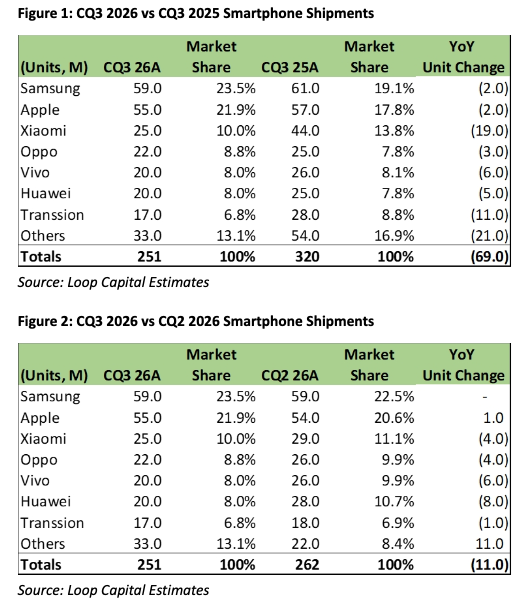
Loop Capital analyst John Donovan wrote early Tuesday that handset shipments totaled 251 million units in the quarter, down from 320 million a year earlier. The decline accelerated from 3% in the first quarter and 7% in the second.
Donovan added more color:
Loop's smartphone team breaks down the quarterly numbers:
"Entry-level and even mid-tier options have precious little margin to begin with," Donovan said, adding that manufacturers also have limited pricing power to absorb rising component costs.
The squeeze is most severe among Chinese brands competing on affordability: Xiaomi's shipments plunged to 25 million in 3Q from 44 million in the same quarter one year ago, a staggering 43% decline. Soaring costs made many of its existing models uneconomic, prompting the company to halt production of lower-end models.
Chinese brand Oppo shipped 22 million phones, and Vivo shipped 20 million in the quarter. Oppo dialed back its OnePlus and realme offerings, while Vivo faced mounting pressure from rising costs and supply-chain challenges. Transsion, which focuses on lower-tier devices, shipped 17 million units in 3Q, down from 28 million a year earlier.
South Korea's Samsung retained the top spot, shipping 59 million units in 3Q. Supply-chain management helped shield its midrange lineup, while premium devices, particularly its new foldable, sold well.
Apple's preliminary shipments totaled about 55 million in 3Q, compared with 57 million a year earlier, allowing it to gain market share despite lower volumes. Donovan said the iPhone 18 Pro Max was outselling the Pro and pushed back against reports of order cuts (read here).
Donovan slashed his 2026 forecast for new smartphone shipments to 1.08 billion from a previously announced 1.091 billion, compared with 1.237 billion in 2025.
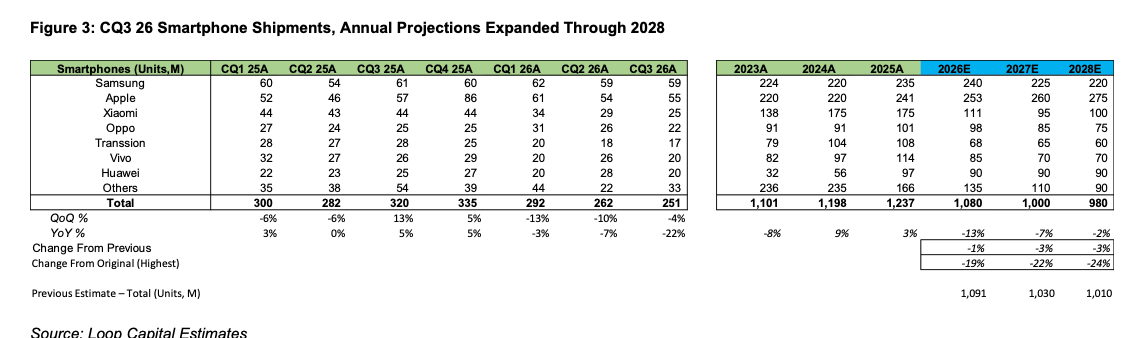
He expects shipments to slide even further to 1 billion in 2027 and 980 million in 2028.
Tyler Durden Tue, 10/13/2026 - 12:10
Continue reading...
[ H/T ZeroHedge ]
Global smartphone shipments tumbled 22% in the third quarter as soaring memory chip costs forced handset manufacturers to scrap lower-priced models and focus on premium models, delaying purchases for working-class consumers, according to a new note by Loop Capital Markets.
Loop Capital analyst John Donovan wrote early Tuesday that handset shipments totaled 251 million units in the quarter, down from 320 million a year earlier. The decline accelerated from 3% in the first quarter and 7% in the second.
Donovan added more color:
Loop's smartphone team breaks down the quarterly numbers:
"Entry-level and even mid-tier options have precious little margin to begin with," Donovan said, adding that manufacturers also have limited pricing power to absorb rising component costs.
The squeeze is most severe among Chinese brands competing on affordability: Xiaomi's shipments plunged to 25 million in 3Q from 44 million in the same quarter one year ago, a staggering 43% decline. Soaring costs made many of its existing models uneconomic, prompting the company to halt production of lower-end models.
Chinese brand Oppo shipped 22 million phones, and Vivo shipped 20 million in the quarter. Oppo dialed back its OnePlus and realme offerings, while Vivo faced mounting pressure from rising costs and supply-chain challenges. Transsion, which focuses on lower-tier devices, shipped 17 million units in 3Q, down from 28 million a year earlier.
South Korea's Samsung retained the top spot, shipping 59 million units in 3Q. Supply-chain management helped shield its midrange lineup, while premium devices, particularly its new foldable, sold well.
Apple's preliminary shipments totaled about 55 million in 3Q, compared with 57 million a year earlier, allowing it to gain market share despite lower volumes. Donovan said the iPhone 18 Pro Max was outselling the Pro and pushed back against reports of order cuts (read here).
Donovan slashed his 2026 forecast for new smartphone shipments to 1.08 billion from a previously announced 1.091 billion, compared with 1.237 billion in 2025.
He expects shipments to slide even further to 1 billion in 2027 and 980 million in 2028.
Tyler Durden Tue, 10/13/2026 - 12:10
Continue reading...
[ H/T ZeroHedge ]