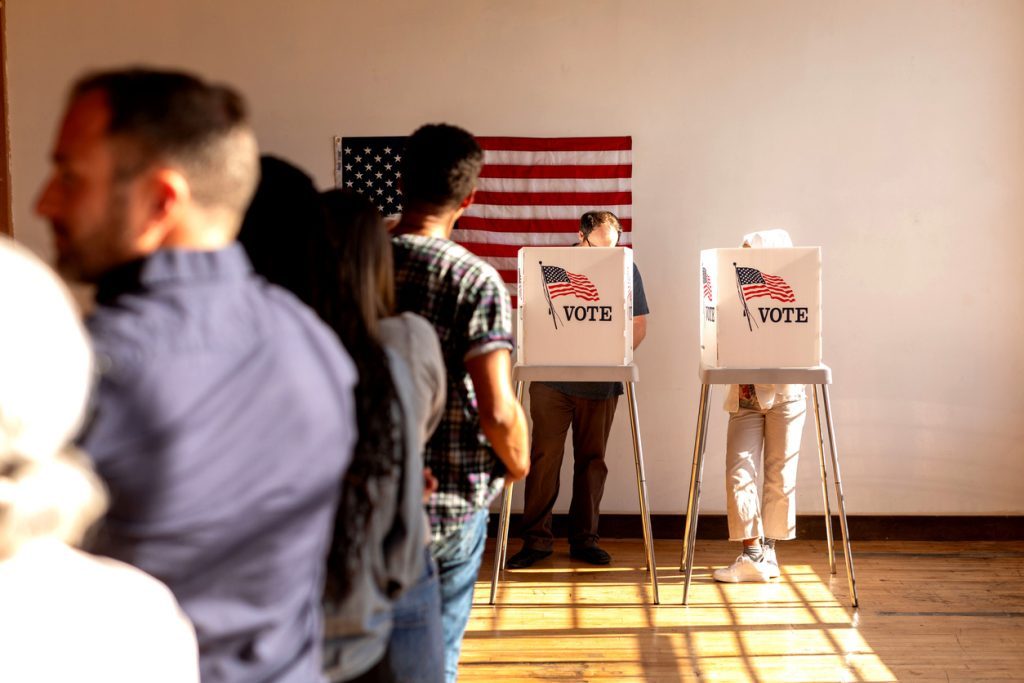



Control of the U.S. Senate may be decided in 2026 by a handful of candidates who genuinely have no hope of winning their own races.
While Democrats seem primed to retake the majority in the U.S. House of Representatives, control of the upper chamber is still up for grabs. Democrats must defend the seats they currently hold and flip at least four additional Senate races to win back majority control, with their best chances coming in Alaska, Iowa, Kansas, Maine, North Carolina, Ohio, and Texas.
TRACKING TRUMP’S MIDTERM CAMPAIGN PLEDGES
Currently, Democrats are viewed as outright favorites in only one of those races: North Carolina, where former Gov. Roy Cooper (D-NC) leads former Republican National Committee Chairman Michael Whatley by more than 10 points, according to the RealClearPolitics polling average.
But in four of the other races — Alaska, Iowa, Ohio, and Texas — Republicans have legitimate concern that third-party candidates may pull enough support away to hand victory, and potentially Senate control, to the Democrats.
Here’s what you need to know about the spoiler candidates that could determine the Senate majority in 2026.
Alaska — Daniel J. Sullivan, Jr. (unaffiliated)
Despite rarely speaking to the press or campaigning across the cycle, retired schoolteacher Daniel J. Sullivan, Jr. is by far the best-known spoiler candidate running in 2026. That’s in large part due to the fact that he shares his first and surname with the incumbent candidate, Sen. Dan S. Sullivan (R-AK). President Donald Trump and GOP officials have made repeated claims that Daniel J. Sullivan’s candidacy is an attempt by Democrats to take advantage of the state’s ranked-choice voting system.
“It’s just cheating. They’re terrible,” the president declared at an Oct. 13 rally in Wasilla, Alaska. “They found a guy named Dan Sullivan. They put him up to get a little confused. And actually, by mistake, he got 2.4%. That’s a lot. That’s too much. That could be the difference. So you got to remember Dan Sullivan, Republican incumbent.”
Daniel J. Sullivan, the teacher, and former Rep. Mary Peltola, the Democratic nominee in the 2026 Alaska Senate race, have repeatedly rejected GOP claims the candidacy was an orchestrated attempt to pull support away from the incumbent.
However, the New York Times published a lengthy report on Wednesday detailing how, in 2025, Peltola aides carried out what they referred to as a ballot composition project — an effort to comb the state for people named “Dan Sullivan” and convince at least one of them to enter the 2026 race. The New York Times cited text messages and interviews with 12 people familiar with establishing its report, which notes that ballot-stacking is not illegal and is a frequent practice by both parties in the state.
Still, Trump himself confirmed to reporters over the weekend that he ordered the Justice Department to file a suit seeking to block the results of the Alaska election if the incumbent Republican does not win the race. Experts have questioned the legal standing of the lawsuit, which is still making its way through the court system.
Daniel J. Sullivan has said that he previously voted for Peltola in her past state races and initially registered as a Republican before switching to unaffiliated when voting himself in the 2026 cycle. Gerald Heikes, another Republican, has also qualified to appear on the first round of balloting in the Alaska Senate race.
The incumbent senator Sullivan was granted a special dispensation from the state’s Supreme Court earlier this year to have “incumbent” listed beside his name on the ballot in addition to his party affiliation.
As of Wednesday, Peltola held a 1.2% lead over the incumbent Sen. Sullivan in the RealClearPolitics polling average.
Iowa — Thomas Laehn (Libertarian)
In a two-candidate field, Iowa’s Republican Senate nominee Ashley Hinson (R-IA) holds a lead of just 0.6 points over Democrat nominee Josh Turek.
But when Libertarian nominee Thomas Laehn is factored in, Hinson’s lead literally halves, according to the RealClearPolitics average.
Laehn has served as Greene County attorney since 2018, and he’s made reducing the influence of both parties in Washington the core focus of his platform. He qualified to appear on the ballot in November by submitting the requisite 3,500 signatures, including at least 100 in 19 different counties, to the state’s election office after announcing his candidacy last October.
And while Laehn’s campaign has advocated cutting federal spending, securing the Southern border, and ending America’s wars in the Middle East, he’s getting a surprise funding boost from the other side of the aisle. At least two Democratic super PACs were launched this month, allocating hundreds of thousands of dollars into backing Laehn’s campaign on Iowa airwaves.
Our Heritage Matters, a super PAC that was registered on Oct. 15, spent $304,000 on ads backing Laehn between Oct. 20 and 24. The PAC has also cut ads supporting Libertarian Rick Stewart in Iowa’s 2nd Congressional District. Meanwhile, Hawkeye Liberty PAC, which was registered on Oct. 7, spent roughly $120,000 on SMS and print mailers supporting Laehn.
Laehn himself said he was alerted to the outside spending through news reports.
“That was the first I learned of it,” he told the Des Moines Register. “These expenditures are being made without my knowledge or permission, without the knowledge or permission of anyone associated with my campaign.”
Ohio — Bill Redpath (Libertarian), Gregory Levy (independent)
Like in Iowa, outside political groups are spending on minor U.S. Senate candidates in Ohio with hopes of spoiling things for the other side.
Both Libertarian Senate candidate Bill Redpath and independent Gregory Levy will appear on the ballot in November. Each is polling in the low single digits and has disavowed the outside spending campaigns.
“Maybe they think that there are MAGA supporters out there, who are disillusioned with Jon Husted,” Redpath told a local NPR affiliate when asked about mailers backing his candidacy, paid for by Ohio Democrats. “I’m not aware of that being the case, but perhaps it’s the case.”
Levy, a progressive critic of both parties, has likewise received more than $1.58 million in outside spending by Republican interest groups highlighting his own campaign.
“That billionaire-backed Democrats have also stooped to the level of deceiving voters comes as no surprise to us,” he similarly told NPR. “This is exactly why we launched this campaign – to call the true nature of this system, a plutocracy, into question. Every day proves the need for a total reorganization of power into the hands of working people, starting with outlawing political donations and the legalized bribery that lets the rich buy our elections.”
The RealClearPolitics polling average showed incumbent Sen. John Husted (R-OH) trailing Democratic nominee former Sen. Sherrod Brown (D-OH) by 3.3 points in a head-to-head matchup on Wednesday. Brown’s lead shrank to 2.5 points when Redpath and Levy were added onto the polls.
Texas — Ted Brown (Libertarian)
The 2026 election won’t be the first time Libertarian Ted Brown has run for the U.S. Senate in Texas.
In 2018, he finished third behind Sen. Ted Cruz (R-TX) and former Rep. Beto O’Rourke, earning just over 2% of the total vote. Cruz ended up beating O’Rourke that year by more than 8 points.
However, in 2026, polling suggests that the Texas Senate race between state Rep. James Talarico and state Attorney General Ken Paxton, the respective Democratic and Republican nominees, is significantly closer than the Cruz-O’Rourke contest.
The RealClearPolitics average on Wednesday gave Talarico a 1.8-point advantage over Paxton, and Brown believes that the tight nature of the race, coupled with dissatisfaction from Texas voters for both candidates, means “there is more interest” in his own candidacy than there was in 2018.
In a local news interview this week, Brown knocked Talarico’s economic platform while adding that “he seems like an honest and decent guy.”
He had significantly harsher words for Paxton, who successfully knocked off Sen. John Cornyn (R-TX) in the primary after earning an endorsement from Trump.
“With Paxton, he’s a very corrupt person. Usually, it takes a while to become corrupt in Washington,” Brown explained before seemingly relishing the idea that he’d get blamed by whoever the losing candidate turns out to be.
‘WE ALL HAVE OUR LIMITATIONS’: HOW LONG WILL MAGA KEEP WATCHING THE TRUMP SHOW?
“You can’t spoil something that’s so rotten and corrupt, but on the numbers there’s a lot of Republicans, including those that voted for Cornyn in the primary, that might say, ‘You know what, I just can’t vote for Paxton but I’ve been a lifelong Republican [and] there’s no way I can vote for James Talarico and his views,” he said. “I would love to see [the winner] be below 50% and then whoever loses will blame me, which really won’t necessarily be the case, but it’ll look that way.”
Continue reading...
[ H/T Washington Examiner ]