


Ronald Reagan once said that an American “lives in anticipation of the future because he knows it will be a great place.” But today’s backlash against data center construction, the latest target of an increasingly vigorous “Not In My Backyard” movement, is putting Americans in the opposite mood.
At issue in both the data center controversy and the larger NIMBY push to urge state and local governments to block new construction is Americans’ shifting attitude toward change itself. Americans are increasingly skeptical that changes in their community will usher in a “great” future. New construction is viewed as bad by default until proven otherwise.
This attitude poses a challenge to freedom-to-build supporters, who believe that America would be a stronger, happier nation if construction were easier. If they want to respond effectively to NIMBYism, they’ll have to find a way to speak to the deeper anxieties about changes that drive it. The best place to start is to force the NIMBY coalition to wrestle with the fact that change is an essential part of life.
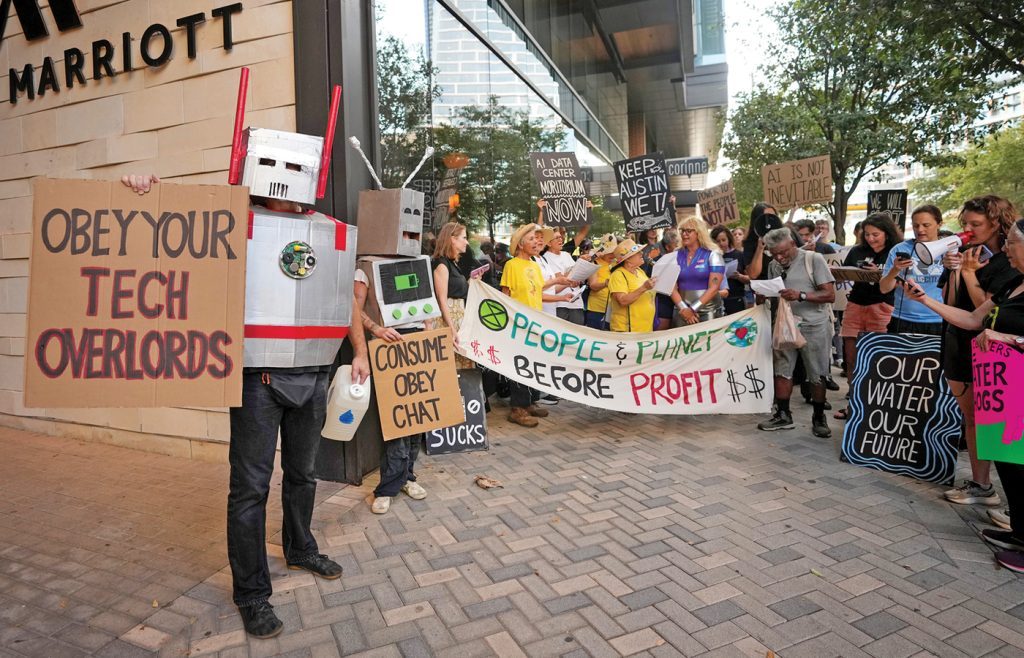
Protesters opposed to data center projects in downtown Austin, Sept. 2, 2026. (Jay Janner/Austin American-Statesman/Getty)
" data-large-file="https://www.washingtonexaminer.com/.../Feat.Tech3_.093026-e1792425757609.jpg?w=1024" src="https://www.washingtonexaminer.com/wp-content/uploads/2026/09/Feat.Tech3_.093026.jpg?w=1024" alt="Protesters opposed to data center projects in downtown Austin, Sept. 2, 2026. (Jay Janner/Austin American-Statesman/Getty)" class="wp-image-4743454">
Protesters opposed to data center projects in downtown Austin on Wednesday, Sept. 2, 2026. (Jay Janner/Austin American-Statesman/Getty)
While NIMBYs agree that they want to block construction, they don’t often agree on why they want to block it. While just 11% of Americans told pollsters at the University of Massachusetts Amherst that they supported the construction of an AI data center in their community, relatively few of those opposed “expressed more general opposition to generative AI.” They instead worried about noisy trucks and equipment converting empty land into large commercial centers, which would plug into the local power grid and draw from the municipal water supply.
These concerns apply equally well to all types of construction projects, which is why you’ll almost never hear anyone argue that land, energy, and water shouldn’t go to data centers because they should be saved for another type of industrial development in their area. What national press coverage treats as “anti-data center” backlash is largely motivated by the same concerns that drive people to oppose the construction of new housing, energy infrastructure, and manufacturing facilities in their area.
The widespread backlash against data centers has contributed to a general skepticism of construction, imperiling reforms that would make new developments easier and more affordable. Media reports indicate, and my own conversations with congressional staff confirm, that in the past several months, “permitting reform” has lost some of its status as a consensus buzzword. If formerly pro-construction politicians get cold feet and NIMBYism succeeds in blocking commercial and residential building projects across the country, Americans will suffer higher housing costs, have fewer manufacturing and construction jobs, and pay more for electricity.
Builders can attempt to alleviate local concerns about proposed projects, but all of us should also be calling attention to a fundamental contradiction at the heart of the NIMBY attitude toward change. That attitude treats the present as a solid, fixed starting point that we already securely possess, onto which we can accept changes as optional “add-ons” only when it suits us.
In fact, there are countless ways that our enjoyment of the present depends on future-oriented activities such as planning, investing — even hoping and dreaming — all of which rely on physical and technological changes to the world around us.
It’s easy to understand why financial investments rely on change: 62% of U.S. adults own stocks, which entitle them to a share of a company’s future earnings. If rising NIMBYism forces businesses to cancel their plans for new locations and expanded facilities, the impact will be felt immediately in people’s retirement accounts and college funds.
A yard sign expressing opposition to data center construction is seen outside of a home in Nescopeck, Pa., on July 3, 2026. (Paul Weaver/Sipa USA via Newscom)
" data-large-file="https://www.washingtonexaminer.com/...ostwentyseven343266-e1791314734331.jpg?w=1024" src="https://www.washingtonexaminer.com/...ostwentyseven343266-e1791314734331.jpg?w=1024" alt="A yard sign expressing opposition to data center construction." class="wp-image-4706447" srcset="https://www.washingtonexaminer.com/...ipaphotostwentyseven343266-e1791314734331.jpg 1024w, https://www.washingtonexaminer.com/...seven343266-e1791314734331.jpg?resize=300,200 300w, https://www.washingtonexaminer.com/...seven343266-e1791314734331.jpg?resize=768,512 768w" sizes="(max-width: 1024px) 100vw, 1024px">
A yard sign expressing opposition to data center construction is seen outside of a home in Nescopeck, Pennsylvania, on Friday, July 3, 2026. (Paul Weaver/Sipa USA via Newscom)
While all that is true, it won’t on its own have much purchase with the many Americans who’ve gotten fatigued with money-based arguments that feel like hidden attempts to advance the interests of Wall Street firms and big companies. Why, they ask, should we be forced to endure disruptive changes just so that big corporations can continue to grow? Arguments that touch only on these financial concerns won’t be enough.
But it’s important to remember that many of our lives revolve around thinking up and bringing about all sorts of changes to the physical world. Hundreds of thousands of U.S. students enroll in college each year to study engineering. These students aren’t hoping to simply do maintenance on the existing stock of buildings and machinery. They want to invent new technologies, design new structures, and build them.
The same goes for architects, construction workers, scientists, and the millions of other Americans whose enjoyment of their present lives depends on the sense of purpose and meaning they get from using their talents to dream up and effectuate change.
GREG ABBOTT’S DEMOCRATIC CHALLENGER VOWS MORATORIUM ON DATA CENTERS
That is the core contradiction of NIMBYism: The economic activity they oppose is an indispensable part of the lifestyle they are trying to preserve through that opposition. They haven’t fully grasped the ways in which the future is today’s concern.
We all deserve a say in how our communities develop. By clinging too tightly to the way things are, we risk choking off the vital element of change that makes the status quo enjoyable, unwittingly destroying the very thing we were trying to protect.
Jace White is the manager of government relations at Advancing American Freedom.
Continue reading...
[ H/T Washington Examiner ]