

President Donald Trump signed an executive order creating a specific women’s health division at the National Institutes of Health, a move prompted by first lady Melania Trump.
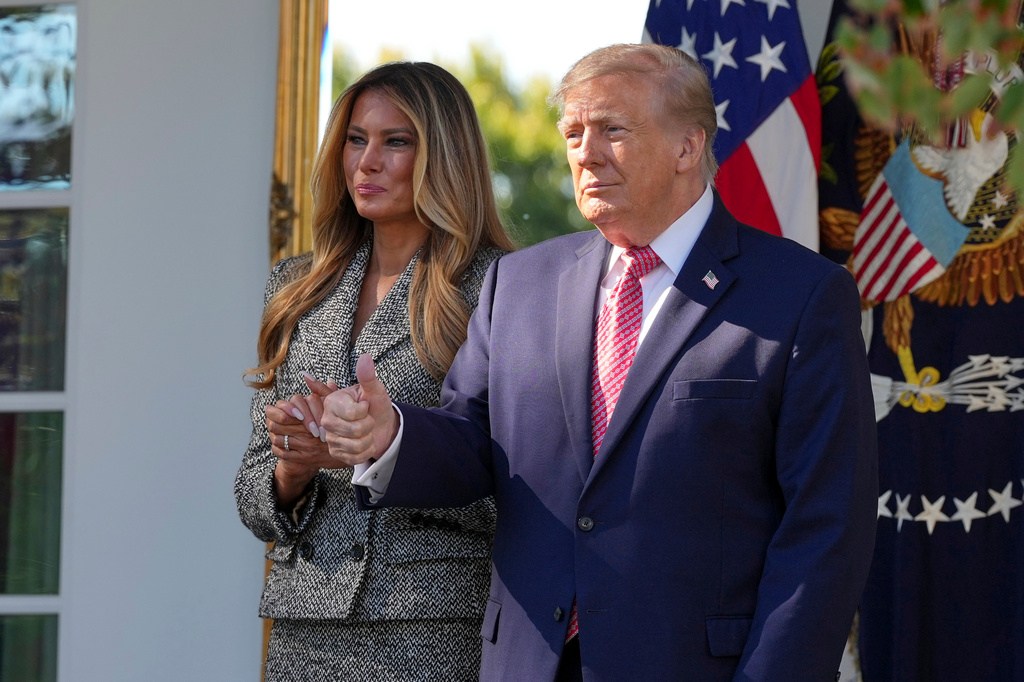
The president signed the executive order alongside his wife Monday in the White House Rose Garden, calling the creation of a new NIH office “a big deal.”
Donald Trump said creating a women’s health office at NIH “would seem so basic” and remarked he was amazed it did not already exist.
“When I heard about it, I said, ‘Are you sure they don’t have that?’” the president said. “Who the hell wouldn’t have a women’s health division? Melania said, ‘They don’t have it.’”
The new initiative, launched by the first lady, will emphasize using artificial intelligence and emerging technologies to advance the understanding of how diseases affect the female body differently.
“Previous generations fought for women’s rights,” the first lady said. “Our generation will fight to discover the cures that will ensure a woman can live her life in health and to the fullest.”
The executive order revokes a similar one issued by former President Joe Biden in 2024 that directed federal agencies to prioritize “addressing health disparities and inequities affecting women,” including race and socioeconomic status.
Women’s health advocates argue there is a great need for a specific focus on how conditions such as heart disease, dementia, and cancer are different in men and women rather than solely focusing on women’s reproductive health as the only difference between the sexes.
The NIH already spends roughly 10% of its annual budget on women’s health research, about $5 billion. It is not clear how this will change as a result of the executive order.
“As Melania said, today we’re taking historic action to promote women’s health through all phases of life,” the president said. “Despite amazing advances in medical science, many diseases and conditions that disproportionately affect women remain chronically understudied.”
The new women’s health office comes as the president’s approval rating among women sank to just 29% in August, down 10 percentage points from the start of his term, according to a University of Massachusetts Amherst poll. Winning over female voters is important for the Republican Party to maintain control of Congress after the midterm elections.
The move from the Trumps also stands in contrast to some of the rhetoric regarding men’s health as being in a more precarious position than women’s.
Dr. Brian Christine, the assistant health and human services secretary for health, has called for the creation of an Office of Men’s Health to parallel the Office of Women’s Health created in the 1990s.
Men in the United States, Christine often says, live six years less than women on average, with male life expectancy reaching only 73 as of 2023, compared to 79 for women.
Although depression rates for the sexes are roughly equal, the suicide rate for men is four times higher than it is for women, with men making up more than 80% of the nearly 50,000 suicides each year. American men are also three times more likely to die from opioid use and have higher rates of alcohol abuse.
In April 2025, Trump administration health officials slashed funding for the Women’s Health Initiative, a long-term NIH study started in the 1990s that has tracked the health of tens of thousands of women to better understand postmenopausal health. The funding was restored several days after the cuts were announced, following public outcry.
Health and Human Services Secretary Robert F. Kennedy Jr. has, however, made attempts to push forward women’s health by having the Food and Drug Administration remove certain restrictions on hormone replacement therapy for menopause symptom relief and by hosting the first-ever HHS National Conference on Women’s Health in April.
President Donald Trump, right, kisses first lady Melania Trump, left, after he signed an executive order at an event about women’s health on Monday, Oct. 19, 2026, in the Rose Garden of the White House in Washington. (AP Photo/Alex Brandon)
" data-large-file="https://www.washingtonexaminer.com/wp-content/uploads/2026/10/AP26292558732218.jpg?w=1024" src="https://www.washingtonexaminer.com/wp-content/uploads/2026/10/AP26292558732218.jpg?w=1024" alt="President Donald Trump, right, kisses first lady Melania Trump, left" class="wp-image-4770680" srcset="https://www.washingtonexaminer.com/wp-content/uploads/2026/10/AP26292558732218.jpg 1024w, https://www.washingtonexaminer.com/wp-content/uploads/2026/10/AP26292558732218.jpg?resize=300,200 300w, https://www.washingtonexaminer.com/wp-content/uploads/2026/10/AP26292558732218.jpg?resize=768,512 768w" sizes="(max-width: 1024px) 100vw, 1024px">
President Donald Trump, right, kisses first lady Melania Trump, left, after he signed an executive order at an event about women’s health on Monday, Oct. 19, 2026, in the Rose Garden of the White House in Washington. (AP Photo/Alex Brandon)
Although NIH Director Jay Bhattacharya and Kennedy were present at the event, they did not give public remarks on the occasion.
The new executive order also positions the first lady as an advocate for women’s health policy.
In her husband’s first term, Melania Trump focused on children’s bullying prevention and online safety with her Be Best campaign. During Donald Trump’s second term, the first lady has continued those efforts by working to improve the nation’s foster care system as well as shepherding through Congress the Take It Down Act, legislation passed last year meant to combat AI-generated and nonconsensual sexual abuse material online.
The president thanked his wife, saying she “works so hard, you wouldn’t believe it.”
“We’re delighted that she’s bringing her extraordinary leadership and skills — she’s a very skilled person, actually — to help improve the health of our nation’s women and girls,” he said.
Continue reading...
[ H/T Washington Examiner ]