




How Howard Lutnick Built the Infrastructure For America’s Largest Financial Conflict of Interest
Citation: The Leah Files
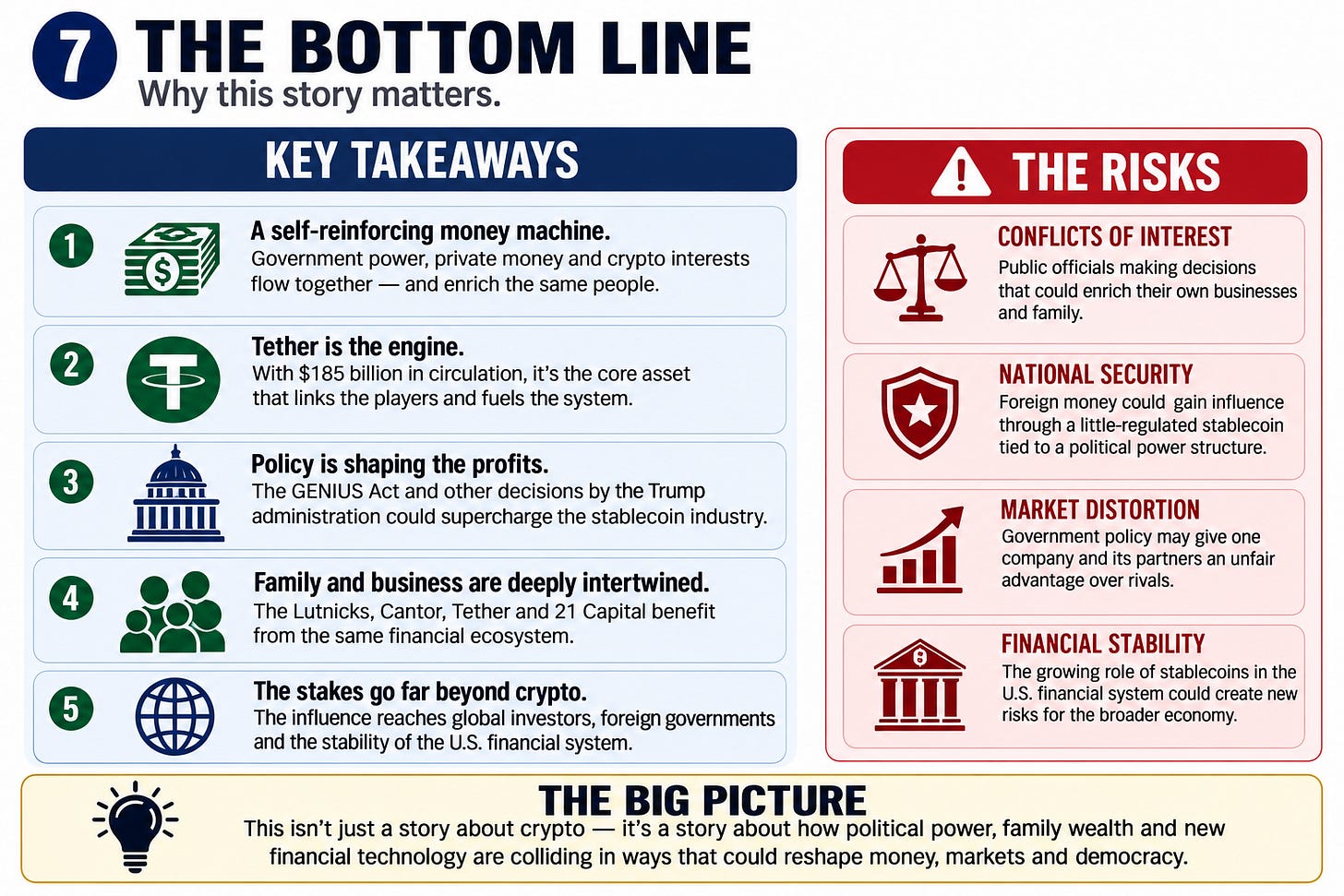
Note: This is a very long article but, if you even read just the summary at the bottom, you will see just how crooked this administration is and how they are, and will be lining their pockets with Stablecoin and how Tether is tied to the Lutnick family.
In Part I of “The Currency Killer”, I showed you how Treasury Secretary Scott Bessent is using the same tools he deployed as a hedge fund manager to manipulate the US bond market. He doubled the Treasury buyback program to $4 billion per operation. He is sitting on a $950 billion war chest.
Read Part 1 Now
But a buyback scheme only works if there is demand for the bonds you are buying. Someone has to be on the other side of the trade.
That someone is Howard Lutnick.
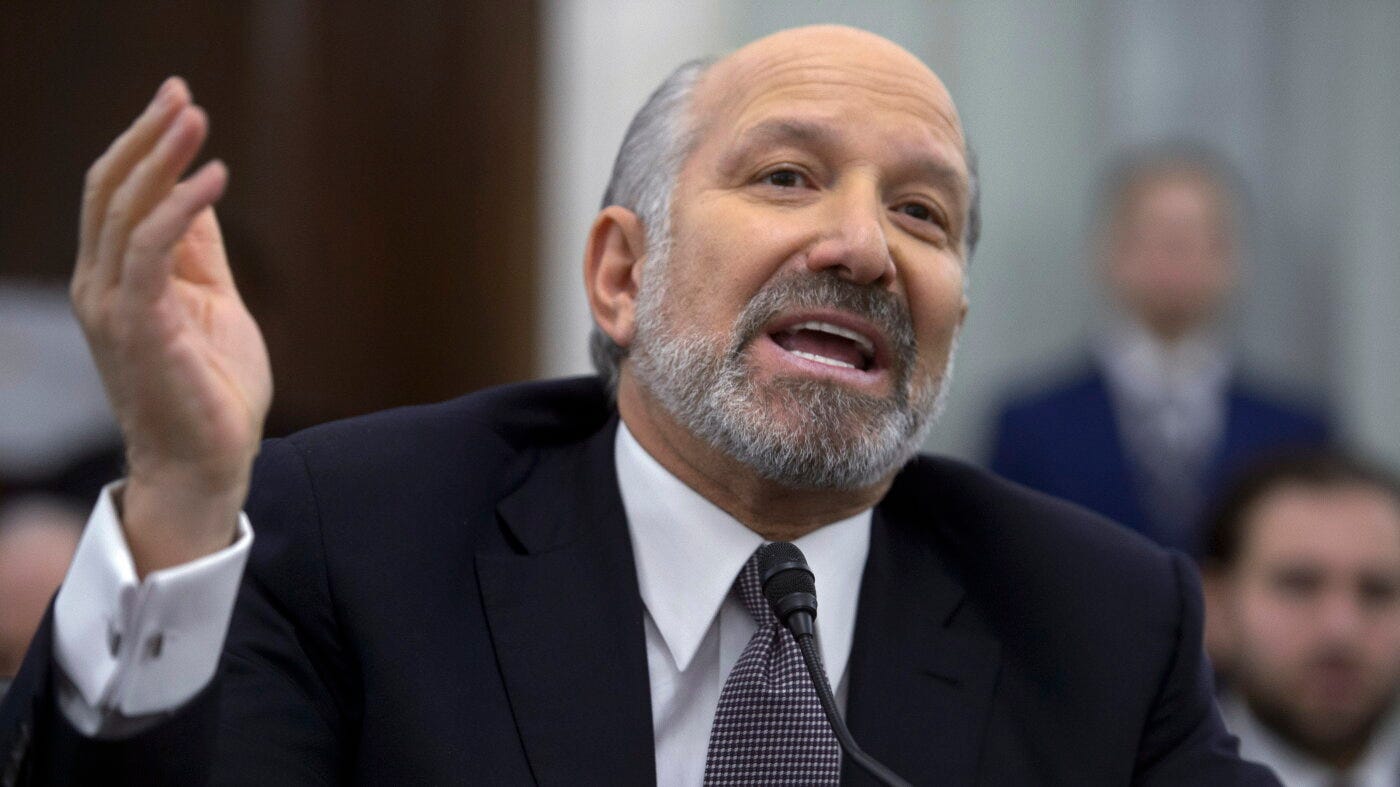
Before he became the 41st Secretary of Commerce, Lutnick was the CEO of Cantor Fitzgerald, one of Wall Street’s largest bond dealers. I did a deep dive on Lutnick, so go check it out on my Substack if you haven’t already. But in summary, he is, in my opinion, one of the worst of the worst of this administration. Forbes called him the most hated guy on Wall Street. He was confirmed 51-45 on a strict party-line vote. He co-chaired Trump’s transition and was the 31st largest donor in the 2024 cycle, putting nearly $9 million into MAGA, Inc.
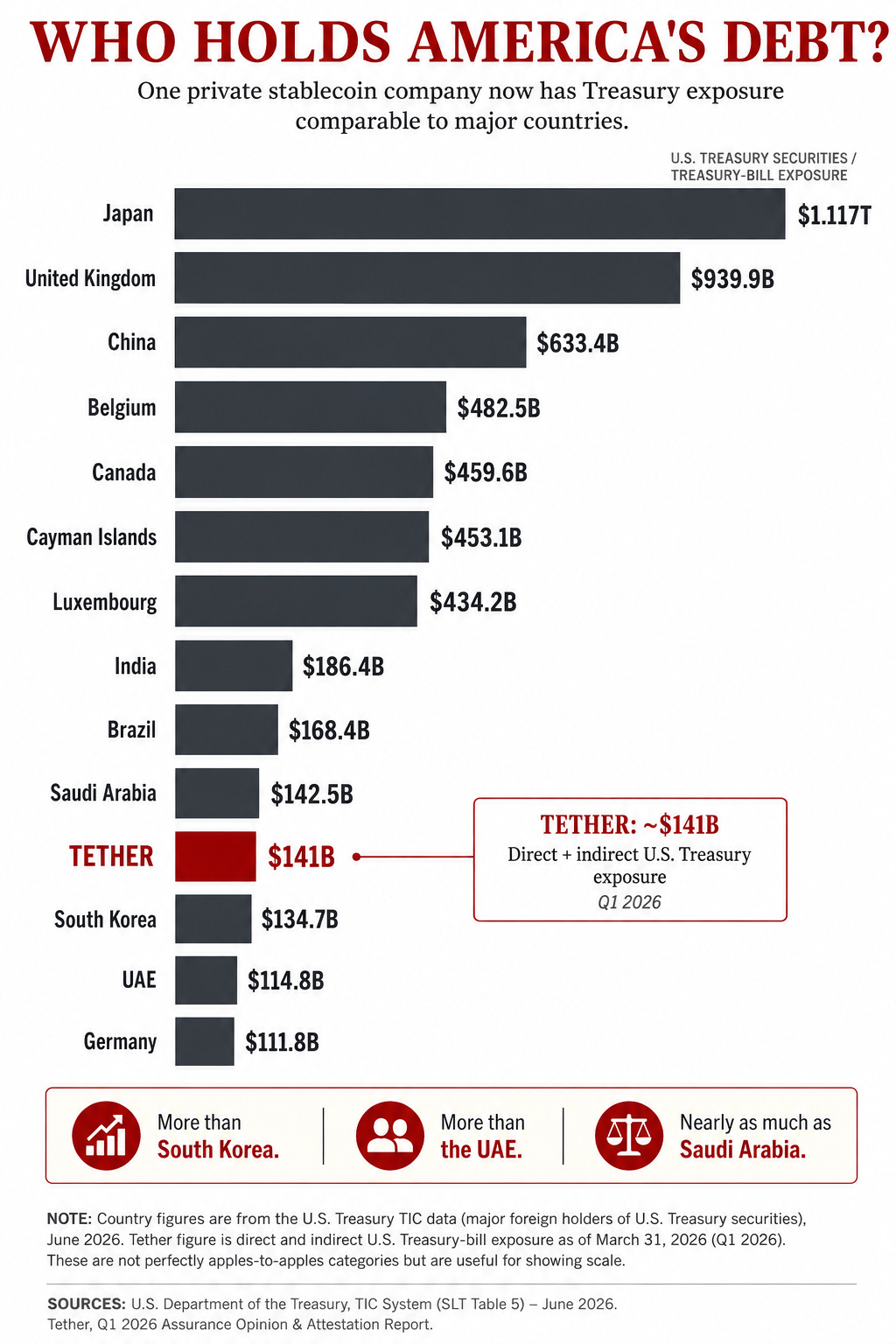
His firm has a client that matters more than any other in this Currency Killer series. That client is Tether, the largest stablecoin in the world, with $185 billion in circulation. Cantor Fitzgerald is Tether’s primary custodian, holding $141 billion in US Treasury bills backing Tether’s reserves.
That makes Tether one of the twenty largest holders of US government debt on earth, bigger than Germany.
But Lutnick did not just manage Tether’s money, he vouched for them publicly, and shaped the law that protects them. His family still profits from the relationship. The stablecoin at the center of all of it has documented ties to terrorism financing, nuclear proliferation, and the global fentanyl trade. Welcome to the most corrupt administration folks.
This is the story of the custodian, ie Howard Lutnick.
Cantor Fitzgerald began custodying Tether’s reserves in late 2021. Lutnick first disclosed the relationship publicly in a December 2023 podcast. By 2024, he was the company’s most prominent defender.
At the World Economic Forum in Davos in January 2024, Lutnick went on camera and said: “There is a company that I like called Tether. From what we have seen, and we did a lot of work, they have the money they say they have.”
That endorsement was important because Tether had been dogged for years by questions about whether its stablecoin was actually backed one-to-one by real assets. The company has never published an independent audit. It publishes quarterly attestations prepared by BDO, a mid-tier accounting firm, but an attestation is not an audit or a forensic examination, it is a snapshot in time.
What Lutnick was really saying at Davos was, trust me, bro.
As of the first quarter of 2026, Tether reported $141 billion in direct and indirect US Treasury bill exposure. Approximately $117 billion in direct T-bill holdings and another $24 billion in reverse repurchase agreements collateralized by Treasuries. Cantor custodies the vast majority of this.
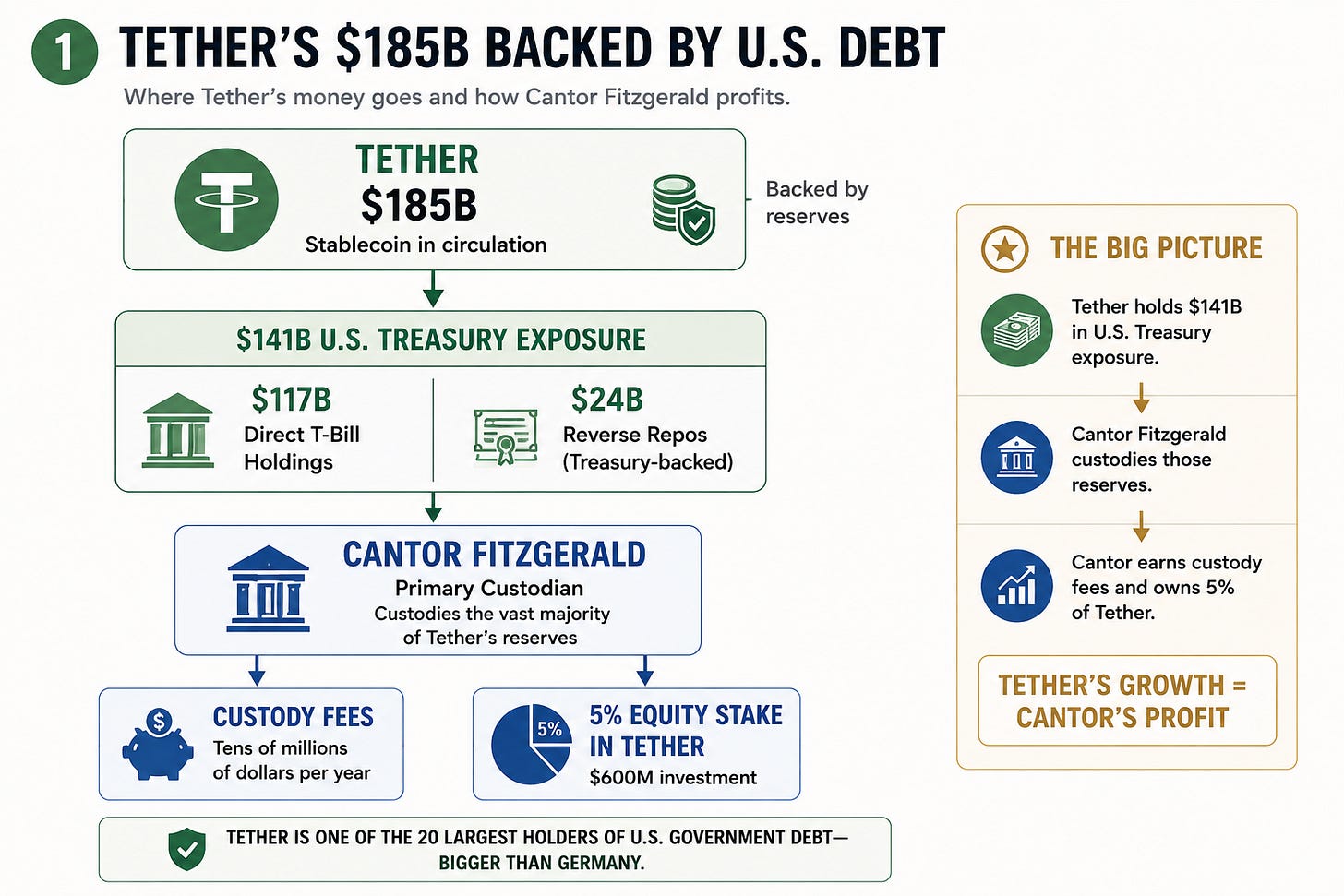
The custody fees alone generate tens of millions of dollars a year for Cantor Fitzgerald. But the real prize came in 2024, when Cantor acquired a 5% equity stake in Tether through a $600 million convertible bond. At Tether’s current valuation, that stake is worth considerably more.
So Lutnick’s firm was not just holding Tether’s money, it owned a piece of Tether itself, while Lutnick is sitting at the Secretary of Commerce.
When Lutnick was confirmed as Commerce Secretary in February 2025, he was required by federal ethics rules to divest his ownership of Cantor Fitzgerald, BGC Group, and Newmark Group.
In October 2025, he transferred his multibillion-dollar ownership stake to trusts benefiting his four children. The transactions closed on October 6. His son Brandon became CEO and chairman, holding 22.3% of outstanding common stock with 58.6% of total voting power. A minority stake went to an investor group including Apollo co-founder Josh Harris.

On paper, the divestiture was complete.
But Bloomberg reported that at about the same time, Dynasty Trust A, which benefits all four Lutnick children, borrowed an undisclosed sum from Tether. The loan was secured by trust assets.
Tether gave his children the money to buy his company. The company he was required to separate from received a loan from the company whose reserves his firm custodies.
A Cantor spokesperson said the acquisition was financed through multiple sources, multiple companies, and multiple trusts at market rates and market prices. They declined to disclose the loan amount or confirm whether the funds were used to finance the asset purchase.
On April 30, 2026, Senators Elizabeth Warren and Ron Wyden sent letters to both Lutnick and Tether CEO Paolo Ardoino demanding answers. They cited potential conflicts of interest, national security concerns, and questions about foreign stablecoin access to US markets.
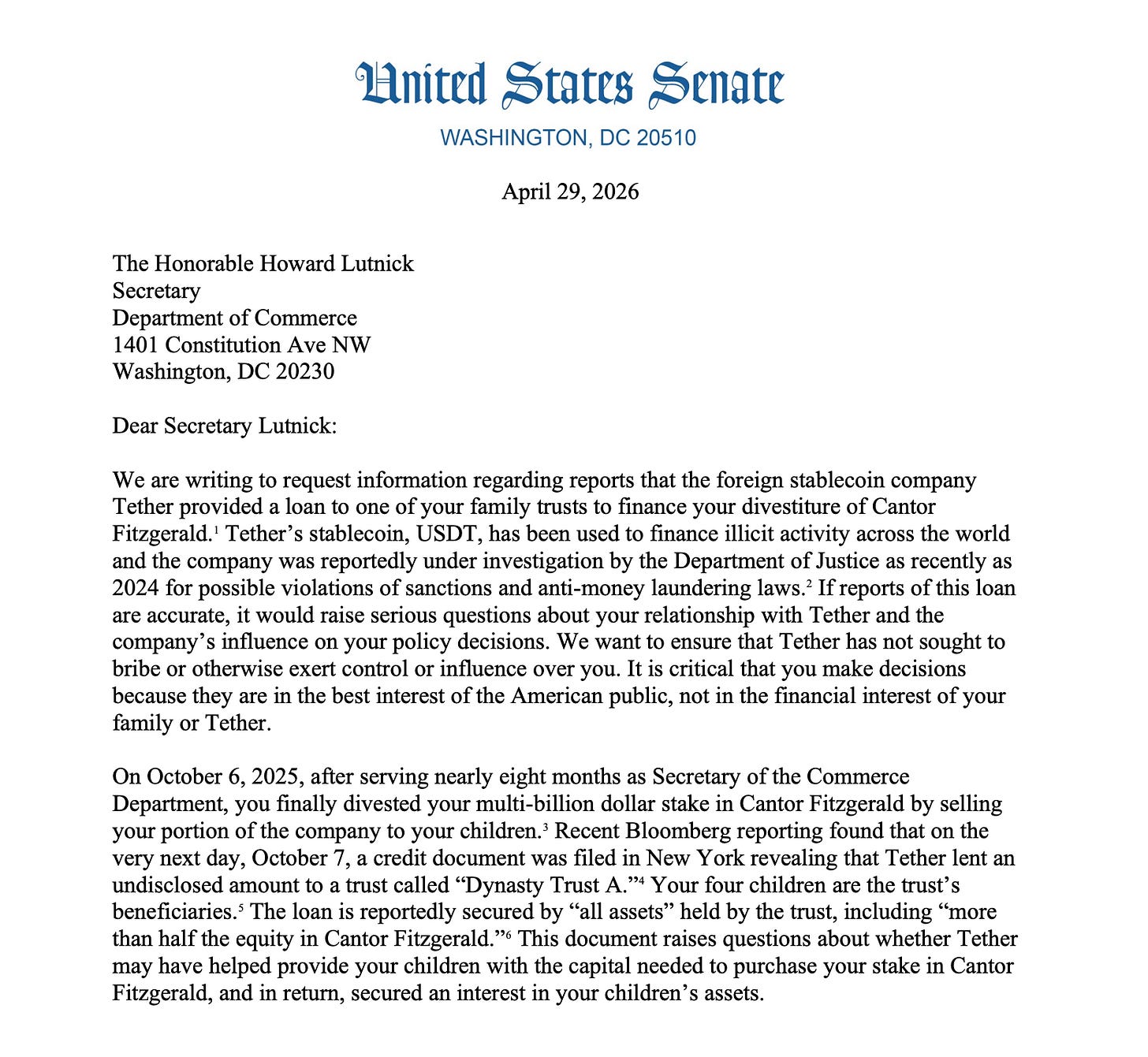
They noted that the coziness of his relationship with Tether prior to his nomination, and the favorable treatment Tether received in the GENIUS Act, make reports of a loan from Tether to his children’s trust even more troubling.
The loan amount has not been disclosed.
Then in July 2025, the White House gave Lutnick a limited ethics waiver. It allows him to “participate personally and substantially” in government business that may have a “direct and predictable effect” on Cantor Fitzgerald, Newmark, and BGC Group. The White House counsel wrote that his financial interest is “not so substantial as to be likely to affect the integrity of his service.”
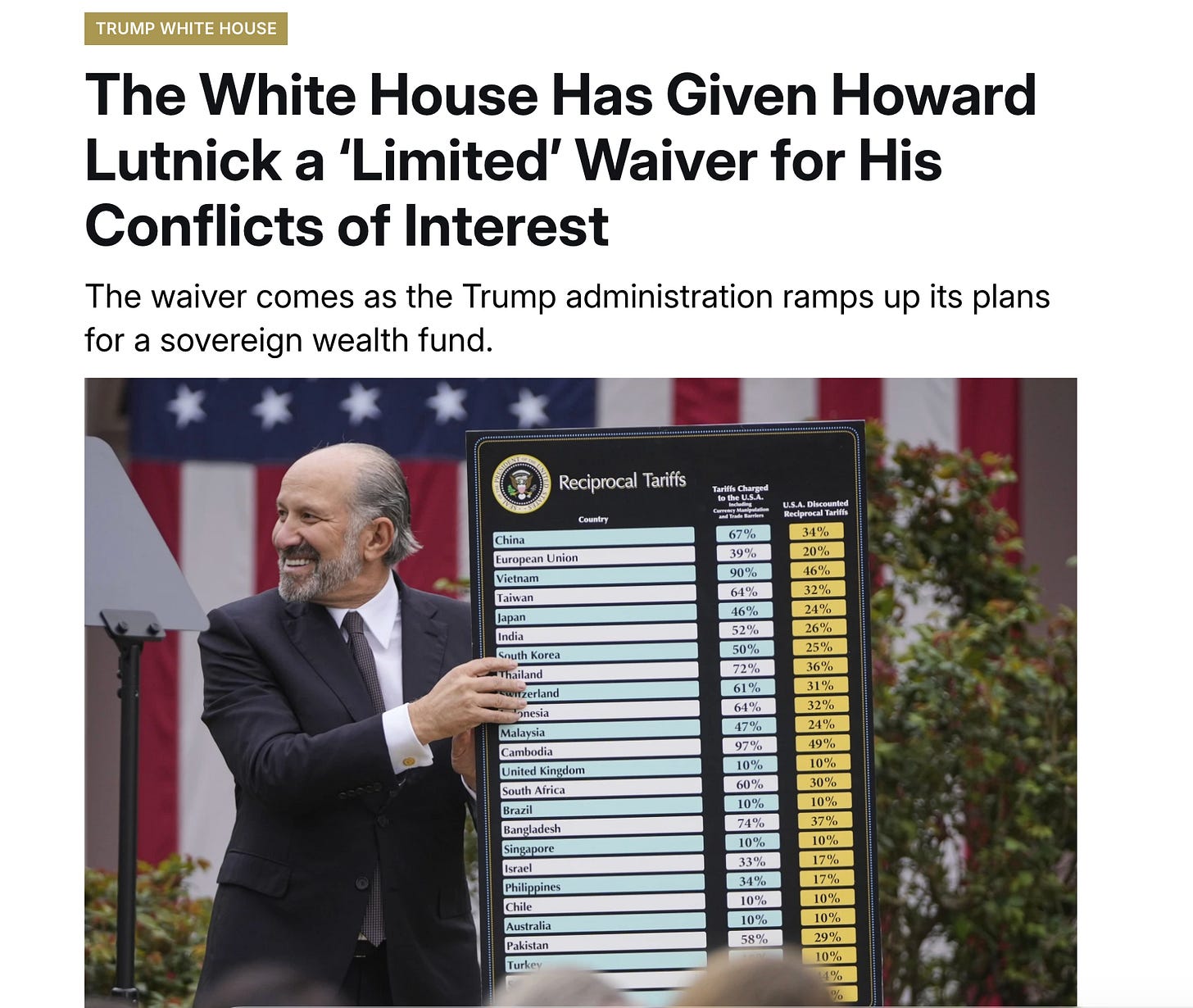
He held roles in 818 companies. This is the most I have ever seen.

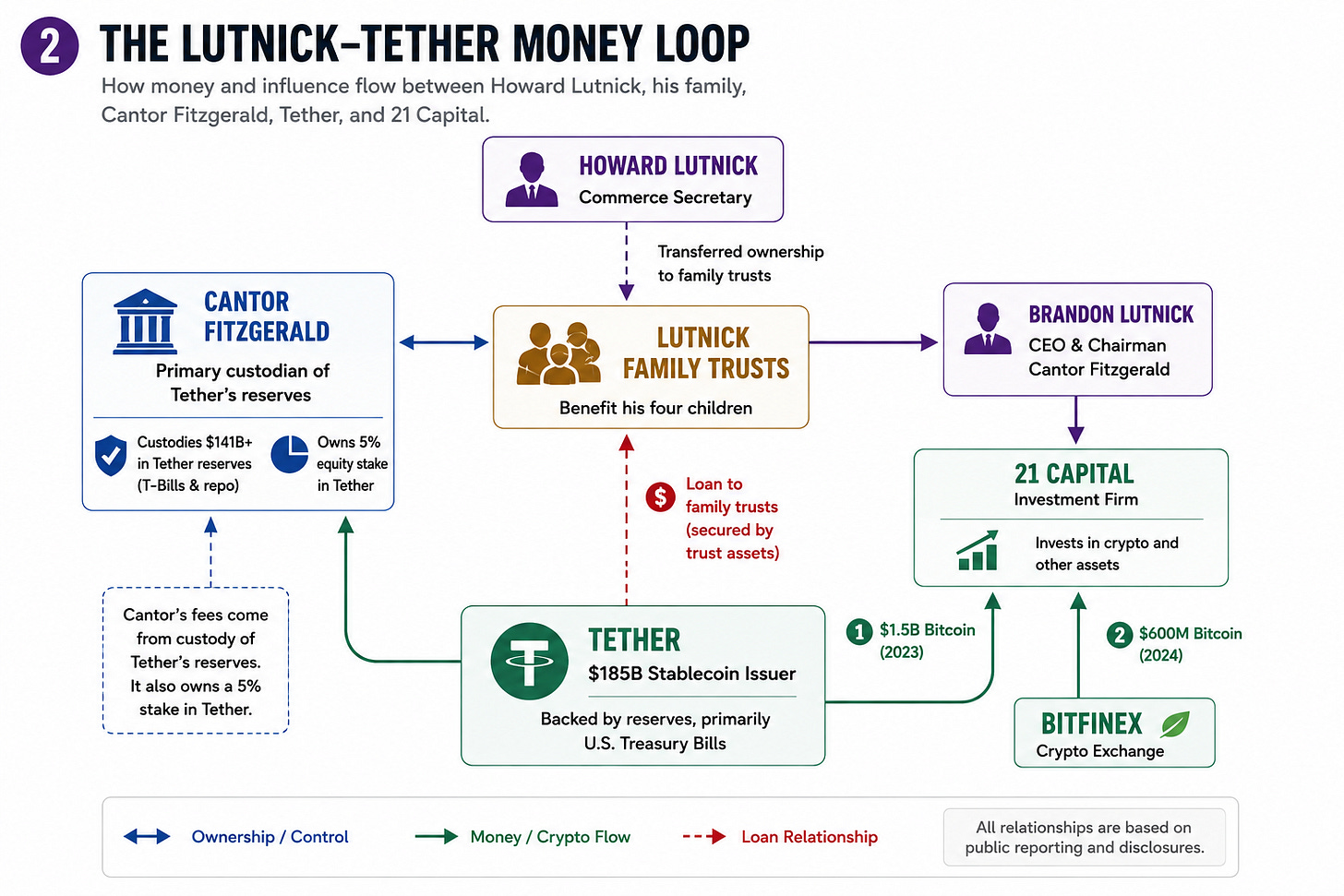
In April 2025, Brandon Lutnick announced 21 Capital, a Bitcoin-focused investment vehicle designed to replicate the MicroStrategy model of holding Bitcoin as a treasury asset for long-term appreciation.
The funding came from three sources.
Total: $3 billion in Bitcoin contributions, with an additional $350 million in convertible bonds and $200 million in private equity.
The enterprise value at announcement was approximately $3.6 billion with the plan was to take the company public on the Nasdaq.
Let’s recap. The Commerce Secretary’s son, running the Commerce Secretary’s former company, launched a multibillion-dollar crypto venture backed primarily by the same stablecoin issuer whose reserves his company custodies and who loaned his family trust the money to buy the company in the first place.
At the same time, Cantor was in discussions with Tether about a $2 billion Bitcoin-backed lending program that would allow clients to borrow dollars using Bitcoin as collateral, with plans to scale to tens of billions.
Howard Lutnick may have divested on paper but the Lutnick family’s financial interests in the crypto ecosystem have only grown since he took office.
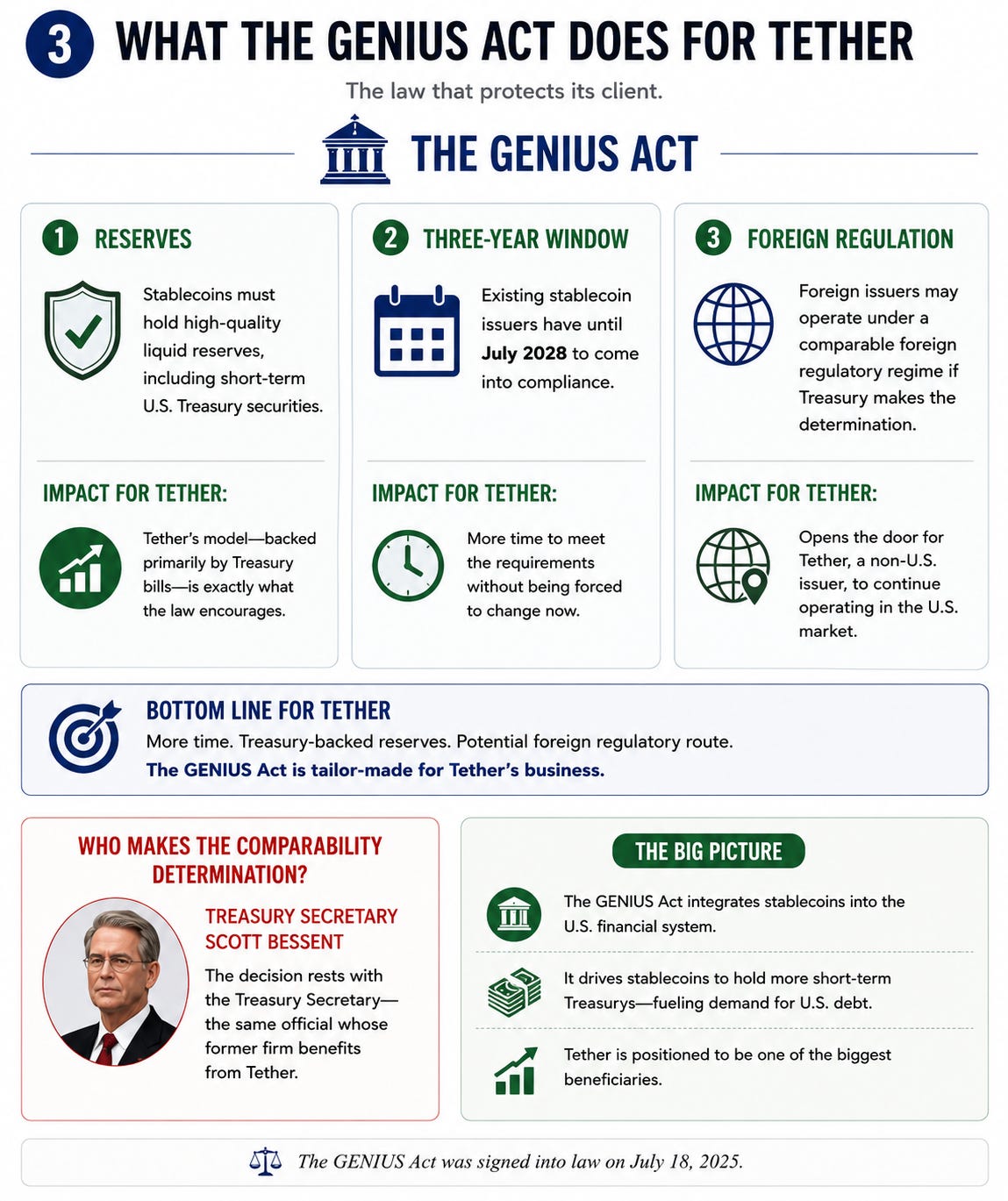
The GENIUS Act is the first major stablecoin legislation in the United States. It establishes a licensing framework for stablecoin issuers, requires reserves to be held in high-quality liquid assets like short-term Treasury bills, and creates compliance requirements for both domestic and foreign issuers.
Read The GENIUS ACT Here
Bloomberg reported on July 22, 2026 that Howard Lutnick and Bo Hines, Trump’s executive director of the Presidential Council of Advisers for Digital Assets, worked behind the scenes to shape the law in ways that directly benefited Tether.
The central issue was the compliance timeline. The GENIUS Act gives existing stablecoin issuers a grace period before non-compliant tokens can no longer be offered through US trading platforms. Democrats proposed 18 months, but Tether wanted three years.
Three people familiar with the negotiations told Bloomberg that Hines made clear the three-year window was a White House red line that could not be crossed, so guess what happened, Tether got three years. The deadline is now July 2028.
But the grace period is only part of it all.
The law contains a provision that allows foreign stablecoin issuers to operate in the US market if the Treasury Secretary determines their home country’s regulatory framework is comparable to the American one. For Tether, this means its USDT token could potentially be supervised from El Salvador, where the company has established its headquarters, rather than being regulated directly by US authorities.
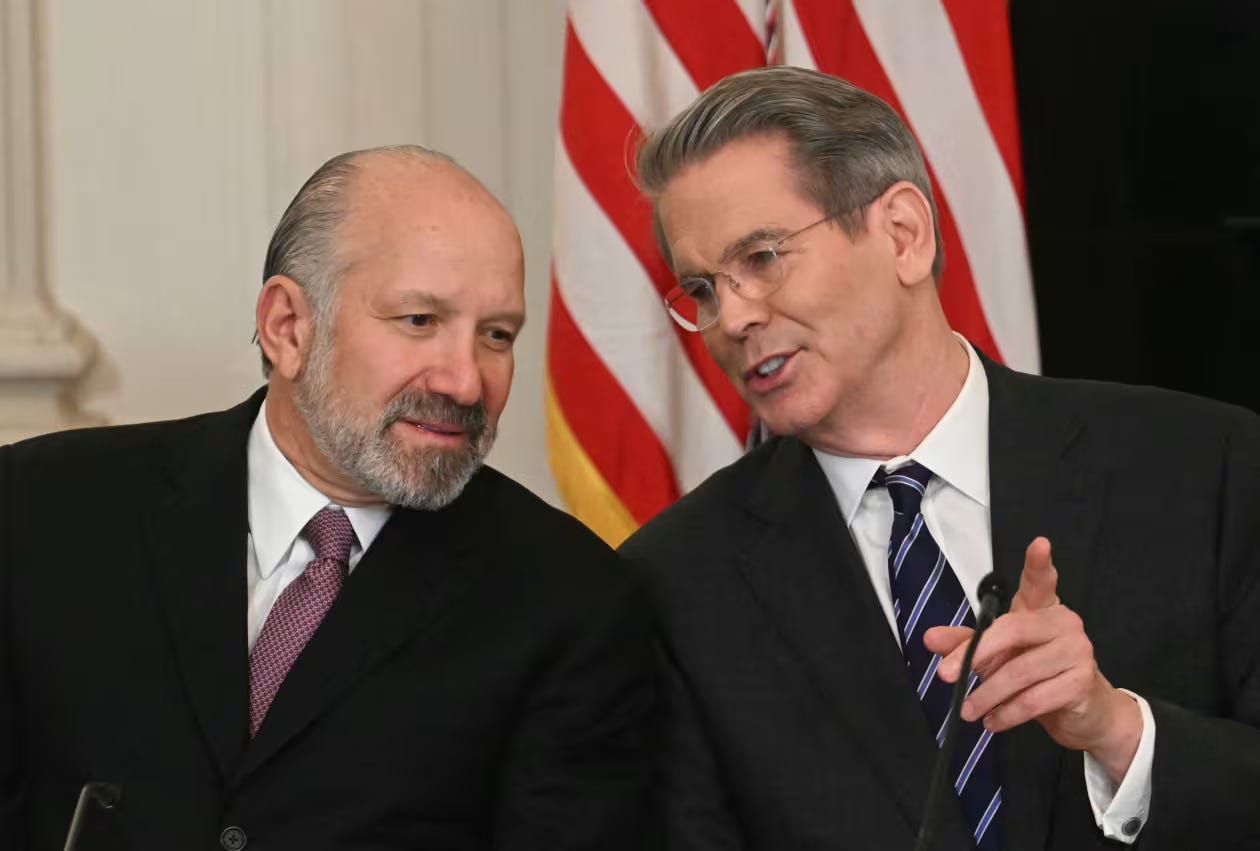
That determination is made by one person: you guessed it, Scott Bessent.
There is also a DeFi loophole. Companies like Tether are not responsible for tracking their products on decentralized finance platforms. This means USDT can circulate freely on secondary markets without regulatory oversight, even after the grace period expires.
Senator Jack Reed introduced an amendment to close what he called an alarming loophole, but it did not pass.
Throughout 2024, before becoming Commerce Secretary, Lutnick acted as Tether’s crisis PR point man. He defused negative publicity and lobbied lawmakers to oppose bills that Tether did not support. According to congressional lobbying records and a federal court filing, he worked to influence legislation the company opposed.
Then he became the Commerce Secretary, and the law came out the way Tether wanted.
Here is where the two halves of the scheme connect.
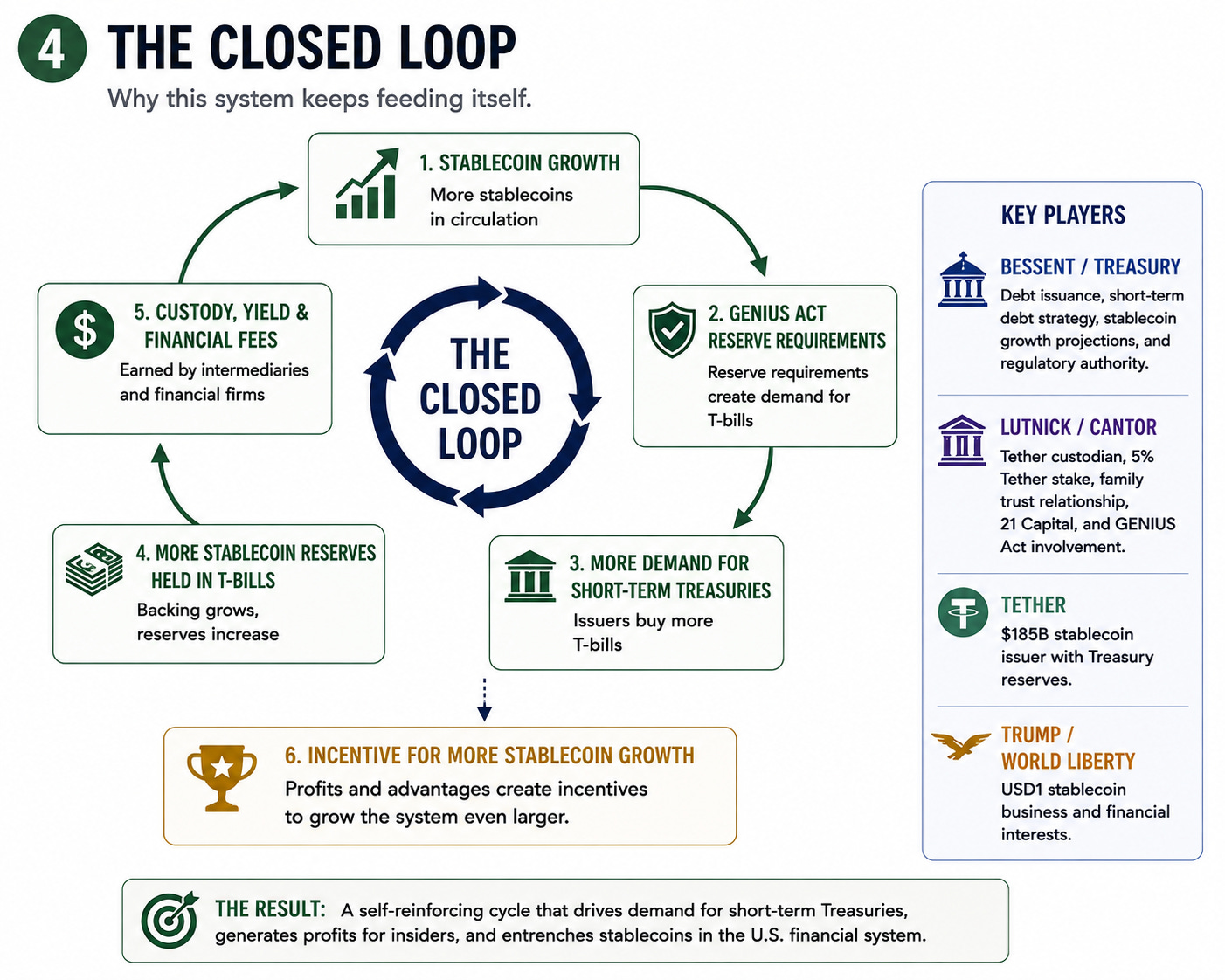
The GENIUS Act requires that stablecoin reserves be held in Treasury securities maturing within 93 days. This means every dollar of stablecoin growth creates new demand for short-term US government debt.
Treasury Secretary Bessent has publicly cited projections that the stablecoin market could grow from its current $300 billion to nearly $4 trillion. At $4 trillion, stablecoin issuers would collectively hold more short-term US debt than most countries. They would be a top-five foreign holder of Treasury bills.
That demand is precisely what Bessent needs for his buyback operation to work. When there are more buyers of T-bills, yields stay low. Low yields mean the government can refinance its debt cheaply. That is the entire premise of the buyback scheme I documented in The Currency Killer.
Bessent manipulates the bond market through buybacks. Lutnick’s family firm custodies the reserves that create demand for those bonds. Both men attend the same White House crypto meetings. Both men are pushing Congress to expand stablecoin legislation. And the growth of the stablecoin market, which enriches the Lutnick family, is the same growth that makes Bessent’s scheme viable.
One creates the supply of cheap bonds and the other creates the demand.
It is a closed loop.
If we have learned one thing about this president it’s that nothing would be allowed if it didn’t personally benefit Donald Trump himself. So, what’s in it for him?
Donald Trump disclosed $1.4 billion in cryptocurrency-related income in his 2026 financial disclosure. This makes digital assets the largest source of his personal earnings during his second term.
Let’s break it down: more than $635 million from a licensing agreement with a cryptocurrency group specializing in meme coins bearing his name. More than $500 million from World Liberty Financial, the crypto company he co-founded with his sons Eric and Donald Jr. More than $33 million from Bitcoin. More than $150 million from Ethereum.
World Liberty Financial operates USD1, Trump’s stablecoin. As of mid-2026, there is over $4 billion of USD1 in circulation, with more than a billion dollars in daily trading volume.
In May 2025, USD1 was used to settle MGX’s $2 billion investment in Binance, the world’s largest crypto exchange. MGX is a state-backed Abu Dhabi fund chaired by Sheikh Tahnoon bin Zayed Al Nahyan. The same sheikh’s representatives bought 49% of World Liberty Financial for $500 million in January 2025, just a few days before the inauguration.
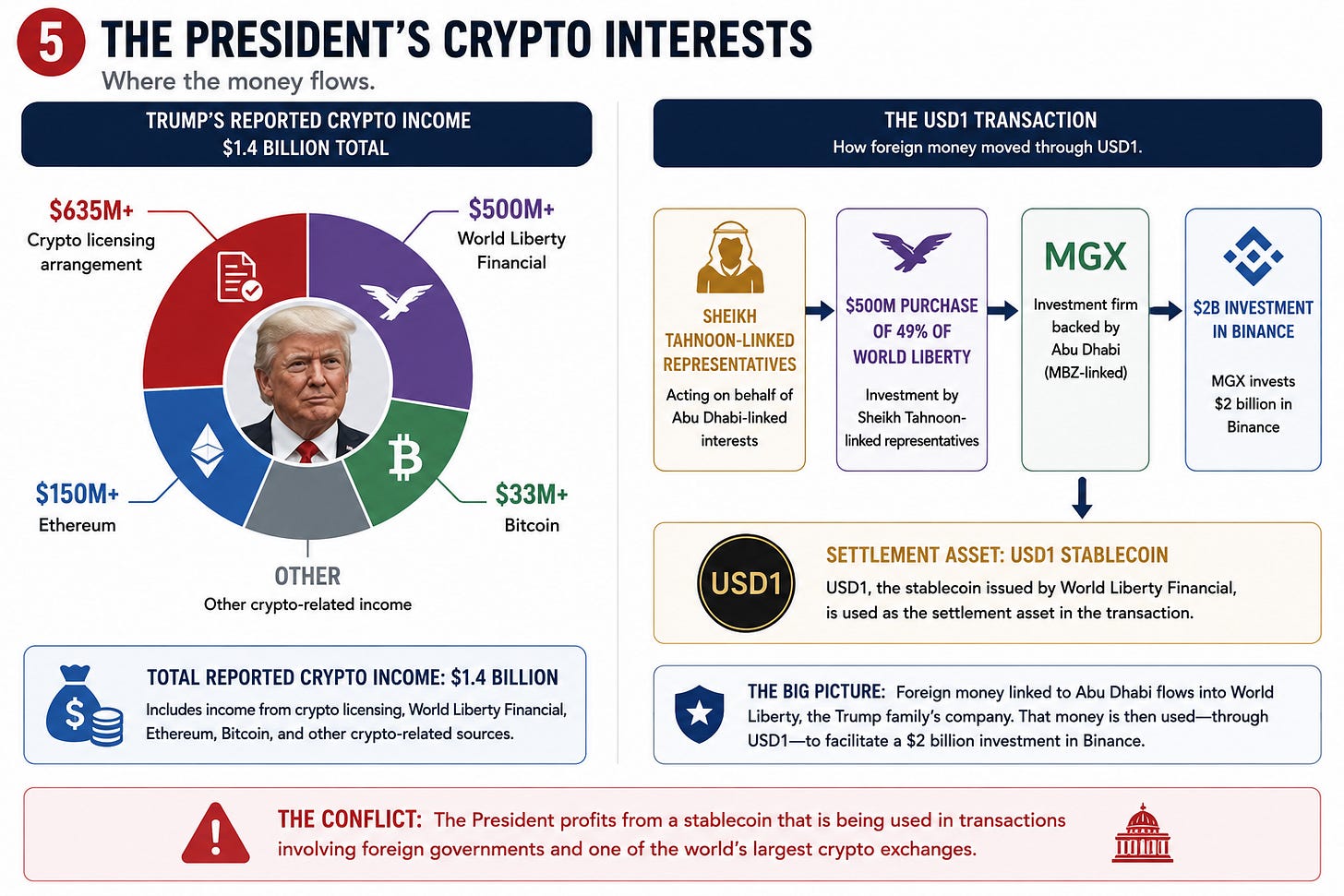
So a sovereign wealth fund run by the same person who invested $500 million in the president’s crypto company used the president’s stablecoin to complete a $2 billion deal with the world’s largest crypto exchange. And it chose a brand-new, untested stablecoin over established options like USDC, citing its compliance history, despite the coin having no compliance history because it had just been created.
In August 2026, the OCC gave World Liberty Financial conditional approval to issue USD1 to clients nationwide through a bank charter. The president’s crypto company can now function as a quasi-bank.
The White House says there is no conflict of interest. All I see is conflict of interest.
This is the company at the center of it all. The one Lutnick personally endorsed at Davos, the one his family’s firm custodies $141 billion for, the one the GENIUS Act was shaped to protect, and the one that loaned his children the money to buy his company.
In January 2025, Senator Warren sent a letter to Lutnick during his confirmation process, calling Tether a crypto firm with a long record of financing terrorists and illicit activity.
The evidence is extensive.
Tether has been documented as a tool for financing Hamas. For funding North Korea’s nuclear weapons and ballistic missile programs, with over half of North Korea’s missile program reportedly funded through cryptocurrency. For facilitating payments to Chinese fentanyl precursor suppliers, with 97% of over 120 surveyed Chinese chemical companies willing to accept crypto payment. For enabling sanctions evasion by Russian arms companies and oligarchs purchasing Venezuelan oil. For money laundering operations across multiple continents.
Tether disputes these findings saying there is no evidence it has violated sanctions laws or the Bank Secrecy Act.
However, Tether has never been independently audited. It publishes quarterly attestations, not audits and that distinction is important. An attestation confirms the balance at a single point in time while an audit examines the books forensically over a sustained period.
And yet, the Commerce Secretary’s family firm custodies its reserves. The Treasury Secretary may determine its home country regulation is good enough. The GENIUS Act gave it three years to comply, and the president’s family is making billions in the same industry.
The New York Times examined the 818 corporate entities Lutnick reported in his financial disclosure. Most were affiliated with Cantor Fitzgerald. They revealed how far he had taken the firm from its original mission as a bond broker into new investment areas, some traditional like real estate, others risky, like startups and gambling.
449 of the 818 entities were Cantor AFF entities, 55 were BGC AFF entities, and 9 were Newmark AFF entities. The rest were related holding companies and investment vehicles.
He used five shell companies to buy properties in New York, Washington, and Florida, in addition to the sprawling Manhattan townhouse he had purchased in his own name.
In at least three cases, he withheld payments at luxury properties bought through those shells. At his waterfront condo in Miami Beach, he collected nearly $12 million from his insurer after a failed air-conditioning hose caused flooding, but ignored requests to reimburse the building for $145,000 in damage to common areas and elevators. He offered to pay only if the building agreed to let him combine two vestibules outside his apartment into a single entryway. The building sued him. He settled.
In 1998, the Comet Trust sold the property at 11 East 71st Street in Manhattan to Howard Lutnick for ten dollars. Transfer taxes show the real price was $7.6 million. Lutnick took out a $4 million mortgage the same day.
That property shares a wall with 9 East 71st Street. Jeffrey Epstein’s mansion.
The house’s history is a chain of $10 transfers through Epstein-connected trusts. In 1988, SAM Conversion Corp bought the townhouse using Leslie Wexner’s Columbus, Ohio address, with Epstein as vice president. In 1992, SAM Conversion sold it to the 11 East 71st Street Trust for $10, with Epstein as trustee. In 1996, that trust sold it to the Comet Trust for $10. In 1998, the Comet Trust sold it to Lutnick for $10.
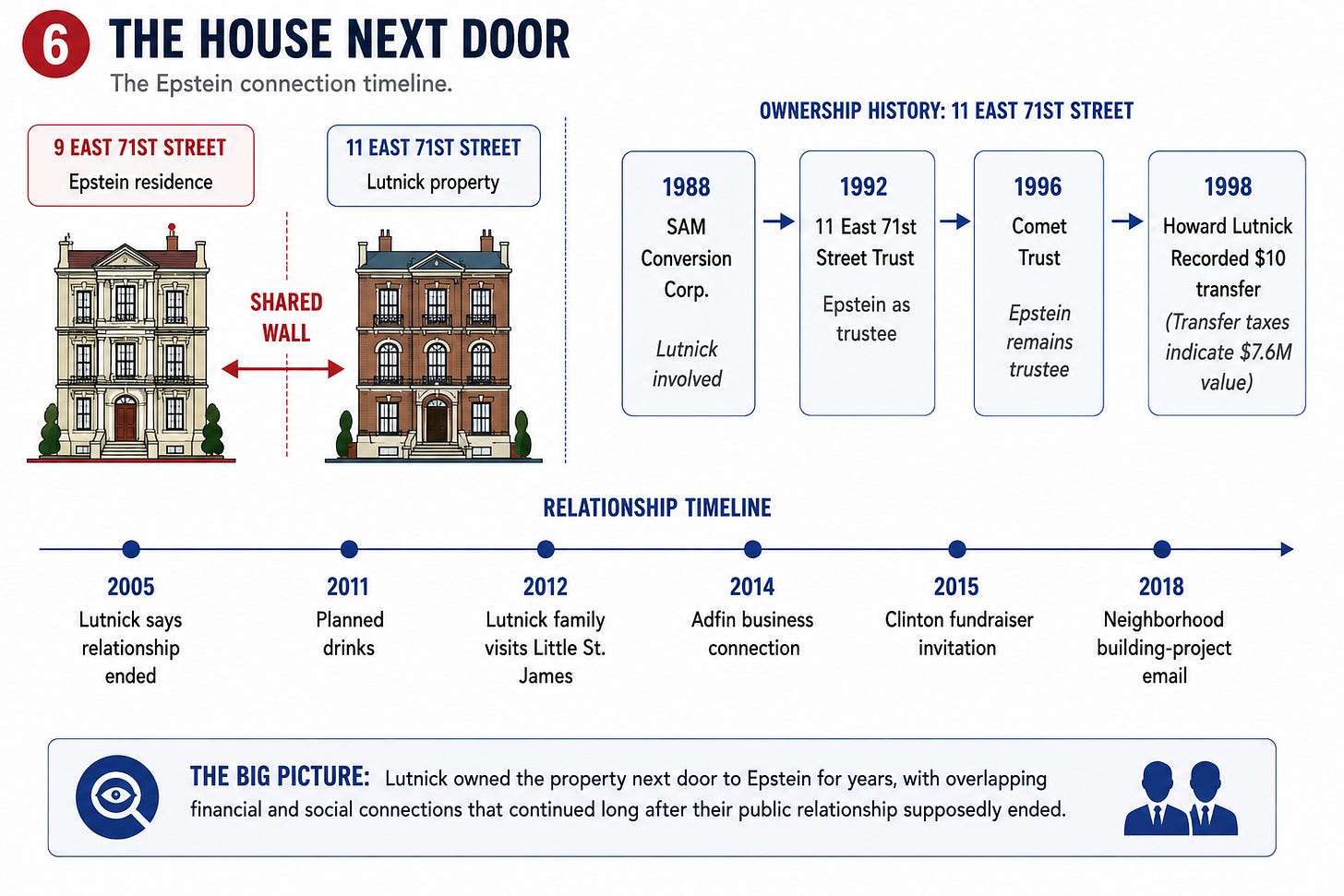
Lutnick has maintained that he cut ties with Epstein in 2005 but the Epstein files tell a different story.
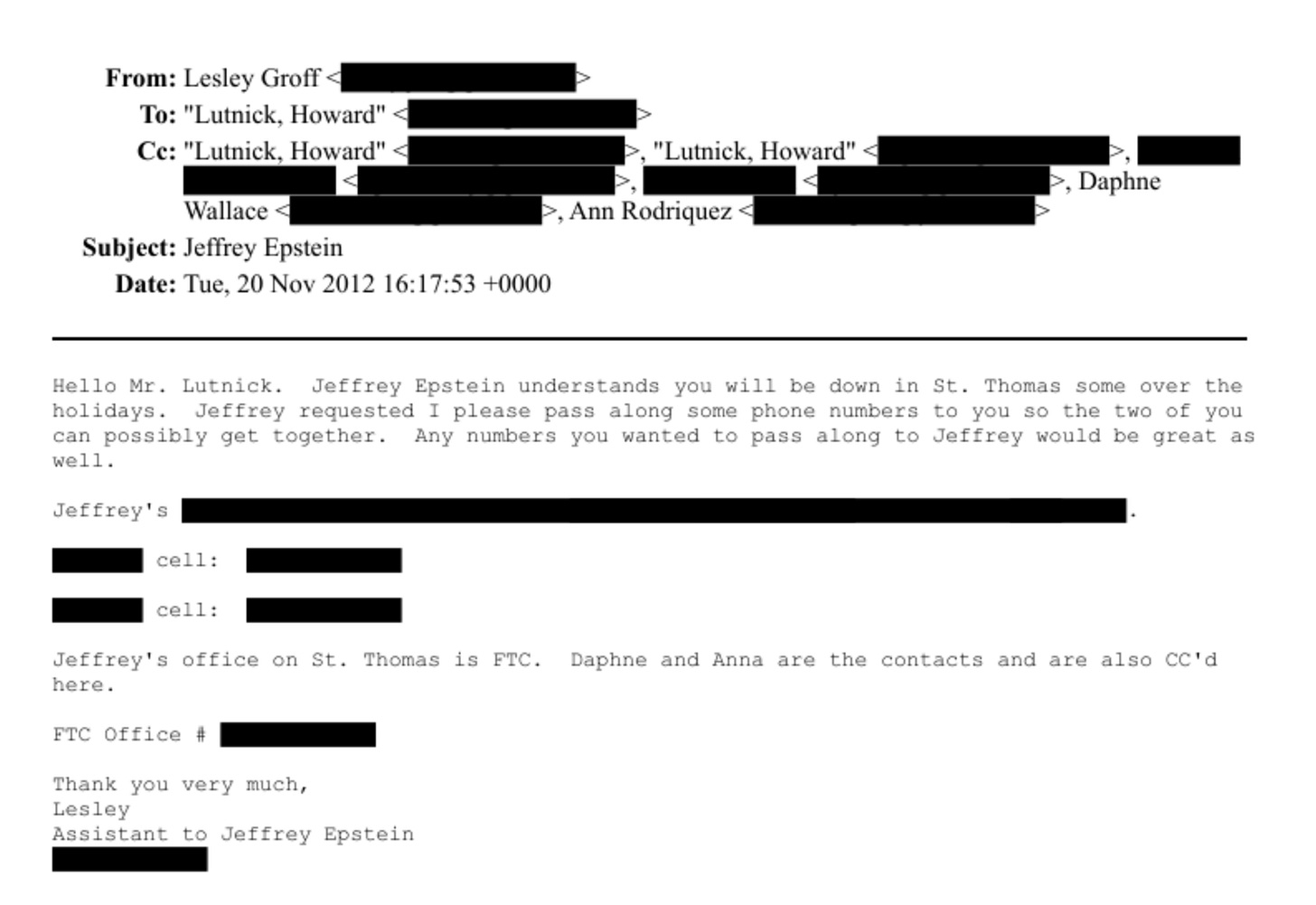
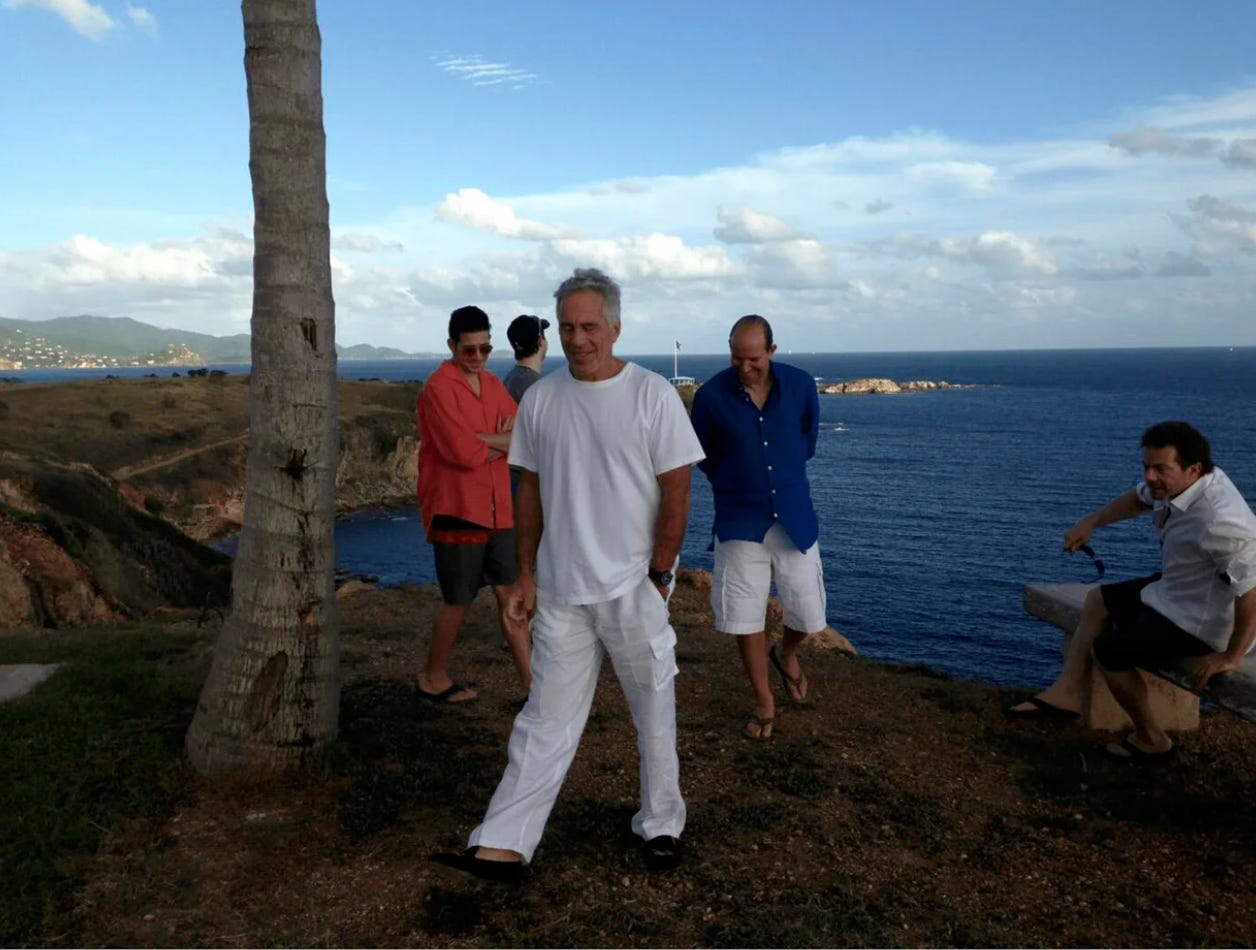
In May 2011, the two planned to meet for drinks. In December 2012, Lutnick, his wife, their four children, and their nannies visited Epstein’s private island, Little St. James, for lunch. He was invited and attended. After the visit, Epstein’s assistant wrote on his behalf: it was nice seeing you.
In 2014, the two were in business together through an advertising company called Adfin. In November 2015, Lutnick invited Epstein to what he described as a very intimate fundraising event with Hillary Clinton. In May 2018, Lutnick emailed Epstein about a proposed building project in their neighborhood. That was the year before Epstein’s death.
When the files were released, a photo of Lutnick on Epstein’s island was removed from Justice Department files. It was later restored after the removal was reported.
The House Oversight Committee questioned Lutnick behind closed doors. Every Democrat on the committee called for his resignation, saying he lied about the relationship. Public Citizen and the Democracy Defenders Fund demanded his resignation, citing the Epstein lies along with other concerns.
Lutnick’s defense: it was a family vacation. They had lunch for about an hour. But he forgot to mention he went into business with him after this lunch.
In April 2021, the FBI received a whistleblower complaint about Cantor Fitzgerald. The whistleblower was a securities industry professional with 32 years of experience and a Series 30 license.
The complaint alleged that Howard Lutnick ran a Ponzi scheme and money laundering operation through Cantor Fitzgerald. The whistleblower told the FBI that Lutnick “ran everything” and “instructed all of the fraud being committed.” The complaint alleged that Cantor laundered money for the Russian Mafia. The whistleblower said Lutnick “used philanthropy as a smokescreen for illegal activity.”
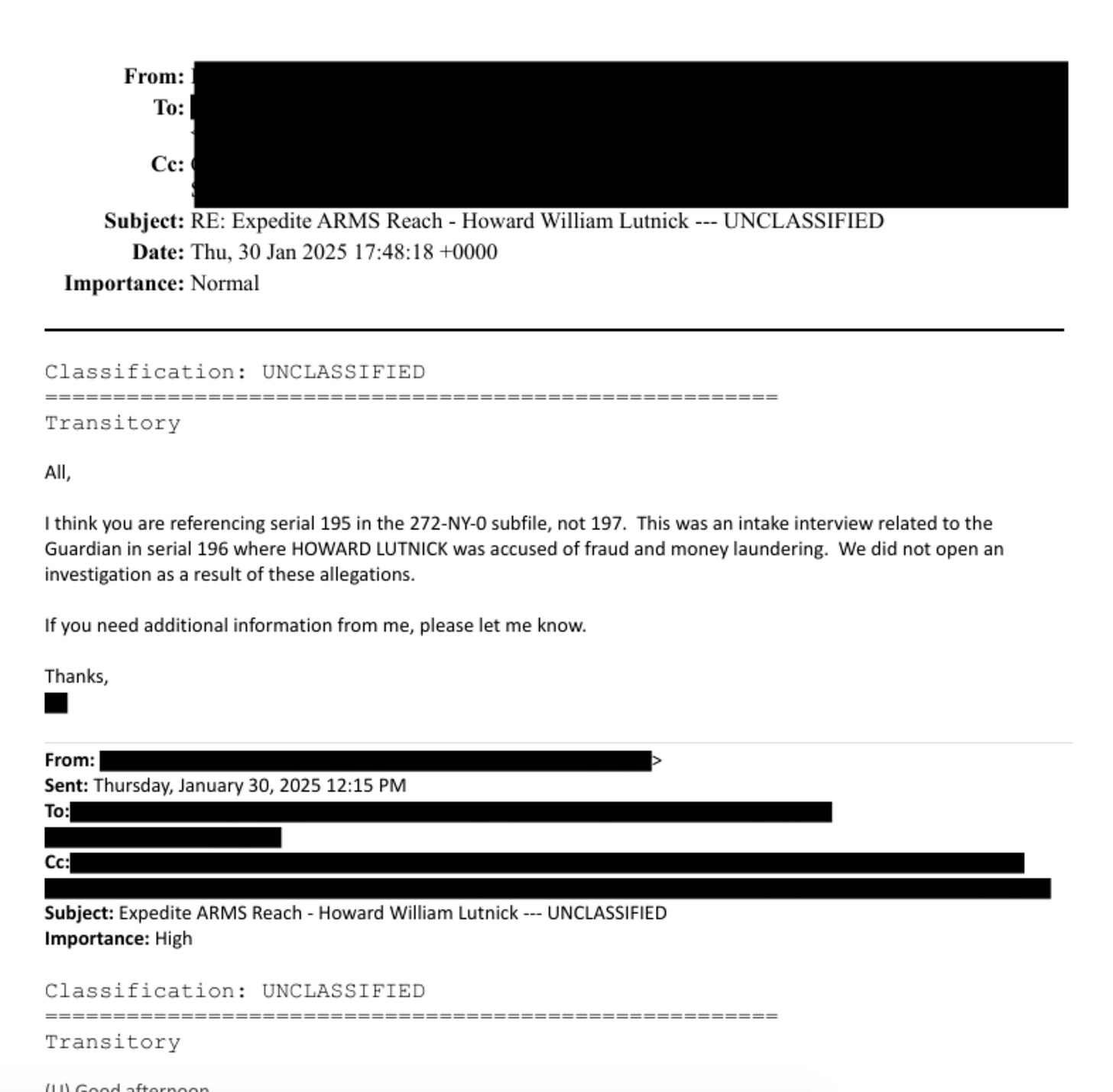
The FBI searched its internal databases. It turned up over two dozen hits, including suspicious activity alerts and two existing cases dealing with investigations into money laundering and RICO violations.
The FBI did not open an investigation into Lutnick.
In December 2024, separately, Cantor Fitzgerald paid a $6.75 million fine to the SEC for misleading investors in two SPACs. The firm told investors in public filings that it had not identified or approached any potential merger targets when it had. Cantor settled without admitting or denying the charges.
On March 19, 2025, Commerce Secretary Howard Lutnick appeared on Fox News and told viewers: “Buy Tesla. It’s unbelievable that this guy’s stock is this cheap. If you want to learn something on this show tonight, buy Tesla. It’ll never be this cheap again.”
The same day, Cantor Fitzgerald upgraded Tesla stock to a buy rating. Cantor holds hundreds of millions of dollars in Tesla stock. Although Lutnick agreed to divest from Cantor, his sons were recently installed in top positions at the firm.
The Campaign Legal Center filed an ethics complaint. Warren and Waters demanded an investigation. House Oversight Democrats launched a probe, saying his conduct violated federal ethics laws that prohibit officials from endorsing products or businesses.
Then in 2026, Cantor Fitzgerald ended up as lead placement agent on a $1.6 billion rare earth metals deal funded by Lutnick’s own Commerce Department. The department provided a letter of intent covering $277 million in proposed federal funding and a $1.3 billion proposed loan under the CHIPS Act. The same day the agreement was announced, USA Rare Earth said it had raised $1.5 billion in private funding with Cantor Fitzgerald serving as the lead placement agent.
Cantor was positioned to collect fees directly tied to a government-backed deal from the Commerce Secretary’s own department.
Warren, Wyden, Van Hollen, and Lofgren sent letters to Cantor and USA Rare Earth questioning the circumstances. Jamie Raskin opened a separate investigation into potential conflicts between Lutnick and his former firm’s tariff dealings.
And the White House response to all of it was to grant him a limited ethics waiver allowing him to participate in decisions affecting his family’s companies. They said his financial interest was not so substantial as to be likely to affect the integrity of his service.
818 companies, $141 billion in custody, a Tether-funded dynasty trust, and the White House says his interest is not substantial.
So, what do I think they are actually doing?
What this looks like is a currency attack run from inside the government.
That is not something I say lightly or even want to be thinking, but it’s where we are. A currency attack is when someone deliberately undermines a currency to profit from its decline. George Soros and Scott Bessent did it to the British pound in 1992. They made a billion dollars in a single day by betting against it while pressuring it to break. Bessent then ran the same play on the Japanese yen and made $3.5 billion. He knows exactly how to break a currency and now he is the United States Treasury Secretary, and the dollar has dropped 9% on his watch.
But here is what makes this different from every other currency attack in history. Soros attacked the pound from outside. He was a private speculator betting against a government. Bessent is attacking the dollar from inside. He is the government. He controls the Treasury, sets the buyback levels, decides how much debt to issue and at what maturity and hechooses whether to intervene in currency markets. He has every tool available to strengthen the dollar, and he is using those tools to weaken it instead. That has never happened before. There is no precedent for the Treasury Secretary of the United States running the same playbook against his own currency that he used to attack other countries’ currencies for profit.
Now look at what Lutnick is doing, because this is what makes me lean towards coordination. Stablecoins are not growing because Americans are fleeing the dollar. They are growing because billions of people in emerging markets want dollar access and cannot get a US bank account. Someone in Argentina with triple-digit inflation or Nigeria with capital controls does not care that the dollar dropped 9% against the euro. They want any dollar. Stablecoins are how they get it. That is a massive, expanding global market, and Lutnick positioned his family to collect a fee on every dollar that enters it.
He shaped the GENIUS Act so that stablecoins become the legal infrastructure for global dollar access. He positioned his family’s firm to custody the reserves. He made sure his biggest client, the one his family has a $10 billion equity stake in, got three years to comply and a loophole to avoid US regulation entirely. He did not ride a wave. He built the wave machine.
Think about what that means. Bessent’s job weakens the dollar, which pumps crypto broadly. That is where Trump’s $1.4 billion comes from. Bitcoin goes up when the dollar goes down. Separately, stablecoins grow because of global demand for digital dollar access, and every dollar of that growth generates custody fees for Cantor Fitzgerald and increases the value of the Lutnick family’s Tether equity. Each man profits from a different piece of the same macro environment, and they shaped the rules to make sure all three pieces keep growing. They are not just in the same administration. They are three legs of the same trade.
And the president is the third piece.
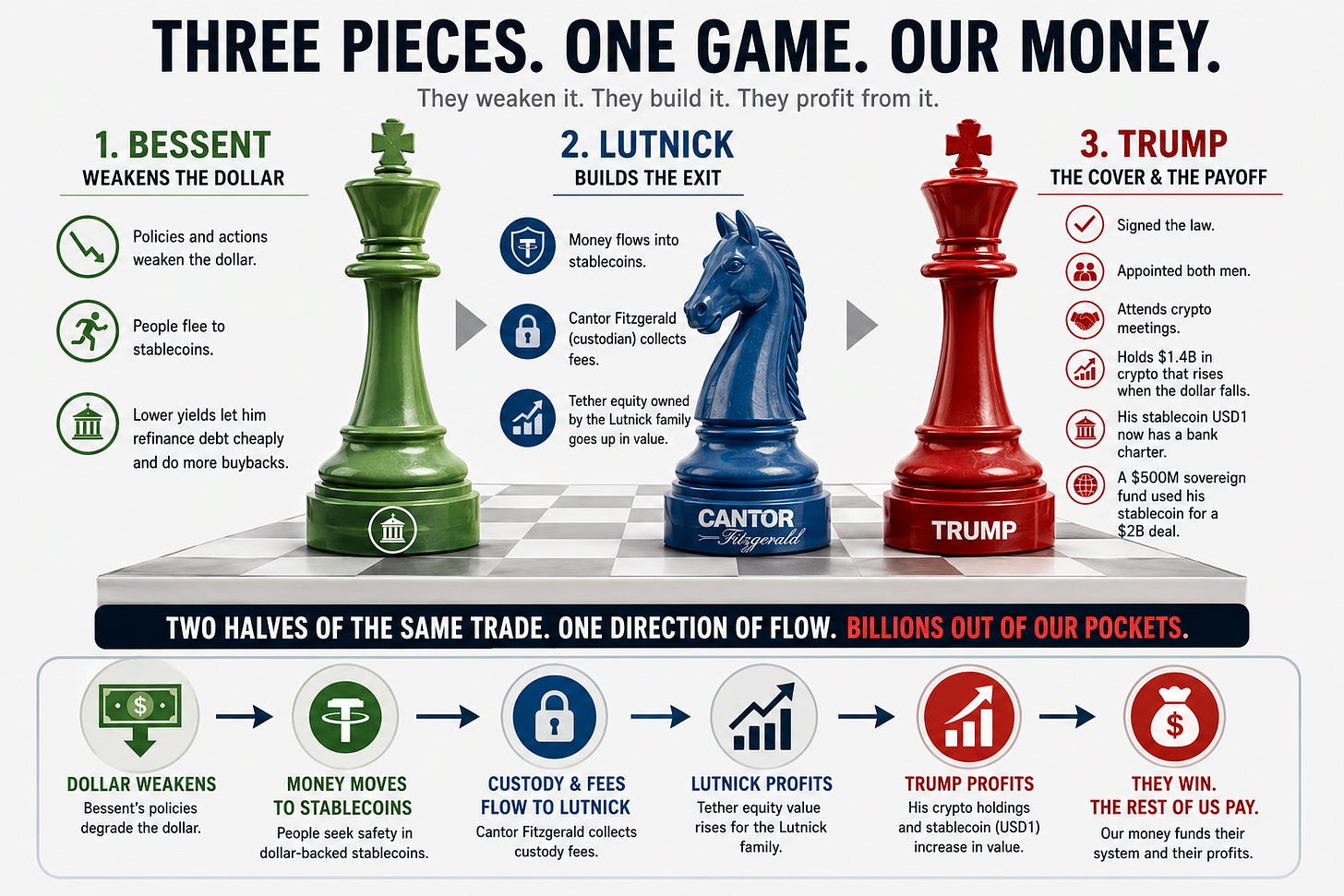
Trump is not directing the operation, no way. He is the political cover and the payoff structure. He signed the law, appointed both men, attends the crypto meetings, and he personally holds $1.4 billion in crypto assets that go up in value every time the dollar goes down. His stablecoin USD1 now has a bank charter. A sovereign wealth fund that invested $500 million in his crypto company used his stablecoin for a $2 billion deal. The president of the United States has a direct financial interest in the success of the same scheme his Treasury Secretary and Commerce Secretary are running. We are far beyond conflict of interest at this point, folks.
One of the most concerning things for me is that this is self-reinforcing. The pieces reinforce each other. Stablecoins grow because of global demand for digital dollars. Every stablecoin issued must hold reserves in Treasury bills —> That T-bill demand helps Bessent fund government debt cheaply and keeps yields low —> Low yields give him room to run more buybacks, which weakens the dollar —> A weaker dollar pumps crypto, which draws more trading activity, which requires more stablecoins as the settlement layer, which buys more T-bills. The stablecoins are not the escape vehicle for this, they are the financing mechanism with each piece feeding the next. It is a flywheel, and once it starts spinning, it accelerates on its own.
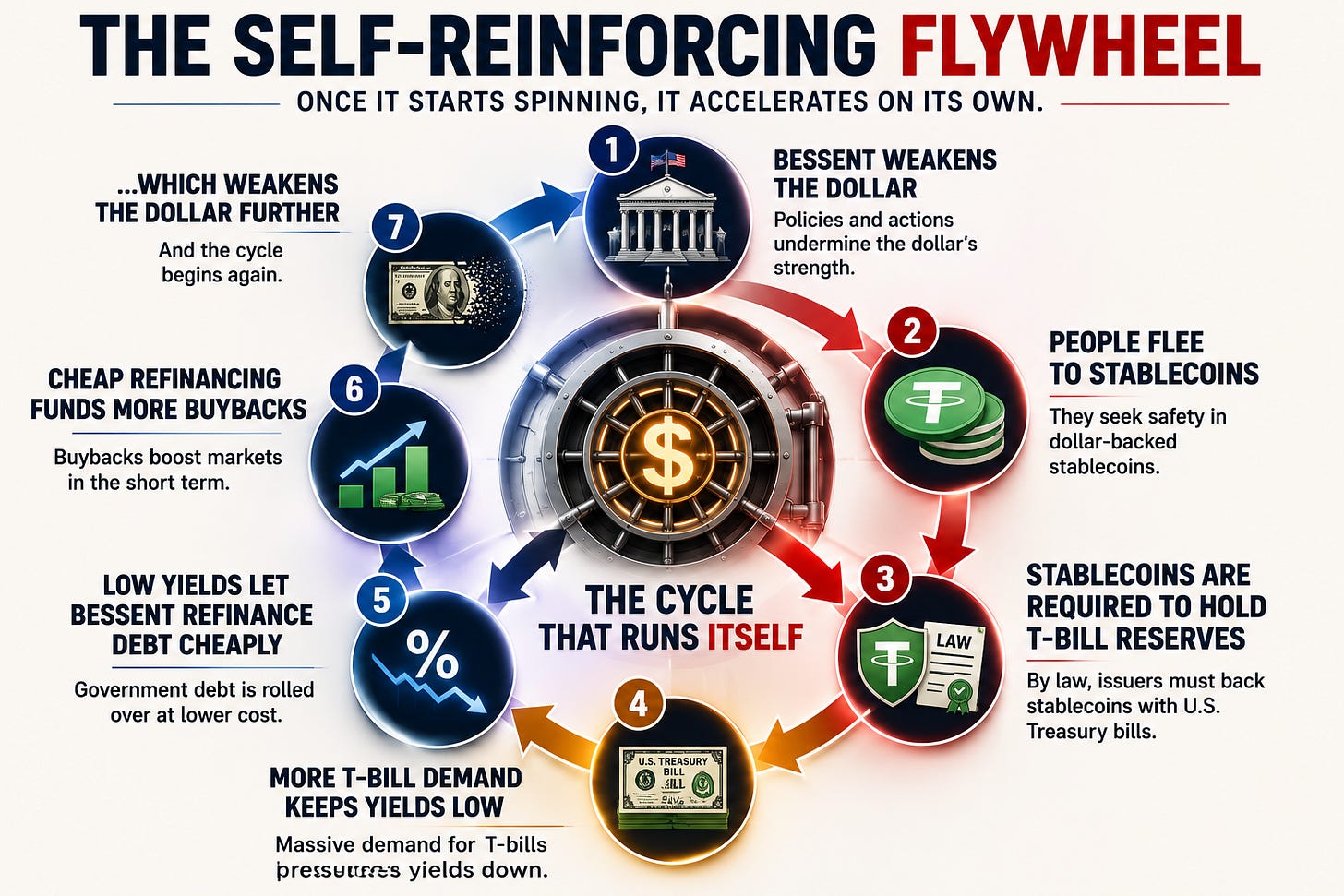
And the endgame is permanence.
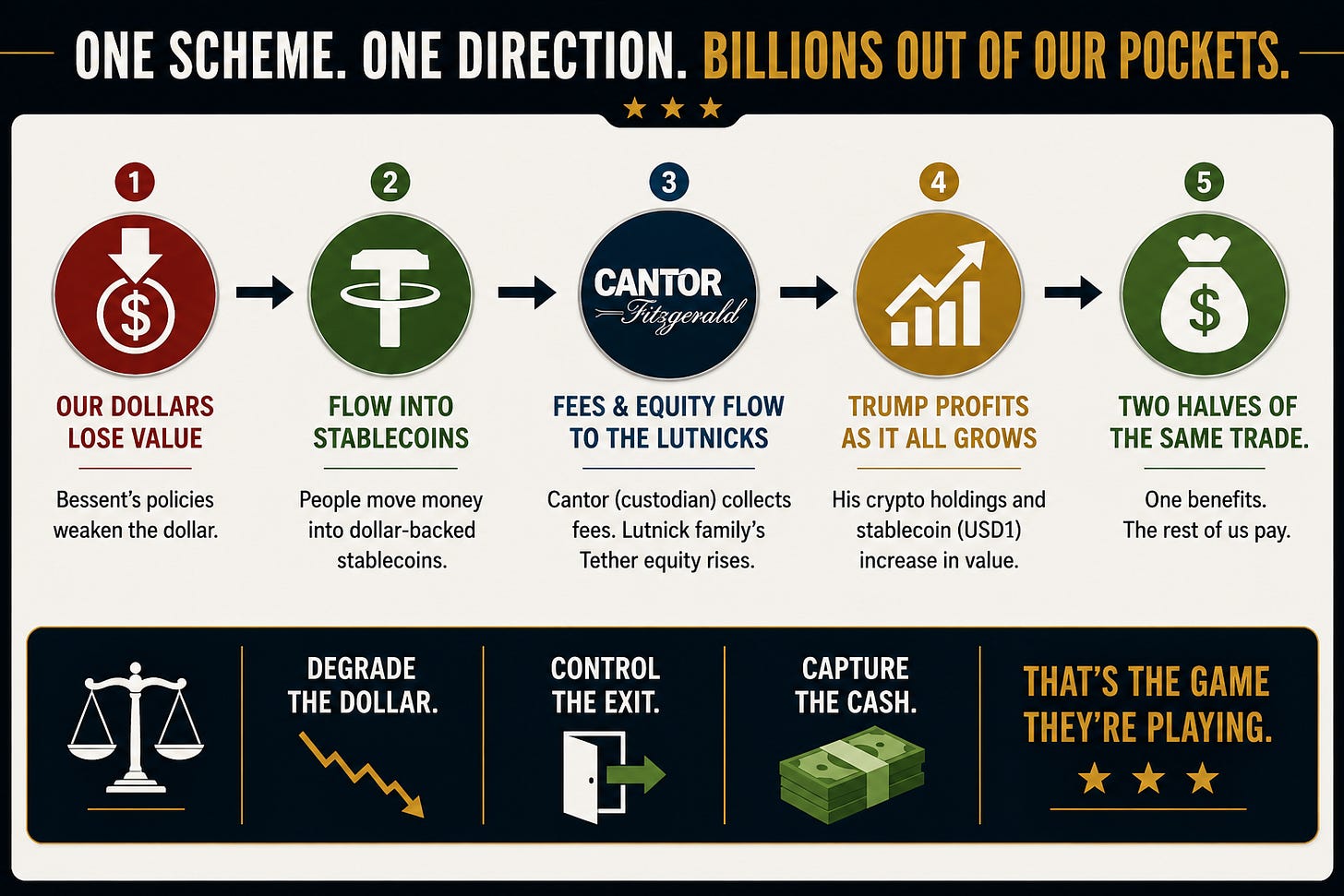
At $4 trillion in stablecoins, which is Bessent’s own projection, stablecoin issuers would hold more short-term US government debt than most countries. Citi projects they could hold a quarter of all Treasury bills outstanding by 2030. At that scale, you cannot shut it down. You cannot unwind the architecture without crashing the bond market. Any future president who tries to dismantle it triggers a financial crisis. That is not an accident. That is the design. Build it so big and so embedded that it becomes permanent, and then the people who built it collect the toll on the new financial system forever.
Every step of this has already been executed. The currency speculator is installed. The dollar is falling. The law is written. The family is positioned. The loop is spinning. The president is collecting. And the architecture is approaching the point where it cannot be reversed.
In my professional opinion, what I am looking at is the privatization of the American monetary system by three men who used government power to build it, government authority to legalize it, and government debt to fund it. And they did it in 18 months.
The Treasury Secretary is a former currency speculator who made billions crashing foreign currencies. He is now running the same playbook on the US dollar. The dollar has lost nearly 9% of its value since he took office. That means everything you buy costs more. Your groceries, your gas, your rent. The purchasing power of your paycheck is shrinking, and it is shrinking because the people in charge are making it shrink on purpose.
The Commerce Secretary disclosed roles in 818 companies. He bought a mansion through a chain of Epstein-connected trusts for $10. He lied about his relationship with Epstein under oath. An FBI whistleblower accused him of running a Ponzi scheme through Cantor Fitzgerald and the FBI found over two dozen hits in its own database and still did not open an investigation. He went on Fox News and told you to buy Tesla stock the same day his family’s firm upgraded it. And the White House responded to all of that by giving him an ethics waiver.
His family’s firm custodies $141 billion in US Treasury bills for Tether, a company that has never been independently audited and has documented ties to terrorism financing, nuclear proliferation, and the fentanyl trade. Cantor paid $600 million for a 5% stake in Tether that Forbes now values at $10 billion. If Tether hits its target valuation of $500 billion, that stake will be worth $25 billion. That is the payday his family is building toward while he sits in the cabinet.
Tether loaned his children the money to buy his company. His son launched a $3.6 billion crypto venture backed by Tether money. His former firm collected fees on a $1.6 billion rare earth deal funded by his own Commerce Department, and he personally shaped the law that gives Tether three years to comply with US regulation and a path to avoid it entirely through El Salvador.
The president made $1.4 billion in crypto income last year. His stablecoin has a bank charter. A sovereign wealth fund that invested $500 million in the president’s crypto company used the president’s stablecoin to settle a $2 billion deal. The president is directly profiting from the financial infrastructure his own cabinet is building.
Now look at how these three are working together. This is not three separate guys doing three separate corrupt things, it’s an intentional and coordinated operation.
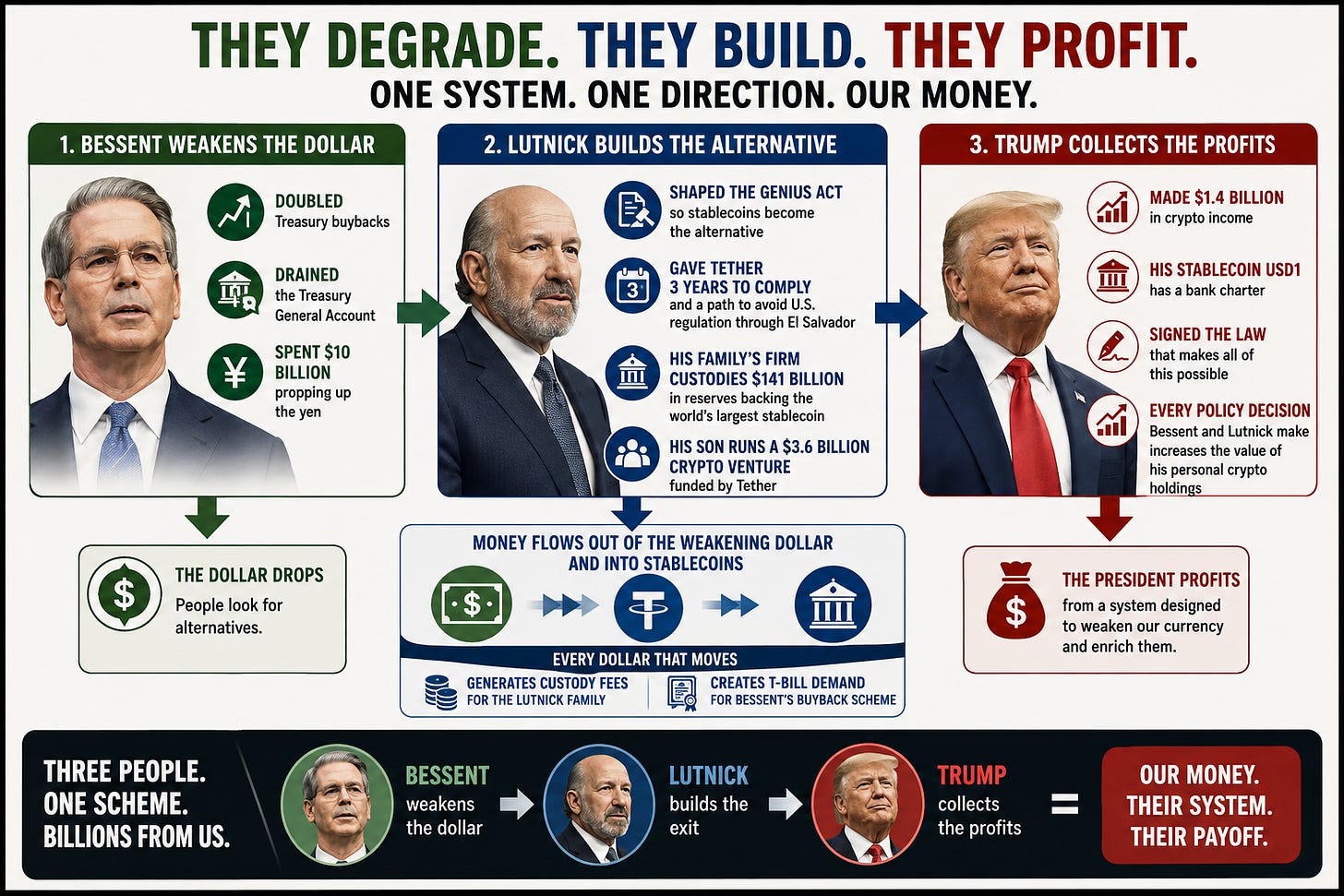
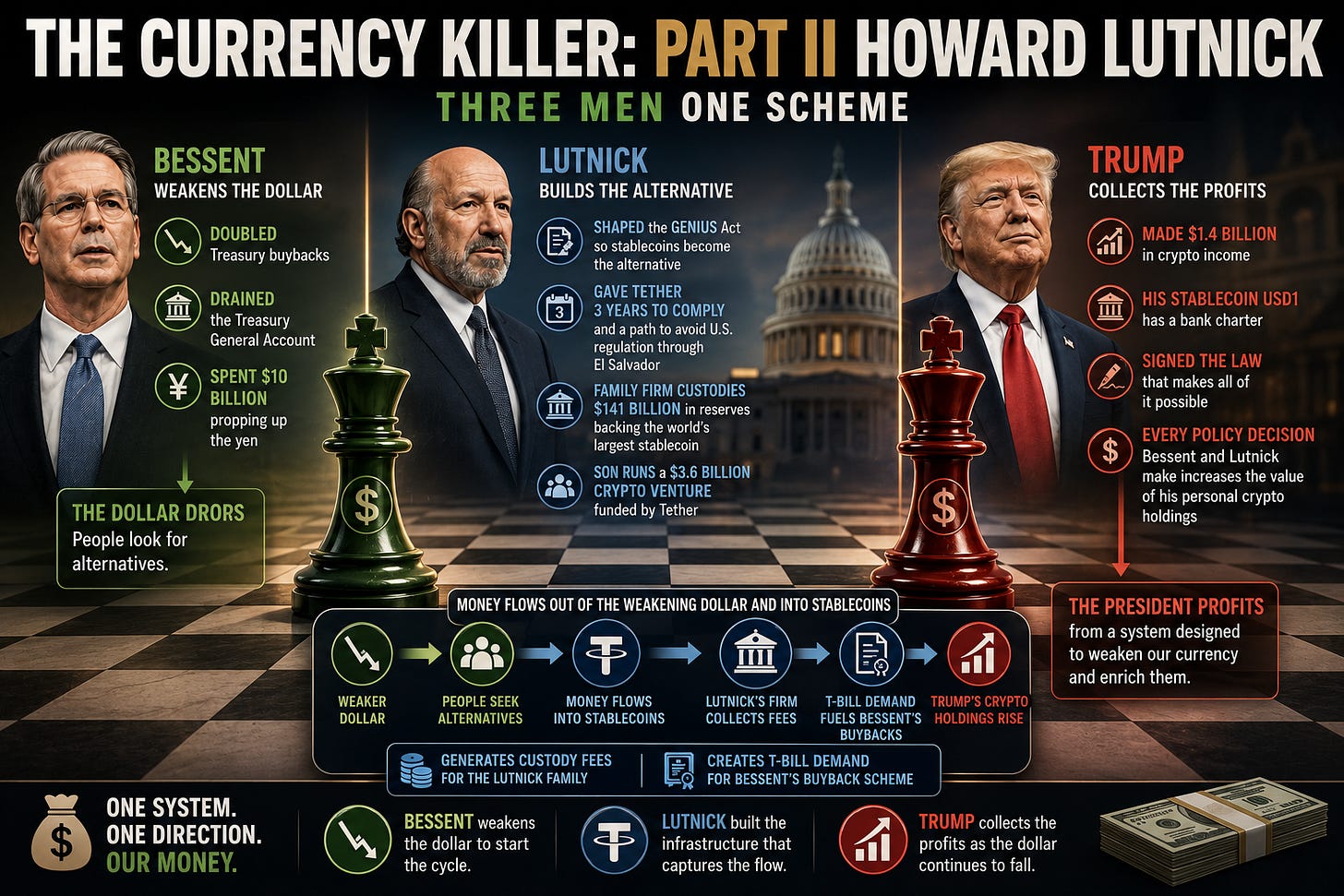
Bessent weakens the dollar. That is his job in this. He doubled Treasury buybacks, drained the Treasury General Account, spent $10 billion propping up the yen. The dollar drops. When the dollar drops, people look for alternatives. That is where Lutnick comes in.
Lutnick built the alternative. He shaped the GENIUS Act so stablecoins become that alternative. He made sure Tether got three years to comply and a path to avoid US regulation through El Salvador. His family’s firm custodies $141 billion in the reserves that back the biggest stablecoin on earth. His son runs a $3.6 billion crypto venture funded by Tether. Every dollar that moves out of the weakening US dollar and into stablecoins generates custody fees for the Lutnick family and T-bill demand for Bessent’s buyback scheme.
Trump collects the profits. He made $1.4 billion in crypto income. His stablecoin USD1 has a bank charter. He signed the law that makes all of it possible. And every policy decision Bessent and Lutnick make is increasing the value of the president’s personal crypto holdings.
That is their coordination. Bessent creates the conditions. Lutnick builds the infrastructure. Trump provides the political cover and collects the payoff. They attend the same White House crypto meetings. They push the same legislation. They benefit from the same market dynamics, and the dollar, your dollar, the thing your savings and your paycheck are denominated in, is the thing they are deliberately weakening to make it all work.
Here is what this does to the economy if they keep going.
The dollar has already lost 9% of its value since January 2025. That is not an abstraction. When the dollar weakens, everything America imports gets more expensive. The US imports roughly $3 trillion in goods every year. Oil, electronics, pharmaceuticals, food, car parts, clothing. A 9% drop in the dollar means American businesses are paying more for all of it, and they pass those costs directly to you. Inflation is still running at 2.8%, above the Fed’s 2% target, and the dollar decline is one of the reasons it will not come down.
Your savings are losing value. If your bank account earns 1% interest but inflation runs at 3%, your purchasing power drops by 2% every year. Over ten years, $10,000 in savings becomes worth about $8,200 in real terms. The people running this scheme hold their wealth in crypto, which goes up when the dollar goes down. You hold yours in dollars, which means you lose while they win.
Unfortunately, it gets worse. The dollar’s share of global foreign exchange reserves has dropped from 71% in 2000 to about 58% today. Countries are already looking for alternatives. Russia, China, India, and Brazil are setting up trade channels that bypass the dollar entirely. When foreign governments lose confidence in the US dollar, they stop buying our Treasury bonds. When they stop buying our bonds, interest rates go up. That means higher mortgage rates, higher car loan rates, higher credit card rates. The average American pays more to borrow money for everything because the people in charge decided to weaken the currency so they could get rich in crypto.
As the stablecoin market grows toward Bessent’s projection of $4 trillion, stablecoin issuers become one of the largest holders of US government debt on earth. Citi projects they could hold a quarter of all Treasury bills outstanding by 2030. At that point, the US government depends on Tether and companies like it to finance its own operations. If Tether ever pulled its reserves, if there were ever a run on stablecoins, or if the whole structure collapsed, it would crash the bond market. Interest rates would spike overnight, the housing market would freeze, the stock market would crater, and the people who built the system would have already cashed out.
That is their endgame, in my opinion. Build a financial architecture so large and so embedded in the US government’s own financing that no future president can dismantle it without triggering a crisis. By then, the Lutnick family has a $25 billion Tether stake. The president has billions in crypto. Bessent has refinanced the national debt on terms he set himself. And the American public is left holding a weaker dollar, higher prices, and a financial system that was redesigned to make a handful of people rich at their expense.
This is not incompetence or partisan politics, it’s three men running a financial operation through the United States government, using your Treasury bills as the raw material and the declining purchasing power of your paycheck as the fuel.
And you are paying for it every time you buy groceries.
This is not inevitable. The architecture may be built, but it is not finished. It can still be stopped, slowed down, or made so expensive politically that the people running it have to choose between the scheme and their jobs. But that only happens if enough people understand what is happening and act before the window closes.
The CLARITY Act, which would expand crypto deregulation further, has a Senate cloture vote scheduled for September 15, 2026. That vote needs 60 senators. Democrats have refused to pass it without conflict-of-interest provisions that would prevent government officials from personally profiting off crypto policy they shape. The White House has said it will not accept any provision that targets the president. That is the fault line. If the bill passes without ethics guardrails, there is no legal mechanism to stop sitting officials from writing the rules for industries they own stakes in.
The GENIUS Act is already law, but regulators are still writing the rules. The Treasury, OCC, and Federal Reserve published proposed regulations with a public comment period. That is where the details get decided: how much reserve stablecoins need to hold, who qualifies as an issuer, and whether foreign-headquartered companies like Tether can operate without direct US supervision. Those comment periods are where citizens have legal standing to push back.
Warren and Wyden demanded answers about the Tether loan by May 13 with no response. Four separate congressional probes into Lutnick’s conflicts of interest have gone unanswered. The Senate Banking Committee has subpoena power but for some reason, they have not used it. Pressure on committee members to compel testimony and document production is one of the few mechanisms that can force disclosure.
The Commerce Department’s Inspector General can investigate whether Lutnick’s ethics waiver was properly issued and whether the rare earth deal created an illegal conflict. The GAO can audit Treasury’s buyback program and assess whether Bessent’s interventions served public interest or private profit. Both institutions act on congressional request but neither has been asked.
That is the policy level. Here are some things you can do today.
The window is not closed but it is closing. At $1 trillion in stablecoins, the architecture becomes much harder to undo. At $4 trillion, it becomes permanent. We are at $240 billion right now. The time to act is before the flywheel reaches a speed that no regulation, no election, and no investigation can reverse.
— Leah
stablecoininsider.org/tether-usdt-january-2026-reserves-report/
fxstreet.com/cryptocurrencies/news/tether-surpasses-germanys-111b-of-us-treasury-holdings-202505191109
finance.yahoo.com/news/tether-outlaw-years-now-132-180147472.html
financemagnates.com/cryptocurrency/lutnicks-cantor-mulls-2b-bitcoin-lending-project-with-tether-after-600m-investment/
forbes.com/sites/ninabambysheva/2026/02/27/tethers-new-market-value-would-make-its-top-shareholder-richer-than-warren-buffett/
bloomberg.com/news/features/2026-03-18/tether-made-loan-to-lutnick-s-children-as-they-bought-his-assets
banking.senate.gov/newsroom/minority/warren-wyden-probe-national-security-risks-surrounding-reported-lutnick-tether-loan
usnews.com/news/politics/articles/2025-05-19/us-commerce-secretary-lutnick-transfers-cantor-fitzgerald-stakes-to-children
bitcoinnews.com/markets/cantor-fitzgerald-bitcoin-21-capital/
cryptoslate.com/cantor-fitzgerald-spearheads-3b-move-into-bitcoin-with-tether-softbank-and-bitfinex/
bloomberg.com/features/2026-howard-lutnick-bo-hines-trump-tether-crypto-law/
cryptobriefing.com/tether-lutnick-legislation-influence-court-filing/
latinamericareports.com/el-salvador-based-stablecoin-firm-tether-considering-return-to-u-s-in-wake-of-genius-act-approval/11906/
reed.senate.gov/news/releases/reed-seeks-to-close-alarming-loophole-in-genius-act
qz.com/trump-crypto-clarity-act-bessent-treasury-stablecoins-082426
finance.yahoo.com/news/us-treasury-secretary-lifts-stablecoin-122120307.html
nbcnews.com/politics/donald-trump/financial-disclosure-1-billion-cryptocurrency-earnings-meme-coins-rcna352497
forbes.com/sites/zacheverson/2025/10/02/mgx-usd1-binance-trump-stablecoin-world-liberty-financial/
axios.com/2026/08/18/trump-world-libert-wltc-wlf-crypto-usda1
warren.senate.gov/newsroom/press-releases/warren-probes-lutnick-for-ties-to-crypto-firm-with-long-record-of-financing-terrorists-illicit-activity
trmlabs.com/reports-and-whitepapers/shadow-bankers
gvwire.com/2026/05/28/4-takeaways-from-the-new-york-times-reporting-on-howard-lutnick/
narativ.org/p/breaking-jeffrey-epstein-sold-howard
time.com/7377466/epstein-files-secretary-howard-lutnick-island-visit/
cnbc.com/2026/02/10/lutnick-epstein-island-vacation-congress.html
bloomberg.com/news/articles/2026-01-31/doj-epstein-files-lutnick-sought-visit-to-island
cbsnews.com/news/photo-of-howard-lutnick-on-epsteins-island-was-removed-from-justice-department-files/
oversightdemocrats.house.gov/news/press-releases/ranking-member-robert-garcia-every-oversight-democrat-call-on-commerce-secretary-howard-lutnick-to-immediately-resign-after-dishonest-and-evasive-interview
citizen.org/article/public-citizen-and-democracy-defenders-call-upon-howard-lutnick-to-resign-as-commerce-secretary/
bisnow.com/national/news/capital-markets/cantor-fitzgerald-sec-fine-spacs-127192
washingtonpost.com/politics/2025/03/20/lutnick-urges-fox-news-viewers-buy-tesla-stock-raising-ethical-questions/
campaignlegal.org/press-releases/commerce-secretary-lutnicks-call-buy-tesla-stock-violates-federal-ethics-rules
warren.senate.gov/newsroom/press-releases/warren-waters-call-for-investigation-after-commerce-secretary-lutnick-promotes-tesla-stock-on-national-tv
notus.org/trump-white-house/howard-lutnick-white-house-conflicts-of-interest-waiver
thedailybeast.com/trump-goon-howard-lutnick-hit-with-bombshell-probe-over-billion-dollar-deal/
cnbc.com/2026/02/26/warren-lutnick-usa-rare-earth-usar-critical-minerals.html
notus.org/congress/jamie-raskin-howard-lutnick-congress-house-investigation-tariffs
citizen.org/news/democracy-defenders-fund-public-citizen-demand-resignation-of-commerce-secretary-howard-lutnick/
senate.gov/legislative/LIS/roll_call_votes/vote1191/vote_119_1_00057.htm
opensecrets.org/news/2025/03/trump-administration-profile-howard-lutnick/
vantagemarkets.com/market-analysis/us-dollar-index-dxy-falls-98-55-jackson-hole-august-24-28-2026/
npr.org/2026/01/04/nx-s1-5662540/why-the-dollar-fell-over-9-in-2025-and-what-to-expect-in-2026
bloomberg.com/news/articles/2026-08-24/lutnick-s-intervention-in-canada-talks-draws-praise-and-blame
stocktwits.com/news-articles/markets/cryptocurrency/senator-bill-hagerty-genius-act-treasury-demand-scott-bessent/cZYkYzgRJ8U
cnbc.com/2026/08/20/bessent-says-treasury-buyback-operation-could-be-more-than-4-billion.html
bloomberg.com/news/articles/2026-02-11/what-a-weaker-us-dollar-means-for-the-economy
morningstar.com/economy/what-weaker-us-dollar-means-investors-2026-beyond
marketplace.org/story/2026/06/17/what-if-the-us-dollar-was-no-longer-the-worlds-reserve-currency
Tweet
Continue reading...
[ H/T The Burning Platform ]
Citation: The Leah Files
Note: This is a very long article but, if you even read just the summary at the bottom, you will see just how crooked this administration is and how they are, and will be lining their pockets with Stablecoin and how Tether is tied to the Lutnick family.
THE OTHER HALF OF THE SCHEME
In Part I of “The Currency Killer”, I showed you how Treasury Secretary Scott Bessent is using the same tools he deployed as a hedge fund manager to manipulate the US bond market. He doubled the Treasury buyback program to $4 billion per operation. He is sitting on a $950 billion war chest.
Read Part 1 Now
But a buyback scheme only works if there is demand for the bonds you are buying. Someone has to be on the other side of the trade.
That someone is Howard Lutnick.
Before he became the 41st Secretary of Commerce, Lutnick was the CEO of Cantor Fitzgerald, one of Wall Street’s largest bond dealers. I did a deep dive on Lutnick, so go check it out on my Substack if you haven’t already. But in summary, he is, in my opinion, one of the worst of the worst of this administration. Forbes called him the most hated guy on Wall Street. He was confirmed 51-45 on a strict party-line vote. He co-chaired Trump’s transition and was the 31st largest donor in the 2024 cycle, putting nearly $9 million into MAGA, Inc.
His firm has a client that matters more than any other in this Currency Killer series. That client is Tether, the largest stablecoin in the world, with $185 billion in circulation. Cantor Fitzgerald is Tether’s primary custodian, holding $141 billion in US Treasury bills backing Tether’s reserves.
That makes Tether one of the twenty largest holders of US government debt on earth, bigger than Germany.
But Lutnick did not just manage Tether’s money, he vouched for them publicly, and shaped the law that protects them. His family still profits from the relationship. The stablecoin at the center of all of it has documented ties to terrorism financing, nuclear proliferation, and the global fentanyl trade. Welcome to the most corrupt administration folks.
This is the story of the custodian, ie Howard Lutnick.
$141 BILLION IN YOUR NAME
Cantor Fitzgerald began custodying Tether’s reserves in late 2021. Lutnick first disclosed the relationship publicly in a December 2023 podcast. By 2024, he was the company’s most prominent defender.
At the World Economic Forum in Davos in January 2024, Lutnick went on camera and said: “There is a company that I like called Tether. From what we have seen, and we did a lot of work, they have the money they say they have.”
That endorsement was important because Tether had been dogged for years by questions about whether its stablecoin was actually backed one-to-one by real assets. The company has never published an independent audit. It publishes quarterly attestations prepared by BDO, a mid-tier accounting firm, but an attestation is not an audit or a forensic examination, it is a snapshot in time.
What Lutnick was really saying at Davos was, trust me, bro.
As of the first quarter of 2026, Tether reported $141 billion in direct and indirect US Treasury bill exposure. Approximately $117 billion in direct T-bill holdings and another $24 billion in reverse repurchase agreements collateralized by Treasuries. Cantor custodies the vast majority of this.
The custody fees alone generate tens of millions of dollars a year for Cantor Fitzgerald. But the real prize came in 2024, when Cantor acquired a 5% equity stake in Tether through a $600 million convertible bond. At Tether’s current valuation, that stake is worth considerably more.
So Lutnick’s firm was not just holding Tether’s money, it owned a piece of Tether itself, while Lutnick is sitting at the Secretary of Commerce.
THE DYNASTY TRUST
When Lutnick was confirmed as Commerce Secretary in February 2025, he was required by federal ethics rules to divest his ownership of Cantor Fitzgerald, BGC Group, and Newmark Group.
In October 2025, he transferred his multibillion-dollar ownership stake to trusts benefiting his four children. The transactions closed on October 6. His son Brandon became CEO and chairman, holding 22.3% of outstanding common stock with 58.6% of total voting power. A minority stake went to an investor group including Apollo co-founder Josh Harris.
On paper, the divestiture was complete.
But Bloomberg reported that at about the same time, Dynasty Trust A, which benefits all four Lutnick children, borrowed an undisclosed sum from Tether. The loan was secured by trust assets.
Tether gave his children the money to buy his company. The company he was required to separate from received a loan from the company whose reserves his firm custodies.
A Cantor spokesperson said the acquisition was financed through multiple sources, multiple companies, and multiple trusts at market rates and market prices. They declined to disclose the loan amount or confirm whether the funds were used to finance the asset purchase.
On April 30, 2026, Senators Elizabeth Warren and Ron Wyden sent letters to both Lutnick and Tether CEO Paolo Ardoino demanding answers. They cited potential conflicts of interest, national security concerns, and questions about foreign stablecoin access to US markets.
They noted that the coziness of his relationship with Tether prior to his nomination, and the favorable treatment Tether received in the GENIUS Act, make reports of a loan from Tether to his children’s trust even more troubling.
The loan amount has not been disclosed.
Then in July 2025, the White House gave Lutnick a limited ethics waiver. It allows him to “participate personally and substantially” in government business that may have a “direct and predictable effect” on Cantor Fitzgerald, Newmark, and BGC Group. The White House counsel wrote that his financial interest is “not so substantial as to be likely to affect the integrity of his service.”
He held roles in 818 companies. This is the most I have ever seen.
THE SON’S EMPIRE
In April 2025, Brandon Lutnick announced 21 Capital, a Bitcoin-focused investment vehicle designed to replicate the MicroStrategy model of holding Bitcoin as a treasury asset for long-term appreciation.
The funding came from three sources.
- Tether contributed $1.5 billion in Bitcoin
- SoftBank contributed $900 million
- Bitfinex, Tether’s sister company, contributed $600 million.
Total: $3 billion in Bitcoin contributions, with an additional $350 million in convertible bonds and $200 million in private equity.
The enterprise value at announcement was approximately $3.6 billion with the plan was to take the company public on the Nasdaq.
Let’s recap. The Commerce Secretary’s son, running the Commerce Secretary’s former company, launched a multibillion-dollar crypto venture backed primarily by the same stablecoin issuer whose reserves his company custodies and who loaned his family trust the money to buy the company in the first place.
At the same time, Cantor was in discussions with Tether about a $2 billion Bitcoin-backed lending program that would allow clients to borrow dollars using Bitcoin as collateral, with plans to scale to tens of billions.
Howard Lutnick may have divested on paper but the Lutnick family’s financial interests in the crypto ecosystem have only grown since he took office.
WRITING THE LAW THAT PROTECTS YOUR CLIENT
The GENIUS Act is the first major stablecoin legislation in the United States. It establishes a licensing framework for stablecoin issuers, requires reserves to be held in high-quality liquid assets like short-term Treasury bills, and creates compliance requirements for both domestic and foreign issuers.
Read The GENIUS ACT Here
Bloomberg reported on July 22, 2026 that Howard Lutnick and Bo Hines, Trump’s executive director of the Presidential Council of Advisers for Digital Assets, worked behind the scenes to shape the law in ways that directly benefited Tether.
The central issue was the compliance timeline. The GENIUS Act gives existing stablecoin issuers a grace period before non-compliant tokens can no longer be offered through US trading platforms. Democrats proposed 18 months, but Tether wanted three years.
Three people familiar with the negotiations told Bloomberg that Hines made clear the three-year window was a White House red line that could not be crossed, so guess what happened, Tether got three years. The deadline is now July 2028.
But the grace period is only part of it all.
The law contains a provision that allows foreign stablecoin issuers to operate in the US market if the Treasury Secretary determines their home country’s regulatory framework is comparable to the American one. For Tether, this means its USDT token could potentially be supervised from El Salvador, where the company has established its headquarters, rather than being regulated directly by US authorities.
That determination is made by one person: you guessed it, Scott Bessent.
There is also a DeFi loophole. Companies like Tether are not responsible for tracking their products on decentralized finance platforms. This means USDT can circulate freely on secondary markets without regulatory oversight, even after the grace period expires.
Senator Jack Reed introduced an amendment to close what he called an alarming loophole, but it did not pass.
Throughout 2024, before becoming Commerce Secretary, Lutnick acted as Tether’s crisis PR point man. He defused negative publicity and lobbied lawmakers to oppose bills that Tether did not support. According to congressional lobbying records and a federal court filing, he worked to influence legislation the company opposed.
Then he became the Commerce Secretary, and the law came out the way Tether wanted.
THE BESSENT-LUTNICK LOOP
Here is where the two halves of the scheme connect.
The GENIUS Act requires that stablecoin reserves be held in Treasury securities maturing within 93 days. This means every dollar of stablecoin growth creates new demand for short-term US government debt.
Treasury Secretary Bessent has publicly cited projections that the stablecoin market could grow from its current $300 billion to nearly $4 trillion. At $4 trillion, stablecoin issuers would collectively hold more short-term US debt than most countries. They would be a top-five foreign holder of Treasury bills.
That demand is precisely what Bessent needs for his buyback operation to work. When there are more buyers of T-bills, yields stay low. Low yields mean the government can refinance its debt cheaply. That is the entire premise of the buyback scheme I documented in The Currency Killer.
Bessent manipulates the bond market through buybacks. Lutnick’s family firm custodies the reserves that create demand for those bonds. Both men attend the same White House crypto meetings. Both men are pushing Congress to expand stablecoin legislation. And the growth of the stablecoin market, which enriches the Lutnick family, is the same growth that makes Bessent’s scheme viable.
One creates the supply of cheap bonds and the other creates the demand.
It is a closed loop.
THE PRESIDENT’S CUT
If we have learned one thing about this president it’s that nothing would be allowed if it didn’t personally benefit Donald Trump himself. So, what’s in it for him?
Donald Trump disclosed $1.4 billion in cryptocurrency-related income in his 2026 financial disclosure. This makes digital assets the largest source of his personal earnings during his second term.
Let’s break it down: more than $635 million from a licensing agreement with a cryptocurrency group specializing in meme coins bearing his name. More than $500 million from World Liberty Financial, the crypto company he co-founded with his sons Eric and Donald Jr. More than $33 million from Bitcoin. More than $150 million from Ethereum.
World Liberty Financial operates USD1, Trump’s stablecoin. As of mid-2026, there is over $4 billion of USD1 in circulation, with more than a billion dollars in daily trading volume.
In May 2025, USD1 was used to settle MGX’s $2 billion investment in Binance, the world’s largest crypto exchange. MGX is a state-backed Abu Dhabi fund chaired by Sheikh Tahnoon bin Zayed Al Nahyan. The same sheikh’s representatives bought 49% of World Liberty Financial for $500 million in January 2025, just a few days before the inauguration.
So a sovereign wealth fund run by the same person who invested $500 million in the president’s crypto company used the president’s stablecoin to complete a $2 billion deal with the world’s largest crypto exchange. And it chose a brand-new, untested stablecoin over established options like USDC, citing its compliance history, despite the coin having no compliance history because it had just been created.
In August 2026, the OCC gave World Liberty Financial conditional approval to issue USD1 to clients nationwide through a bank charter. The president’s crypto company can now function as a quasi-bank.
The White House says there is no conflict of interest. All I see is conflict of interest.
THE COMPANY THEY ARE PROTECTING
This is the company at the center of it all. The one Lutnick personally endorsed at Davos, the one his family’s firm custodies $141 billion for, the one the GENIUS Act was shaped to protect, and the one that loaned his children the money to buy his company.
In January 2025, Senator Warren sent a letter to Lutnick during his confirmation process, calling Tether a crypto firm with a long record of financing terrorists and illicit activity.
The evidence is extensive.
Tether has been documented as a tool for financing Hamas. For funding North Korea’s nuclear weapons and ballistic missile programs, with over half of North Korea’s missile program reportedly funded through cryptocurrency. For facilitating payments to Chinese fentanyl precursor suppliers, with 97% of over 120 surveyed Chinese chemical companies willing to accept crypto payment. For enabling sanctions evasion by Russian arms companies and oligarchs purchasing Venezuelan oil. For money laundering operations across multiple continents.
Tether disputes these findings saying there is no evidence it has violated sanctions laws or the Bank Secrecy Act.
However, Tether has never been independently audited. It publishes quarterly attestations, not audits and that distinction is important. An attestation confirms the balance at a single point in time while an audit examines the books forensically over a sustained period.
And yet, the Commerce Secretary’s family firm custodies its reserves. The Treasury Secretary may determine its home country regulation is good enough. The GENIUS Act gave it three years to comply, and the president’s family is making billions in the same industry.
818 COMPANIES
The New York Times examined the 818 corporate entities Lutnick reported in his financial disclosure. Most were affiliated with Cantor Fitzgerald. They revealed how far he had taken the firm from its original mission as a bond broker into new investment areas, some traditional like real estate, others risky, like startups and gambling.
449 of the 818 entities were Cantor AFF entities, 55 were BGC AFF entities, and 9 were Newmark AFF entities. The rest were related holding companies and investment vehicles.
He used five shell companies to buy properties in New York, Washington, and Florida, in addition to the sprawling Manhattan townhouse he had purchased in his own name.
In at least three cases, he withheld payments at luxury properties bought through those shells. At his waterfront condo in Miami Beach, he collected nearly $12 million from his insurer after a failed air-conditioning hose caused flooding, but ignored requests to reimburse the building for $145,000 in damage to common areas and elevators. He offered to pay only if the building agreed to let him combine two vestibules outside his apartment into a single entryway. The building sued him. He settled.
THE $10 MANSION
In 1998, the Comet Trust sold the property at 11 East 71st Street in Manhattan to Howard Lutnick for ten dollars. Transfer taxes show the real price was $7.6 million. Lutnick took out a $4 million mortgage the same day.
That property shares a wall with 9 East 71st Street. Jeffrey Epstein’s mansion.
The house’s history is a chain of $10 transfers through Epstein-connected trusts. In 1988, SAM Conversion Corp bought the townhouse using Leslie Wexner’s Columbus, Ohio address, with Epstein as vice president. In 1992, SAM Conversion sold it to the 11 East 71st Street Trust for $10, with Epstein as trustee. In 1996, that trust sold it to the Comet Trust for $10. In 1998, the Comet Trust sold it to Lutnick for $10.
Lutnick has maintained that he cut ties with Epstein in 2005 but the Epstein files tell a different story.
In May 2011, the two planned to meet for drinks. In December 2012, Lutnick, his wife, their four children, and their nannies visited Epstein’s private island, Little St. James, for lunch. He was invited and attended. After the visit, Epstein’s assistant wrote on his behalf: it was nice seeing you.
In 2014, the two were in business together through an advertising company called Adfin. In November 2015, Lutnick invited Epstein to what he described as a very intimate fundraising event with Hillary Clinton. In May 2018, Lutnick emailed Epstein about a proposed building project in their neighborhood. That was the year before Epstein’s death.
When the files were released, a photo of Lutnick on Epstein’s island was removed from Justice Department files. It was later restored after the removal was reported.
The House Oversight Committee questioned Lutnick behind closed doors. Every Democrat on the committee called for his resignation, saying he lied about the relationship. Public Citizen and the Democracy Defenders Fund demanded his resignation, citing the Epstein lies along with other concerns.
Lutnick’s defense: it was a family vacation. They had lunch for about an hour. But he forgot to mention he went into business with him after this lunch.
THE FBI FILE
In April 2021, the FBI received a whistleblower complaint about Cantor Fitzgerald. The whistleblower was a securities industry professional with 32 years of experience and a Series 30 license.
The complaint alleged that Howard Lutnick ran a Ponzi scheme and money laundering operation through Cantor Fitzgerald. The whistleblower told the FBI that Lutnick “ran everything” and “instructed all of the fraud being committed.” The complaint alleged that Cantor laundered money for the Russian Mafia. The whistleblower said Lutnick “used philanthropy as a smokescreen for illegal activity.”
The FBI searched its internal databases. It turned up over two dozen hits, including suspicious activity alerts and two existing cases dealing with investigations into money laundering and RICO violations.
The FBI did not open an investigation into Lutnick.
In December 2024, separately, Cantor Fitzgerald paid a $6.75 million fine to the SEC for misleading investors in two SPACs. The firm told investors in public filings that it had not identified or approached any potential merger targets when it had. Cantor settled without admitting or denying the charges.
THE VIOLATIONS
On March 19, 2025, Commerce Secretary Howard Lutnick appeared on Fox News and told viewers: “Buy Tesla. It’s unbelievable that this guy’s stock is this cheap. If you want to learn something on this show tonight, buy Tesla. It’ll never be this cheap again.”
The same day, Cantor Fitzgerald upgraded Tesla stock to a buy rating. Cantor holds hundreds of millions of dollars in Tesla stock. Although Lutnick agreed to divest from Cantor, his sons were recently installed in top positions at the firm.
The Campaign Legal Center filed an ethics complaint. Warren and Waters demanded an investigation. House Oversight Democrats launched a probe, saying his conduct violated federal ethics laws that prohibit officials from endorsing products or businesses.
Then in 2026, Cantor Fitzgerald ended up as lead placement agent on a $1.6 billion rare earth metals deal funded by Lutnick’s own Commerce Department. The department provided a letter of intent covering $277 million in proposed federal funding and a $1.3 billion proposed loan under the CHIPS Act. The same day the agreement was announced, USA Rare Earth said it had raised $1.5 billion in private funding with Cantor Fitzgerald serving as the lead placement agent.
Cantor was positioned to collect fees directly tied to a government-backed deal from the Commerce Secretary’s own department.
Warren, Wyden, Van Hollen, and Lofgren sent letters to Cantor and USA Rare Earth questioning the circumstances. Jamie Raskin opened a separate investigation into potential conflicts between Lutnick and his former firm’s tariff dealings.
And the White House response to all of it was to grant him a limited ethics waiver allowing him to participate in decisions affecting his family’s companies. They said his financial interest was not so substantial as to be likely to affect the integrity of his service.
818 companies, $141 billion in custody, a Tether-funded dynasty trust, and the White House says his interest is not substantial.
THEIR PLAYBOOK
So, what do I think they are actually doing?
What this looks like is a currency attack run from inside the government.
That is not something I say lightly or even want to be thinking, but it’s where we are. A currency attack is when someone deliberately undermines a currency to profit from its decline. George Soros and Scott Bessent did it to the British pound in 1992. They made a billion dollars in a single day by betting against it while pressuring it to break. Bessent then ran the same play on the Japanese yen and made $3.5 billion. He knows exactly how to break a currency and now he is the United States Treasury Secretary, and the dollar has dropped 9% on his watch.
But here is what makes this different from every other currency attack in history. Soros attacked the pound from outside. He was a private speculator betting against a government. Bessent is attacking the dollar from inside. He is the government. He controls the Treasury, sets the buyback levels, decides how much debt to issue and at what maturity and hechooses whether to intervene in currency markets. He has every tool available to strengthen the dollar, and he is using those tools to weaken it instead. That has never happened before. There is no precedent for the Treasury Secretary of the United States running the same playbook against his own currency that he used to attack other countries’ currencies for profit.
Now look at what Lutnick is doing, because this is what makes me lean towards coordination. Stablecoins are not growing because Americans are fleeing the dollar. They are growing because billions of people in emerging markets want dollar access and cannot get a US bank account. Someone in Argentina with triple-digit inflation or Nigeria with capital controls does not care that the dollar dropped 9% against the euro. They want any dollar. Stablecoins are how they get it. That is a massive, expanding global market, and Lutnick positioned his family to collect a fee on every dollar that enters it.
He shaped the GENIUS Act so that stablecoins become the legal infrastructure for global dollar access. He positioned his family’s firm to custody the reserves. He made sure his biggest client, the one his family has a $10 billion equity stake in, got three years to comply and a loophole to avoid US regulation entirely. He did not ride a wave. He built the wave machine.
Think about what that means. Bessent’s job weakens the dollar, which pumps crypto broadly. That is where Trump’s $1.4 billion comes from. Bitcoin goes up when the dollar goes down. Separately, stablecoins grow because of global demand for digital dollar access, and every dollar of that growth generates custody fees for Cantor Fitzgerald and increases the value of the Lutnick family’s Tether equity. Each man profits from a different piece of the same macro environment, and they shaped the rules to make sure all three pieces keep growing. They are not just in the same administration. They are three legs of the same trade.
And the president is the third piece.
Trump is not directing the operation, no way. He is the political cover and the payoff structure. He signed the law, appointed both men, attends the crypto meetings, and he personally holds $1.4 billion in crypto assets that go up in value every time the dollar goes down. His stablecoin USD1 now has a bank charter. A sovereign wealth fund that invested $500 million in his crypto company used his stablecoin for a $2 billion deal. The president of the United States has a direct financial interest in the success of the same scheme his Treasury Secretary and Commerce Secretary are running. We are far beyond conflict of interest at this point, folks.
One of the most concerning things for me is that this is self-reinforcing. The pieces reinforce each other. Stablecoins grow because of global demand for digital dollars. Every stablecoin issued must hold reserves in Treasury bills —> That T-bill demand helps Bessent fund government debt cheaply and keeps yields low —> Low yields give him room to run more buybacks, which weakens the dollar —> A weaker dollar pumps crypto, which draws more trading activity, which requires more stablecoins as the settlement layer, which buys more T-bills. The stablecoins are not the escape vehicle for this, they are the financing mechanism with each piece feeding the next. It is a flywheel, and once it starts spinning, it accelerates on its own.
And the endgame is permanence.
At $4 trillion in stablecoins, which is Bessent’s own projection, stablecoin issuers would hold more short-term US government debt than most countries. Citi projects they could hold a quarter of all Treasury bills outstanding by 2030. At that scale, you cannot shut it down. You cannot unwind the architecture without crashing the bond market. Any future president who tries to dismantle it triggers a financial crisis. That is not an accident. That is the design. Build it so big and so embedded that it becomes permanent, and then the people who built it collect the toll on the new financial system forever.
Every step of this has already been executed. The currency speculator is installed. The dollar is falling. The law is written. The family is positioned. The loop is spinning. The president is collecting. And the architecture is approaching the point where it cannot be reversed.
In my professional opinion, what I am looking at is the privatization of the American monetary system by three men who used government power to build it, government authority to legalize it, and government debt to fund it. And they did it in 18 months.
WHAT DOES IT MEAN FOR US?
The Treasury Secretary is a former currency speculator who made billions crashing foreign currencies. He is now running the same playbook on the US dollar. The dollar has lost nearly 9% of its value since he took office. That means everything you buy costs more. Your groceries, your gas, your rent. The purchasing power of your paycheck is shrinking, and it is shrinking because the people in charge are making it shrink on purpose.
The Commerce Secretary disclosed roles in 818 companies. He bought a mansion through a chain of Epstein-connected trusts for $10. He lied about his relationship with Epstein under oath. An FBI whistleblower accused him of running a Ponzi scheme through Cantor Fitzgerald and the FBI found over two dozen hits in its own database and still did not open an investigation. He went on Fox News and told you to buy Tesla stock the same day his family’s firm upgraded it. And the White House responded to all of that by giving him an ethics waiver.
His family’s firm custodies $141 billion in US Treasury bills for Tether, a company that has never been independently audited and has documented ties to terrorism financing, nuclear proliferation, and the fentanyl trade. Cantor paid $600 million for a 5% stake in Tether that Forbes now values at $10 billion. If Tether hits its target valuation of $500 billion, that stake will be worth $25 billion. That is the payday his family is building toward while he sits in the cabinet.
Tether loaned his children the money to buy his company. His son launched a $3.6 billion crypto venture backed by Tether money. His former firm collected fees on a $1.6 billion rare earth deal funded by his own Commerce Department, and he personally shaped the law that gives Tether three years to comply with US regulation and a path to avoid it entirely through El Salvador.
The president made $1.4 billion in crypto income last year. His stablecoin has a bank charter. A sovereign wealth fund that invested $500 million in the president’s crypto company used the president’s stablecoin to settle a $2 billion deal. The president is directly profiting from the financial infrastructure his own cabinet is building.
Now look at how these three are working together. This is not three separate guys doing three separate corrupt things, it’s an intentional and coordinated operation.
Bessent weakens the dollar. That is his job in this. He doubled Treasury buybacks, drained the Treasury General Account, spent $10 billion propping up the yen. The dollar drops. When the dollar drops, people look for alternatives. That is where Lutnick comes in.
Lutnick built the alternative. He shaped the GENIUS Act so stablecoins become that alternative. He made sure Tether got three years to comply and a path to avoid US regulation through El Salvador. His family’s firm custodies $141 billion in the reserves that back the biggest stablecoin on earth. His son runs a $3.6 billion crypto venture funded by Tether. Every dollar that moves out of the weakening US dollar and into stablecoins generates custody fees for the Lutnick family and T-bill demand for Bessent’s buyback scheme.
Trump collects the profits. He made $1.4 billion in crypto income. His stablecoin USD1 has a bank charter. He signed the law that makes all of it possible. And every policy decision Bessent and Lutnick make is increasing the value of the president’s personal crypto holdings.
That is their coordination. Bessent creates the conditions. Lutnick builds the infrastructure. Trump provides the political cover and collects the payoff. They attend the same White House crypto meetings. They push the same legislation. They benefit from the same market dynamics, and the dollar, your dollar, the thing your savings and your paycheck are denominated in, is the thing they are deliberately weakening to make it all work.
Here is what this does to the economy if they keep going.
The dollar has already lost 9% of its value since January 2025. That is not an abstraction. When the dollar weakens, everything America imports gets more expensive. The US imports roughly $3 trillion in goods every year. Oil, electronics, pharmaceuticals, food, car parts, clothing. A 9% drop in the dollar means American businesses are paying more for all of it, and they pass those costs directly to you. Inflation is still running at 2.8%, above the Fed’s 2% target, and the dollar decline is one of the reasons it will not come down.
Your savings are losing value. If your bank account earns 1% interest but inflation runs at 3%, your purchasing power drops by 2% every year. Over ten years, $10,000 in savings becomes worth about $8,200 in real terms. The people running this scheme hold their wealth in crypto, which goes up when the dollar goes down. You hold yours in dollars, which means you lose while they win.
Unfortunately, it gets worse. The dollar’s share of global foreign exchange reserves has dropped from 71% in 2000 to about 58% today. Countries are already looking for alternatives. Russia, China, India, and Brazil are setting up trade channels that bypass the dollar entirely. When foreign governments lose confidence in the US dollar, they stop buying our Treasury bonds. When they stop buying our bonds, interest rates go up. That means higher mortgage rates, higher car loan rates, higher credit card rates. The average American pays more to borrow money for everything because the people in charge decided to weaken the currency so they could get rich in crypto.
As the stablecoin market grows toward Bessent’s projection of $4 trillion, stablecoin issuers become one of the largest holders of US government debt on earth. Citi projects they could hold a quarter of all Treasury bills outstanding by 2030. At that point, the US government depends on Tether and companies like it to finance its own operations. If Tether ever pulled its reserves, if there were ever a run on stablecoins, or if the whole structure collapsed, it would crash the bond market. Interest rates would spike overnight, the housing market would freeze, the stock market would crater, and the people who built the system would have already cashed out.
That is their endgame, in my opinion. Build a financial architecture so large and so embedded in the US government’s own financing that no future president can dismantle it without triggering a crisis. By then, the Lutnick family has a $25 billion Tether stake. The president has billions in crypto. Bessent has refinanced the national debt on terms he set himself. And the American public is left holding a weaker dollar, higher prices, and a financial system that was redesigned to make a handful of people rich at their expense.
This is not incompetence or partisan politics, it’s three men running a financial operation through the United States government, using your Treasury bills as the raw material and the declining purchasing power of your paycheck as the fuel.
And you are paying for it every time you buy groceries.
WHAT TO WATCH
- The Tether-Lutnick loan: Warren and Wyden demanded answers by May 13, 2026. That deadline passed with no response from Lutnick or Tether. The loan amount has still not been disclosed. If Tether funded a significant portion of the Cantor purchase, the divestiture is a legal fiction, and both parties have decided that ignoring a United States Senate inquiry is preferable to answering the question.
- Bessent’s El Salvador determination: If the Treasury Secretary declares El Salvador’s regulatory framework comparable to the US, Tether avoids direct American supervision. That decision is entirely at Bessent’s discretion.
- 21 Capital’s Nasdaq listing: If Brandon Lutnick’s $3.6 billion Bitcoin vehicle goes public, it creates a publicly traded entity backed primarily by Tether money, run by the Commerce Secretary’s son, with a valuation that depends on favorable crypto regulation his father helped shape.
- The FBI whistleblower complaint: Over two dozen database hits and no investigation. Whether that complaint is revisited matters. The allegations of Ponzi schemes and Russian money laundering through the firm that custodies $141 billion in Tether reserves is not something that should remain uninvestigated.
- The $1.6 billion rare earth deal: If Cantor collected fees on a Commerce Department contract while Lutnick’s sons run the firm, the conflict of interest investigation becomes something larger.
- The stablecoin market crossing $1 trillion: Bessent has projected growth to $4 trillion. When it crosses $1 trillion and how much of that is in T-bills matters. At that scale, stablecoin issuers become a structural pillar of US government financing, which means the scheme becomes too big to unwind.
- Tether’s audit: Or rather, the continued absence of one. If a company with $185 billion in circulation, custody by the Commerce Secretary’s family firm, and documented ties to terrorism still cannot produce an independent audit, that tells you everything.
WHAT YOU CAN DO
This is not inevitable. The architecture may be built, but it is not finished. It can still be stopped, slowed down, or made so expensive politically that the people running it have to choose between the scheme and their jobs. But that only happens if enough people understand what is happening and act before the window closes.
The CLARITY Act, which would expand crypto deregulation further, has a Senate cloture vote scheduled for September 15, 2026. That vote needs 60 senators. Democrats have refused to pass it without conflict-of-interest provisions that would prevent government officials from personally profiting off crypto policy they shape. The White House has said it will not accept any provision that targets the president. That is the fault line. If the bill passes without ethics guardrails, there is no legal mechanism to stop sitting officials from writing the rules for industries they own stakes in.
The GENIUS Act is already law, but regulators are still writing the rules. The Treasury, OCC, and Federal Reserve published proposed regulations with a public comment period. That is where the details get decided: how much reserve stablecoins need to hold, who qualifies as an issuer, and whether foreign-headquartered companies like Tether can operate without direct US supervision. Those comment periods are where citizens have legal standing to push back.
Warren and Wyden demanded answers about the Tether loan by May 13 with no response. Four separate congressional probes into Lutnick’s conflicts of interest have gone unanswered. The Senate Banking Committee has subpoena power but for some reason, they have not used it. Pressure on committee members to compel testimony and document production is one of the few mechanisms that can force disclosure.
The Commerce Department’s Inspector General can investigate whether Lutnick’s ethics waiver was properly issued and whether the rare earth deal created an illegal conflict. The GAO can audit Treasury’s buyback program and assess whether Bessent’s interventions served public interest or private profit. Both institutions act on congressional request but neither has been asked.
That is the policy level. Here are some things you can do today.
- Call your senators: Both of them. Tell them you oppose the CLARITY Act without enforceable conflict-of-interest provisions. Tell them you want the Senate Banking Committee to subpoena Lutnick and Tether for the loan documents. The September 15 vote is the leverage point. Every call before that date matters. The Capitol switchboard number is (202) 224-3121.
- File a public comment: Go to regulations.gov and search for the GENIUS Act proposed rules. You do not need to be a lawyer. You can write three sentences saying you oppose allowing foreign stablecoin issuers to avoid US oversight, or that you believe conflict-of-interest screening should apply to all officials involved in stablecoin regulation. Public comments become part of the regulatory record and agencies are legally required to address them.
- File a FOIA request: You can submit Freedom of Information Act requests to the Commerce Department asking for all communications between Lutnick’s office and Tether, Cantor Fitzgerald, or 21 Capital. You can file with Treasury asking for internal analyses of the buyback program’s impact on the dollar. FOIA.gov walks you through the process. It is free.
- Support the organizations doing the oversight work: CREW, the Citizens for Responsibility and Ethics in Washington, has been tracking Lutnick’s conflicts since his confirmation. The Project on Government Oversight has been pushing for Inspector General independence. Consumer Reports formally opposed the GENIUS Act. These organizations file the lawsuits, pull the documents, and keep the pressure on when the news cycle moves on.
- Share this investigation: Send it to people who do not follow crypto policy but do care about grocery prices, rent, and what their savings will be worth in ten years. The reason this scheme works is that it is technical enough to hide behind jargon. The reason it can be stopped is that its consequences are simple: your money is worth less so theirs can be worth more.
The window is not closed but it is closing. At $1 trillion in stablecoins, the architecture becomes much harder to undo. At $4 trillion, it becomes permanent. We are at $240 billion right now. The time to act is before the flywheel reaches a speed that no regulation, no election, and no investigation can reverse.
— Leah
SOURCES
stablecoininsider.org/tether-usdt-january-2026-reserves-report/
fxstreet.com/cryptocurrencies/news/tether-surpasses-germanys-111b-of-us-treasury-holdings-202505191109
finance.yahoo.com/news/tether-outlaw-years-now-132-180147472.html
financemagnates.com/cryptocurrency/lutnicks-cantor-mulls-2b-bitcoin-lending-project-with-tether-after-600m-investment/
forbes.com/sites/ninabambysheva/2026/02/27/tethers-new-market-value-would-make-its-top-shareholder-richer-than-warren-buffett/
bloomberg.com/news/features/2026-03-18/tether-made-loan-to-lutnick-s-children-as-they-bought-his-assets
banking.senate.gov/newsroom/minority/warren-wyden-probe-national-security-risks-surrounding-reported-lutnick-tether-loan
usnews.com/news/politics/articles/2025-05-19/us-commerce-secretary-lutnick-transfers-cantor-fitzgerald-stakes-to-children
bitcoinnews.com/markets/cantor-fitzgerald-bitcoin-21-capital/
cryptoslate.com/cantor-fitzgerald-spearheads-3b-move-into-bitcoin-with-tether-softbank-and-bitfinex/
bloomberg.com/features/2026-howard-lutnick-bo-hines-trump-tether-crypto-law/
cryptobriefing.com/tether-lutnick-legislation-influence-court-filing/
latinamericareports.com/el-salvador-based-stablecoin-firm-tether-considering-return-to-u-s-in-wake-of-genius-act-approval/11906/
reed.senate.gov/news/releases/reed-seeks-to-close-alarming-loophole-in-genius-act
qz.com/trump-crypto-clarity-act-bessent-treasury-stablecoins-082426
finance.yahoo.com/news/us-treasury-secretary-lifts-stablecoin-122120307.html
nbcnews.com/politics/donald-trump/financial-disclosure-1-billion-cryptocurrency-earnings-meme-coins-rcna352497
forbes.com/sites/zacheverson/2025/10/02/mgx-usd1-binance-trump-stablecoin-world-liberty-financial/
axios.com/2026/08/18/trump-world-libert-wltc-wlf-crypto-usda1
warren.senate.gov/newsroom/press-releases/warren-probes-lutnick-for-ties-to-crypto-firm-with-long-record-of-financing-terrorists-illicit-activity
trmlabs.com/reports-and-whitepapers/shadow-bankers
gvwire.com/2026/05/28/4-takeaways-from-the-new-york-times-reporting-on-howard-lutnick/
narativ.org/p/breaking-jeffrey-epstein-sold-howard
time.com/7377466/epstein-files-secretary-howard-lutnick-island-visit/
cnbc.com/2026/02/10/lutnick-epstein-island-vacation-congress.html
bloomberg.com/news/articles/2026-01-31/doj-epstein-files-lutnick-sought-visit-to-island
cbsnews.com/news/photo-of-howard-lutnick-on-epsteins-island-was-removed-from-justice-department-files/
oversightdemocrats.house.gov/news/press-releases/ranking-member-robert-garcia-every-oversight-democrat-call-on-commerce-secretary-howard-lutnick-to-immediately-resign-after-dishonest-and-evasive-interview
citizen.org/article/public-citizen-and-democracy-defenders-call-upon-howard-lutnick-to-resign-as-commerce-secretary/
bisnow.com/national/news/capital-markets/cantor-fitzgerald-sec-fine-spacs-127192
washingtonpost.com/politics/2025/03/20/lutnick-urges-fox-news-viewers-buy-tesla-stock-raising-ethical-questions/
campaignlegal.org/press-releases/commerce-secretary-lutnicks-call-buy-tesla-stock-violates-federal-ethics-rules
warren.senate.gov/newsroom/press-releases/warren-waters-call-for-investigation-after-commerce-secretary-lutnick-promotes-tesla-stock-on-national-tv
notus.org/trump-white-house/howard-lutnick-white-house-conflicts-of-interest-waiver
thedailybeast.com/trump-goon-howard-lutnick-hit-with-bombshell-probe-over-billion-dollar-deal/
cnbc.com/2026/02/26/warren-lutnick-usa-rare-earth-usar-critical-minerals.html
notus.org/congress/jamie-raskin-howard-lutnick-congress-house-investigation-tariffs
citizen.org/news/democracy-defenders-fund-public-citizen-demand-resignation-of-commerce-secretary-howard-lutnick/
senate.gov/legislative/LIS/roll_call_votes/vote1191/vote_119_1_00057.htm
opensecrets.org/news/2025/03/trump-administration-profile-howard-lutnick/
vantagemarkets.com/market-analysis/us-dollar-index-dxy-falls-98-55-jackson-hole-august-24-28-2026/
npr.org/2026/01/04/nx-s1-5662540/why-the-dollar-fell-over-9-in-2025-and-what-to-expect-in-2026
bloomberg.com/news/articles/2026-08-24/lutnick-s-intervention-in-canada-talks-draws-praise-and-blame
stocktwits.com/news-articles/markets/cryptocurrency/senator-bill-hagerty-genius-act-treasury-demand-scott-bessent/cZYkYzgRJ8U
cnbc.com/2026/08/20/bessent-says-treasury-buyback-operation-could-be-more-than-4-billion.html
bloomberg.com/news/articles/2026-02-11/what-a-weaker-us-dollar-means-for-the-economy
morningstar.com/economy/what-weaker-us-dollar-means-investors-2026-beyond
marketplace.org/story/2026/06/17/what-if-the-us-dollar-was-no-longer-the-worlds-reserve-currency
Tweet
Continue reading...
[ H/T The Burning Platform ]