








The adage that “all politics is local” seems a quaint concept these days. For much of this century, state and local races have been dominated by national political discourse. Gubernatorial candidates, county commissioners, and even would-be school board members have taken up the hyperpartisan mantle of their respective national political parties, injecting wedge and culture war issues into races with little connection to issues affecting their local constituents.
And for the last dozen years, this fixation on national politics has been supercharged by one happily polarizing presence. No matter how local the race, the question increasingly boils down to this: Are you for or against Donald Trump?
Localized politics may be the salve for a democracy in decline.
At first blush, this midterm election season feels like more of the same. Democrats are dominating airwaves with attack ads tying Republican candidates to a deeply unpopular president. Republicans respond with ads linking Democratic candidates to a socialist takeover. Negative ads can be quite effective, and they may have even greater resonance in a cycle where an increasing number of voters detest both national parties.
Ironically, it may be this “pox on both their houses” mentality that gives reason for optimism this election season. A toxic Republican president increasingly out of touch with even his own base and a leaderless Democratic Party still reeling from the self-inflicted wounds of the last election have forced more candidates to ignore national narratives and focus instead on intensely local matters of actual importance to voters.
Rob Sand, the Democratic candidate for governor in Iowa, has expressly eschewed partisan talking points in favor of a laser focus on water quality and agricultural runoff in the state’s farmland. Texas Democratic Senate candidate James Talarico has run ads featuring small-town mayors and local football coaches describing the detrimental impact of rural hospital closures in the state and expressing concern over data centers taking over farmland.
Both Senate candidates in Ohio, Democrat Sherrod Brown and Republican Jon Husted, have run similar ads criticizing the presence of data centers and resulting higher electricity prices for Ohioans. And Republican candidates from northern border states with otherwise national brands and name recognition — Susan Collins, John Sununu, and Michele Tafoya — have decried the trade war with Canada as harmful specifically to their geographically proximate constituents.
RELATED: On the ground: Texas voters pack Vance rally, give a clear message ahead of midterms
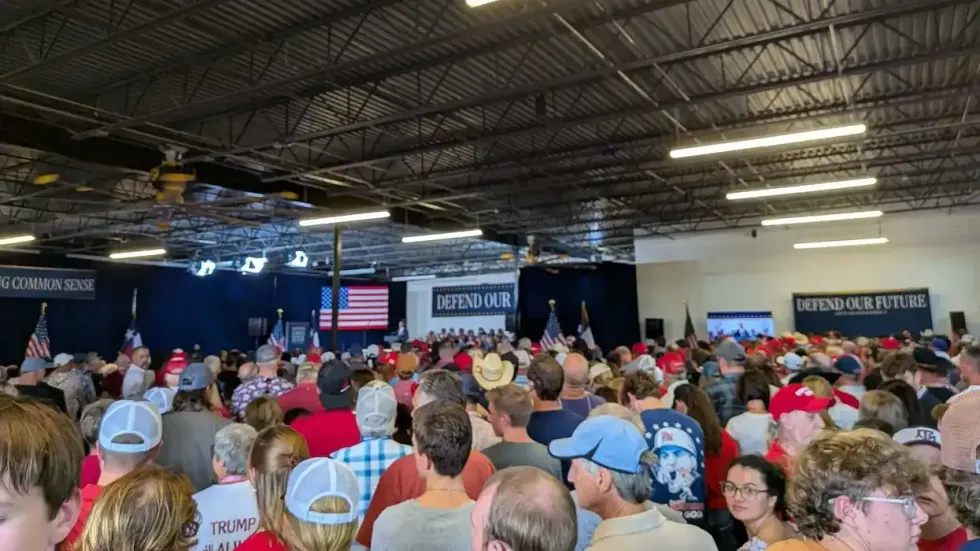
While affordability, tariffs, and data centers can certainly be described as national political issues, politicians’ focus on their local impact even when it bucks the party line reflects a growing comfort with running more localized campaigns independent of the national political machinery. A Brookings Institution analysis from September confirms that while national political forces remain powerful, state-specific issues are dominating and shaping individual races in ways not seen in recent years.
A return to local politics should be celebrated. Focusing on local issues has intrinsic value because the needs of a Maine lobsterman and an Iowa corn farmer will differ from those of a suburban Atlanta office worker or a Silicon Valley tech employee. We want our politicians to respond to our individual issues, and a local focus is the best way to promote that.
More fundamentally, localized politics may be the salve for a democracy in decline. For years, political scientists have described the nationalization of American politics and its resulting polarization as one of the defining features of our democratic regression. A 2023 study of congressional elections over nearly two centuries described the contemporary era as one of historically high nationalization and, as a result, polarization.
When Americans reflexively identify with one of two political camps as if they were sports teams and consume only national political news, they invariably interpret even local controversies through a national ideological lens. Campaigns know this. A 2026 study showed that campaign ads targeting a national donor audience were more ideologically extreme than locally targeted ads aimed at voters.
RELATED: Independents can bust Washington’s corruption racket
And as Sand, Talarico, Tafoya, and others have shown, campaigns can refocus attention on nonpartisan, nonpolarizing issues that actually matter to people on the ground. In turn, a Democrat may become the governor of red-state Iowa at the same time a Republican may become the junior senator in blue-state Minnesota, because they successfully connect with the needs of those states and their citizens.
Sure, the case for optimism is a mild one. Politics still offers plenty to be disgusted about. Vivek Ramaswamy’s support for an ad questioning his opponent’s account of being raped as a child by her indicted stepfather sparked bipartisan outrage.
And the Mary Peltola campaign’s actions to prop up a candidate with the same name as her opponent to confuse voters (and then lie about it for months) have breathed unnecessary life into claims of election fraud chicanery.
And, of course, the national stakes — control of the House and Senate — remain front and center, with the outcome of many races undoubtedly to be decided by the singular unpopularity of one man who has been the center of political gravity in America for more than a decade.
But as Kansas Republican Sen. Roger Marshall recently reminded voters, those elected to the Senate this year will serve twice as much of their term with Trump out of office as with him in office. What better time than now to start thinking about how to shape the future of politics?
With any luck, that future will be local.
Continue reading...
[H/T Blaze Media]


