

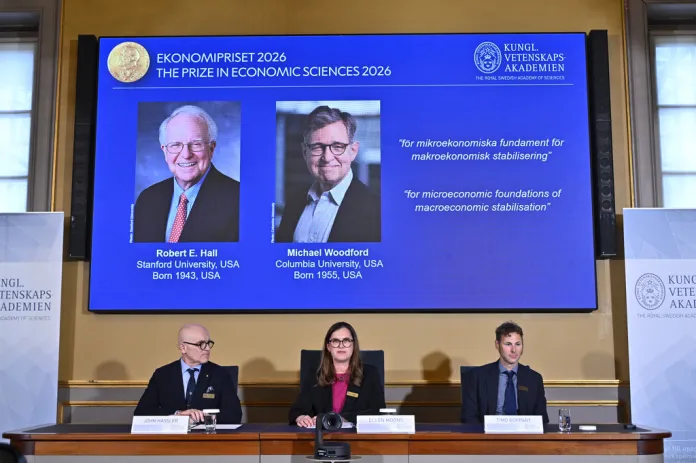
Supply-side activists are rejoicing in the award of a Nobel Memorial Prize in Economics to Stanford’s Robert Hall, the author of the flat tax that would replace the existing tax system with a single flat rate.
“It surely adds credibility to the flat tax, that even those people would think it’s good,” Arthur Laffer, a longtime GOP adviser who is credited with helping develop supply-side economics in the 1970s, told the Washington Examiner on Monday after the announcement of the award.
WAGE GROWTH LAGS INFLATION, MAKING THE AFFORDABILITY CRISIS FEEL EVEN MORE ACUTE
The flat tax proposal developed by Hall and Alvin Rabushka in 1985 would replace income taxes for individuals and businesses with a single tax at a single rate on wages and business income, while excluding investment. Proponents argue that it would radically simplify the system and boost economic growth by shifting the tax base to consumption.
Iterations of a flat tax have been incorporated in the policy platforms of several political figures over the decades.
Laffer pointed out that the idea gained much attention when former California Gov. Jerry Brown ran for the Democratic nomination for president in 1992, supporting a flat income tax system. Brown ended up coming in second place in the primary that year, losing to Bill Clinton, who went on to be elected president.
Steve Forbes, a businessman and the editor-in-chief of his eponymous news publication, ran for president in 1996 and 2000 on a platform of implementing a flat tax system.
The flat tax wasn’t part of the Nobel committee’s basis for awarding Hall the prize, which he shared with Columbia professor Michael Woodford for work on the “microeconomic foundations of macroeconomic stabilisation.”
But it is highly influential among tax experts.
Joe Bishop‐Henchman, the executive vice president at National Taxpayers Union Foundation, said polling indicates voters find the current federal tax system too complicated and that the Hall-Rabushka proposal would also give every taxpayer an exemption based on family size.
“It retains a lot of the progressivity of the code and avoids taxation of investment activity,” Bishop-Henchman said. “So it’s both pro-growth and fair.”
Alex Durante, a senior economist at the Tax Foundation, told the Washington Examiner that the idea of a flat tax popularized by Hall has proven “pretty influential” in the field of economics.
“It seems like ancient history at this point, but like if you go back to 10 years ago, the Republican primaries in 2016, 2015 — I mean, a lot of those candidates kind of had variants of a flat tax,” Durante said.
Sen. Ted Cruz (R-TX) ran for president in 2016 on instituting a flat individual income tax rate of 10%, while ending payroll taxes, and implementing a 16% corporate rate.
President Donald Trump, the current standard-bearer of the Republican Party, does not support a flat tax system. He successfully ran for reelection in 2024 on creating new tax breaks, such as for tipped workers, that cut against the idea of a single tax rate applied to all salaries and wages. His tax priorities ultimately turned into law with last year’s signing of the One Big Beautiful Bill Act.
But Trump is term-limited, and the flat tax idea could be raised again during the 2028 presidential contest. Hall’s Nobel Prize win could give more credence to the policy.
“I think it’ll probably give renewed attention to the idea,” Durante said.
The group Unleash Prosperity, which supports free markets, repealing regulations, and more, released a statement congratulating Hall on the win on Monday.
“Congrats to our friend Robert Hall,” the group said. “But the award really should have been shared with our UP co-founders Arthur Laffer and Steve Forbes who popularized this idea and spread the word around the world!”
Other politicians have embraced the idea of a flat tax more recently. For instance, back in early 2024, amid a run for the presidency, Gov. Ron DeSantis (R-FL) said that he wanted to see the IRS abolished and a flat tax system introduced.
During a CNN town hall event, DeSantis said he thinks such an arrangement would be an “ideal tax system to be able to take away the distortions.”
“I want to eliminate the IRS, and I would like a flat one, single rate flat tax,” DeSantis said. “Obviously, I would only do it if it was lower taxes for everybody. But that is the ideal tax system.”
While in Congress, the Florida governor also co-sponsored the FairTax Act, which has been proposed unsuccessfully by a contingent of conservative lawmakers for nearly two decades.
The perennial “FairTax” legislation, which has never come close to becoming law, envisions simplifying the tax code by scrapping the income tax, payroll tax, corporate tax, gift tax, and death tax altogether and replacing them with a nationwide consumption tax on goods and services. The IRS, as an entity, would, in turn, be killed off as part of the plan.
Also, Durante noted that some Eastern European countries, after the fall of the Soviet Union, adopted flat tax systems in the mold of Hall and Rabushka.
Some argue that a flat tax system would help with the longtime Republican goal of “broadening the base.”
FEDERAL DEFICIT ROSE TO $2 TRILLION FOR FISCAL 2026, ADDING TO DEBT FEARS
Broadening the base had been a goal of Republicans since the Reagan-era tax reform effort. The idea is that special deductions and credits should be limited in the tax code so that more income is taxed. That larger pool allows for overall rates to be lowered without cutting into revenue.
“How you collect your taxes matter, and you want to have the lowest possible rate on the broadest possible tax base,” Laffer said.
Continue reading...
[ H/T Washington Examiner ]