



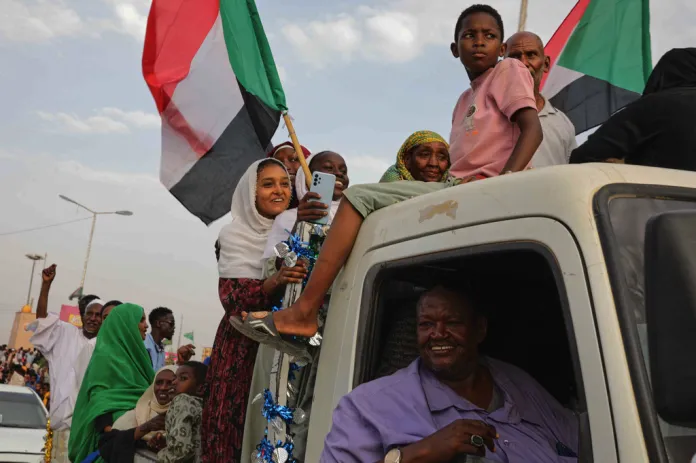
The Sudanese government asked for United Nations intervention after the United States withheld its delegation’s visas, making them contingent on accepting a U.S.-backed ceasefire.
The U.S. withheld an entry visa for Sudanese Armed Forces leader Abdel Fattah al Burhan, saying it would only provide him with a visa to speak at the U.N. General Assembly in New York if he agreed to sign a 90-day ceasefire proposal put forward by U.S. negotiators, according to sources speaking to the Sudan Tribune and Reuters. The outlet reported that the delegation was only made aware of his barring just days before his scheduled speech, sending diplomats scrambling to appeal to the U.N. for their intervention.
COULD TRUMP’S INTERVENTION BRING AN END TO THE WORLD’S GREATEST HUMANITARIAN CRISIS?
The U.S. imposed restrictions on Burhan and the delegation’s movements last year, requiring them to get approval before traveling anywhere outside a 25-mile radius of Columbus Circle in New York City. The restrictions influenced his decision not to attend the assembly, for the first time since taking power in a coup on Oct. 25, 2021. He traveled to New York City to speak for the first two years of the Civil War, which began on April 15, 2023.
Transitional Prime Minister Kamil Idris spoke in Burhan’s place last year. The restrictions this year appear to be a step up from those imposed last year, barring him from the country altogether.
A Monday letter from Sudan’s ambassador to the U.N., viewed by Reuters, pleaded for the body to intervene to allow Burhan to attend.
“Should this situation persist, it would effectively prevent the Head of State of a Member State of the United Nations from participating in person in the work of the General Assembly,” Al Harith Idriss al Harith Mohamed wrote.
However, the Sudan Tribune reported that diplomatic sources in Khartoum believe the U.S. will ultimately grant Burhan a visa before his speech, which is set to occur on Thursday.
U.N. spokesman Stephane Dujarric told Reuters that the secretary general was “deeply concerned” that a visa hadn’t yet been given to Burhan, and had raised the matter with the U.S.
The U.S. has agreed not to withhold visas for political opponents under the 1947 U.N. Headquarters Agreement, but Republican and Democratic administrations have periodically violated this for decades. The Obama administration famously blocked Burhan’s predecessor, Omar al Bashir, from the General Assembly in 2013.
Burhan is viewed by many in Washington as a preferable partner to his rival in the Sudanese Civil War, the Rapid Support Forces led by General Mohamed Hamdan “Hemedti” Dagalo, his erstwhile ally that grew from the genocidal Janjaweed militias. Despite this, the SAF’s Islamist connections and litany of war crimes have driven Washington to hesitate before definitively choosing a side, preferring instead to serve as a mediator. The Biden administration sanctioned Burhan in one of its final acts before handing over power to the Trump administration.
The U.S. became more closely involved in the Sudanese Civil War late last year, when appeals from Arab partners after the RSF’s capture of the Darfur city of El Fasher pushed Trump to announce a new effort to bring an end to the conflict. The SAF has proven even more implacable than the RSF in diplomatic efforts, refusing any ceasefire until RSF forces withdraw from all cities, a nonstarter for the group, which has firm control over half the country.
Burhan was scheduled to speak in the U.S. during a low point in his relationship with U.S. negotiators, coming shortly after the U.S. suggested extending its arms embargo to cover the whole country, a move analysts fear would disproportionately hurt the SAF. The RSF has easily been able to evade the embargo through massive alleged United Arab Emirates support.
Burhan penned an op-ed for Foreign Policy magazine on Monday, outlining his plan to end the war. Though he implied a military solution couldn’t be the endgame of the conflict and called for a transitional government under civilian control, he simultaneously delegitimized the RSF and implied that its dissolution was the only acceptable outcome.
“Peace dictated from the outside does not last,” he wrote. “Cease-fires have collapsed over the course of this war because they were written about Sudan without Sudan and because their sponsors knew they would not have to pay the price if those negotiations failed. A ‘pause’ became time for the RSF and its backers to regroup, while the world’s attention drifted once again—as was made horribly clear by the massacre in El Fasher. Sudan has lived that cycle and will not accept it again.”
INVESTIGATORS SAY EL FASHER MASSACRE DEATH TOLL COMPARABLE TO THAT OF ENTIRE GAZA WAR IN JUST THREE WEEKS
Burhan’s commitment to a civilian transitional government is also in doubt, however, as it was he who launched the 2021 coup with RSF support that put him in power in the first place.
On the military front, the SAF has been on the front foot for several weeks, halting the RSF advance and making gains after a series of catastrophic defeats over the past year.
Continue reading...
[ H/T Washington Examiner ]
