







China Ranked #1 In World At Math; USA 27th...
How do math skills compare around the world?
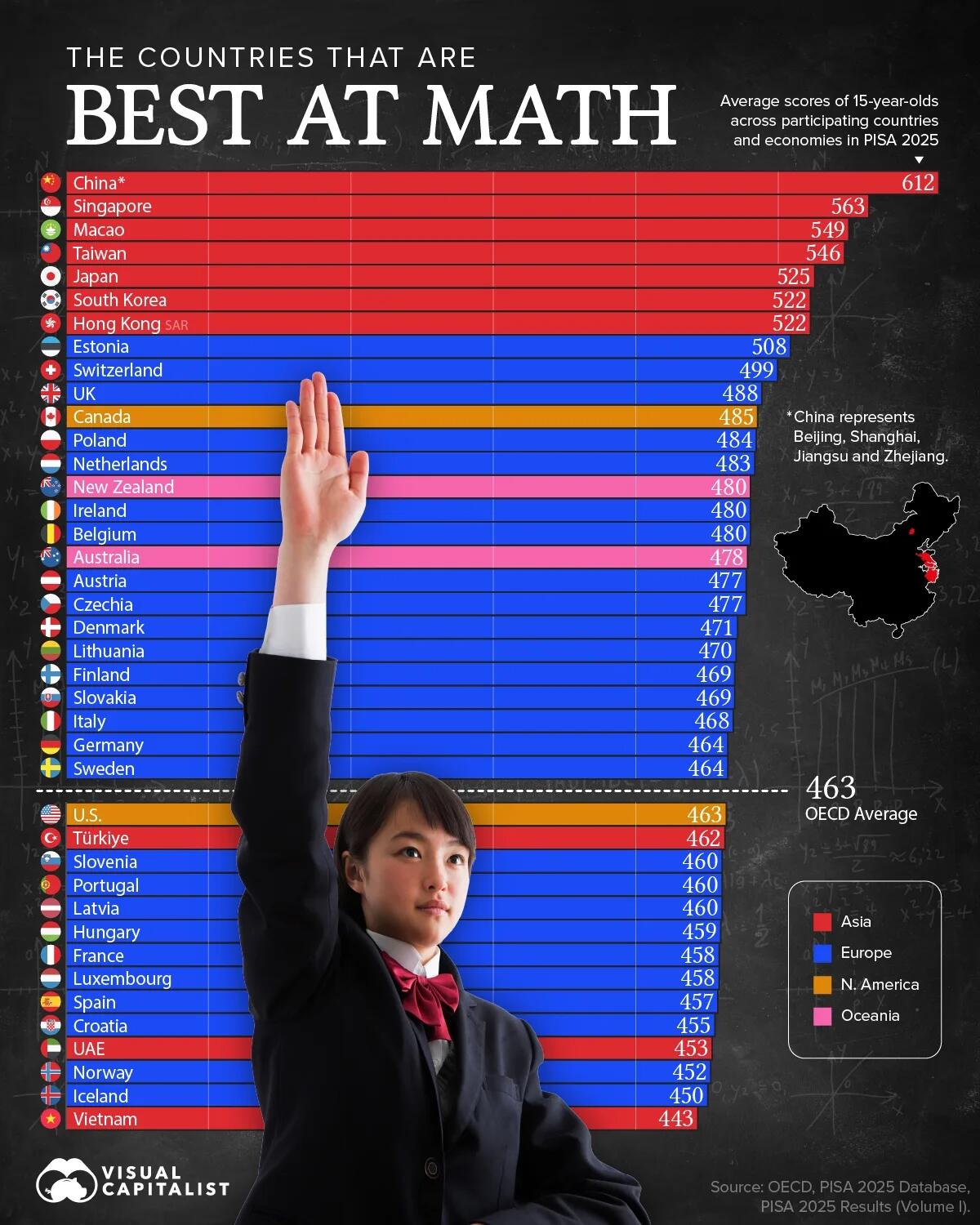
This graphic, via Visual Capitalist's Bruno Venditti, ranks participating countries and economies by the average mathematics scores of 15-year-old students in the most recent PISA 2025 study, published in September 2026.
PISA assesses students in mathematics, reading, and science. Its mathematics assessment goes beyond memorizing formulas or procedures, measuring whether students can apply mathematical knowledge and reasoning to real-world problems.
More than 760,000 students took part in PISA 2025 across 91 countries and economies, representing roughly 33 million 15-year-olds worldwide.
China in this ranking represents the participating jurisdictions of Beijing, Shanghai, Jiangsu, and Zhejiang. Uzbekistan is excluded because a comparable mathematics score was not reported.
China leads Singapore by 49 points, while Macao and Taiwan rank third and fourth with scores of 549 and 546, respectively.
Japan ranks fifth with 525 points, while Korea and Hong Kong are tied at 522. Estonia breaks up the concentration of East Asian education systems at the top, ranking eighth globally with a score of 508 and placing highest among European countries.
The United States ranks 27th with a score of 463, exactly matching the OECD average.
Canada ranks 11th overall with an average mathematics score of 485, putting it 22 points above the OECD average. It also places ahead of several major European economies, including Germany, France, Spain, and Italy.
The United Kingdom ranks 10th with a score of 488. Australia comes in 17th at 478, while New Zealand ties for 14th at 480.
Across OECD countries, average mathematics scores fell by 22 points between 2015 and 2025, equivalent to just over one year of learning. Declines were also recorded among non-OECD participants.
PISA also found an association between heavy digital leisure use and student outcomes. Students spending more than four hours a day on digital leisure activities outside school tended to have lower mathematics scores and a weaker sense of belonging.
By contrast, moderate digital use was associated with better outcomes on both measures than either no use or very high use.
If you enjoyed today’s post, check out Countries by Education Spending as % of GDP on Voronoi.
Tyler Durden Wed, 09/23/2026 - 05:45
Continue reading...
[ H/T ZeroHedge ]
How do math skills compare around the world?
This graphic, via Visual Capitalist's Bruno Venditti, ranks participating countries and economies by the average mathematics scores of 15-year-old students in the most recent PISA 2025 study, published in September 2026.
PISA assesses students in mathematics, reading, and science. Its mathematics assessment goes beyond memorizing formulas or procedures, measuring whether students can apply mathematical knowledge and reasoning to real-world problems.
More than 760,000 students took part in PISA 2025 across 91 countries and economies, representing roughly 33 million 15-year-olds worldwide.
China in this ranking represents the participating jurisdictions of Beijing, Shanghai, Jiangsu, and Zhejiang. Uzbekistan is excluded because a comparable mathematics score was not reported.
Why East Asia Stands Out in Math Scores
China leads Singapore by 49 points, while Macao and Taiwan rank third and fourth with scores of 549 and 546, respectively.
| Rank | Country | Average PISA score |
|---|---|---|
| 1 |  China China | 612 |
| 2 |  Singapore Singapore | 563 |
| 3 |  Macao Macao | 549 |
| 4 |  Taiwan Taiwan | 546 |
| 5 |  Japan Japan | 525 |
| 6 |  Korea Korea | 522 |
| 6 |  Hong Kong Hong Kong | 522 |
| 8 |  Estonia Estonia | 508 |
| 9 |  Switzerland Switzerland | 499 |
| 10 |  UK UK | 488 |
| 11 |  Canada Canada | 485 |
| 12 |  Poland Poland | 484 |
| 13 |  Netherlands Netherlands | 483 |
| 14 |  New Zealand New Zealand | 480 |
| 14 |  Ireland Ireland | 480 |
| 14 |  Belgium Belgium | 480 |
| 17 |  Australia Australia | 478 |
| 18 |  Austria Austria | 477 |
| 18 |  Czechia Czechia | 477 |
| 20 |  Denmark Denmark | 471 |
| 21 |  Lithuania Lithuania | 470 |
| 22 |  Finland Finland | 469 |
| 22 |  Slovakia Slovakia | 469 |
| 24 |  Italy Italy | 468 |
| 25 |  Germany Germany | 464 |
| 25 |  Sweden Sweden | 464 |
| 27 | OECD average | 463 |
| 27 |  United States United States | 463 |
| 28 |  Türkiye Türkiye | 462 |
| 29 |  Slovenia Slovenia | 460 |
| 29 |  Portugal Portugal | 460 |
| 29 |  Latvia Latvia | 460 |
| 32 |  Hungary Hungary | 459 |
| 33 |  France France | 458 |
| 33 |  Luxembourg Luxembourg | 458 |
| 35 |  Spain Spain | 457 |
| 36 |  Croatia Croatia | 455 |
| 37 |  UAE UAE | 453 |
| 38 |  Norway Norway | 452 |
| 39 |  Iceland Iceland | 450 |
| 40 |  Vietnam Vietnam | 443 |
Japan ranks fifth with 525 points, while Korea and Hong Kong are tied at 522. Estonia breaks up the concentration of East Asian education systems at the top, ranking eighth globally with a score of 508 and placing highest among European countries.
Where the U.S. and Canada Rank
The United States ranks 27th with a score of 463, exactly matching the OECD average.
Canada ranks 11th overall with an average mathematics score of 485, putting it 22 points above the OECD average. It also places ahead of several major European economies, including Germany, France, Spain, and Italy.
The United Kingdom ranks 10th with a score of 488. Australia comes in 17th at 478, while New Zealand ties for 14th at 480.
Math Scores Have Fallen Across the OECD
Across OECD countries, average mathematics scores fell by 22 points between 2015 and 2025, equivalent to just over one year of learning. Declines were also recorded among non-OECD participants.
PISA also found an association between heavy digital leisure use and student outcomes. Students spending more than four hours a day on digital leisure activities outside school tended to have lower mathematics scores and a weaker sense of belonging.
By contrast, moderate digital use was associated with better outcomes on both measures than either no use or very high use.
If you enjoyed today’s post, check out Countries by Education Spending as % of GDP on Voronoi.
Tyler Durden Wed, 09/23/2026 - 05:45
Continue reading...
[ H/T ZeroHedge ]