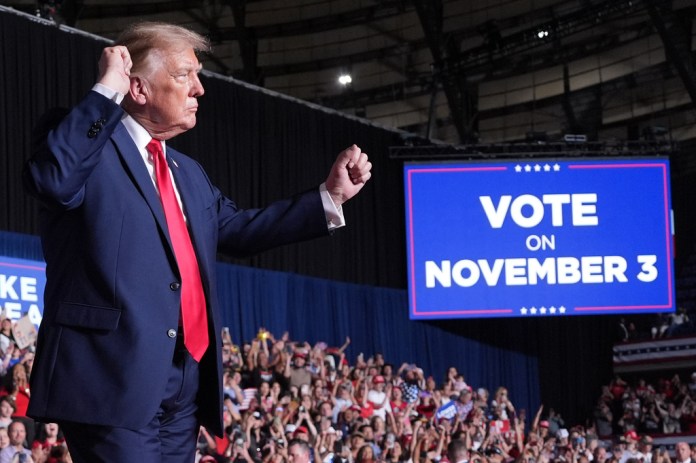




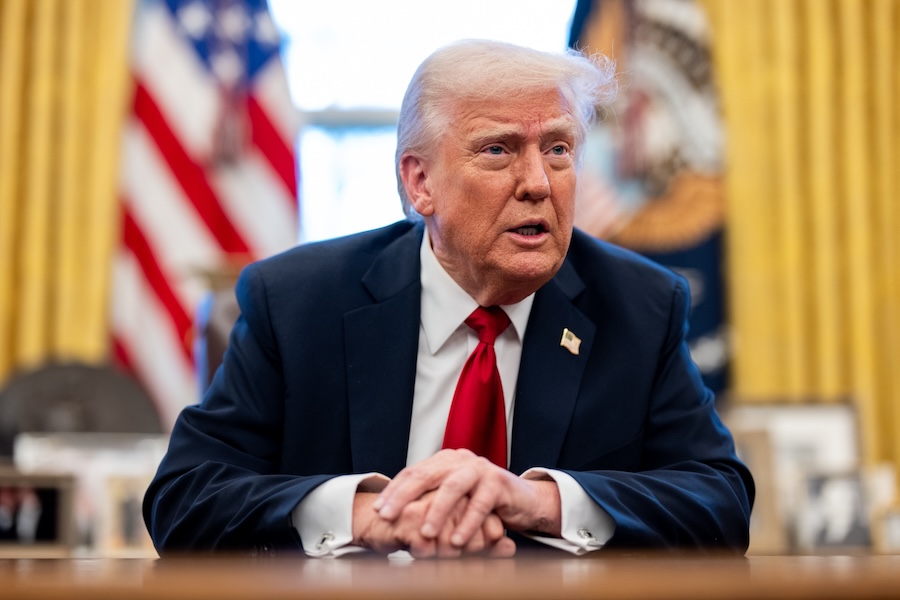


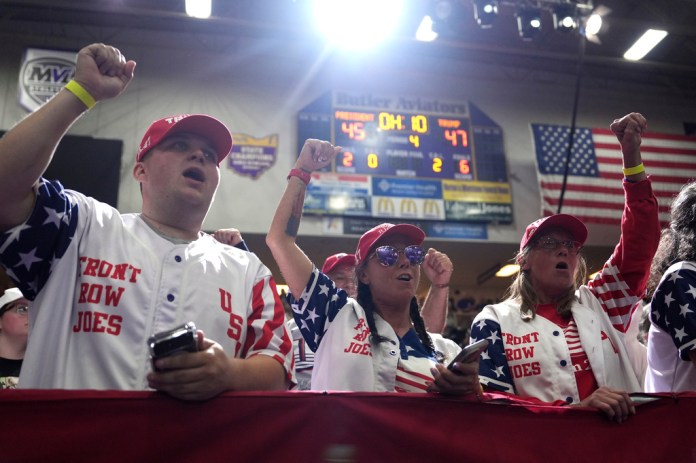
A column made the rounds this month arguing that President Donald Trump’s remaining supporters stay loyal chiefly out of racial grievance and fear of losing majority status, reaching at one point for a comparison to the kind of allegiance an authoritarian strongman commands. That is a serious charge, and it deserves a serious check against the data.
Start with the number everyone agrees on. By September 2026, national approval sits at roughly 38% approve to 59% disapprove, one of the weakest standings of any American president at this point in a term. A 43-day government shutdown last fall, the longest in the country’s history, hurt him further. A February war with Iran still ongoing pushed several polls into the low 30s.
A fair objection follows: national polls badly missed 2016 and, to a lesser degree, 2024. That is a reasonable caution about precision and a weaker reason to discard the data altogether. A horse-race poll must nail one number in a few states; an approval trend only needs the direction and rough size right, and 10 independently run aggregators, using different methods, are converging on the same high-30s range.
What has not happened is more interesting than what has. No major poll shows Trump’s floor falling into the 20s. A core of roughly 35% to 38% has held through a war, a record shutdown, and a Supreme Court ruling that struck down his tariff program 6-to-3 in February. Two structural forces explain that floor better than a single moral label: an institutional grudge nine years in the making, and tax changes that put real money into real paychecks.
A grudge nine years in the making
The distrust started in 2016, when Trump beat a crowded Republican field on trade protectionism and border enforcement the party establishment had long avoided. It hardened through the Special Counsel investigation, which, in its own words, did not establish a criminal conspiracy between the campaign and Russia, and again during the 2019 Ukraine impeachment. To Trump’s supporters, two multiyear investigations that ended without a criminal conviction on the core allegation looked less like accountability journalism and more like an extended campaign by institutions they already distrusted. That reaction is not irrational, whatever one thinks of the underlying facts, and it helps explain why a war or a shutdown can sink overall approval without sinking the base.
What the tax bill does, and does not do
The second force is money. In July 2025, Trump signed the One Big Beautiful Bill Act, allowing tipped workers to deduct up to $25,000 a year in reported tips from federal taxable income through 2028, and letting workers with heavy overtime deduct up to $12,500 single or $25,000 married, on the same schedule. Neither is a full tax holiday; both phase out above $150,000 in income for individuals and $300,000 for joint filers, and neither touches Social Security or Medicare withholding. The Yale Budget Lab notes that tipped work accounts for only about 2.5% of employment, and that the lowest earners, who already owe little federal income tax, gain almost nothing. The policy’s economic footprint is smaller than the applause it received. What it may buy politically is a visible, specific promise a voter can see on a pay stub.
Checking a number before repeating it
The claim about racial motivation often leans on a statistic that 37% of Trump voters self-identify as racist. That traces to a Manhattan Institute survey in which 15% said they personally hold racist views, and a separate 22% said something else: cancel culture has gone too far and shouldn’t count against people who hold such views. Added together, the total is 37%, apparently the source of the widely repeated figure. But a self-identification answer and a tolerance-for-others answer are not the same claim, and treating them as interchangeable overstates the finding. The same survey found a plurality, 36%, said openly racist individuals are not welcome in the coalition at all.
Not identity, arithmetic
TRUMP ON THE RIGHT, MAMDANI ON THE LEFT: WHY THEY BOTH WIN USING THE EXACT SAME PLAYBOOK
None of this means Trump’s supporters are indifferent to his rhetoric or his handling of Iran and the shutdown. Plenty are not, and plenty of his decisions invite fair criticism. But dismissing 35% to 38% of the country as a monolith driven by prejudice cannot explain why that number held through a war and a record shutdown, and it rests partly on a statistic that says less than advertised.
A tax break on a pay stub and a decade of institutions losing their own investigations are checkable claims. The claim that a third of the country is simply prejudiced is not. Understanding why a floor holds, even as a ceiling collapses, is a better use of democratic goodwill than repeating, once more, that a third of the country must be wrong about everything.
Meda Parameswara Reddy, Ph.D., is the director of the Reddy Center for Critical and Integrated Thinking. A former R&D executive holding 30 U.S. patents, he specializes in interdisciplinary research and public policy analysis. His writing has appeared in Proc. Natl. Acad. Sci., RealClear platforms, Washington Examiner, The Fulcrum, The Humanist, AFRO American, and South Asia Monitor, where he serves on the editorial board. He also hosts the interview show “SAM Dialogues with Dr. M. P. Reddy.”
Continue reading...
[ H/T Washington Examiner ]