






SpaceX Reportedly Caps Starlink Speed As Kiev Defies Trump's Calls To Halt Refinery Strikes
Reports say that SpaceX has imposed a movement-speed restriction on certain Starlink terminals used in Ukraine.
The Kyiv Independent cited presidential adviser Serhii "Flash" Beskrestnov, who wrote on social media that the measure took effect overnight and applies to the StarShield "military service package," setting a threshold of 100 miles per hour (about 160 kilometers per hour).
"I confirm that (Starlink owner) SpaceX implemented speed restrictions on Starlink terminals while in motion last night. Currently, the restriction applies to the StarShield 'military service package' and limits speed to 100 miles per hour (160 kilometers per hour)," Beskrestnov said in a post on social media.
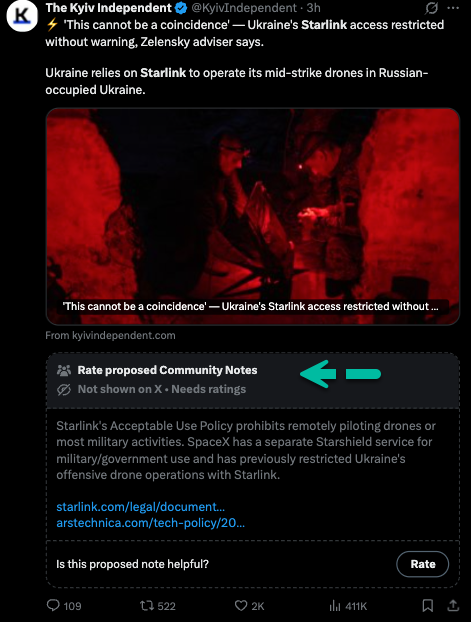
The local outlet noted, "Ukraine relies on Starlink for several military applications including operating its mid-strike campaign in Russian-occupied Ukraine, as well as interceptor drones that defend against Russia's new jet-powered attack drones."
"The consequences are already being felt in the field. Since the start of the day alone, a drone unit operating within the 7th Corps' area of responsibility in the Huliaipole sector has had to cancel a number of missions due to these connectivity issues," Ukraine's 7th Air Assault Corps told the outlet.
Western media, such as the Financial Times, said Ukraine was "blindsided by Starlink restrictions and intelligence gaps during Russian attack."
However, stated clearly in Starlink's Acceptable Use Policy:
The reported restrictions come amid tensions over Kiev's strikes on Russian refineries despite White House requests to halt the strikes. Those attacks, alongside disruptions in the Strait of Hormuz, has sparked a global refining crisis and sent diesel at the pump - worldwide - soaring and has complicate things for the Trump administration ahead of the US midterms. The timing raises questions about a defiant Kiev (read here) and whether those attacks on refineries were politically motivated to affect the outcome of the US midterms.
There was an overnight report from Semafor:
Last week, Trump announced an "energy ceasefire" between Russia and Ukraine, along with a deal with Moscow to temporarily lift US sanctions and allow Russian diesel imports to ease supply pressures and bring down record-high fuel prices ahead of the midterms.
Tyler Durden Wed, 10/14/2026 - 07:20
Continue reading...
[ H/T ZeroHedge ]
Reports say that SpaceX has imposed a movement-speed restriction on certain Starlink terminals used in Ukraine.
The Kyiv Independent cited presidential adviser Serhii "Flash" Beskrestnov, who wrote on social media that the measure took effect overnight and applies to the StarShield "military service package," setting a threshold of 100 miles per hour (about 160 kilometers per hour).
"I confirm that (Starlink owner) SpaceX implemented speed restrictions on Starlink terminals while in motion last night. Currently, the restriction applies to the StarShield 'military service package' and limits speed to 100 miles per hour (160 kilometers per hour)," Beskrestnov said in a post on social media.
The local outlet noted, "Ukraine relies on Starlink for several military applications including operating its mid-strike campaign in Russian-occupied Ukraine, as well as interceptor drones that defend against Russia's new jet-powered attack drones."
"The consequences are already being felt in the field. Since the start of the day alone, a drone unit operating within the 7th Corps' area of responsibility in the Huliaipole sector has had to cancel a number of missions due to these connectivity issues," Ukraine's 7th Air Assault Corps told the outlet.
Western media, such as the Financial Times, said Ukraine was "blindsided by Starlink restrictions and intelligence gaps during Russian attack."
However, stated clearly in Starlink's Acceptable Use Policy:
The reported restrictions come amid tensions over Kiev's strikes on Russian refineries despite White House requests to halt the strikes. Those attacks, alongside disruptions in the Strait of Hormuz, has sparked a global refining crisis and sent diesel at the pump - worldwide - soaring and has complicate things for the Trump administration ahead of the US midterms. The timing raises questions about a defiant Kiev (read here) and whether those attacks on refineries were politically motivated to affect the outcome of the US midterms.
There was an overnight report from Semafor:
Last week, Trump announced an "energy ceasefire" between Russia and Ukraine, along with a deal with Moscow to temporarily lift US sanctions and allow Russian diesel imports to ease supply pressures and bring down record-high fuel prices ahead of the midterms.
Tyler Durden Wed, 10/14/2026 - 07:20
Continue reading...
[ H/T ZeroHedge ]
