



Futures Rise Ahead Of Hot CPI As Houthis Torch Aramco HQ, ASML Beat Fails To Revive Chip Trade
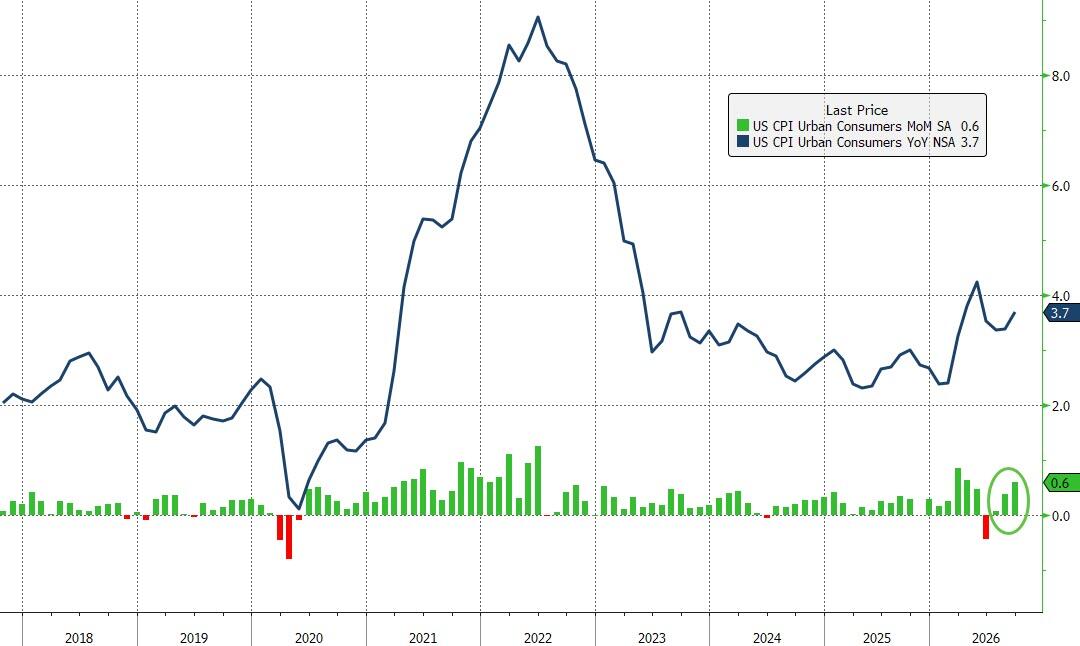
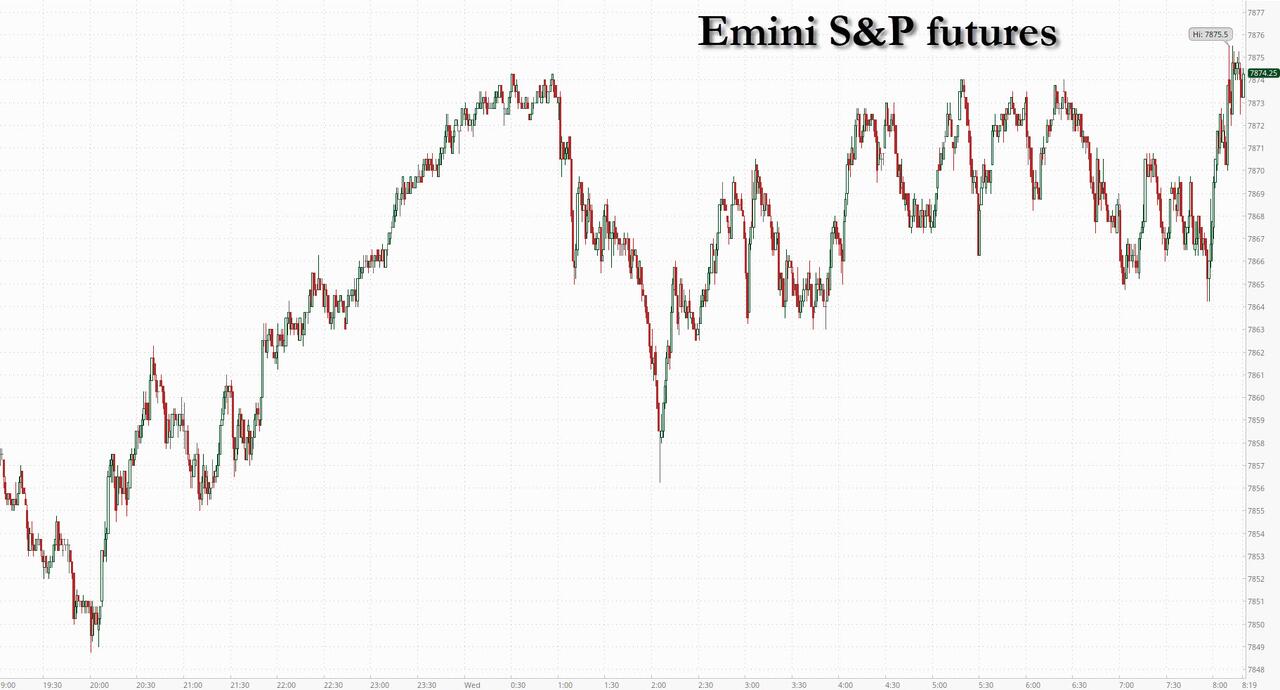
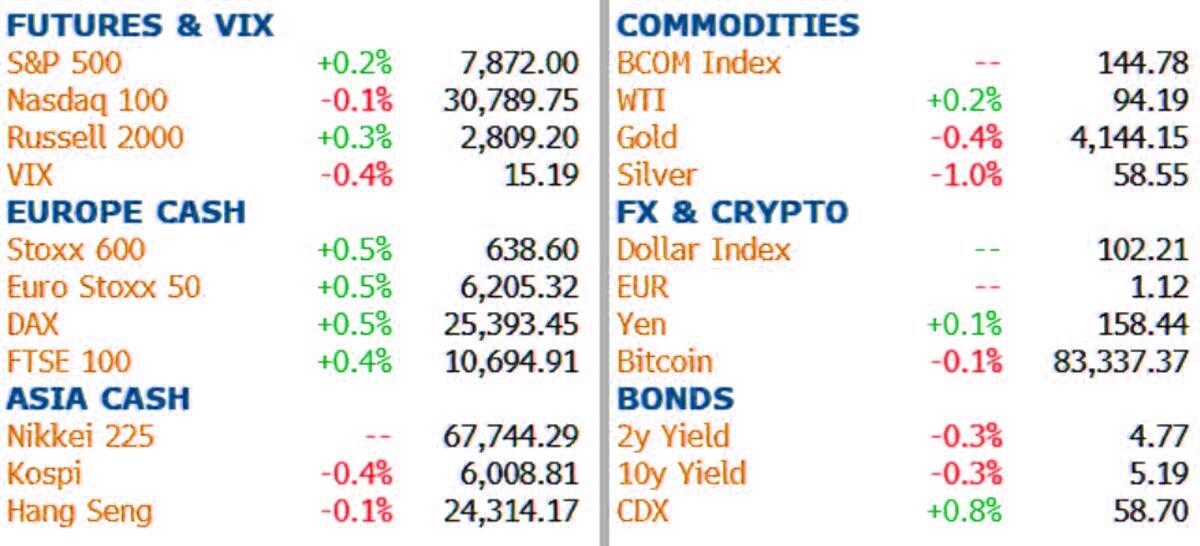
US futures are higher, with small caps leading and tech lagging, as traders brace for what is expected to be the hottest monthly CPI print since the spring, digest more escalation in the Gulf after Yemen's Houthis hit Saudi Aramco's Dhahran headquarters and vowed more strikes on Saudi airports and oil facilities, and count down to Anthropic's pre-IPO investor day which one strategist warns "will move the entire market"; as a result oil is grinding higher while the bond rout takes another breather with the 10Y sliding to 5.20%. As of 8:15am ET, S&P futures are 0.2% higher at 7,872 while Nasdaq futures are down 0.1% and Dow futures are up 0.4%; Russell 2000 contracts are up 0.3%.On Tuesday the S&P closed fractionally lower (-0.02%) as the Philly semi index posted a fifth straight drop - its longest losing streak since July - and the KBW Banks index slid 1.4% with all 24 members lower on day one of bank earnings. In premarket trading, Mag 7 names are mostly higher led by Alphabet, BlackRock jumps after pulling in $205 billion in new money, while Bank of America slips after a $1.21 billion money-laundering fine (as we reported yesterday) and an equities trading miss; memory names are again under pressure (MU -1.4%, SNDK -2.3%), extending the memory meltdown, even as ASML's beat-and-raise sparked a modest rally in Europe. The day's driver is CPI: consensus expects headline to jump 0.6% M/M and 3.6% Y/Y - the biggest monthly advance in five months on the back of surging gasoline prices - with core seen at 0.2%, while swaps price roughly 24% odds of a quarter-point hike at the Oct. 28 FOMC, meaning that the print "mostly decides December". Treasuries are slightly richer, with yields down about 1bp across the front-end and belly and the 10Y at 5.20%, dragged lower by a rally in gilts after BoE Chief Economist Huw Pill cast doubt on market pricing of four hikes by next summer and the FT reported Chancellor Healey will fund budget giveaways with taxes or spending cuts rather than more borrowing. The Bloomberg dollar index is little changed, while the Aussie is the best G-10 performer after blowout Chinese trade data. In commodities, WTI has swung between gains and losses and was last up around 1.6% as traders weigh the latest Middle East hostilities, after the IEA warned diesel supplies will remain constrained well into 2027 and OECD government oil stocks hit the lowest since 1989; gold slips 0.4% to $4,144 and silver drops over 1% to its lowest since August, while copper is firmer. Bitcoin is flat around $83,000. US economic data slate includes MBA mortgage applications (already out: -2.7%) and September CPI (8:30am); the Fed releases its Beige Book at 2pm. Fed speaker slate includes Barkin (1:30pm), Goolsbee (3pm) and Bowman (10:55pm). The Treasury sells $75 billion in 17-week bills at 11:30am.
In premarket trading, Alphabet leads Magnificent 7 peers higher a day after Google's Gemini 4 Argon was made available for developers and enterprises: Alphabet (GOOGL) +0.9%, Amazon (AMZN) +0.5%, Apple (AAPL) +0.4%, Meta Platforms (META) +0.2%, Microsoft (MSFT) +0.2%, Nvidia (NVDA) +0.2%, Tesla (TSLA) little changed.
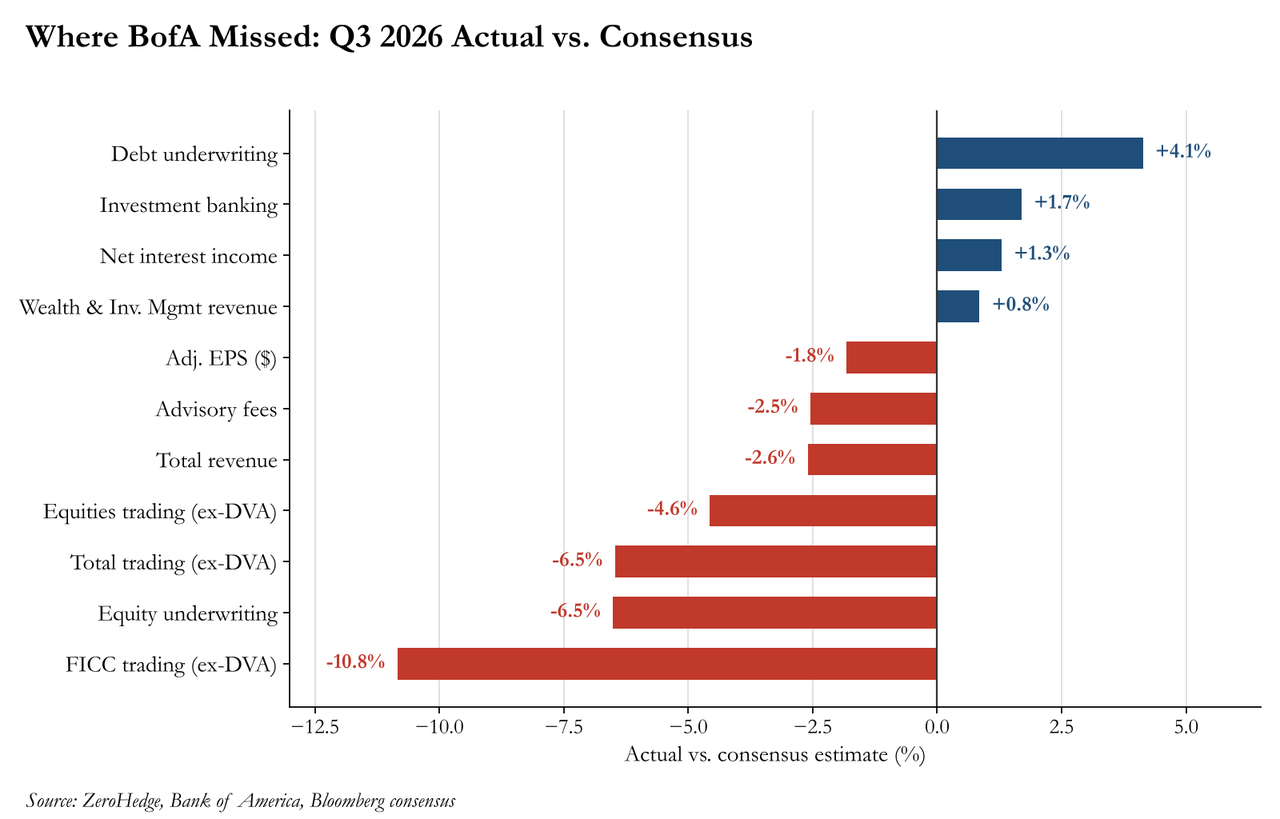
In other corporate news, Bank of America was fined more than $1.21 billion for money laundering and sanctions violations by US regulators, who said the bank "effectively outsourced" a key part of its compliance efforts as it sought to protect revenue (it then reported 3Q equities trading revenue ex-DVA of $2.51 billion, short of the $2.63 billion estimate, so not the best morning in Charlotte); BofA is also no longer part of the potential roster of banks working on Moonshot AI's IPO as the Chinese AI darling faces scrutiny in the US. Palliser Capital wants Samsung Electronics to list shares in the US and use the proceeds to buy back preferred stock. Galderma agreed to buy ZO Skin Health for an enterprise value of $1.5 billion in an all-cash deal. OpenAI is in early talks to buy security startup Trail of Bits, The Information reported - which comes a day after an OpenAI employee was arrested for planting a recording device in one of its offices. SentinelOne brought a $1.25 billion zero-coupon convertible to market, Sierra Space's CFO has left after about six months in the role, Nvidia committed $250 million to UK agentic safety research over five years, and the EU is set to lift a sanction on a Chinese firm to save an ASML supplier.
Stock futures are edging higher as traders await inflation data, more bank earnings and an even bigger catalyst in the form of Anthropic's pre-IPO investor day in San Francisco, where the company is set to disclose new revenue numbers to a select group of investors. Investors are already getting more selective on the AI trade: ASML had a subdued reaction to a solid headline print, while Applied Materials sank after its results lacked detailed guidance, pointing to high expectations for the picks and shovels part of the technology. Meanwhile, after another day in which tech was wrecked again as AI credit cracks widened, the median stock is 16% below its 52-week high - the weakest breadth since the Dotcom Bubble according to Goldman's Prime desk - or as BTIG put it, the Mag 7 is all that's left holding up the index.
"When word gets out about the revenue run rate, it will move the entire market," said Jonestrading's Mike O'Rourke. "The investment community wants to know whether Anthropic is going public from a position of strength or weakness."
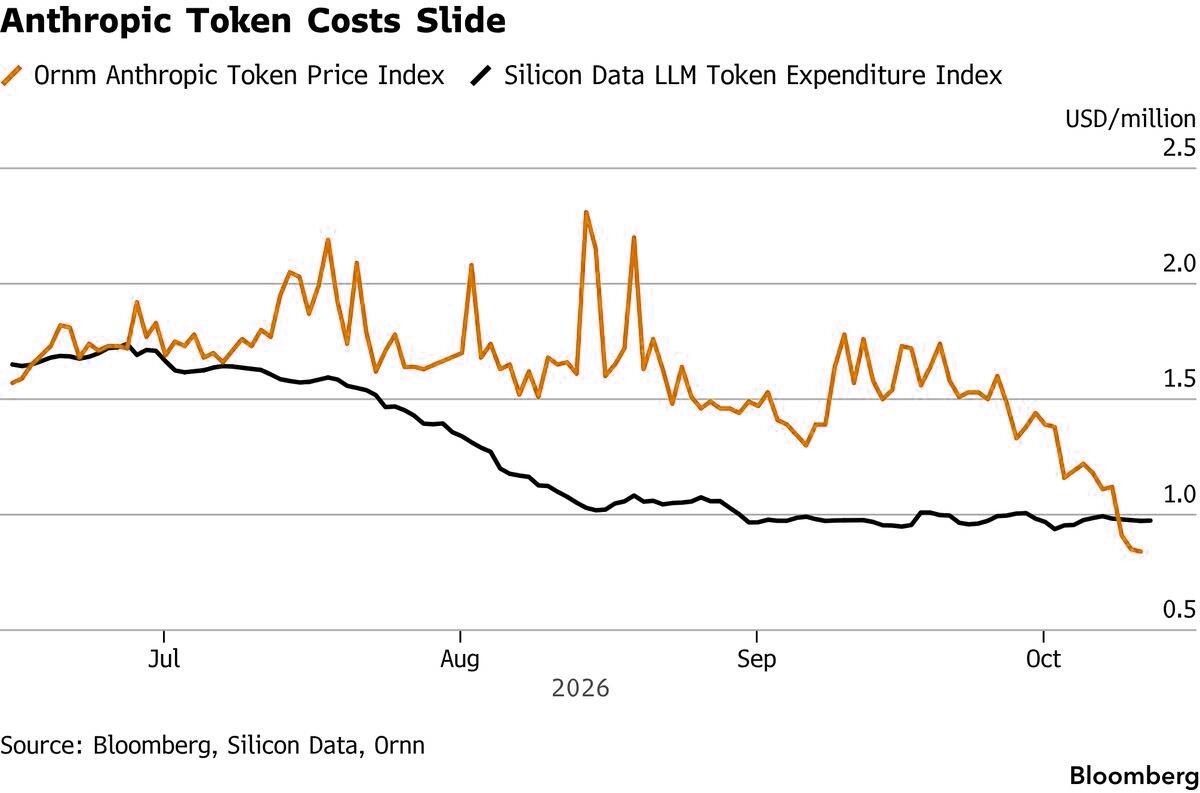
There's also a distinction emerging between the cost of compute (expensive) and the cost of intelligence (falling fast). "If AI follows the path of previous general-purpose technologies, the price of the technology itself will trend towards marginal cost, while value migrates to whatever is built on top," said Northern Trust's Gary Paulin.
As for CPI, Bloomberg Economics expects September headline to accelerate to 3.7% as gasoline prices rise, with core edging up to 2.5%, but sees the pickup as "mostly a story of localized hot spots, not broad-based price pressures," leaving the Fed room to stay patient; Goldman expects core at 0.24% (vs 0.2% consensus) and headline at 0.59%, while DB's economists see core at just 0.16%. Whatever the number, the options market is barely paying attention: option event premium suggests CPI is likely a non-event, with the SPX implied swing around 0.5% - as Goldman's Gail Hafif notes, the 52bp straddle is "one of the lowest CPI straddles we've seen this year." Our full preview is here.
“Headline inflation remains elevated, but as long as we don’t get something like 1.0% month-on-month, markets should be able to absorb the print quite well,” said Bank of New York Mellon strategist Geoffrey Yu. “The challenge is if core inflation is elevated.”
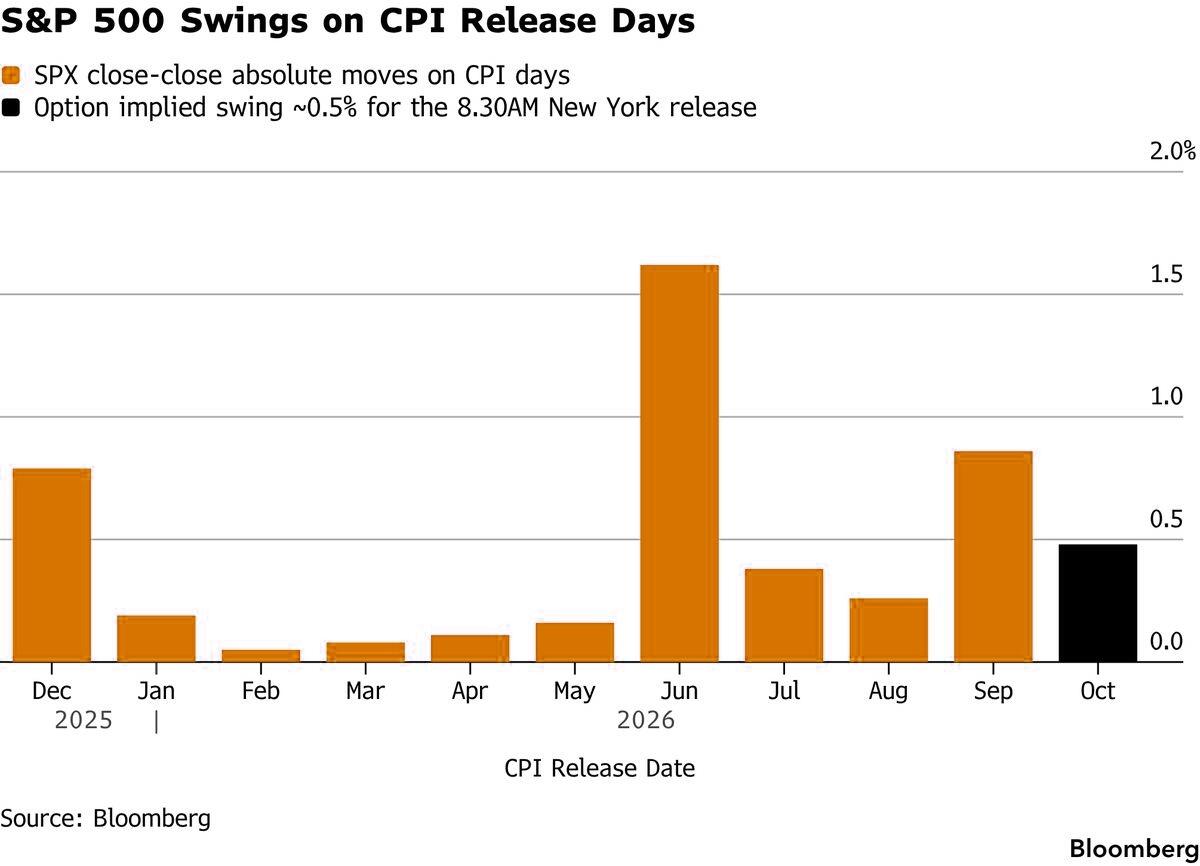
Option event premium suggests the event is likely a non-event for the market. The real stress, however, remains in bonds, not stocks: the MOVE index of Treasury volatility at 101 has climbed about 20 points over a month while the VIX at 15 sits in the calm band, and Fidelity's chief investment strategist Salman Ahmed says the 10Y could still climb to 6% (more on that below). Meanwhile, day one of bank earnings was messier than the headline beats suggested: JPMorgan posted a surprise drop in fixed income trading revenue and Goldman missed in credit and rates, and per Goldman sector specialist Christian DeGrasse, bank shares are taking their cues from semiconductors and rates rather than anything lenders themselves have said, with CET1 ratios at JPM and Wells down 30bp on the quarter and JPM's buyback slowing to about $1 billion from $6.7 billion. The S&P 500 banks index is down about 7.5% over the past month.
JPM's Market Intel desk (Andrew Tyler's team) remains Tactically Bullish and notes that after five straight down sessions in the SOX, ASML's beat-and-raise drew a positive stock reaction "but didn't restart the broader Semis / Memory trade"; with tech front and center, the desk says to watch for a possible squeeze post-CPI. JPM's Feroli sees headline at 0.55% M/M (3.6% Y/Y) and core at 0.18% (2.4% Y/Y), a print that "should be enough to keep the bond market from re-pricing an October hike." On banks, JPM's financials specialist Rob O'Dwyer says the universal feedback on the sector's weakness is "head scratching, which tends to suggest that price action is driven by quants and passive flow" - in his view a reason to fade the move and buy the group. The desk's bank earnings read-through was unambiguously bullish on the consumer: card spending grew 10% Y/Y at JPM and 13% at Citi, while delinquencies and net credit losses are falling at C and WFC.
Over at Goldman, Rich Privorotsky says he "can't remember a time when the frontier was quite so competitive" and is "increasingly conscious that the limiting factor may not be demand, but our willingness and ability to finance and deliver the supply." Goldman's London TMT desk called this morning "a test just how bearish the market has become on AI and semiconductors", with sentiment "caught in a bearish feedback loop" - ASML's own warning that capacity growth of "30% in 2027, 30% in 2028 will not allow us to meet our customer demand" is hardly the stuff of an AI bust. In New York, Peter Callahan notes that Mag 7 has outperformed the NDX for eight straight sessions while Semis lag the market by ~8 points over their five-day losing streak, adding: "As if we needed another reminder that the 'index' often doesn't tell the whole story anymore."
In France, the OAT-Bund spread is holding around 137bp after narrowing on Tuesday, as ECB President Lagarde said "the primary and first solution lies in French fiscal policy" when asked about French debt, while National Rally leader Le Pen told the FT she has the "will and conviction" to cut France's contribution to the EU budget and wants the ECB to be able to finance borrowing for priorities such as defence and the energy transition (more on the Le Pen shadow budget here).
In Europe, the Stoxx 600 is up 0.5% at 638.60 as the earnings season gathers pace, with chip-equipment maker ASML buoying the tech sector after its sales outlook exceeded expectations. Real estate tops the sector pile, followed by tech and consumer products & services, while autos, insurance and banks lag; per JPM, homebuilders and luxury are among the best performing baskets. Here are the biggest European movers:
Asian stocks ended mixed after an early tech-led rebound faded: the MSCI Asia Pacific Index climbed as much as 0.7% before erasing gains to trade 0.1% lower, as "ASML's earnings and supply outlook comments weighed on regional semiconductor sentiment during afternoon trading" per Goldman's Asia desk. The Kospi, which had been up more than 1% after Tuesday's 5.5% crash, closed 0.4% lower, the Nikkei was flat (-0.05%) and the Topix fell 0.3%. Taiwan's Taiex led with a 0.6% gain, while the Hang Seng slipped 0.1% even as the Hang Seng Tech index rose 0.9% after China's September trade surplus hit a record $133.5 billion, with exports up 36.3% (vs 25.5% expected) and imports up 31%. Mainland China lagged, with the CSI 300 down 1.4% and turnover back near year-to-date lows, while Australia's ASX 200 fell 0.6%. In Japan, Olympus tumbled 13.5% on an FDA warning.
In FX, the Bloomberg Dollar Spot Index is little changed and the DXY is stuck in a 102.07-102.23 range, initially pressured by Fed's Williams' dovish remarks before a bounce in oil and the Houthi threats brought it back to unchanged. The Australian dollar is the best performing G-10 currency, rising 0.4% against the greenback on the strong China trade data, while havens CHF and JPY are the slight underperformers given the risk tone; USD/JPY is at 158.2. EUR/USD is flat at 1.1206 and GBP/USD at 1.3264 as UK budget coverage ramps up ahead of the Oct. 28 Autumn Budget.
In rates, Treasuries are slightly richer across the curve, with front and belly leading marginal gains, supported by a wider rally across European bonds after dovish comments from BoE Chief Economist Huw Pill. US yields are richer by up to 1bp across the front-end and belly, with the 5s30s spread about 1bp steeper and the 10Y at 5.205%, as gilts outperform by about 3bp in the sector; UK 10-year yields fall 5bp to 5.40% after Pill cast doubt on market pricing of four hikes by next summer (at least someone at the BoE is pushing back on the market, rather than the other way around). Bunds are about 10 ticks firmer while the OAT-Bund spread holds at 137bp. Ahead of CPI, swaps price around 6bp of tightening for the Oct. 28 meeting, or roughly 24% odds of a quarter-point move, and around 80bp of hikes over the next year. The IG dollar issuance slate is empty so far after eight names priced almost $15 billion on Tuesday, paying about 5bp in new-issue concessions on deals that were 2.8x covered.
"Tactically speaking, we still see a scenario where this can go to 6%," Fidelity's Salman Ahmed said of the 10-year yield in a Bloomberg TV interview; at that level, "you have to take a pulse check." Fidelity's models are starting to see value around 5%, "but you do need higher yields to compensate for that positive equity/bond correlation, which was working in favor of bonds before."
In commodities, oil has been volatile, with WTI swinging between gains and declines as traders weigh the latest Middle East hostilities and last up around 1.6%, after trading in a $93.97-95.41 range earlier; Brent hovers around $106 within a $105.21-107.15 range. Yemen's Houthis said operations against Saudi airports and oil facilities will continue after hitting Aramco's executive headquarters in Dhahran, while Iranian press reported that a vessel sank in the Strait of Hormuz after hitting a mine. The IEA's monthly report warned that diesel supplies will remain constrained well into 2027, OECD government oil stockpiles fell to the lowest since at least December 1989, and 2026 global oil demand will fall by 2.6m b/d; it also cut its 2027 demand forecast to 104.4m b/d from 105.0m b/d. Dutch TTF gas is firmer but off a €87.44/MWh high. Spot gold is down 0.4% at about $4,144 in a $4,141-4,170 range, silver is down over 1% to its lowest since August, and copper is firmer on the strong Chinese data, though it eased after BHP's Escondida mine reached a preliminary agreement with its union to avoid a strike.
US economic data slate includes MBA mortgage applications (already out: -2.7%) and September CPI (8:30am); the Fed releases its Beige Book at 2pm. Fed speaker slate includes Barkin (1:30pm), Goolsbee (3pm) and Bowman (10:55pm). On the earnings front, Bank of America, Morgan Stanley, BlackRock, Progressive, State Street and Fastenal report before the open, and Anthropic holds its pre-IPO investor day in San Francisco.
Market Snapshot
Top Overnight News
A more detailed look at global markets courtesy of Newsquawk
APAC stocks were ultimately mixed as the region clawed back some of the recent tech-related losses, while participants also digested key releases from China, including inflation and trade figures. ASX 200 declined with the index dragged lower by underperformance in the top-weighted financials sector, while sentiment amongst miners was not helped by the indecision in Rio Tinto following its quarterly production update. Nikkei 225 reclaimed the 68,000 level as tech stocks got some reprieve from recent selling. KOSPI was among the biggest gainers as tech rebounded from the recent underperformance. Hang Seng and Shanghai Comp were flat as participants digested a slew of data, including stronger-than-expected trade figures and mixed inflation numbers in which CPI printed softer-than-expected, while PPI was hot and showed a faster-than-anticipated acceleration in factory gate prices.
Top Asian News
European bourses (STOXX 600 +0.6%) are firmer across the board, with outperformance in the AEX (+0.9%), following positive ASML (+1.6%) earnings. The Co. reported Q3 top- and bottom-line beats, while also lifting its Q4 and FY guidance. In the prepared remarks, the CEO highlighted that the planned supply for 2027 and 2028 will not fully meet the demand and are looking at ways to increase capacity for 2028 beyond the 30% increase previously communicated. Sectors highlight the positive bias. Real Estate tops the sector pile, with Tech and Consumer Products & Services following closely behind. The sector laggards include Autos, Insurance and Banks. US equity futures are broadly firmer, with the NQ flat. More bank earnings to report, with BofA on deck. Outside of earnings, US CPI is expected to tick higher to 3.6% (prev. 3.4%). Pointing to UST positioning, traders are short with BofA FMS pointing to this being a crowded trade. A dovish surprise could see a large unwind of this positioning and can also support the equity space. ASML (ASML NA) Q3 2026 (EUR): Basic EPS 12.95 (exp. 10.68), Revenue 11.66bln (exp. 11.58bln). Q4 guidance: Net Sales 14.2-15.2bln (exp. 14bln). FY guidance: Total net sales 44-45bln (exp. 43.6bln, prev. guided 43-45bln).
Top European News
FX
Central Banks
Fixed Income
Commodities
Trade/Tariffs
Geopolitics: Middle East
Geopolitics: Ukraine
Crypto
US Event Calendar
Central Bank Speakers
DB's Jim Reid concludes the overnight wrap
Markets have put in a subdued performance over the last 24 hours, as investors are grappling with various crosscurrents. First, chip stocks sold off yesterday on the back of AI fears, with the Philly semiconductor index (-0.23%) posting a 5th consecutive decline even as the stocks saw an afternoon recovery off the lows. Second, US banks struggled as earnings season got underway. The KBW Banks index closed near the lows of the day down, having fallen -1.39%. And third, inflation fears were still prominent, as the 12-month Brent future (+1.12%) hit a new high for this year of $87.37/bbl. On the plus side French 10yr spreads tightened -4.9bps to bunds. All that before today’s US CPI print, which is expected to be a strong one.
Let's start with US CPI , which occurs just two weeks out from the Fed’s next decision, and a bit of hawkishness has crept back into the market narrative. For instance, market pricing for an October rate hike was back up to 24% yesterday, the highest since October 1, before the underwhelming jobs report (and a day after the initial French stress) led to mounting questions as to whether they actually could deliver back-to-back hikes. But with oil prices still elevated, the speculation has persisted going into the CPI.
This report is likely to be a strong one given the run-up in energy prices over September, and our US economists expect that motor fuel prices were up +9.6% over the month. So they think that would see headline CPI come in at +0.57% on a monthly basis, which would be the strongest month since April, shortly after the Iran conflict began. And in turn, that would take the year-on-year rate back up to +3.6%, its highest since May. To be fair, they think core inflation will be relatively softer, at a monthly pace of just +0.16%, leaving the year-on-year rate at +2.4%. But even so, any surprises either way will help shape the narrative going into the next Fed meeting, as we don’t get the PCE inflation readings (which they officially target) until the day after the next decision.
Federal Reserve Bank of New York President Williams yesterday reiterated his support for another 25bp Fed hike this year, but added that “I don’t think at this time I have any reason to believe that we would need to do more.” This puts him in line with the median from the September meeting dot plot. Federal Reserve Bank of Richmond President Barkin also spoke yesterday about the need for the Fed to grow more restrictive as he said that “It seems clear to me at this point that these shocks are continuing, and that inflation is enduring, and that doing something about it makes some sense.” He also asserted that the Fed’s goal of 2% was “actually something” that you can hit.
With that backdrop in mind, front-end yields generally moved higher around the world. For instance, the US 2yr Treasury was up +2.1bps on the day to 4.78%, while the 2yr UK yield (+1.7bps) also rose even as 2yr Bunds were unchanged. However, this wasn’t echoed further out the curve, as the risk-off tone put downward pressure at the long end. So the 10yr Treasury yield fell -2.9bps to 5.21%, whilst the 10yr bund yield fell -0.8bps to 3.47%. The one piece of (relative) good news came from France, where the 10yr yield fell -5.8bps to 4.84%, but even that still left the Franco-German 10yr spread at 137bps, clearly above its levels before the stress began a couple of weeks ago.
As all that was going on, it wasn’t the best day for equities either, as AI concerns meant there was a fresh drag from chip stocks and data centers. While chips are just one sector, semiconductors and semiconductor equipment make up over a sixth of the S&P 500, so what happens there can easily drive the overall index. And that was clear once again yesterday, as the Philly semiconductor index (-0.23%) posted a 5th consecutive decline for the first time since July. So that exerted a drag on the overall S&P 500, which was just worse than unchanged (-0.02%) on the day, whilst Europe’s STOXX 600 also fell -0.10%. Data centers also lagged yesterday with CoreWeave’s stock down -3.05% alongside Applied Digital (-3.48%) and GDS Holding (-2.60%). CoreWeave, who has been a large issuer in the $HY market this year, saw their 5Y CDS contract close +79bps wider yesterday after having briefly traded above 1000bps intraday.
Otherwise, yesterday also brought the start of US bank earnings, with several names reporting. JPMorgan (-0.86%) reported an unexpected decline in fixed-income trading revenue, as the bank joined all other 24 members of the KBW Banks Index in closing lower on the day. Goldman Sachs (-0.23%) also missed on fixed-income revenue relative to estimates, but saw equity trading beat estimates. The worst performing bank in the index was Citi (-5.60%), who saw its fixed income revenue beat expectations, but its share price struggled despite that.
In the meantime, yesterday also brought a fresh rise in energy prices that led to renewed concerns on inflation. That was particularly clear in Europe, where the front-end natural gas contract (+3.40%) hit a post-2022 high of €87.22/MWh. Admittedly, Brent crude oil (-0.90%) came down slightly to $105.69/bbl, but concern about a longer period of high prices persisted, as the 12-month Brent future (+1.12%) hit a new high for the year of $87.37/bbl – also its highest level since August 2022. So near-term inflation expectations continued to rise, with the 1yr Euro inflation swap (+7.3bps) back up to 3.59%.
Asian equity markets are mostly trading higher this morning as semiconductor stocks rebound from the recent selloff, though rising oil prices are capping gains. Across the region, South Korea’s KOSPI (+1.13%) is leading advances, supported by a recovery in chipmakers. Japan’s Nikkei (+0.89%) is also posting solid gains, while Hong Kong’s Hang Seng (+0.16%) is modestly higher. In contrast, Australia’s S&P/ASX 200 (-0.66%) is under pressure, and China’s CSI 300 (-0.31%) is lagging regional peers. Meanwhile, the Shanghai Composite (+0.01%) is hovering around flat levels. S&P 500 (+0.22%), Nasdaq 100 (+0.24%) and Stoxx (+0.34%) futures are higher.
Earlier this morning, data showed that Chinese consumer inflation remained relatively subdued in September, as holiday-related spending provided only limited support to prices, while producer price inflation accelerated sharply to a more than four-year high. Consumer prices rose +0.9% y/y, coming in just below expectations of +1.0% and slightly above August’s +0.8% increase. In contrast, producer prices climbed +5.0% y/y, exceeding forecasts of +4.4% and accelerating from +3.8% in August. The stronger-than-expected increase in factory-gate prices reflected resilient business demand, rising input costs linked to AI-related investment, and supply disruptions associated with the Middle East conflict, pushing PPI to its highest level since June 2022.
Separately, China’s trade data surprised to the upside in September. Exports surged +36.3% y/y, marking their strongest growth since February, while imports rose +31.0%, the fastest pace since June and an acceleration from August’s +28.2% increase. Both figures comfortably exceeded market expectations of +25.7% for exports and +25.0% for imports.
Finally, there wasn’t much data yesterday, but we did get a couple of US releases. One was the NFIB’s small business optimism index, which fell a bit more than expected to 97.9 in September (vs. 98.2 expected). Conversely though, the existing home sales for September beat expectations, coming in at an annualised rate of 3.99m (vs. 3.95m expected).
Looking at the day ahead now, the main data highlight will be the US CPI print for September. Otherwise, central bank speakers include ECB President Lagarde, the ECB’s Elderson, Pereira, Escriva, Makhlouf and Schnabel, and the Fed’s Bowman and Barkin. Otherwise, we’ll get the Fed’s Beige Book. Finally, today’s earnings include Bank of America, Morgan Stanley, and BlackRock.
Tyler Durden Wed, 10/14/2026 - 08:29
Continue reading...
[ H/T ZeroHedge ]
US futures are higher, with small caps leading and tech lagging, as traders brace for what is expected to be the hottest monthly CPI print since the spring, digest more escalation in the Gulf after Yemen's Houthis hit Saudi Aramco's Dhahran headquarters and vowed more strikes on Saudi airports and oil facilities, and count down to Anthropic's pre-IPO investor day which one strategist warns "will move the entire market"; as a result oil is grinding higher while the bond rout takes another breather with the 10Y sliding to 5.20%. As of 8:15am ET, S&P futures are 0.2% higher at 7,872 while Nasdaq futures are down 0.1% and Dow futures are up 0.4%; Russell 2000 contracts are up 0.3%.On Tuesday the S&P closed fractionally lower (-0.02%) as the Philly semi index posted a fifth straight drop - its longest losing streak since July - and the KBW Banks index slid 1.4% with all 24 members lower on day one of bank earnings. In premarket trading, Mag 7 names are mostly higher led by Alphabet, BlackRock jumps after pulling in $205 billion in new money, while Bank of America slips after a $1.21 billion money-laundering fine (as we reported yesterday) and an equities trading miss; memory names are again under pressure (MU -1.4%, SNDK -2.3%), extending the memory meltdown, even as ASML's beat-and-raise sparked a modest rally in Europe. The day's driver is CPI: consensus expects headline to jump 0.6% M/M and 3.6% Y/Y - the biggest monthly advance in five months on the back of surging gasoline prices - with core seen at 0.2%, while swaps price roughly 24% odds of a quarter-point hike at the Oct. 28 FOMC, meaning that the print "mostly decides December". Treasuries are slightly richer, with yields down about 1bp across the front-end and belly and the 10Y at 5.20%, dragged lower by a rally in gilts after BoE Chief Economist Huw Pill cast doubt on market pricing of four hikes by next summer and the FT reported Chancellor Healey will fund budget giveaways with taxes or spending cuts rather than more borrowing. The Bloomberg dollar index is little changed, while the Aussie is the best G-10 performer after blowout Chinese trade data. In commodities, WTI has swung between gains and losses and was last up around 1.6% as traders weigh the latest Middle East hostilities, after the IEA warned diesel supplies will remain constrained well into 2027 and OECD government oil stocks hit the lowest since 1989; gold slips 0.4% to $4,144 and silver drops over 1% to its lowest since August, while copper is firmer. Bitcoin is flat around $83,000. US economic data slate includes MBA mortgage applications (already out: -2.7%) and September CPI (8:30am); the Fed releases its Beige Book at 2pm. Fed speaker slate includes Barkin (1:30pm), Goolsbee (3pm) and Bowman (10:55pm). The Treasury sells $75 billion in 17-week bills at 11:30am.
In premarket trading, Alphabet leads Magnificent 7 peers higher a day after Google's Gemini 4 Argon was made available for developers and enterprises: Alphabet (GOOGL) +0.9%, Amazon (AMZN) +0.5%, Apple (AAPL) +0.4%, Meta Platforms (META) +0.2%, Microsoft (MSFT) +0.2%, Nvidia (NVDA) +0.2%, Tesla (TSLA) little changed.
- Albemarle (ALB) rises 3% after Mizuho raised its recommendation to buy on lithium demand.
Bank of America (BAC) falls 4% after its stock and fixed-income traders missed estimates as the bank’s results were also hurt by a charge tied to regulatory penalties over money laundering and sanctions violations. - BlackRock (BLK) jumps 4% after the asset manager pulled in $205 billion of new money in the third quarter and revenue surged.
- Brinker International (EAT) rises 2% after Jefferies upgraded the restaurant operator to buy, noting the firm’s transition from “turnaround into a durable, compounding story.”
- Enovix (ENVX) spikes 8% after the advanced lithium-ion battery manufacturer announced a purchase order from a multinational provider of dual-use drone systems.
- Hewlett Packard Enterprise (HPE -4%), Dell (DELL -2%) and NetApp (NTAP -3%) decline after Barclays downgraded all the names to equal-weight, citing the recent “significant” stock run and a more cautious approach on the stocks given the enterprise spending environment.
- Liquidia (LQDA) soars 40% after reaching a global settlement resolving all pending litigation with United Therapeutics.
In other corporate news, Bank of America was fined more than $1.21 billion for money laundering and sanctions violations by US regulators, who said the bank "effectively outsourced" a key part of its compliance efforts as it sought to protect revenue (it then reported 3Q equities trading revenue ex-DVA of $2.51 billion, short of the $2.63 billion estimate, so not the best morning in Charlotte); BofA is also no longer part of the potential roster of banks working on Moonshot AI's IPO as the Chinese AI darling faces scrutiny in the US. Palliser Capital wants Samsung Electronics to list shares in the US and use the proceeds to buy back preferred stock. Galderma agreed to buy ZO Skin Health for an enterprise value of $1.5 billion in an all-cash deal. OpenAI is in early talks to buy security startup Trail of Bits, The Information reported - which comes a day after an OpenAI employee was arrested for planting a recording device in one of its offices. SentinelOne brought a $1.25 billion zero-coupon convertible to market, Sierra Space's CFO has left after about six months in the role, Nvidia committed $250 million to UK agentic safety research over five years, and the EU is set to lift a sanction on a Chinese firm to save an ASML supplier.
Stock futures are edging higher as traders await inflation data, more bank earnings and an even bigger catalyst in the form of Anthropic's pre-IPO investor day in San Francisco, where the company is set to disclose new revenue numbers to a select group of investors. Investors are already getting more selective on the AI trade: ASML had a subdued reaction to a solid headline print, while Applied Materials sank after its results lacked detailed guidance, pointing to high expectations for the picks and shovels part of the technology. Meanwhile, after another day in which tech was wrecked again as AI credit cracks widened, the median stock is 16% below its 52-week high - the weakest breadth since the Dotcom Bubble according to Goldman's Prime desk - or as BTIG put it, the Mag 7 is all that's left holding up the index.
"When word gets out about the revenue run rate, it will move the entire market," said Jonestrading's Mike O'Rourke. "The investment community wants to know whether Anthropic is going public from a position of strength or weakness."
There's also a distinction emerging between the cost of compute (expensive) and the cost of intelligence (falling fast). "If AI follows the path of previous general-purpose technologies, the price of the technology itself will trend towards marginal cost, while value migrates to whatever is built on top," said Northern Trust's Gary Paulin.
As for CPI, Bloomberg Economics expects September headline to accelerate to 3.7% as gasoline prices rise, with core edging up to 2.5%, but sees the pickup as "mostly a story of localized hot spots, not broad-based price pressures," leaving the Fed room to stay patient; Goldman expects core at 0.24% (vs 0.2% consensus) and headline at 0.59%, while DB's economists see core at just 0.16%. Whatever the number, the options market is barely paying attention: option event premium suggests CPI is likely a non-event, with the SPX implied swing around 0.5% - as Goldman's Gail Hafif notes, the 52bp straddle is "one of the lowest CPI straddles we've seen this year." Our full preview is here.
“Headline inflation remains elevated, but as long as we don’t get something like 1.0% month-on-month, markets should be able to absorb the print quite well,” said Bank of New York Mellon strategist Geoffrey Yu. “The challenge is if core inflation is elevated.”
Option event premium suggests the event is likely a non-event for the market. The real stress, however, remains in bonds, not stocks: the MOVE index of Treasury volatility at 101 has climbed about 20 points over a month while the VIX at 15 sits in the calm band, and Fidelity's chief investment strategist Salman Ahmed says the 10Y could still climb to 6% (more on that below). Meanwhile, day one of bank earnings was messier than the headline beats suggested: JPMorgan posted a surprise drop in fixed income trading revenue and Goldman missed in credit and rates, and per Goldman sector specialist Christian DeGrasse, bank shares are taking their cues from semiconductors and rates rather than anything lenders themselves have said, with CET1 ratios at JPM and Wells down 30bp on the quarter and JPM's buyback slowing to about $1 billion from $6.7 billion. The S&P 500 banks index is down about 7.5% over the past month.
JPM's Market Intel desk (Andrew Tyler's team) remains Tactically Bullish and notes that after five straight down sessions in the SOX, ASML's beat-and-raise drew a positive stock reaction "but didn't restart the broader Semis / Memory trade"; with tech front and center, the desk says to watch for a possible squeeze post-CPI. JPM's Feroli sees headline at 0.55% M/M (3.6% Y/Y) and core at 0.18% (2.4% Y/Y), a print that "should be enough to keep the bond market from re-pricing an October hike." On banks, JPM's financials specialist Rob O'Dwyer says the universal feedback on the sector's weakness is "head scratching, which tends to suggest that price action is driven by quants and passive flow" - in his view a reason to fade the move and buy the group. The desk's bank earnings read-through was unambiguously bullish on the consumer: card spending grew 10% Y/Y at JPM and 13% at Citi, while delinquencies and net credit losses are falling at C and WFC.
Over at Goldman, Rich Privorotsky says he "can't remember a time when the frontier was quite so competitive" and is "increasingly conscious that the limiting factor may not be demand, but our willingness and ability to finance and deliver the supply." Goldman's London TMT desk called this morning "a test just how bearish the market has become on AI and semiconductors", with sentiment "caught in a bearish feedback loop" - ASML's own warning that capacity growth of "30% in 2027, 30% in 2028 will not allow us to meet our customer demand" is hardly the stuff of an AI bust. In New York, Peter Callahan notes that Mag 7 has outperformed the NDX for eight straight sessions while Semis lag the market by ~8 points over their five-day losing streak, adding: "As if we needed another reminder that the 'index' often doesn't tell the whole story anymore."
In France, the OAT-Bund spread is holding around 137bp after narrowing on Tuesday, as ECB President Lagarde said "the primary and first solution lies in French fiscal policy" when asked about French debt, while National Rally leader Le Pen told the FT she has the "will and conviction" to cut France's contribution to the EU budget and wants the ECB to be able to finance borrowing for priorities such as defence and the energy transition (more on the Le Pen shadow budget here).
In Europe, the Stoxx 600 is up 0.5% at 638.60 as the earnings season gathers pace, with chip-equipment maker ASML buoying the tech sector after its sales outlook exceeded expectations. Real estate tops the sector pile, followed by tech and consumer products & services, while autos, insurance and banks lag; per JPM, homebuilders and luxury are among the best performing baskets. Here are the biggest European movers:
- ASML shares rise as much as 3.6% after the semiconductor equipment maker gave a strong demand outlook, saying customers are expressing interest in placing orders for 2029 and 2030.
- Aker BP shares rise 2.5% after the Norwegian oil company reported average production for the third quarter that missed the average analyst estimate.
- Technip Energies gains as much as 2.3% after UBS upgrades the engineering company to buy from neutral, arguing that a record backlog and margin recovery will likely turn around sentiment.
- Bossard shares rise as much as 5% after the Swiss logistics company's third-quarter sales beat the average analyst estimate, supported by organic growth in Asia.
- Big Yellow rises as much as 6.3% after activist investor Ancora said it holds a more than 4% stake and released a presentation urging the UK-listed company's board to launch a strategic review, including a full sale process.
- Lonza shares rise as much as 2.7% after the Swiss drug ingredients maker gave mid-term guidance at its capital markets day that included a new target for Ebitda margin in the high-30s.
- Ashmore shares rise as much as 3.4% after the emerging-market fund manager's first-quarter update showed assets under management slightly ahead of estimates and gross redemptions at the lowest quarterly level in over 15 years.
- SEB shares fall as much as 5.7% after the lender said it expects the Swedish regulator's ruling that its Internal Ratings-Based credit risk models are deficient to temporarily reduce capital buffers by about 120 basis points.
- Softcat shares fall as much as 8.5%. The software reseller reiterated its recently-upgraded guidance for Ebit growth through fiscal year 2027, though analysts note that it lags both consensus expectations and prior years' performance.
- Orsted drops as much as 4.4% after the US Justice Department asked a federal court to remand the Interior Department's approval of a construction and operations plan for the Danish firm's Revolution Wind project.
Asian stocks ended mixed after an early tech-led rebound faded: the MSCI Asia Pacific Index climbed as much as 0.7% before erasing gains to trade 0.1% lower, as "ASML's earnings and supply outlook comments weighed on regional semiconductor sentiment during afternoon trading" per Goldman's Asia desk. The Kospi, which had been up more than 1% after Tuesday's 5.5% crash, closed 0.4% lower, the Nikkei was flat (-0.05%) and the Topix fell 0.3%. Taiwan's Taiex led with a 0.6% gain, while the Hang Seng slipped 0.1% even as the Hang Seng Tech index rose 0.9% after China's September trade surplus hit a record $133.5 billion, with exports up 36.3% (vs 25.5% expected) and imports up 31%. Mainland China lagged, with the CSI 300 down 1.4% and turnover back near year-to-date lows, while Australia's ASX 200 fell 0.6%. In Japan, Olympus tumbled 13.5% on an FDA warning.
In FX, the Bloomberg Dollar Spot Index is little changed and the DXY is stuck in a 102.07-102.23 range, initially pressured by Fed's Williams' dovish remarks before a bounce in oil and the Houthi threats brought it back to unchanged. The Australian dollar is the best performing G-10 currency, rising 0.4% against the greenback on the strong China trade data, while havens CHF and JPY are the slight underperformers given the risk tone; USD/JPY is at 158.2. EUR/USD is flat at 1.1206 and GBP/USD at 1.3264 as UK budget coverage ramps up ahead of the Oct. 28 Autumn Budget.
In rates, Treasuries are slightly richer across the curve, with front and belly leading marginal gains, supported by a wider rally across European bonds after dovish comments from BoE Chief Economist Huw Pill. US yields are richer by up to 1bp across the front-end and belly, with the 5s30s spread about 1bp steeper and the 10Y at 5.205%, as gilts outperform by about 3bp in the sector; UK 10-year yields fall 5bp to 5.40% after Pill cast doubt on market pricing of four hikes by next summer (at least someone at the BoE is pushing back on the market, rather than the other way around). Bunds are about 10 ticks firmer while the OAT-Bund spread holds at 137bp. Ahead of CPI, swaps price around 6bp of tightening for the Oct. 28 meeting, or roughly 24% odds of a quarter-point move, and around 80bp of hikes over the next year. The IG dollar issuance slate is empty so far after eight names priced almost $15 billion on Tuesday, paying about 5bp in new-issue concessions on deals that were 2.8x covered.
"Tactically speaking, we still see a scenario where this can go to 6%," Fidelity's Salman Ahmed said of the 10-year yield in a Bloomberg TV interview; at that level, "you have to take a pulse check." Fidelity's models are starting to see value around 5%, "but you do need higher yields to compensate for that positive equity/bond correlation, which was working in favor of bonds before."
In commodities, oil has been volatile, with WTI swinging between gains and declines as traders weigh the latest Middle East hostilities and last up around 1.6%, after trading in a $93.97-95.41 range earlier; Brent hovers around $106 within a $105.21-107.15 range. Yemen's Houthis said operations against Saudi airports and oil facilities will continue after hitting Aramco's executive headquarters in Dhahran, while Iranian press reported that a vessel sank in the Strait of Hormuz after hitting a mine. The IEA's monthly report warned that diesel supplies will remain constrained well into 2027, OECD government oil stockpiles fell to the lowest since at least December 1989, and 2026 global oil demand will fall by 2.6m b/d; it also cut its 2027 demand forecast to 104.4m b/d from 105.0m b/d. Dutch TTF gas is firmer but off a €87.44/MWh high. Spot gold is down 0.4% at about $4,144 in a $4,141-4,170 range, silver is down over 1% to its lowest since August, and copper is firmer on the strong Chinese data, though it eased after BHP's Escondida mine reached a preliminary agreement with its union to avoid a strike.
US economic data slate includes MBA mortgage applications (already out: -2.7%) and September CPI (8:30am); the Fed releases its Beige Book at 2pm. Fed speaker slate includes Barkin (1:30pm), Goolsbee (3pm) and Bowman (10:55pm). On the earnings front, Bank of America, Morgan Stanley, BlackRock, Progressive, State Street and Fastenal report before the open, and Anthropic holds its pre-IPO investor day in San Francisco.
Market Snapshot
Top Overnight News
- Iran is deploying new tactics to target ships sailing through the Strait of Hormuz as it seeks to keep oil prices high and influence the US midterm elections, two senior Iranian officials told Reuters. RTRS
- Oil edged higher as attacks on Saudi Aramco's headquarters added to a flare-up in the Middle East conflict, increasing uncertainty over a recovery in Persian Gulf energy flows. BBG
- Yemeni Army Spokesperson said operations towards Saudi airports and oil facilities will continue in the coming days and warned for global shipping companies, civilians and workers to evacuate such airports and firms, as they are legitimate targets. Newsquawk
- Diesel supplies will remain constrained well into 2027 as a result of conflicts in the Middle East and Russia, despite a weaker outlook for oil consumption, while OECD government oil stockpiles fell to the lowest since at least December 1989, the IEA said. BBG
- ASML boosted its outlook and said it's searching for ways to produce more chip-making machines over the next two years to meet soaring AI demand. Shares rose. BBG
- Anthropic is to disclose new revenue numbers at pre-IPO investor day today: CNBC, citing sources
- It is not clear that the Bank of England will need to raise its key rate by a full percentage point in order to tame inflation, as investors expect, Chief Economist Huw Pill said Wednesday. WSJ
- China's trade momentum gained pace in September – driven by strong global tech demand and a pre-holiday shipping rush ahead of the "golden week" break – logging a monthly high for its trade surplus in 2026 and putting the country on course for another record gap this year. SCMP
- China's consumer and producer inflation both accelerated last month, with factory gate prices rising their fastest since 2022. SCMP
- Singapore's central bank unexpectedly held off on further tightening as year-over-year economic growth slowed in the third quarter but beat forecasts. The Monetary Authority of Singapore said Wednesday that its existing policy settings would allow the Singapore dollar to keep strengthening, helping to counter an expected near-term rise in import prices and ease inflationary pressures in 2027. WSJ
- Japan's largest banks and insurance companies have been buying domestic government bonds and selling foreign debt in recent months, in moves that investors say could be early signs of a wider repatriation of capital by the country's institutions. FT
- Russia said it attacked Ukrainian electricity plants in a "massive strike" overnight, further undermining Donald Trump's claim of an energy truce between the two countries. BBG
- Bank of America was fined more than $1.2 billion for money laundering and sanctions violations by US regulators. Equities divisions at five of the largest US banks are on track to deliver more than $66 billion of revenue in the first nine months of the year, roughly $3 billion higher than what's expected from units handling bonds, currencies and commodities. BBG
- Fed Governor Cook's lawyer denounced the Trump administration's new investigation and said she will not be able to attend the hearing on November 5th: The New York Times
- The head of the IMF said US Treasury Secretary Scott Bessent's plan to grow the economy out of its mounting debt and fiscal deficit problems won't work fast enough. BBG
- US President Trump said Taiwan has agreed to buy 30% of gas coming off the Alaska pipeline and is to invest USD 4.4 billion in the project, on top of the USD 50bln South Korea committed to invest. Newsquawk
- As we wade into earnings season, we expect corporates to progressively exit blackout ~1-2 days post release. We estimate ~10% will be in open window by the end of the week and 48% by the end of the month. November is the 2nd highest month of corporate repurchases on our desk and will bring back a key source of demand to the marketplace. The full force of corporates won't pick up until almost the end of this month, so the market still has a bit to go before this flow reaches its peak formidability. GIR
- Goldman estimates AI price pressures are boosting core PCE by about 45bp, peaking at around 50bp by end-2026 and falling to 10bp by end-2027, and says "the impact of AI demand on inflation is meaningful but moderate, still comes in large part from mismeasurement, and is likely near its peak." GIR
A more detailed look at global markets courtesy of Newsquawk
APAC stocks were ultimately mixed as the region clawed back some of the recent tech-related losses, while participants also digested key releases from China, including inflation and trade figures. ASX 200 declined with the index dragged lower by underperformance in the top-weighted financials sector, while sentiment amongst miners was not helped by the indecision in Rio Tinto following its quarterly production update. Nikkei 225 reclaimed the 68,000 level as tech stocks got some reprieve from recent selling. KOSPI was among the biggest gainers as tech rebounded from the recent underperformance. Hang Seng and Shanghai Comp were flat as participants digested a slew of data, including stronger-than-expected trade figures and mixed inflation numbers in which CPI printed softer-than-expected, while PPI was hot and showed a faster-than-anticipated acceleration in factory gate prices.
Top Asian News
- China's Customs Vice Minister said in the first three quarters, China's foreign trade has effectively dealt with various external shocks and China's foreign trade has kept good development momentum, while it has shown resilience despite rising international changes, risks and challenges. However, the official also stated that China's trade development still faces many challenges, and for full-year trade, there are many uncertainties globally, including geopolitical conflicts.
European bourses (STOXX 600 +0.6%) are firmer across the board, with outperformance in the AEX (+0.9%), following positive ASML (+1.6%) earnings. The Co. reported Q3 top- and bottom-line beats, while also lifting its Q4 and FY guidance. In the prepared remarks, the CEO highlighted that the planned supply for 2027 and 2028 will not fully meet the demand and are looking at ways to increase capacity for 2028 beyond the 30% increase previously communicated. Sectors highlight the positive bias. Real Estate tops the sector pile, with Tech and Consumer Products & Services following closely behind. The sector laggards include Autos, Insurance and Banks. US equity futures are broadly firmer, with the NQ flat. More bank earnings to report, with BofA on deck. Outside of earnings, US CPI is expected to tick higher to 3.6% (prev. 3.4%). Pointing to UST positioning, traders are short with BofA FMS pointing to this being a crowded trade. A dovish surprise could see a large unwind of this positioning and can also support the equity space. ASML (ASML NA) Q3 2026 (EUR): Basic EPS 12.95 (exp. 10.68), Revenue 11.66bln (exp. 11.58bln). Q4 guidance: Net Sales 14.2-15.2bln (exp. 14bln). FY guidance: Total net sales 44-45bln (exp. 43.6bln, prev. guided 43-45bln).
Top European News
- UK Chancellor Healey is to target online marketplaces in a GBP 1bln tax crackdown, in which the UK plans to make them responsible for collecting tax owed by retailers selling on their platforms, according to The Times.
- UK Chancellor Healey is expected to pay for new giveaways in this month's budget, with higher taxes or spending cuts rather than more borrowing, according to FT
- UK Chancellor Healey is reportedly making plans to cut the cost of hiring under-25-year-olds at the UK Budget, according to CityAM citing sources.
- The EU Commission proposed a one-year delay to the implementation of specific provisions of the EU Methane Regulation related to importers.
- French National Rally (RN) leader Le Pen sees the extraordinary political events of late-2026 and 2027 as ushering in significant European change, the FT reported. The report added that Le Pen thinks EU Commission President von der Leyen no longer has the confidence of many EU governments and describes the EU attempt to agree a seven-year budget before the French Presidential election as "deeply objectionable". Furthermore, Le Pen has the "will and conviction" to cut France's contribution to the EU budget, adding that the heavy European debt burden is more of a concern than any French-EU clash over fiscal contributions. To end, Le Pen added that she wants the ECB to be able to finance borrowing for priorities such as defence and the energy transition.
- Spanish PM Sanchez is expected to hold an "intense" debate at the European Council over migration, Politico reported citing sources, Sanchez expected to be combative with Italian PM Meloni on the issue.
- Italian PM Meloni said they see a deal with the EU being close on measures to cut the impact of gas costs on electricity prices.
FX
- DXY was initially under mild pressure following on from the dovish remarks from Fed's Williams and as crude benchmarks moved lower in early morning trade. However, a bounce back in oil prices and hawkish commentary from the Houthis has allowed the index to sit around the unchanged mark, within a 102.07 to 102.23 range. To recap that announcement, the group warned that it will continue operations towards Saudi airports/oil facilities in the coming days; it also warned global shipping companies.
- G10s are mixed against the USD, vs initial gains across all majors early doors. The Antipodeans remain the outperformers, on the back of stronger-than-expected Chinese Export data, and with Chinese CPI Y/Y rising from the prior, albeit less than expected. The broader positive risk tone across markets is also facilitating the strength in Antipodeans today. Typical havens (CHF and JPY) are the slight underperformers this morning, given the broader risk tone.
- GBP and EUR are both essentially flat. For the former, UK press have been boosting their coverage ahead of the Autumn Budget (Oct 28th). The Times reported that UK Chancellor Healey is expected to pay for new giveaways in this month's budget, with higher taxes or spending cuts rather than more borrowing. This will offer investors some confidence on the fiscal side of things. Elsewhere, UK Chancellor Healey is to target online marketplaces in a GBP 1bln tax crackdown, in which the UK plans to make them responsible for collecting tax owed by retailers selling on their platforms.
Central Banks
- Fed's Collins (2028 voter) said tightening monetary policy will help return inflation to 2%, and she expects the Fed to raise interest rates 'a bit further' by the end of the year, while she expects inflation to stay above 2% due to high energy prices. Furthermore, she supported the Fed raising rates at the September meeting and stated the future path of monetary policy in the new year will depend on data.
- ECB's Lagarde said inflation has been rising predominantly, but not exclusively as a result of energy prices, while she noted that they are not seeing any second-round effects yet and they cannot wait until they are in full view, but can anticipate and look for hints. Furthermore, she responded that the primary and first solution lies in French fiscal policy when asked about French debt, and stated that growth is not brilliant, but 1.1% growth in 2026 is not bad.
- ECB's Wunsch said they are probably going to have to hike again, but he's not making any bets because they have so much uncertainty on the energy front and maybe also in AI, according to Bloomberg.
- ECB's Moulin said inflation is mainly due to conflict in the Middle East and energy-related, while he added that inflation expectations by corporates and households in the medium term are well anchored. Moulin also stated that a rise in yields may affect demand and prompt a more moderate response to an inflation shock.
- BoE Governor Bailey said UK companies are focusing intensely on containing costs amid surging energy prices caused by the Iran war, while he reiterated that broader UK inflation pressure from the energy shock has remained subdued so far.
- BoE Chief Economist Pill said he is somewhat more sceptical of market pricing for four rate hikes over the next year.
- Monetary Authority of Singapore kept its FX-based policy settings unchanged, with the rate of appreciation of the policy band maintained (exp. very slight tightening), while it made no changes to the width and level the band is centred. MAS said Singapore's economy is expected to continue expanding steadily in the quarters ahead and core inflation should remain slightly elevated in the immediate quarters ahead, but is projected to ease discernibly from the middle of next year.
Fixed Income
- USTs are firmer, but only modestly so, in a bit of a holding pattern ahead of US CPI this afternoon, which will be scoured for insight into near-term Fed bets. A cool print could add to the dovish move seen after the September NFP report, and thus further push back on end-2026 tightening bets. Conversely, a hot series would likely see that NFP-driven move unwind. As it stands, that sees USTs three ticks firmer in 104-22 to 104-29+ confines, while yields are lower across the curve with the short-end leading the downside currently.
- EGBs are in fitting, with no real reaction to the energy developments thus far. Instead, the bloc is focused on the fiscal front, as France's Le Pen speaks later and is expected to once again push back on the level of French contribution to the EU budget. Elsewhere, confrontation is expected between Spanish PM Sanchez and Italian PM Meloni, according to Politico, on the migration situation.
- Bunds similarly bid by about 10 ticks, in narrow confines. More generally, the OAT-Bund 10yr yield spread is holding at 137bps and is modestly narrower on the session vs a c. 140bps start. While the BTP-Bund equivalent is around 108bps, and slightly wider as it stands.
- Finally, Gilts see relative outperformance today, supported by the FT report that Chancellor Healey's fiscal giveaways will be funded via taxation and/or spending cuts, rather than via more borrowing. Additionally, BoE Chief Economist Pill pushed back on the extent of market pricing for hikes by end-2027; however, his commentary was more pragmatic on the data-dependent and uncertainty points, rather than a complete dovish reassessment from the known hawk. Firmer by 50 ticks at best, hitting an 84.37 peak, but around 10 ticks shy of Tuesday's best as things stand.
- Germany sells EUR 1.882bln vs Exp. EUR 2.5bln 3.40% 2047 and 2.90% 2056 Bund.
- The UK sells GBP 5bln 4.625% 2030 Gilt: b/c 3.41x (prev. 3.24x), average yield 4.945% (prev. 4.786%), tail 0.2bps (prev. 0.3bps).
- Japan sells JPY 1.9tln 5-year JGBs; b/c 3.56x (prev. 3.42x), average yield 2.379% (prev. 2.239%), Tail in price 0.02 (prev. 0.04).
Commodities
- WTI Nov and Brent Dec futures are currently flat/mildly firmer, in what has been a volatile session for the complex. Overnight strength was facilitated by ongoing uncertainty related to the Strait of Hormuz; thereafter, the complex came under mild pressure, but lacked a clear driver. Some modest upticks were then seen after the Houthis warned that further operations against Saudi airports/oil facilities could happen in the coming days. Iranian press then reported that a tanker was sunk in the Strait of Hormuz after hitting a mine; a report which failed to lift prices any further.
- As it stands, WTI and Brent are holding towards the bottom end of their respective USD 93.97-95.41/bbl and USD 105.21-107.15/bbl ranges.
- Dutch TTF is also firmer but off its best level amid the aforementioned Middle Eastern tensions, with winter conditions underpinning demand at a time supply remains uncertain. TTF has fallen from a EUR 87.44/MWh high to sub-EUR 86.00/MWh at the time of writing, but remains well above its USD 84/MWh low.
- Precious metals are subdued, with spot gold posting mild losses, given the broadly positive risk tone. The yellow metal will await US CPI for further direction; it currently trades within a USD 4,141-4,170/oz range.
- Base metals are firmer, with copper benefiting from renewed Chinese demand and stronger-than-expected trade data, alongside the broader recovery in Asian technology stocks. Chinese exports (USD) rose 36.3% Y/Y (exp. 25.5%), while imports increased 31% (exp. 24.5%), although factory-gate inflation accelerated to 5.0% Y/Y (exp. 4.5%). Some mild pressure was seen in Copper after BHP's Escondida mine reached a prelim agreement with its union, to avoid a strike.
- US President Trump said they are going to announce two deals today and stated every permit needed has been granted regarding Alaska LNG, while Trump then stated that Taiwan has agreed to buy 30% of gas coming off Alaska pipeline and is to invest USD 4.4 billion in the project, on top of the USD 50bln South Korea committed to invest. Trump later posted that "Massive Oil, Gas, and Mineral Exploration is getting ready to begin in our new and beautiful Greenland!"
- IEA OMR (Oct): Sees world oil demand falling by 2.6mln BPD in 2026 on Iran war disruption and rising prices (prev. 2.5mln BPD drop).
- BHP's (BHP AT) Escondida mine has reportedly reached a preliminary agreement with Supervisor's Union and is to be ratified by members, with a strike being avoided, according to sources.
- Japan's aluminium premium for Oct-Dec delivery set at USD 255/t, -35% Q/Q, according to sources.
Trade/Tariffs
- UK Business Secretary said the UK will not put tariffs on Chinese vehicles and he will not change trade rules due to EU pressure, according to The Guardian.
- Germany is reportedly set to push the EU to impose caps on additional Chinese imports, according to Bloomberg.
- China bought 8-10 cargoes of US soybeans for December shipment, according to traders.
Geopolitics: Middle East
- US President Trump said during a rally in Alaska that they've been taking more oil out of the Strait of Hormuz than before the war, while he reiterated that the war with Iran will end soon and that Iran will not possess a nuclear weapon. Trump also commented "Wait and see what we do to Iran. We're going to hit them hard. Wait and see what we do to Iran, because we've had enough".
- US Central Command rejected a claim by the IRGC Navy Commander that the Strait of Hormuz is under Iranian control and that any approaching US warships would be sunk, while it stated that "IRGC's navy commander has no navy. American forces and regional partners clearly control the Strait of Hormuz. Just yesterday US forces assisted Gulf partners in shipping more than 19mln barrels of crude oil through the strait."
- A source told the Tehran Times that the assessment is that the US President Trump, under pressure from Israeli President Netanyahu, is seeking a new confrontation in the region, but does not have the capacity to expand or sustain this.
- Iran is reportedly shifting tactics to step up attacks on shipping ahead of US midterms, according to two Iranian officials cited by Reuters.
- IRGC Navy said that a container ship carrying 2,500 containers sank south of the Strait of Hormuz, Sepah News reported.
- Iran and Oman Foreign Ministers held a call and discussed latest regional developments, including developments in Yemen, and examined ways to achieve peace and stability in the region.
- Pakistan's Foreign Minister said they have discussed Bab el-Mandeb with Oman, further efforts need to be made to resolve the current situation.
- Oman Foreign Ministry said that discussions with Iran on Hormuz have concluded, adding that the finalisation depends on US-Iran talks.
- Yemeni Army Spokesperson said operations towards Saudi airports and oil facilities will continue in the coming days and warned for global shipping companies, civilians and workers to evacuate such airports and firms, as they are legitimate targets. The spokesperson confirmed that forces carried out a military operation targeting the Aramco company in Dhahran in the Eastern Province and King Khaled International Airport and the Aramco refinery in Riyadh with a large number of ballistic missiles.
- Houthi official warned that Saudi oil and vital installations will be visited overnight.
Geopolitics: Ukraine
- UK PM Burnham will host Ukrainian President Zelensky in Downing Street on Wednesday as Ukraine and its allies scramble to respond to Trump's diesel deal with Putin, while Burnham will tell Zelensky that Britain's support is rock solid with faster delivery of lightweight, multi-role missiles to help Ukraine defend itself, according to Bloomberg.
- A US official said the idea of cutting off intelligence-sharing with Ukraine is being discussed inside the White House, Semafor reported.
- Russian air attack hit energy facilities in Ukraine's capital Kyiv, according to the mayor.
Crypto
- Bitcoin has lacked a clear bias and trades in a USD 83.1k-84.06k range, as it remains contained within Tuesday's range.
US Event Calendar
- 7:00am: Oct 9 MBA Mortgage Applications, prior -4.2% (actual: -2.7%)
- 8:30am: Sep CPI MoM, est. 0.6%, prior 0.4%
- 8:30am: Sep Core CPI MoM, est. 0.2%, prior 0.3%
- 8:30am: Sep CPI YoY, est. 3.6%, prior 3.4%
- 8:30am: Sep Core CPI YoY, est. 2.5%, prior 2.4%
- 8:30am: Sep CPI Index NSA, est. 336.625, prior 334.980
- 8:30am: Sep Core CPI Index SA, est. 338.510, prior 337.765
- 8:30am: Sep Real Avg Weekly Earnings YoY, prior 0.3%, revised prior 0.4%
- 11:30am: US to sell $75 billion 17-week bills
- 2:00pm: Sep Federal Budget Balance, est. -$30.0b, prior $197.9b
Central Bank Speakers
- 1:30pm: Fed's Barkin Speaks in Fireside Chat
- 2:00pm: Fed Releases Beige Book
- 3:00pm: Fed's Goolsbee Speaks in Interview on Yahoo Finance
- 10:55pm: Fed's Bowman Speaks at Bangkok Economic Festival
DB's Jim Reid concludes the overnight wrap
Markets have put in a subdued performance over the last 24 hours, as investors are grappling with various crosscurrents. First, chip stocks sold off yesterday on the back of AI fears, with the Philly semiconductor index (-0.23%) posting a 5th consecutive decline even as the stocks saw an afternoon recovery off the lows. Second, US banks struggled as earnings season got underway. The KBW Banks index closed near the lows of the day down, having fallen -1.39%. And third, inflation fears were still prominent, as the 12-month Brent future (+1.12%) hit a new high for this year of $87.37/bbl. On the plus side French 10yr spreads tightened -4.9bps to bunds. All that before today’s US CPI print, which is expected to be a strong one.
Let's start with US CPI , which occurs just two weeks out from the Fed’s next decision, and a bit of hawkishness has crept back into the market narrative. For instance, market pricing for an October rate hike was back up to 24% yesterday, the highest since October 1, before the underwhelming jobs report (and a day after the initial French stress) led to mounting questions as to whether they actually could deliver back-to-back hikes. But with oil prices still elevated, the speculation has persisted going into the CPI.
This report is likely to be a strong one given the run-up in energy prices over September, and our US economists expect that motor fuel prices were up +9.6% over the month. So they think that would see headline CPI come in at +0.57% on a monthly basis, which would be the strongest month since April, shortly after the Iran conflict began. And in turn, that would take the year-on-year rate back up to +3.6%, its highest since May. To be fair, they think core inflation will be relatively softer, at a monthly pace of just +0.16%, leaving the year-on-year rate at +2.4%. But even so, any surprises either way will help shape the narrative going into the next Fed meeting, as we don’t get the PCE inflation readings (which they officially target) until the day after the next decision.
Federal Reserve Bank of New York President Williams yesterday reiterated his support for another 25bp Fed hike this year, but added that “I don’t think at this time I have any reason to believe that we would need to do more.” This puts him in line with the median from the September meeting dot plot. Federal Reserve Bank of Richmond President Barkin also spoke yesterday about the need for the Fed to grow more restrictive as he said that “It seems clear to me at this point that these shocks are continuing, and that inflation is enduring, and that doing something about it makes some sense.” He also asserted that the Fed’s goal of 2% was “actually something” that you can hit.
With that backdrop in mind, front-end yields generally moved higher around the world. For instance, the US 2yr Treasury was up +2.1bps on the day to 4.78%, while the 2yr UK yield (+1.7bps) also rose even as 2yr Bunds were unchanged. However, this wasn’t echoed further out the curve, as the risk-off tone put downward pressure at the long end. So the 10yr Treasury yield fell -2.9bps to 5.21%, whilst the 10yr bund yield fell -0.8bps to 3.47%. The one piece of (relative) good news came from France, where the 10yr yield fell -5.8bps to 4.84%, but even that still left the Franco-German 10yr spread at 137bps, clearly above its levels before the stress began a couple of weeks ago.
As all that was going on, it wasn’t the best day for equities either, as AI concerns meant there was a fresh drag from chip stocks and data centers. While chips are just one sector, semiconductors and semiconductor equipment make up over a sixth of the S&P 500, so what happens there can easily drive the overall index. And that was clear once again yesterday, as the Philly semiconductor index (-0.23%) posted a 5th consecutive decline for the first time since July. So that exerted a drag on the overall S&P 500, which was just worse than unchanged (-0.02%) on the day, whilst Europe’s STOXX 600 also fell -0.10%. Data centers also lagged yesterday with CoreWeave’s stock down -3.05% alongside Applied Digital (-3.48%) and GDS Holding (-2.60%). CoreWeave, who has been a large issuer in the $HY market this year, saw their 5Y CDS contract close +79bps wider yesterday after having briefly traded above 1000bps intraday.
Otherwise, yesterday also brought the start of US bank earnings, with several names reporting. JPMorgan (-0.86%) reported an unexpected decline in fixed-income trading revenue, as the bank joined all other 24 members of the KBW Banks Index in closing lower on the day. Goldman Sachs (-0.23%) also missed on fixed-income revenue relative to estimates, but saw equity trading beat estimates. The worst performing bank in the index was Citi (-5.60%), who saw its fixed income revenue beat expectations, but its share price struggled despite that.
In the meantime, yesterday also brought a fresh rise in energy prices that led to renewed concerns on inflation. That was particularly clear in Europe, where the front-end natural gas contract (+3.40%) hit a post-2022 high of €87.22/MWh. Admittedly, Brent crude oil (-0.90%) came down slightly to $105.69/bbl, but concern about a longer period of high prices persisted, as the 12-month Brent future (+1.12%) hit a new high for the year of $87.37/bbl – also its highest level since August 2022. So near-term inflation expectations continued to rise, with the 1yr Euro inflation swap (+7.3bps) back up to 3.59%.
Asian equity markets are mostly trading higher this morning as semiconductor stocks rebound from the recent selloff, though rising oil prices are capping gains. Across the region, South Korea’s KOSPI (+1.13%) is leading advances, supported by a recovery in chipmakers. Japan’s Nikkei (+0.89%) is also posting solid gains, while Hong Kong’s Hang Seng (+0.16%) is modestly higher. In contrast, Australia’s S&P/ASX 200 (-0.66%) is under pressure, and China’s CSI 300 (-0.31%) is lagging regional peers. Meanwhile, the Shanghai Composite (+0.01%) is hovering around flat levels. S&P 500 (+0.22%), Nasdaq 100 (+0.24%) and Stoxx (+0.34%) futures are higher.
Earlier this morning, data showed that Chinese consumer inflation remained relatively subdued in September, as holiday-related spending provided only limited support to prices, while producer price inflation accelerated sharply to a more than four-year high. Consumer prices rose +0.9% y/y, coming in just below expectations of +1.0% and slightly above August’s +0.8% increase. In contrast, producer prices climbed +5.0% y/y, exceeding forecasts of +4.4% and accelerating from +3.8% in August. The stronger-than-expected increase in factory-gate prices reflected resilient business demand, rising input costs linked to AI-related investment, and supply disruptions associated with the Middle East conflict, pushing PPI to its highest level since June 2022.
Separately, China’s trade data surprised to the upside in September. Exports surged +36.3% y/y, marking their strongest growth since February, while imports rose +31.0%, the fastest pace since June and an acceleration from August’s +28.2% increase. Both figures comfortably exceeded market expectations of +25.7% for exports and +25.0% for imports.
Finally, there wasn’t much data yesterday, but we did get a couple of US releases. One was the NFIB’s small business optimism index, which fell a bit more than expected to 97.9 in September (vs. 98.2 expected). Conversely though, the existing home sales for September beat expectations, coming in at an annualised rate of 3.99m (vs. 3.95m expected).
Looking at the day ahead now, the main data highlight will be the US CPI print for September. Otherwise, central bank speakers include ECB President Lagarde, the ECB’s Elderson, Pereira, Escriva, Makhlouf and Schnabel, and the Fed’s Bowman and Barkin. Otherwise, we’ll get the Fed’s Beige Book. Finally, today’s earnings include Bank of America, Morgan Stanley, and BlackRock.
Tyler Durden Wed, 10/14/2026 - 08:29
Continue reading...
[ H/T ZeroHedge ]